How to hire security staff: expert steps for UK businesses

Hiring the wrong person in the security sector is not simply an HR inconvenience. It can expose your organisation to legal liability, reputational damage, and genuine physical risk. With one in four applicants failing background checks in the UK security industry, the margin for error is slim. Whether you are recruiting door supervisors, static guards, or corporate security personnel, this guide walks you through every stage of the process, from defining your requirements to onboarding compliantly and retaining your best people.
Table of Contents
- Understanding your security staffing needs
- Essential compliance for hiring UK security staff
- Step-by-step hiring process for security staff
- Screening, onboarding, and early retention
- Mistakes to avoid and troubleshooting difficult hires
- Streamline your security hiring with expert tools
- Frequently asked questions
Key Takeaways
| Point | Details |
|---|---|
| Define role needs first | Start hiring by identifying the precise skills, clearance, and licences the position demands. |
| Always check SIA and BS7858 | Legal and safety compliance require SIA licence verification and BS7858 screening for every security hire. |
| Follow a proven 7-step process | Use a systematic approach to recruiting, screening, and onboarding for reliable results. |
| Retention beats high turnover | Investing in staff support and onboarding saves money and enhances business stability. |
| Avoid shortcut pitfalls | Don’t skip compliance steps or rush—most security hiring errors are preventable with good planning. |
Understanding your security staffing needs
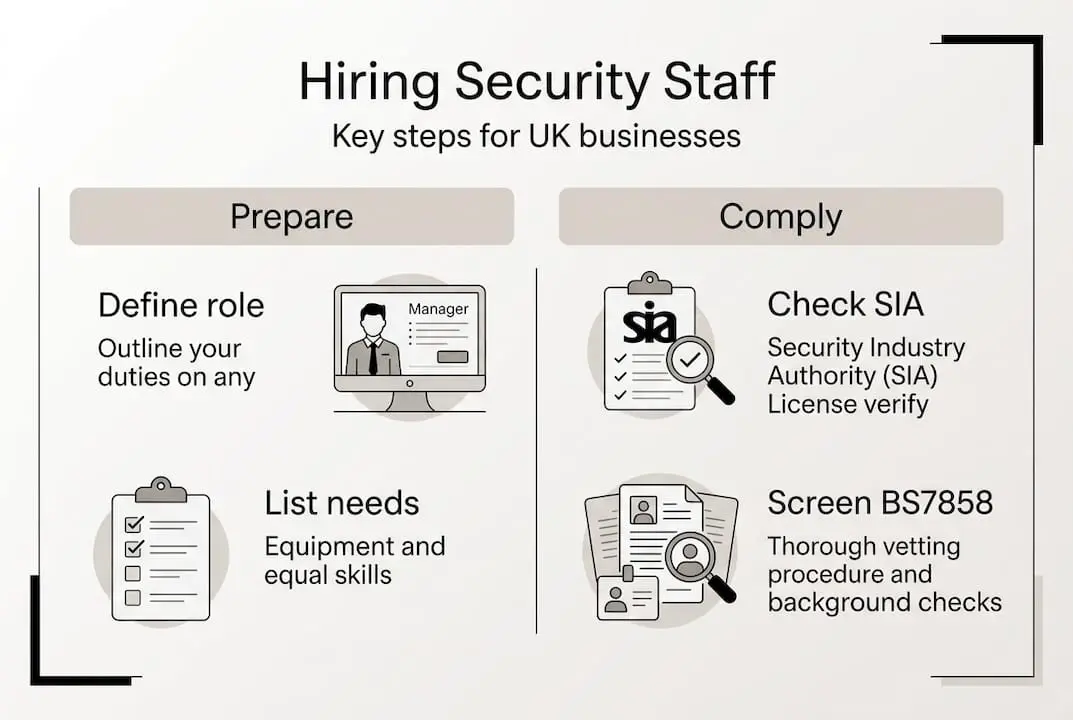
Before you post a job advert, it is crucial to clarify exactly who you need and why. Rushing to fill a vacancy without a clear role definition is one of the most common and costly mistakes security managers make.
Common UK security roles include:
- Door supervisor — requires a specific SIA Door Supervisor licence
- Static security guard — requires an SIA Security Guard licence
- Corporate security officer — may require additional vetting for sensitive environments
- Close protection officer — requires a dedicated SIA Close Protection licence
- CCTV operator — requires an SIA CCTV (Public Space Surveillance) licence
- Key holder/response officer — often requires both a Security Guard licence and alarm response training
Each role carries distinct licensing requirements under the Security Industry Authority (SIA), the UK’s statutory regulator for the private security industry. For sensitive sites such as government buildings, data centres, or defence contractors, you may also need to consider enhanced Developed Vetting (DV) or Security Check (SC) clearances beyond the standard SIA licence.
As role-specific requirements must be defined at the outset, investing time here saves significant cost downstream. Think about not just the immediate vacancy but the shape of your team over the next 12 months. Reviewing your security recruitment steps early helps you build a structured approach rather than reacting to gaps as they appear.
Pro Tip: Build a talent pipeline before you need it. Maintain a shortlist of pre-vetted candidates so that when a vacancy arises, you are not starting from scratch under pressure.
Essential compliance for hiring UK security staff
Once clear on requirements, you need to ensure every candidate can legally and securely work in their intended role. Compliance in UK security hiring is not optional, and the consequences of cutting corners are severe.
The SIA licence is the foundation. Licences are role-specific, valid for three years, and must be verified before deployment. You can confirm a candidate’s licence status via SIA licence verification before making any offer. Employing an unlicensed operative is a criminal offence under the Private Security Industry Act 2001.
Warning: Failing to verify a candidate’s SIA licence before deployment can result in prosecution, unlimited fines, and the revocation of your own operating permissions. Do not rely on a candidate’s word alone.
Alongside SIA licensing, BS7858 is the UK industry standard for pre-employment vetting of security personnel. It covers identity verification, right-to-work checks, a five-year employment history, financial probity, and criminal record checks. Understanding security screening checks in detail will help you apply the standard correctly.
| Check type | Minimum compliance | Enhanced (high-risk/defence) |
|---|---|---|
| SIA licence verification | Mandatory | Mandatory |
| BS7858 pre-employment screening | Mandatory | Mandatory |
| Right-to-work check | Mandatory | Mandatory |
| Criminal record (DBS) check | Standard | Enhanced DBS |
| Financial probity check | Included in BS7858 | Included in BS7858 |
| Security Check (SC) clearance | Not required | Required |
| Developed Vetting (DV) clearance | Not required | Required for highest-risk roles |
Your SIA licence guide can help you understand what each licence covers. A quick checklist of must-always checks:
- Verify SIA licence number on the official register
- Confirm licence category matches the role
- Complete BS7858 screening before deployment
- Conduct right-to-work check and retain copies
- Obtain at least two verifiable employment references
Step-by-step hiring process for security staff
With compliance criteria clear, now put them into practice with a methodical hiring sequence. A structured approach protects you legally and produces better hires.
Follow this 7-step hiring process for compliant and effective recruitment:
- Define the role — write a precise job specification including required SIA licence category, hours, site type, and any enhanced clearance needs
- Source candidates — use specialist job boards, SIA-accredited agencies, or your existing pipeline; review your security firm recruitment steps for sourcing options
- Verify SIA licence — check the SIA register before progressing any candidate to interview
- Initiate BS7858 screening — begin the vetting process early, as it typically takes two to four weeks
- Conduct scenario-based interviews — ask candidates how they would handle specific incidents relevant to your site; this reveals practical judgement, not just rehearsed answers
- Check references — contact previous employers directly and verify dates of employment
- Make the offer and onboard — issue a written contract, complete right-to-work documentation, and begin induction
One key decision is whether to hire directly or use a specialist agency. Both routes have merit depending on your situation.
| Factor | Direct hiring | SIA specialist agency |
|---|---|---|
| Compliance management | Your responsibility | Agency handles most checks |
| Speed to deployment | Slower (2 to 6 weeks) | Faster (days to 2 weeks) |
| Cost | Lower per hire | Higher per hire |
| Temporary cover | Difficult to arrange | Readily available |
| Candidate quality control | Variable | Pre-vetted pool |
| Ongoing licence monitoring | Your responsibility | Often included |
For UK recruitment guidance on both routes, it is worth reviewing what each approach demands of your internal team. Also consider sharing success tips in UK security jobs with new hires to set expectations early.
Pro Tip: Agencies that specialise in SIA-licensed staff can dramatically reduce your compliance burden, particularly for temporary or emergency cover. They often maintain pre-vetted benches of operatives ready to deploy at short notice.
Remember to recheck licences periodically. SIA licences expire every three years, and an operative whose licence lapses mid-contract is a compliance risk you cannot afford.
Screening, onboarding, and early retention
Once a candidate is chosen, the focus shifts to onboarding legally and effectively to maximise retention. Getting this stage right protects your investment and sets the tone for a productive working relationship.
Onboarding a new hire costs roughly £3,600 on average, which means every early departure is a direct hit to your margins. Structured onboarding reduces that risk considerably.
Essential onboarding steps for security staff:
- Complete right-to-work checks and retain certified copies of documents
- Issue a written employment contract within two months of the start date
- Conduct a full site induction covering emergency procedures, access protocols, and reporting lines
- Introduce the new hire to their team and assign a first-month mentor
- Schedule a formal check-in at the end of week one and week four
Contract terms and early support are vital for both legal compliance and staff success. Contracts must specify pay rate, working hours, notice period, and role responsibilities. For shift workers, include provisions for shift patterns and any on-call requirements.

Early engagement is where retention is won or lost. Transparent communication about shift rotas, pay dates, and progression opportunities costs nothing but makes a significant difference to whether a new hire stays beyond their first three months. Consider small incentives such as a completion bonus after a probationary period or access to funded training. Reviewing your UK recruitment process and onboarding security staff guidance together gives you a joined-up approach from offer to settled employee.
Mistakes to avoid and troubleshooting difficult hires
Even with strong processes, common pitfalls and difficult cases still occur. Being ready to spot and solve problems promptly is what separates experienced security managers from those who repeat the same costly errors.
The five most common mistakes when hiring security staff, as identified across the industry, include cost-cutting, skipping screening, and poor role definition:
- Skipping or rushing background checks — pressure to fill a vacancy quickly is never a valid reason to bypass BS7858 or SIA verification
- Under-offering on pay — security roles carry real responsibility; below-market pay attracts lower-quality candidates and drives turnover
- Vague job specifications — a poorly written job advert attracts unsuitable applicants and wastes everyone’s time
- Hiring in haste — reactive hiring without a pipeline leads to poor decisions and compliance shortcuts
- Ignoring pipeline building — treating every vacancy as a one-off event rather than part of an ongoing workforce strategy
For troubleshooting: if a candidate fails a background check, document the decision clearly and do not proceed. If a candidate withdraws late in the process, your pipeline should provide an immediate alternative. If onboarding is delayed due to incomplete vetting, do not deploy the operative early. Review your common hiring pitfalls regularly to keep your process sharp.
Pro Tip: Schedule a quarterly review of your current team’s licence expiry dates and employment history. Proactive rescreening prevents compliance gaps and signals to your staff that standards are taken seriously.
When a hire becomes genuinely problematic, whether through a failed check that emerges post-deployment or a conduct issue, consult an SIA-accredited agency or employment law specialist promptly. Acting quickly limits your exposure.
Streamline your security hiring with expert tools
For security managers and business owners who want a faster, more confident route to compliant hiring, having the right platform behind you makes a measurable difference. The Security Jobs Board is built specifically for the UK security sector, connecting employers with pre-qualified candidates who understand the industry’s licensing and vetting demands.

You can advertise security roles directly to a targeted audience of licensed security professionals, browse CV databases, and manage applications in one place. Whether you are recruiting in London, the Midlands, or looking for security jobs in Northern Ireland, the platform covers the full UK geography. For ongoing support, the security recruitment advice section provides practical guidance to help you refine your hiring strategy at every stage. Backed by BSIA affiliation and built with GDPR compliance at its core, it is the specialist tool your recruitment process deserves.
Frequently asked questions
What is the BS7858 screening standard and is it mandatory?
BS7858 is the UK security screening gold standard for pre-employment vetting and is mandatory for all firms operating under the SIA Approved Contractor Scheme. It covers identity, employment history, financial probity, and criminal record checks.
What happens if I hire someone without a valid SIA licence?
Failing to verify an SIA licence before deployment can result in criminal prosecution, significant fines, and damage to your organisation’s operating permissions. Always check the SIA register before any offer is made.
How often should I rescreen existing security staff?
Annual rescreening is recommended as best practice, and SIA Approved Contractors are required to monitor licence validity. SIA licences themselves must be renewed every three years, and employers should track expiry dates proactively.
Are agencies required for security staff recruitment?
Agencies are not a legal requirement, but SIA-specialist agencies handle compliance checks, maintain pre-vetted candidate pools, and can significantly reduce the risk of a non-compliant hire, particularly for urgent or temporary requirements.
What should an employment contract for security staff include?
Employment contracts within 2 months of the start date are a legal requirement. Contracts must include pay rate, working hours, notice period, job title, and role responsibilities as a minimum under UK employment law.
Recommended
- Hiring for Security Roles Guide: Effective UK Recruitment Steps
- Step by Step Hiring Process for Security Firms UK | Security Jobs Board
- Step by Step Recruitment Process for Security Firms UK
- Remote Hiring Step by Step for UK Security Firms | Security Jobs Board
- Cybersecurity checklist for employees to prevent breaches


