Benefits of security consulting for UK businesses

TL;DR:
- Security consulting enables organizations to significantly reduce breach detection and response times, improving compliance scores and ROI. It involves strategic assessments, ongoing support, and expertise that internal teams often lack, fostering long-term risk reduction. Choosing between boutique and large firms depends on organizational needs, with boutiques generally offering faster, more tailored service.
Security consulting is not a luxury purchase for large enterprises with sprawling IT departments. It is a measurable business decision with quantifiable results. Organisations that engage professional security consultants reduce breach detection times by 31% and cut incident response times from 72 hours down to 24. If your security posture still depends entirely on an internal team working without external challenge or specialist input, you are likely carrying more risk than your board realises. This article covers the core benefits of security consulting, what it actually involves, and how to make it work long-term.
Table of Contents
- Key takeaways
- What security consulting actually involves
- Measurable benefits backed by real data
- Strategic advantages beyond the technical fixes
- Pitfalls and how to avoid them
- Applying consulting outcomes to your risk management
- My take on where security consulting is heading
- Build your security capability with Securityjobsboard
- FAQ
Key takeaways
| Point | Details |
|---|---|
| Breach detection improves sharply | Consulting reduces detection time from 277 to 190 days and response from 72 to 24 hours. |
| Compliance scores rise significantly | Organisations report compliance scores climbing from 68% to 95% after consulting engagements. |
| ROI is strong for SMEs | Small and medium businesses achieve an average return of 2.8x within 18 months of investing in consulting. |
| Ongoing partnerships outperform one-off audits | Post-assessment support and retainer models deliver compounding value over time. |
| Firm size affects service quality | Boutique consultancies often provide senior expert access and faster communication than larger firms. |
What security consulting actually involves
Before examining the benefits, it helps to understand what security consulting is and what it is not. Many organisations conflate it with managed security services or assume it simply means having someone run a penetration test once a year. The scope is considerably wider.
Security consulting covers threat and risk assessments, security architecture planning, regulatory compliance advisory, incident response planning, and implementation oversight. A consultant acts as a strategic partner, not a break-fix technician. The security consulting process involves structured discovery, gap analysis, prioritised recommendations, and ongoing guidance. That last part matters more than most organisations appreciate.
There are two broad service models worth understanding:
- Boutique firms tend to offer direct access to senior practitioners, faster turnaround, and advice shaped around your specific context rather than a templated methodology.
- Large consultancies bring wider resource depth and recognised brand credibility, though engagements can involve more layers between you and the expert actually doing the work.
- Managed Security Service Providers (MSSPs) sit in a different category, handling ongoing operational monitoring rather than strategic advisory. Many organisations benefit from using both.
The distinction between consulting and an unmanaged internal team is worth stating plainly. Internal teams lack the capacity to handle the breadth of threats facing modern organisations, particularly when those teams are stretched across day-to-day operations. Consultants bring external challenge, current threat intelligence, and specialist depth that most internal hires simply cannot replicate.
Pro Tip: When evaluating a consulting firm, ask specifically who will be doing the work on your account. In larger firms, senior consultants often win the contract and junior staff deliver it. Boutique firms tend to keep the same practitioner engaged throughout.
Measurable benefits backed by real data
The advantages of security consulting are not abstract. The numbers are specific enough to make a business case to any sceptical finance director.
| Metric | Before consulting | After consulting |
|---|---|---|
| Breach detection time | 277 days | 190 days |
| Incident response time | 72 hours | 24 hours |
| Average compliance score | 68% | 95% |
| Cloud misconfiguration risk | Baseline | Reduced by 50% |
| Financial impact of a breach | Baseline | Reduced by approx. 30% |
These figures come from documented consulting outcomes in 2026 and reflect patterns across industries rather than cherry-picked case studies.
On compliance specifically, moving from a 68% to a 95% score is not merely cosmetic. It directly reduces exposure to regulatory fines by 40 to 60 percent, which for businesses operating under UK GDPR, PCI DSS, or sector-specific frameworks represents real financial protection. The importance of security consulting becomes tangible when you put those avoided fines against the cost of the engagement itself.
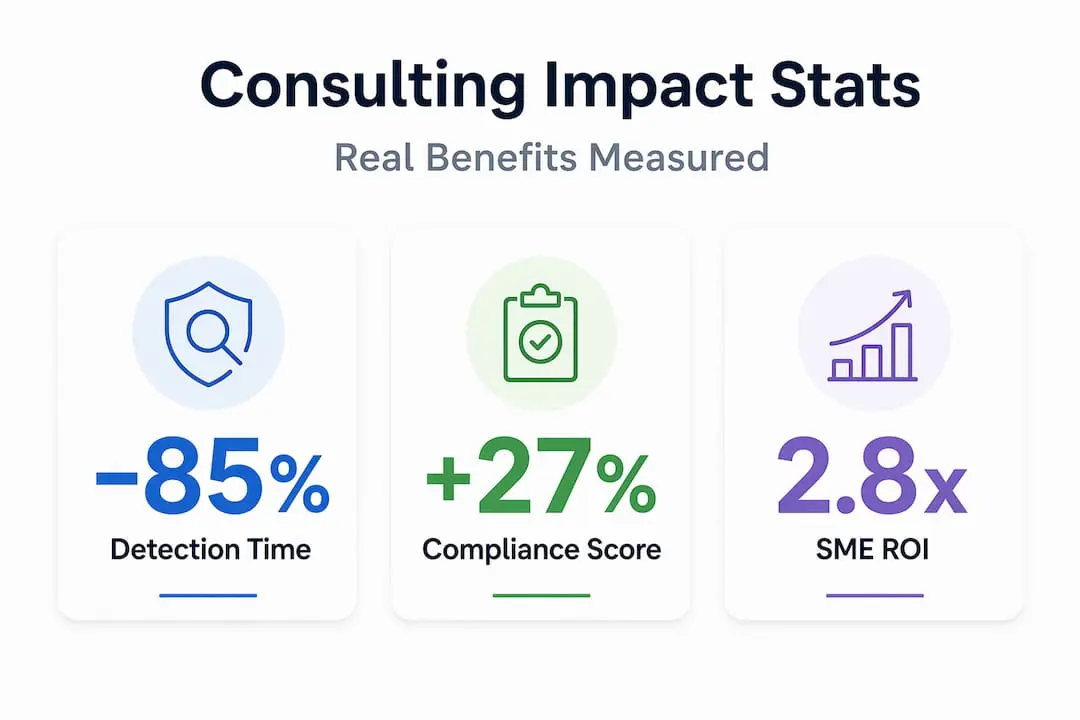
For smaller organisations, the ROI case is particularly clear. SMEs achieve 2.8x returns within 18 months of investing in professional consulting. That is not a marginal improvement. It is the kind of return that repositions security from a cost line to a genuine business investment.
Cloud environments compound the argument further. As organisations migrate workloads, misconfigurations become one of the most common and costly vulnerabilities. Consulting reduces misconfiguration risks by 50% in cloud environments, which matters enormously for any organisation running multi-cloud infrastructure or hybrid setups.
The security assessment advantages extend beyond the immediate findings. A well-structured assessment surfaces risks that internal teams have normalised, spotlights configuration gaps that have gone unchecked, and produces a prioritised remediation roadmap that removes ambiguity about where to spend budget.
Strategic advantages beyond the technical fixes
The security consulting benefits that tend to get overlooked are not on any metrics dashboard. They are structural and strategic, and they quietly determine whether your security posture improves year on year or stagnates.
Access to expertise without the recruitment cost. Hiring a senior security architect or a threat intelligence specialist as a permanent employee is expensive, slow, and competitive. Consulting gives you access to that calibre of expertise on demand, without the overhead of a permanent headcount.

A shift from unpredictable capital expenditure to predictable operating expenditure. Security incidents create financial shocks. Consulting transforms security spending from reactive, lumpy CapEx into a planned OpEx model. That predictability is valuable both for budgeting and for board-level confidence.
Proactive risk identification. The difference between finding a vulnerability before an attacker does and discovering it afterwards is enormous. Managed monitoring and proactive threat detection reduce the chance of that painful discovery. Consultants challenge your assumptions regularly rather than waiting for an incident to trigger a review.
Alignment with business objectives. Security strategy that is designed in isolation from business goals tends to create friction rather than protection. A good consultant connects security priorities to growth plans, regulatory requirements, and operational realities. The result is a security programme that your business can actually operate within.
The question of boutique versus large firm deserves its own attention here. Boutique consultancies provide more direct communication and hands-on senior involvement. They are quicker to adapt and less likely to send you templated outputs. Larger firms offer broader resources and, sometimes, greater credibility in regulated industries. The right choice depends on your size, complexity, and how much bureaucratic friction you are willing to tolerate.
Pro Tip: If you are a mid-sized UK business, a boutique firm with demonstrable sector experience will almost always outperform a large firm on value delivery. Senior practitioners, faster response, and fewer layers of sign-off make a meaningful difference over the life of an engagement.
Pitfalls and how to avoid them
The reasons some organisations fail to realise the benefits of hiring a consultant are rarely about the consultant’s technical competence. They are about how the engagement is structured.
A one-off assessment with no follow-through is the most common mistake. Superficial risk assessments create false security, giving leadership confidence that is not earned. You walk away with a report, no one implements the recommendations properly, and six months later the risks identified are still present. The assessment created an illusion of progress rather than actual improvement.
The solution is to negotiate post-assessment support before you sign anything. Long-term consulting engagements with built-in follow-on advisory deliver compounding value through funded security roadmaps, progress reviews, and access to ongoing expertise. This is not about selling you more hours. It is about whether the work you commission actually reduces your risk.
Here is a comparison of common engagement models:
| Model | Best for | Consideration |
|---|---|---|
| Fixed fee project | Defined scope, one-time assessments | Limited flexibility if scope changes |
| Day rate | Ad hoc advisory, flexible needs | Can escalate in cost without clear boundaries |
| Retainer | Ongoing partnership, evolving risk | Most cost-effective for continuous improvement |
Scalability is another factor that organisations underestimate. Your security requirements will change as you grow, adopt new technologies, or expand into new markets. Choosing providers that can scale with your organisation prevents the costly process of re-tendering when your needs outgrow the original engagement.
Pro Tip: Before signing any consulting contract, ask the provider to describe how the engagement evolves if your organisation grows significantly or undergoes a major technology change. Their answer will tell you whether they are thinking about your long-term success or just the current statement of work.
Applying consulting outcomes to your risk management
Knowing the benefits is one thing. Embedding them into how your organisation actually operates is where the value compounds. Here is a practical sequence for doing that effectively.
-
Incorporate recommendations into a security roadmap. Consultant findings should not sit in a PDF. Translate them into a time-bound plan with owners, budgets, and milestones. Treat it as a live document reviewed quarterly.
-
Schedule periodic reassessments. Your threat environment changes continuously. An annual review at minimum, with targeted assessments after significant IT changes or incidents, keeps your posture current rather than historical.
-
Use consulting expertise in compliance audits. Consultants who understand compliance monitoring and auditing can prepare your organisation more effectively than internal teams working alone, reducing the stress and cost of audit cycles.
-
Consider a hybrid model. Pairing a strategic consulting engagement with an MSSP for day-to-day monitoring covers both the strategic and the operational dimensions. Managed security services reshape security from a reactive cost centre into a proactive function.
-
Build internal collaboration into the engagement. Consultants should not work around your internal team. Structure engagements so that knowledge transfers happen, your team learns, and the organisation becomes more capable over time rather than more dependent.
The security consulting for businesses guide covers how UK organisations are applying these principles in practice, with particular focus on aligning consulting outcomes with operational security processes.
My take on where security consulting is heading
I have watched organisations treat security consulting as a box-ticking exercise for long enough to know exactly where that leads. You commission a report, present it at a board meeting, and file it. Six months later, nothing has changed and you are back to square one.
What I have seen work, consistently, is treating the consultant relationship like you would treat a trusted professional adviser. You do not hire a solicitor for one contract and never speak to them again. You build a relationship where they understand your business, your risk appetite, and your direction of travel. Security consulting works the same way.
The businesses that extract the most value are the ones that negotiate post-assessment support upfront and ask the consultancy to be accountable for outcomes, not just outputs. A document is not a deliverable. Reduced risk is a deliverable.
My instinct on boutique versus large firms has hardened over time. Boutique firms outperform on value delivery because you get the senior person every time. No handoffs, no delays, no junior analysts delivering a £50,000 engagement. For most UK businesses, that matters more than the name on the letterhead.
The organisations winning on security resilience in 2026 are not the ones with the biggest security budgets. They are the ones that made consulting a permanent feature of their risk management approach, not a one-time purchase.
— Rob
Build your security capability with Securityjobsboard

Understanding the benefits of security consulting is one step. Building the team and talent that can act on it is another. Securityjobsboard is the UK’s specialist platform for connecting security employers with experienced professionals across every discipline, from risk management and compliance to physical and cyber security roles. Whether you are looking to recruit a security consultant directly or bring in a risk manager to oversee your consulting outcomes, the platform gives you direct access to a targeted CV database of UK security professionals.
For organisations in Northern Ireland, you can browse security roles across the region and connect with qualified candidates quickly. If you are a security professional looking to grow your expertise and take on consulting-adjacent roles, the career advice section covers progression routes, CV guidance, and the skills employers prioritise in 2026. Securityjobsboard is affiliated with the BSIA, which means every employer and listing meets a recognised industry standard.
FAQ
What are the main benefits of security consulting?
Security consulting reduces breach detection times, improves compliance scores, and delivers measurable ROI. SMEs typically achieve 2.8x returns within 18 months, while compliance scores can rise from 68% to 95% through structured consulting engagements.
Why hire security consultants rather than rely on internal teams?
Internal teams often lack the specialist depth and bandwidth to address the full range of modern threats. Consultants bring current threat intelligence, external challenge, and sector expertise that most internal hires cannot replicate at comparable cost.
How does security consulting improve compliance?
Consultants identify gaps between current practices and regulatory requirements, then provide a prioritised remediation plan. Organisations that act on consulting recommendations typically reduce regulatory fines by 40 to 60 percent.
What is the difference between a retainer and a one-off assessment?
A one-off assessment provides a point-in-time view of your risk posture and can create false confidence if not followed up. A retainer model delivers ongoing advisory support, periodic reassessments, and compounding value as your consultant learns your business over time.
How do I choose between a boutique and a large security consultancy?
Boutique firms offer senior practitioner access, faster communication, and tailored advice with less bureaucracy. Larger firms offer wider resource depth. For most mid-sized UK businesses, boutique consultancies deliver better value relative to cost.


