Understanding compliance auditing for UK security 2026

Up to 70% of UK security incidents trace back to compliance audit failures, making this process critical for protecting your organisation. Compliance auditing is an independent review that verifies whether your security firm adheres to legal requirements, industry standards, and internal policies. This guide equips you with practical knowledge to conduct effective audits, understand regulatory frameworks, and strengthen your security operations through systematic compliance verification.
Table of Contents
- Introduction To Compliance Auditing
- Regulatory Frameworks Governing Compliance Audits In UK Security Industry
- The Compliance Audit Process: Step-By-Step Explained
- Comparison Of Internal And External Compliance Audits
- Practical Applications, Benefits, And Case Studies
- Conceptual Framework And Best Practices For Compliance Auditing
- Explore Security Careers With Confidence
- Frequently Asked Questions
Key takeaways
| Point | Details |
|---|---|
| Definition and purpose | Compliance auditing verifies legal and regulatory adherence in security firms through independent review processes. |
| UK regulatory framework | SIA licensing, BS 7858, and GDPR shape audit requirements for UK security organisations. |
| Structured audit process | Audits follow phases from planning through remediation and continuous monitoring to ensure effectiveness. |
| Internal vs external audits | Both audit types serve complementary purposes with different frequencies, costs, and stakeholder involvement. |
| Risk reduction benefits | Effective compliance auditing reduces incidents by up to 35% and improves organisational security culture. |
Introduction to compliance auditing
Compliance auditing is an independent, systematic process that reviews and verifies whether your security organisation adheres to legal requirements, industry standards, and internal policies. It serves as your primary tool for confirming that operations meet regulatory obligations whilst identifying gaps that could expose your firm to penalties or operational failures. Beyond mere box-ticking, auditing drives continuous improvement by revealing weaknesses before they escalate into incidents.
In UK security firms, audits commonly examine SIA licensing compliance, personnel vetting procedures, data protection practices, and adherence to contract specifications. These reviews create documented evidence that demonstrates your commitment to legal integrity and professional standards. Contractor compliance practices form the backbone of this verification process, ensuring safety and legal integrity across roles.
The real value emerges when you view auditing as a proactive risk management strategy rather than a reactive inspection. Regular audits help you spot procedural drift, update outdated practices, and reinforce accountability throughout your organisation. This approach transforms compliance from a burden into a competitive advantage that builds client trust and protects your reputation.
Pro Tip: Schedule internal audits quarterly to catch compliance issues early, reducing the pressure and cost of annual external audits whilst maintaining continuous improvement momentum.
Key benefits of systematic compliance auditing include:
- Reduced exposure to regulatory penalties and legal liabilities
- Enhanced operational efficiency through standardised procedures
- Improved staff awareness and compliance culture
- Stronger client confidence and contract renewals
- Early detection of security vulnerabilities and control weaknesses
Regulatory frameworks governing compliance audits in UK security industry
UK security firms operate within a complex regulatory landscape that directly shapes your audit requirements and documentation standards. Understanding these frameworks helps you design audits that address mandatory obligations whilst supporting your strategic objectives. The Security Industry Authority licensing regime sets baseline standards for personnel and operational practices that auditors must verify.
BS 7858 establishes the security screening standard for personnel employed in security roles, requiring documented vetting processes that auditors scrutinise during compliance reviews. Your compliance monitoring procedures must demonstrate adherence to this standard through verifiable records. GDPR and the Data Protection Act 2018 impose strict requirements on how you handle personal data during recruitment, vetting, and operational activities.
These regulations mandate specific audit trails and evidence documentation. When conducting a security audit, you must verify that GDPR compliance measures protect employee and client data throughout your systems. Professional bodies like the BSIA provide additional guidance and accreditation standards that influence audit scope and criteria.
Your audit process should verify that security checks and screening procedures meet both legal requirements and industry best practices. This dual focus ensures you satisfy regulatory inspectors whilst maintaining operational excellence. Documentation becomes your primary defence during inspections, proving that you’ve implemented required controls and monitoring systems.
Key regulatory areas requiring audit attention:
- SIA licensing compliance for personnel and operational activities
- BS 7858 vetting and screening documentation for all security roles
- GDPR data protection controls and privacy impact assessments
- Contract-specific requirements and client service level agreements
- Health and safety regulations specific to UK security roles
The compliance audit process: step-by-step explained
A structured audit process transforms compliance verification from an overwhelming task into a manageable, repeatable system. Your audit begins with defining clear objectives tied to specific regulations, policies, or contract requirements. Establishing precise scope prevents mission creep and ensures you allocate resources effectively.
Planning activities include assembling your audit team, creating detailed schedules, and identifying which documents, systems, and personnel you’ll review. Think of this phase as building your roadmap. You’ll determine sampling methodologies for reviewing employee files, incident reports, and operational logs whilst ensuring you cover high-risk areas comprehensively.

Fieldwork involves gathering evidence through document reviews, interviews, system checks, and on-site observations. You’ll verify that actual practices match documented procedures, examining everything from recruitment processes to operational protocols. This phase demands meticulous attention to detail and objective assessment without preconceived conclusions.
Reporting translates your findings into clear, actionable recommendations. Your audit report should categorise issues by severity, specify root causes, and propose realistic remediation steps with assigned responsibilities and deadlines. Avoid vague language; instead, provide specific corrective actions that teams can implement immediately.
Follow-up ensures that identified gaps are addressed and corrective actions prove effective. You’ll schedule remediation deadlines, verify implementation through documentation or re-audits, and update your compliance monitoring systems. This phase completes the audit cycle and feeds into continuous improvement planning.
Pro Tip: Create standardised job description checklists that incorporate compliance requirements, making it easier to audit role-specific obligations systematically across your organisation.
Common audit challenges and solutions:
- Scope creep diluting audit focus ? Define clear boundaries and stick to approved objectives
- Documentation gaps undermining evidence ? Implement real-time record-keeping systems rather than retrospective documentation
- Stakeholder resistance to audits ? Frame audits as improvement tools, not punitive inspections
- Resource constraints limiting coverage ? Prioritise high-risk areas and rotate audit focus across departments
- Inconsistent audit methodologies ? Develop standardised templates and training for all auditors
Comparison of internal and external compliance audits
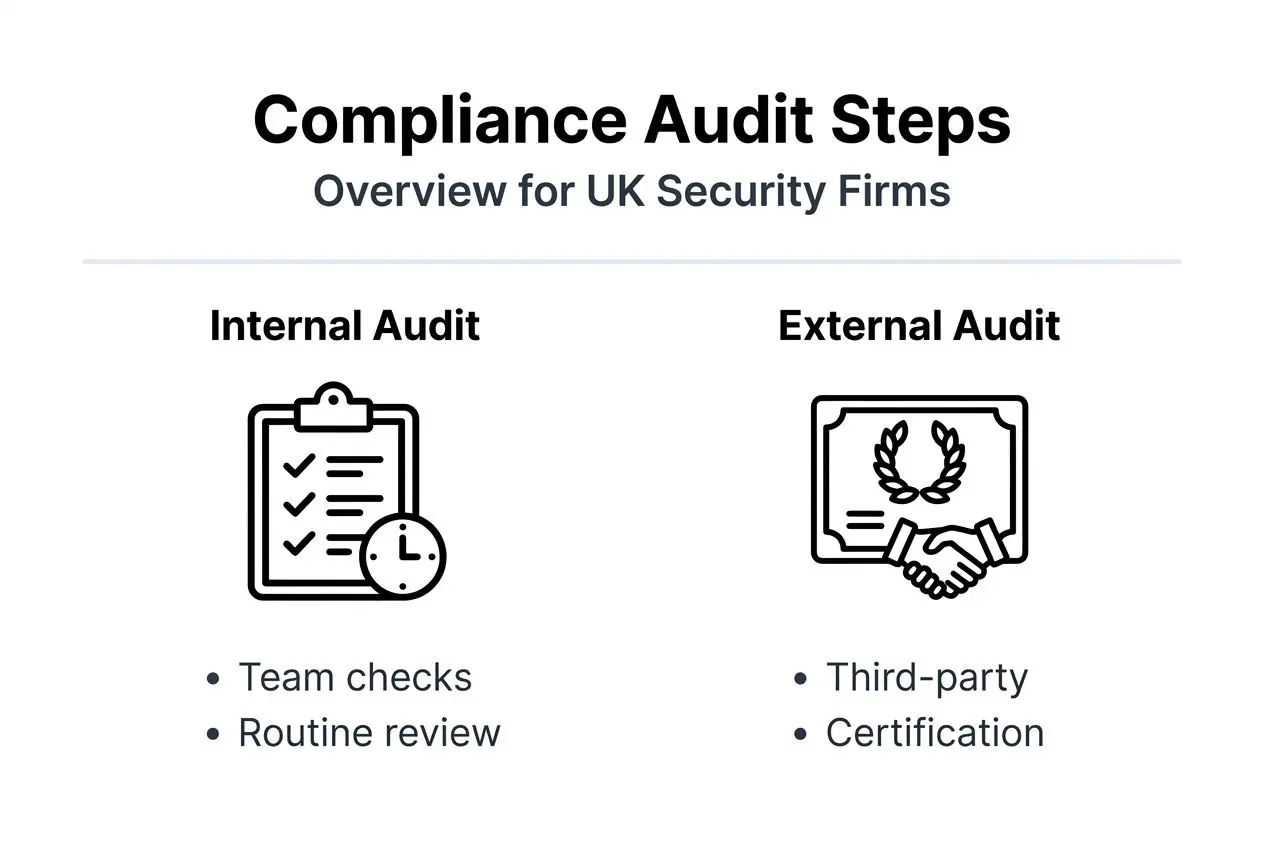
Internal audits are conducted by your own staff or dedicated compliance teams, focusing on frequent checks that drive continuous improvement. They offer flexibility in scheduling, scope, and depth, allowing you to target emerging risks or problem areas without waiting for formal external reviews. Internal audits cost less and provide immediate feedback loops that support rapid corrective action.
External audits are performed by independent third parties, typically for certification purposes or regulatory compliance verification. These audits carry greater credibility with clients and regulators because they’re conducted by impartial experts. External auditors bring fresh perspectives and benchmark your practices against industry standards, revealing blind spots your internal teams might miss.
Frequency differs significantly between audit types. Internal audits typically occur quarterly or even monthly for high-risk areas, whilst external audits happen annually or biennially unless regulations mandate otherwise. This difference reflects their distinct purposes: internal audits catch issues early, whilst external audits provide formal assurance to stakeholders.
Resource requirements vary considerably. Internal audits demand staff time and training but avoid external consultant fees. External audits require budget allocation for auditor fees, preparation time, and potential remediation costs if major gaps emerge. Smaller firms often struggle to justify frequent external audits, making internal reviews their primary compliance mechanism.
| Audit Type | Primary Purpose | Typical Frequency | Cost Level | Independence |
|---|---|---|---|---|
| Internal | Continuous improvement, early issue detection | Quarterly to monthly | Low to moderate | Limited external credibility |
| External | Certification, regulatory compliance, stakeholder assurance | Annual to biennial | Moderate to high | High credibility and objectivity |
| Hybrid | Combines internal monitoring with periodic external validation | Internal quarterly, external annual | Balanced | Best of both approaches |
When to prioritise each audit type:
- Choose internal audits for ongoing compliance monitoring, training verification, and process improvement in resource-constrained environments
- Select external audits when seeking certification, responding to regulatory requirements, or needing independent validation for major clients
- Implement hybrid approaches in medium to large organisations where internal audits maintain daily compliance whilst annual external reviews provide formal assurance
Practical applications, benefits, and case studies
Real-world implementation of compliance auditing delivers measurable risk reduction across UK security organisations. Firms that integrate audits with employee training report incident reductions of up to 35% within the first year. This improvement stems from heightened awareness and clearer accountability when staff understand that compliance checks are regular and thorough.
Enhanced compliance culture emerges as a secondary benefit that often surpasses direct risk mitigation. When your team sees audit findings translated into training updates and process improvements, they recognise that audits serve development rather than punishment. This cultural shift increases voluntary reporting of near-misses and encourages proactive problem-solving before issues escalate.
Technology integration amplifies audit effectiveness dramatically. Modern audit software automates evidence collection, tracks remediation progress, and generates compliance dashboards that provide real-time visibility. These tools reduce manual effort by up to 60%, allowing your compliance team to focus on analysis and strategic improvements rather than administrative tasks.
Lessons from audit failures reveal common pitfalls you must avoid. Organisations that treat audits as one-off events rather than continuous processes consistently miss emerging compliance gaps. Similarly, firms that fail to act on audit recommendations waste resources on reviews that generate reports but no improvement. The most successful organisations close the loop by linking audit findings directly to corrective action plans with clear ownership and deadlines.
“Our quarterly internal audits transformed compliance from a checkbox exercise into a strategic advantage. By catching SIA licensing renewals early and addressing training gaps proactively, we reduced client complaints by 40% and won three major contracts based on our documented compliance record.”
Key practical benefits of systematic auditing:
- Early detection of licensing lapses preventing operational disruptions and penalties
- Documented evidence supporting tender responses and client due diligence requirements
- Reduced insurance premiums through demonstrated risk management practices
- Improved staff retention via transparent, fair compliance processes
- Competitive differentiation in markets where compliance standards separate premium from budget providers
Conceptual framework and best practices for compliance auditing
A cyclical audit model provides the mental framework for sustained compliance success. This approach views auditing as a continuous loop rather than isolated events: preparation feeds execution, which informs reporting, driving remediation, which then shapes the next audit’s preparation. Each cycle builds organisational learning and refines your compliance systems.
Clear documentation forms the foundation of this cycle. Every audit should produce standardised reports that record findings, assign corrective actions, set deadlines, and track completion. This documentation serves multiple purposes: evidence during regulatory inspections, training material for staff development, and historical data for identifying recurring issues that need systemic solutions.
Technology adoption streamlines each cycle phase. Digital audit platforms eliminate paper trails, enable real-time collaboration, and automatically flag overdue corrective actions. These systems integrate with your existing HR and operational databases, pulling employee records, training certificates, and incident reports directly into audit workflows without manual data entry.
Aligning audit goals with organisational objectives ensures your compliance programme supports rather than hinders business strategy. If your firm targets high-security contracts, audits should emphasise vetting depth and security clearances. If rapid growth is your priority, audits must verify that recruitment and training processes maintain quality at scale.
Pro Tip: Create a compliance calendar that maps audit activities, regulatory deadlines, and certification renewals on a single timeline, preventing last-minute scrambles and ensuring adequate preparation time for each activity.
| Audit Phase | Key Activities | Common Pitfalls | Best Practices |
|---|---|---|---|
| Preparation | Define scope, assemble team, schedule activities | Vague objectives, inadequate resources | Use prior audit findings to focus current scope |
| Execution | Evidence gathering, interviews, system checks | Confirmation bias, incomplete sampling | Apply statistical sampling and independent verification |
| Reporting | Document findings, categorise severity, recommend actions | Unclear language, missing root cause analysis | Use standardised templates with specific action items |
| Remediation | Implement corrections, verify effectiveness | Delayed action, inadequate resources | Assign clear ownership and realistic deadlines |
| Monitoring | Track progress, update systems, plan next cycle | Losing focus after initial fixes | Integrate into regular management reviews |
Avoid these common mistakes:
- Conducting audits only when problems emerge, missing prevention opportunities
- Assigning audit responsibilities without adequate training or authority
- Failing to communicate audit purposes, creating defensive staff attitudes
- Ignoring root causes in favour of superficial quick fixes
- Allowing audit findings to languish without follow-up or accountability
Explore security careers with confidence
Your understanding of compliance auditing positions you for advancement in the UK security sector, where firms increasingly value professionals who combine operational expertise with regulatory knowledge. Whether you’re seeking compliance officer roles, audit manager positions, or operational leadership opportunities, demonstrating audit competence sets you apart.

Explore current security jobs in Northern Ireland and across the UK that match your compliance expertise. Our platform connects you with employers who prioritise candidates understanding the regulatory frameworks and audit processes that protect their operations. Access our career advice resources for guidance on highlighting your compliance skills in applications and interviews, positioning yourself as the knowledgeable professional that security firms need to maintain competitive advantage through excellence.
Frequently asked questions
What is the primary goal of compliance auditing in UK security?
The primary goal is verifying adherence to legal, regulatory, and organisational requirements, which reduces operational risks and prevents penalties. Auditing also fosters continuous improvement in compliance culture, strengthening overall security integrity and client confidence.
How often should internal compliance audits be conducted?
Internal audits typically occur quarterly to enable timely detection and resolution of compliance issues before they escalate. Frequency may vary based on your organisation’s size, risk profile, and specific regulatory requirements, with high-risk areas warranting monthly reviews.
What role does documentation play in compliance auditing?
Documentation serves as verifiable evidence during audits and regulatory inspections, proving that required controls exist and function effectively. It supports transparency, enables effective remediation tracking, and provides historical data for identifying systemic issues requiring strategic intervention.
Can smaller security firms rely solely on external audits?
Smaller firms typically benefit more from prioritising internal audits for continuous compliance monitoring due to budget and resource constraints. External audits remain important for certification and formal validation but may occur less frequently, with internal reviews maintaining standards between external assessments.


