The security consulting process explained for 2026

TL;DR:
- Effective security consulting involves a structured, multi-phase process that includes scoping, risk scoring, and treatment planning before delivering actionable recommendations. Selecting the right provider depends on assessing individual expertise, methodology, and ongoing engagement strategies rather than reputation alone. Sustained security improvement requires organizational ownership, continuous support, and viewing consulting as a strategic, long-term partnership rather than a one-off event.
Most organisations believe hiring a security consultant means getting a report and a list of things to fix. That assumption is where things go wrong. The security consulting process is a structured, phased discipline that requires careful scoping, evidence gathering, risk scoring, and treatment planning before a single recommendation lands on anyone’s desk. Understanding how it works, what to expect at each stage, and how to select the right provider makes the difference between a genuinely improved security posture and an expensive document that sits in a drawer. This guide covers all of it.
Table of Contents
- Key takeaways
- The security consulting process: phases and methodologies
- Risk analysis and treatment strategies
- Selecting the right security consulting provider
- Implementing recommendations and sustaining improvement
- Common misconceptions about security consulting
- My experience with what actually makes consulting work
- Build your security team with Securityjobsboard
- FAQ
Key takeaways
| Point | Details |
|---|---|
| Follow a structured methodology | The consulting process follows five defined phases, from scoping through to remediation planning. |
| Risk scoring shapes priorities | Qualitative and quantitative scoring determines which threats receive immediate treatment. |
| Deliverable quality reveals expertise | Request sample reports before engaging any provider to assess depth and board-level clarity. |
| Consultant credentials matter most | The individual practitioner’s experience often outweighs the firm’s overall reputation. |
| Ongoing engagement beats one-off projects | Retainer and hybrid models produce sustained improvement far better than isolated assessments. |
The security consulting process: phases and methodologies
The security consulting process is not a single event. It is a sequence of defined phases, each with its own objectives, data requirements, and deliverables. Understanding that structure is the first step towards getting real value from any engagement.
Enterprise cybersecurity risk assessments follow a five-phase methodology covering asset inventory, threat and vulnerability identification, risk scoring, treatment planning, and final roadmap creation, with phases typically scheduled across a six-week period. That timetable can flex significantly depending on scope. Standard assessments require roughly 14 days for a focused remediation plan, while comprehensive readiness engagements for larger organisations can run to 90 days.
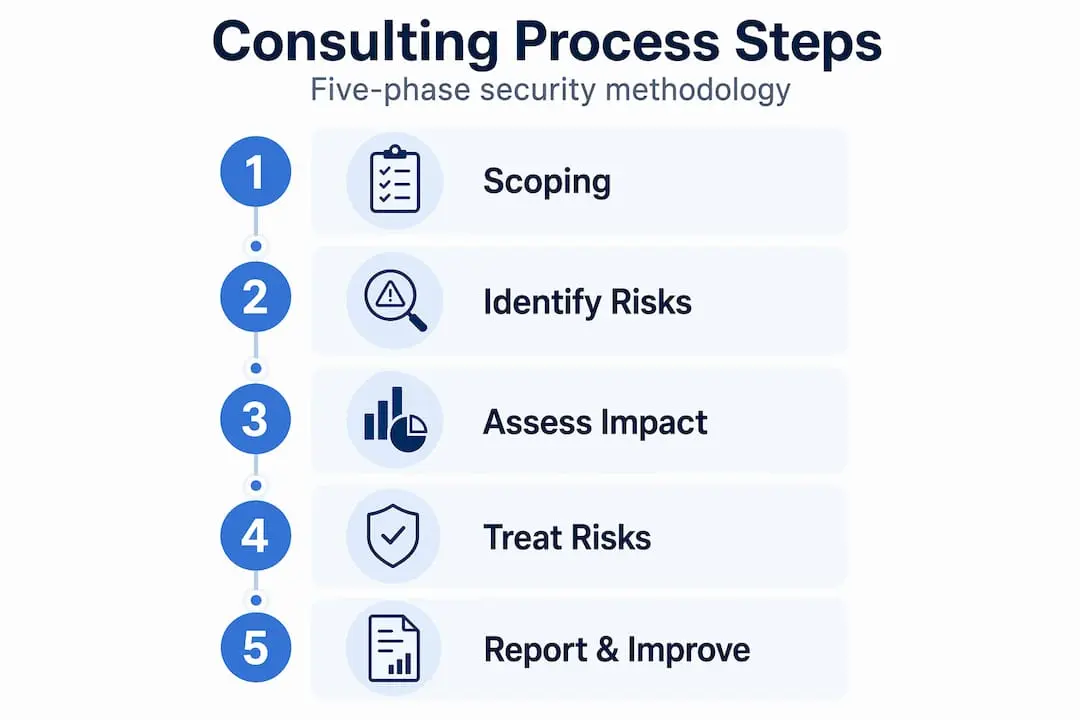
The table below shows how the five phases typically map to outputs and timeframes:
| Phase | Activity | Typical output |
|---|---|---|
| Scoping | Define assets, boundaries, regulatory context | Scoping document, statement of work |
| Threat and vulnerability identification | Asset inventory, penetration tests, interviews | Threat register, vulnerability list |
| Risk scoring | Likelihood and impact assessment | Risk register with scored entries |
| Treatment planning | Mitigate, transfer, accept, or avoid decisions | Costed treatment plan |
| Reporting and roadmap | Board summary, technical annex, heat map | Final report, remediation roadmap |
Popular frameworks structuring this work include ISO 27001 and the NIST Cybersecurity Framework. Both provide vocabulary and control sets that allow consultants to benchmark your current state against recognised standards rather than personal judgement alone. Referencing a framework also makes board-level reporting far more credible because directors can see where the organisation sits against an external standard.
Pro Tip: Ask your prospective consultant which specific framework they will use and why. If they cannot answer that clearly before the engagement starts, treat it as a warning sign.
Documentation matters throughout. Best practice deliverables include a one-page heat map of top risks, an executive summary with costed treatment scenarios, and a detailed technical annex. That three-layer structure serves both the board and the technical team from a single engagement, which is what you should expect from any credible provider.
Risk analysis and treatment strategies
Once threats and vulnerabilities are identified, the next job is to score and prioritise them. This is where many engagements lose their practical value, because risk scoring done poorly produces a list that overwhelms rather than guides.
Consultants use two broad approaches. Qualitative scoring assigns descriptive ratings such as high, medium, or low based on likelihood and impact judgements made by subject matter experts. Quantitative scoring attempts to attach financial values to those same factors, producing a figure that represents probable annual loss. Neither method is perfect in isolation. Most consulting engagements use a hybrid, applying qualitative scoring for breadth and quantitative analysis for the highest-priority risks where the cost of treatment needs to be justified to a finance director.
The scoring matrix typically looks at two variables:
- Likelihood: How probable is the threat given your current controls and threat actor context?
- Impact: What are the financial, operational, regulatory, and reputational consequences if it materialises?
Multiplying these two scores produces a risk rating that sits on a heat map. The top-right quadrant of that heat map, high likelihood combined with high impact, is where treatment becomes non-negotiable.
Risk treatment options fall into four categories: mitigate, transfer, accept, or avoid. Mitigation means introducing controls to reduce likelihood or impact. Transfer typically means cyber insurance or contractual liability shifts. Acceptance means the board consciously acknowledges the residual risk. Avoidance means ceasing the activity that creates the risk entirely.
The risk register should capture the chosen treatment for every scored item, along with ownership, deadline, and estimated cost. Presenting that register with costed scenarios gives boards the information they need to make real resource decisions rather than signing off on vague recommendations.
A common pitfall is communicating risk scores using technical language that loses non-technical stakeholders. Translate every significant risk into plain business language. “An attacker could access customer payment data” lands far harder than “CWE-89 SQL injection vulnerability rated 8.6 CVSS.”
Selecting the right security consulting provider
Choosing a consultancy is itself a risk management exercise. Hiring a security consultancy should be treated as a high-stakes decision given the lack of standard licensing and the wide variation in professional standards across the market.
Generic providers and vendor-aligned consultancies are two specific pitfalls. A firm that also sells you the technology it recommends has a structural conflict of interest. A generalist firm without sector-specific experience may not understand the regulatory environment your organisation operates in.
The evaluation process should cover these areas methodically:
- Review the lead consultant’s biography in detail. Individual practitioner experience in your specific industry, region, and risk profile matters far more than the firm’s general reputation.
- Ask for a sample report from a comparable engagement. High-quality sample reports contain prioritised risk registers and clear executive communication, not generic boilerplate.
- Clarify the methodology. Which framework will they use? How will they score risk? Who decides what constitutes a critical finding?
- Understand the pricing model. Fixed-fee engagements suit well-defined scopes. Day-rate arrangements work for exploratory or advisory work. Retainer models serve ongoing governance needs.
- Confirm confidentiality and data-handling terms before any access is granted. This includes how assessment data will be stored, who can see it, and when it will be destroyed.
Pro Tip: Request two or three references from organisations of similar size and sector. Ask those references specifically how the consultant communicated difficult findings to senior leadership.
Red flags to watch for include vague methodology descriptions, resistance to sharing sample deliverables, no clearly named lead consultant, and pricing that seems unusually low without explanation. Selecting a security consulting firm is a complex decision that shapes your long-term security posture, not just a procurement step.
For organisations building out their security function, reviewing security hiring best practices alongside consultancy selection helps create a joined-up approach to both external advice and internal capability.
Implementing recommendations and sustaining improvement
Receiving a final report is not the end of the security consulting process. It is, in many ways, the beginning. Organisations that treat the report as the deliverable rather than the starting point consistently fail to realise the value of the engagement.

Each item in the remediation roadmap needs a named owner, a realistic deadline, and a budget allocation. Without those three elements, accountability evaporates. The security team may understand what needs doing, but without formal ownership embedded in governance and project cycles, critical fixes stall against competing priorities.
Post-assessment support options worth considering include:
- Retainer advisory services: Monthly or quarterly access to the consulting team for ongoing questions, emerging threat guidance, and progress reviews.
- Staff training and awareness programmes: Particularly relevant when human behaviour featured in the risk register, as it does in the majority of engagements.
- Scheduled re-assessments: Annual or biannual repeat engagements to measure improvement and identify new risks as the threat and technology environment changes.
Hybrid engagement models combining strategic advisory consulting with ongoing managed security services are increasingly common. They pair high-level strategy with continuous monitoring, ensuring that recommendations translate into operational reality rather than aspirational documentation.
Success metrics and SLA alignment matter here too. Clear communication rhythms and defined success metrics help prevent misaligned expectations between consultant and client over the long term. Agree upfront what a successful engagement looks like at six months and twelve months, not just at the point of report delivery.
Pro Tip: Embed the remediation roadmap into your existing governance calendar. Present progress updates at board or risk committee meetings quarterly. This keeps momentum going and signals to the organisation that security is a standing priority.
Common misconceptions about security consulting
Several misconceptions consistently undermine the value organisations get from consulting engagements. Recognising them early saves both time and money.
- Consulting is not auditing. Audits verify compliance against a defined standard. Consulting analyses, advises, and recommends. The two have different objectives, methodologies, and outputs.
- Consulting is not managed security services. A managed security service provider monitors and responds to threats continuously. A consultant advises on strategy and risk. Conflating the two leads to mismatched expectations.
- Data requirements are routinely underestimated. Accurate risk assessments require 30 to 90 days of log data for meaningful analysis. Organisations that cannot supply this produce incomplete results.
- Cross-team cooperation is not optional. Consultants need access to people, systems, and documentation across multiple departments. Resistance from IT, HR, or operations will compromise the engagement.
- Compliance is a floor, not a ceiling. A checkbox mentality produces compliant organisations that remain genuinely vulnerable. Security strategy development should target actual risk reduction, not minimum standards.
Scope creep is a related challenge. Engagements that begin with a defined scope can expand quickly as access reveals new unknowns. Manage this with a formal change control process agreed at the outset.
My experience with what actually makes consulting work
I have seen plenty of organisations go through the security consulting process and come out the other side with little to show for it. Not because the consultants were incompetent, but because the engagement was treated as a procurement obligation rather than a strategic investment.
What I have found consistently is this: the organisations that get the most from consulting engagements are the ones that treat the consultant as a temporary extension of their own governance function, not as an external vendor delivering a product. That means giving them real access, being honest about internal politics and capability gaps, and making sure senior leadership is genuinely engaged rather than just briefed.
The industry assumption I find most questionable is the idea that firm reputation is the primary selection criterion. It is not. A well-known consultancy staffed by junior analysts with no sector experience will consistently underperform compared to a smaller firm whose lead consultant has spent a decade working in your specific regulatory environment. Always look at who will actually be on site doing the work.
My other consistent observation is that one-off engagements almost never produce lasting improvement on their own. The organisations with genuinely mature security postures have a relationship with their consulting partners that stretches across multiple years and multiple assessment cycles. Retainer-based post-assessment advisory, as noted in advisory best practices, reflects a genuine commitment to sustaining the value of initial recommendations rather than treating a report as a final destination.
Be sceptical of any provider who presents security as a solved problem after a single engagement. The threat environment changes. Your organisation changes. Good security consulting is a continuing conversation, not a one-time transaction.
— Rob
Build your security team with Securityjobsboard

Whether your organisation is engaging with the security consulting process for the first time or scaling an established security function, having the right people in place makes everything else work. Securityjobsboard connects UK employers with qualified security professionals across every specialism, from risk and compliance to physical and cyber security roles. Employers can post vacancies, search CVs, and find candidates with the precise experience their organisation needs. If you are looking to hire security professionals or want to explore how the platform supports security recruitment workflows, the platform offers a fast, GDPR-compliant route to the talent that makes consulting recommendations a reality.
FAQ
What are the main phases of the security consulting process?
The security consulting process typically follows five phases: scoping, threat and vulnerability identification, risk scoring, treatment planning, and final reporting. Each phase has defined outputs, from an initial scoping document through to a remediation roadmap.
How long does a security consulting engagement take?
Timelines vary significantly by scope. A focused cybersecurity assessment typically takes around 14 days for remediation, while a comprehensive readiness engagement for a larger organisation can run to 90 days.
What is the difference between security consulting and a security audit?
A security audit verifies compliance against a defined standard. Security consulting analyses your specific risk environment and provides strategic recommendations. The two serve different purposes and should not be treated as interchangeable.
How should organisations evaluate security consulting providers?
Prioritise the individual lead consultant’s experience over firm reputation, request sample reports, confirm the methodology and framework to be used, and check data-handling and confidentiality terms before any access is granted.
Why do many organisations fail to benefit from security consulting?
The most common reason is treating the final report as the end of the engagement. Without named ownership, deadlines, and governance integration for each remediation action, recommendations rarely translate into lasting security improvement.


