Security consulting for businesses: 2026 guide

TL;DR:
- Security consulting involves comprehensive risk assessments, policy development, and strategy integration across physical and cyber domains. Regular updates, tailored recommendations, and strong leadership involvement are crucial to building an effective, future-proof security program. Choosing a credible, sector-experienced consultant ensures your organization adapts to evolving threats and regulatory landscapes.
Most business owners think they understand their security risks. They have a firewall, a CCTV system, maybe a locked server room, and they consider the job done. The reality is starkly different. Security consulting for businesses goes far beyond plugging obvious gaps. It is about building a joined-up, continuously tested strategy that keeps pace with threats which are multiplying in both volume and sophistication. With 859,532 cybercrime incidents reported in 2024 alone, the question is no longer whether your business needs expert guidance. It is whether you can afford to go without it.
Table of Contents
- Key takeaways
- What security consulting for businesses actually covers
- The role of risk assessment in building your strategy
- Building a security programme that actually works
- Choosing the right security consultant
- Future-proofing your business security in 2026
- My honest view on security consulting for businesses
- Find the right people for your security team
- FAQ
Key takeaways
| Point | Details |
|---|---|
| Consulting spans physical and cyber | A credible security consultant addresses both digital and physical risks, not one in isolation. |
| Risk assessments need regular updates | Quarterly or continuous reviews keep your risk picture accurate as threats evolve. |
| Strategy must align with business goals | Security programmes work best when tied to your organisation’s risk appetite and objectives. |
| Consultant selection matters enormously | Look for vendor-neutral advice, manual testing expertise, and clear business-context reporting. |
| Emerging threats require adaptive thinking | AI-driven threats and machine identity risks are reshaping what effective consulting looks like in 2026. |
What security consulting for businesses actually covers
There is a widespread misconception that security consulting is simply someone turning up, running a scan, and handing you a report. The scope is considerably broader. Security consulting encompasses a structured set of services designed to identify vulnerabilities, develop protective strategies, and embed security thinking into the way your organisation operates every day.
Typical services delivered under a consulting engagement include:
- Business risk assessment: Identifying and scoring threats across your people, processes, and technology
- Security programme development: Creating policies, procedures, and controls tailored to your size and sector
- Architecture review: Evaluating your current technology stack to find structural weaknesses
- Incident response planning: Preparing your team to detect, contain, and recover from breaches
- Physical security review: Assessing access control, surveillance, perimeter protection, and personnel risk
- Cybersecurity advisory services: Providing ongoing guidance on threat intelligence, vulnerability management, and defensive tooling
- Policy development: Drafting or refining governance documents that set clear expectations for staff behaviour
What distinguishes good consulting from poor is the degree to which recommendations are tailored to your business objectives and risk tolerance, rather than recycled from a template. A retail operation with fifteen shops faces entirely different risks to a professional services firm handling confidential client data. Your security strategy must reflect that.
Pro Tip: Ask any prospective consultant to show you a sample report from a previous engagement (appropriately anonymised). If it reads like a generic checklist rather than a business-specific analysis, that tells you everything you need to know about their approach.
The role of risk assessment in building your strategy
A business risk assessment is the foundation on which every other consulting recommendation rests. Without it, you are making security decisions based on instinct rather than evidence. With it, you have a ranked, defensible picture of where your greatest exposures lie.
The standard tool for this is the risk assessment matrix, which maps threats according to two variables: the likelihood of occurrence and the potential impact on your organisation. Here is a simplified version of how that might look across common business threats:
| Risk | Likelihood | Impact | Priority rating |
|---|---|---|---|
| Phishing attack on staff | High | High | Critical |
| Unauthorised physical access | Medium | High | High |
| Ransomware attack | Medium | Very high | Critical |
| Employee data theft | Low | High | Medium |
| Supplier security breach | Medium | Medium | Medium |
The matrix converts subjective judgements into defensible, prioritised rankings. But its value depends entirely on how fresh the data is. Quarterly or continuous refreshes are considered best practice for high-velocity risks, because a threat that scored “low likelihood” six months ago may have shifted dramatically following a sector-wide incident or a change in your own operations.
One of the most damaging mistakes businesses make is treating assessments as a compliance exercise. More than 50% of organisations view enterprise risk management primarily through a compliance lens, yet 98% of risk leaders want it to function as a genuine strategic tool. That gap costs businesses real money and real security incidents.
Equally problematic is delegating the assessment entirely to a junior team member or an external consultant with no internal context. Risk assessments led by senior leaders with decision-making authority and direct operational knowledge are significantly more effective. Your consultant should be facilitating this process alongside you, not doing it in a vacuum.
Pro Tip: Before your first consulting session, pull together your incident log from the past 12 months, your staff turnover data, and any third-party supplier contracts. These three sources often reveal risk patterns that no external scan will surface.
Building a security programme that actually works
A risk assessment tells you where you are exposed. A security programme is the plan for what you are going to do about it. Building one effectively, particularly with consulting support, requires moving through several distinct stages rather than jumping straight to buying technology.
-
Define your risk appetite. Decide, as a leadership team, how much residual risk your organisation is willing to carry. This is not a technical question. It is a business one, and your consultant should be helping you frame it in commercial terms.
-
Develop policies and controls. Before any technology goes in, you need documented rules for how people access systems, handle data, and respond to incidents. Integrated corporate security solutions that address both physical and cyber controls simultaneously are considerably more effective than tackling each in isolation.
-
Review your architecture. A security consultant should walk through your current technology stack, identify redundancies and gaps, and recommend changes without being tied to any particular vendor. This vendor-neutral perspective is one of the most valuable things consulting brings.
-
Build a technology roadmap. Prioritise investments based on your risk assessment, not on what vendors are currently promoting. Your consultant should help you sequence changes in a way that addresses the highest-priority risks first while staying within budget.
-
Train your people. Technology controls fail without human behaviour to back them up. Practical security training for staff is often underinvested, yet human error remains among the leading causes of security incidents.
-
Measure and iterate. Set clear metrics for your programme from day one. Reduction in phishing click rates, time to detect incidents, and percentage of policies reviewed annually are all concrete markers of progress.
The physical dimension deserves equal attention here. Many businesses focus consulting resource on cyber risks and neglect physical security entirely. Tailgating, theft of devices, and insider threats with physical access are still among the most common vectors for serious breaches.
Choosing the right security consultant
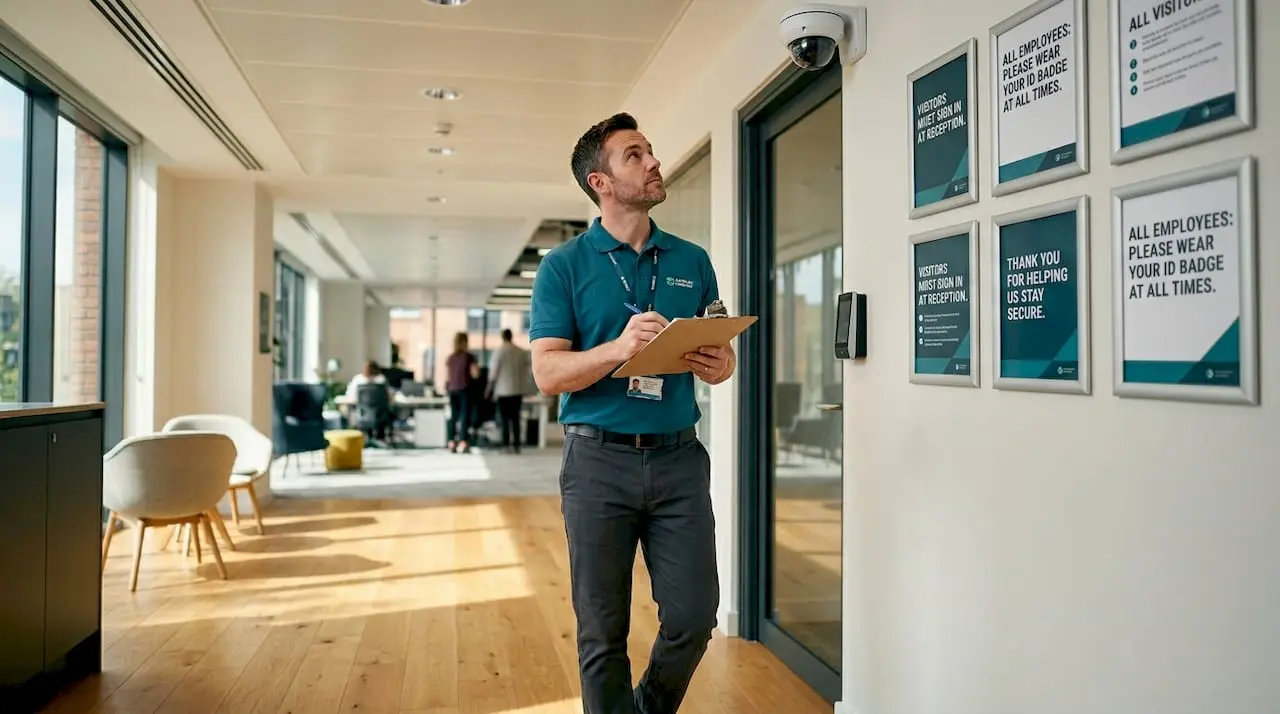
The security consulting market is crowded, and the quality of firms and independent consultants varies enormously. Choosing poorly means spending budget on reports that gather dust rather than driving real change. Here is what to look for and what to avoid.
Attributes of a credible consultant:
- Demonstrable expertise in your sector, not just generic security knowledge
- Relevant certifications such as CISSP, CISM, or ISO 27001 Lead Auditor
- A manual testing approach for technical assessments, not reliance on automated tools alone. Business-context prioritisation separates meaningful findings from theoretical scores.
- Clear, jargon-free reporting that connects findings to business risk
- Evidence of ongoing client relationships rather than purely transactional engagements
Red flags to watch for:
- Consultants who lead with product recommendations before completing an assessment
- Firms that cannot explain how their recommendations align with your specific business objectives
- Reports filled with CVSS scores but no explanation of what each vulnerability means for your operations
- No clear methodology for how they conduct physical security reviews versus cyber assessments
- Resistance to involving your internal team in the process
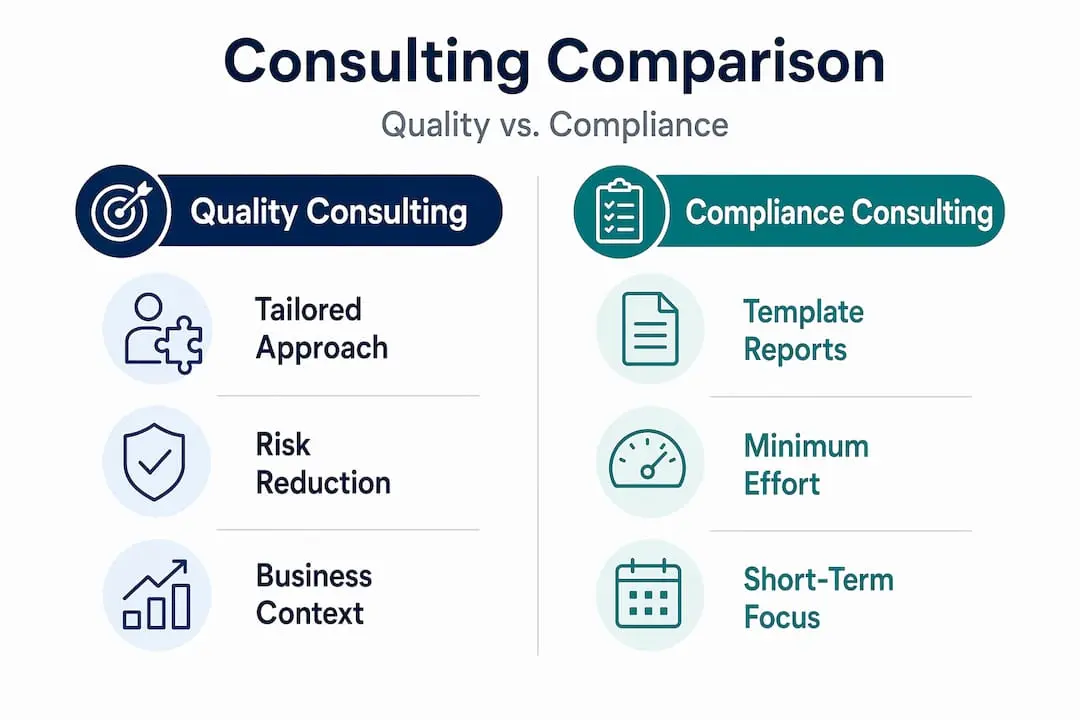
The comparison below illustrates the difference between a consulting engagement built around genuine risk reduction versus one that simply delivers documentation.
| Criterion | Quality consulting | Compliance-only consulting |
|---|---|---|
| Assessment approach | Tailored to business context | Generic template |
| Reporting style | Decision-ready, prioritised | Voluminous, technical |
| Ongoing support | Continuous improvement cycles | One-off deliverable |
| Vendor stance | Neutral, evidence-based | Tied to preferred suppliers |
| Business alignment | Strategy-connected | Compliance-connected |
Future-proofing your business security in 2026
The threat environment businesses face in 2026 is materially different to what it was even three years ago. Security strategy consulting must now account for risks that simply did not exist at scale before.
Identity has become the new security perimeter. Machine identities now vastly outnumber human ones, creating unmanaged attack surfaces that most organisations have not yet addressed. Access sprawl compounds this: 96% of users hold privileges beyond what their role requires, and with 99% of organisations now running AI agents, the complexity of managing who or what has access to what has grown exponentially.
Regulatory expectations are also shifting. The 2026 COSO guidance reflects a sector-wide push to move risk management away from compliance documentation and towards strategic organisational decision-making. Consultants who still position their value primarily around meeting audit requirements are behind the curve.
The market data reflects just how sharply demand is growing. The global security advisory market is projected to reach $55.35 billion by 2032, growing at a 15.40% CAGR. That growth is being driven by businesses finally accepting that reactive, compliance-led security is not a defensible position.
“The expanding role of AI in both creating new threats and enhancing defence requires adaptive consulting strategies. Businesses that treat their security programme as a fixed asset will find it obsolete within months.”
The practical implication for you is straightforward. Whichever consultant you engage in 2026, they should be able to speak fluently about identity access management, AI-assisted threat detection, and how regulatory changes in your sector affect your risk posture. If they cannot, they are not prepared to protect you effectively.
My honest view on security consulting for businesses
I have seen a lot of businesses approach security consulting as a box-ticking exercise. They bring in a consultant, receive a report, file it somewhere, and feel satisfied that they have addressed the issue. Six months later, nothing has changed operationally, and they are no better protected than before.
What consistently works, in my experience, is treating consulting as a partnership rather than a procurement transaction. The businesses that genuinely reduce their risk are the ones that involve their senior leadership throughout the process, build internal ownership of the security programme, and commission follow-up engagements to check whether recommendations have been implemented effectively.
The identity security issue is also far more underappreciated than it should be. Most business owners I speak with focus on perimeter defences and overlook the explosion in machine identities and excessive access privileges sitting inside their own systems. That is where many breaches actually originate.
The other lesson I keep coming back to is the danger of separating physical and cyber security into different conversations. A consultant who only speaks to your IT team and never walks your office, warehouse, or data centre floor is giving you an incomplete picture. Real security works when both disciplines are joined up.
Consulting is not cheap. But the cost of a well-structured engagement is a fraction of what a single serious breach will cost you in regulatory fines, reputational damage, and recovery time. View it as an investment in operational resilience, not an overhead.
— Rob
Find the right people for your security team
If reading this has made you think about the people behind your security operations, Securityjobsboard is built for exactly that purpose. Whether you are a business looking to recruit qualified security professionals or a consultant building your career in the UK sector, the platform connects you with opportunities across the country.

From roles in physical security and risk management to cybersecurity advisory positions, Securityjobsboard lists vacancies across every specialism. The platform is affiliated with the BSIA, which means the jobs listed meet a credible professional standard. If you are looking to strengthen your security function by hiring the right talent, exploring security jobs in Northern Ireland is a good starting point, or browse the full listings at Securityjobsboard to find the right specialist for your organisation.
FAQ
What does security consulting for businesses involve?
Security consulting covers risk assessments, policy development, architecture review, incident response planning, and physical and cyber security strategy. It is designed to align your security posture with your specific business risks and objectives.
How often should a business risk assessment be updated?
Risk assessment matrices should be refreshed quarterly as a minimum, or continuously for businesses facing high-velocity threats such as financial services or healthcare organisations.
What is the difference between cybersecurity advisory services and general IT support?
Cybersecurity advisory services focus on strategic risk reduction, threat intelligence, and programme governance. IT support handles day-to-day technical maintenance. The two are complementary but serve very different functions.
How do I know if a security consultant is right for my business?
Look for sector experience, vendor-neutral advice, clear business-context reporting, and evidence of ongoing client relationships rather than purely one-off engagements. A quality consultant will prioritise understanding your operations before making any recommendations.
Why do businesses need both physical and cyber security consulting?
Many breaches exploit a combination of physical and digital access. Addressing only one creates exploitable gaps. Integrated security programmes that cover both disciplines are consistently more effective at reducing overall organisational risk.


