What Is the Candidate Experience? A Plain-English Guide

Candidate experience is how a job seeker feels about your hiring process, from the first time they see a vacancy to the moment they hear the final outcome, and often beyond it. It covers the advert, the application form, the emails (or the silence), the interviews, the offer and the first days in the job. Whether or not someone gets hired, they leave with an impression of your organisation, and they usually share it.
This guide explains what the term means, the stages it covers, why it matters, what separates a good experience from a bad one, and how to measure and improve it. We run a UK security jobs platform, so the examples lean towards security recruitment, but the principles apply to any hiring.
TL;DR
- Candidate experience is a person’s perception of your whole hiring process, not just the interview.
- It runs through five stages: pre-recruitment, recruitment, selection, job offer and post-offer.
- Research links fair, communicative processes with more recommendations, more offer acceptances and more repeat applications.
- The basics matter most: clear adverts, quick applications, acknowledgements, honest updates and useful feedback.
- Measure it with surveys at each stage and by tracking who responds to candidates, and how fast.
Table of Contents
- What candidate experience means
- The stages of the candidate experience
- Why candidate experience matters
- What makes an experience good or bad
- Perspective: why this matters in security hiring
- How to measure candidate experience
- How to improve candidate experience
- Put it into practice with Security Jobs Board
- FAQ
- Sources
What candidate experience means
The simplest definition: it is how a candidate feels during and after your recruitment process. TechTarget describes it as the feelings people have about a company’s application process, and notes that those feelings can raise or lower their opinion of the hiring organisation regardless of the specific vacancy.
A broader view comes from Talent Board, as summarised in a 2020 guide by exaqueo. It treats candidate experience as the cumulative interactions between a person and an organisation, from awareness through to the employment relationship, including social media and application touchpoints. On that view it is part of your employer brand and the employment lifecycle, not just an application workflow.
Two things follow from this:
- It is perception, not intent. You may think your process is efficient. What counts is how it feels to the person going through it.
- It includes people you do not hire. For every vacancy, most applicants are unsuccessful. How you treat them is most of your candidate experience.
The stages of the candidate experience
A useful model, described in a practitioner article from the Society for Industrial and Organizational Psychology, splits the experience into five stages:
| Stage | What the candidate meets | Typical moments |
|---|---|---|
| Pre-recruitment | Your brand, reputation and career pages | Reviews, social media, word of mouth, job boards |
| Recruitment | The advert and application | Job description, application form, CV upload, acknowledgement |
| Selection | Assessment and interviews | Screening calls, interviews, tests, reference checks |
| Job offer | The decision and the offer | Offer call or letter, negotiation, rejection message |
| Post-offer | The gap before and after day one | Pre-start contact, onboarding, first weeks |
The same article describes how one employer placed its assessment tool across its external career site, email signatures generated by its applicant tracking system, and social-media and email campaigns. The point is that touchpoints are everywhere, not only in the interview room.
A security-industry example
Take a candidate looking for a CCTV operator or door supervisor role. Before applying, they may check your reputation among colleagues and online. They then meet your advert: is the pay or range clear, are the licence requirements stated, and is the location plain? Next comes the application: can they complete it on a phone between shifts? After that, selection: do they get a date for the interview, and do they know what will be asked? Finally the offer and the wait for vetting and onboarding, which in security can take time and leave a new starter in limbo unless someone keeps in touch.
We cover this sector view in more depth in our piece on why candidate experience matters in UK security.
Why candidate experience matters
For employers
There is a commercial case, supported by several studies.
- Fairness shapes attractiveness. The Society for Industrial and Organizational Psychology’s research review reports that Gilliland’s procedural-justice model links how fair a selection process seems with how attractive the organisation looks, whether people recommend it, their intention to take legal action and even their performance in interviews or tests.
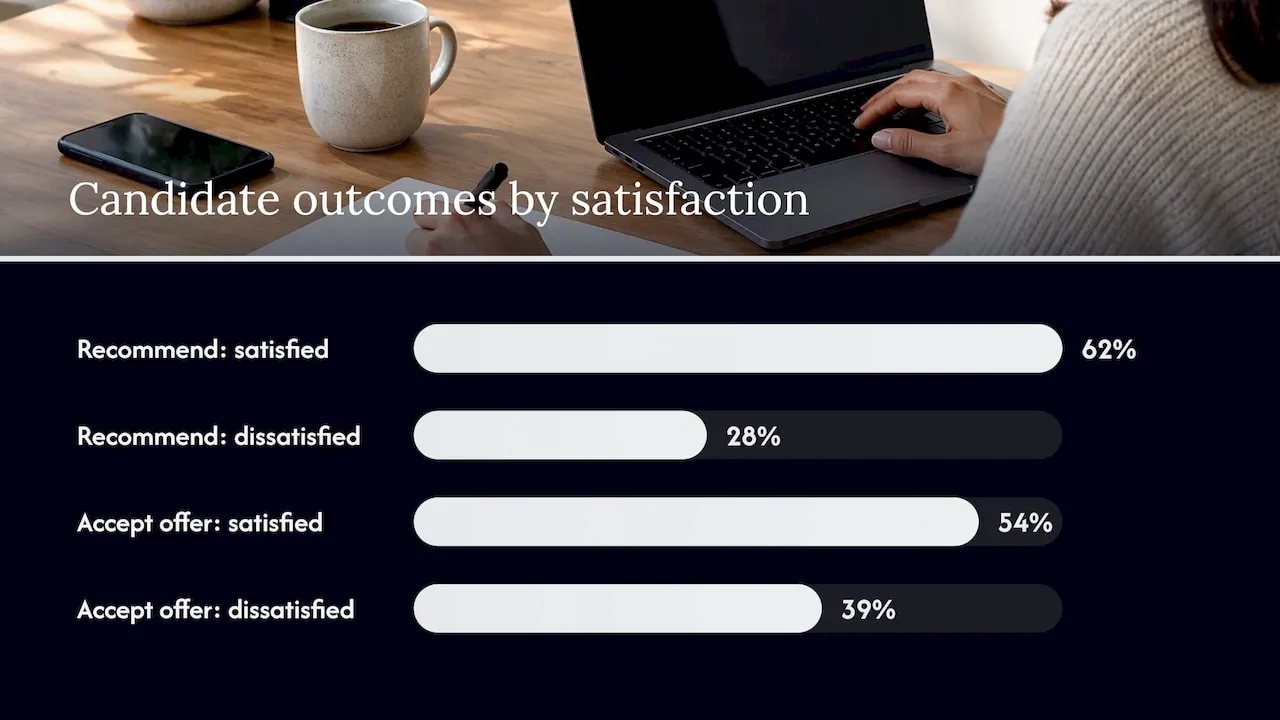
- Satisfied candidates recommend you. A 2016 WorkTrends summary found that satisfied candidates were more than twice as likely to recommend the organisation as an employer than dissatisfied ones, 62% against 28%. They were also 38% more likely to accept a job offer (54% against 39%).
- Unsuccessful candidates come back. In the same global 2016 study, unsuccessful applicants who had a positive impression before applying were more likely to apply again than those with a negative one, 45% against 25%.
- Bad news travels. The same summary reports that more than 60% of candidates share their experiences. More recently, ERE reported in 2024 that 53% of North American candidates were willing to share negative experiences with their inner circle.
- Relationships suffer. Talent Board data from 2018, cited in the exaqueo guide, found that 46% of candidates would decrease their relationship with an organisation after a poor experience.
These figures come from surveys in different years and regions, so treat them as indications of direction rather than exact UK benchmarks. The direction is consistent, though: how you treat applicants affects who recommends you, who accepts your offers and who applies again.
Reputation also does real work in recruitment. An academic study by Cable and Turban found that candidates use an organisation’s reputation as a signal about the job itself and about the pride they would feel as a member. In a sector where employers compete for the same licensed, vetted and experienced people, that signal counts.
For jobseekers
For candidates, the experience decides whether the effort of applying feels worthwhile. The practitioner article above, citing Carpenter, notes that candidates expect a return on the time they invest in a hiring process and want a personalised experience. A form that takes twenty minutes and then vanishes into silence is a poor return.
What makes an experience good or bad
The research on fairness is quite specific. The SIOP review finds that positive selection experiences use job-related and consistent methods, give candidates the chance to show their abilities, provide timely feedback and explanations, communicate honestly and treat people with respect. It lists ten practices:
- Use job-related selection methods.
- Let candidates demonstrate their ability.
- Let candidates challenge results.
- Apply procedures consistently.
- Give timely, useful feedback.
- Explain decisions.
- Communicate honestly.
- Show warmth and respect.
- Allow two-way communication.
- Keep questions legal and non-discriminatory.
The same review notes that candidates may react less favourably to videoconferencing and asynchronous digital interviews. That does not make remote interviews wrong, but it does mean you should explain the format, test the technology and give candidates a human contact.
TechTarget adds a practical view of the online stage: a good process states requirements clearly, takes little time to complete and explains the next steps. Interviews should link the candidate’s skills to what the role needs, and unsuccessful candidates should be turned down in a way that leaves a positive impression.
The most common failure: silence
The exaqueo guide cites Talent Board data that more than 35% of candidates receive no acknowledgement of their application, and fewer than 20% of employers ask for feedback in the early, pre-interview stages. Those are low bars, which is good news: an automatic acknowledgement and a short survey already put you ahead of many employers.
Good and bad side by side
| Stage | Poor experience | Good experience |
|---|---|---|
| Advert | Vague duties, no licence or vetting requirements | Clear requirements, location and next steps |
| Application | Long form, not usable on mobile | Quick form, CV upload, mobile friendly |
| After applying | No acknowledgement | Immediate confirmation and a stated timeline |
| Interview | Unstructured, inconsistent questions | Job-related, consistent, explained in advance |
| Rejection | Silence or a generic template weeks later | Prompt, respectful message, useful feedback where possible |
| Offer to start | Long gaps with no contact | Regular updates through vetting and onboarding |
Perspective: why this matters in security hiring
Security employers often tell us that good people are hard to find. In our experience, they are also easy to lose. A candidate with a valid licence and a clean work history will usually have several options, and the one that replies first, explains the process and treats them with respect tends to win.
That is why we built our platform around the sector. Candidates can create a profile, upload a CV, set alerts and apply quickly, free of charge, from their phone. Employers can post security-specific roles, browse CVs and talk to candidates directly, with human support behind them. Our affiliation with the BSIA, and our GDPR compliance, are there so that both sides can trust the process.
Our view is simple: candidate experience is not a luxury for large HR departments. It is the daily discipline of replying, explaining and being honest, and a specialist board makes it easier because the people on it share your industry’s language.
Rob
How to measure candidate experience
You cannot improve what you do not look at. SHRM’s 2017 guidance on candidate-experience audits says an audit should assess the journey from attraction and application through to onboarding, identify the touchpoints that cause problems, and quantify the experience rather than relying only on time-to-fill or source-of-hire.
Its experts also advise collecting feedback by survey as applicants progress, holding recruiters accountable for communication after applications, and holding hiring managers accountable for communication after interviews.
A workable measurement routine for a small security employer:
- Map the journey. Write down every step from seeing the advert to the first week, and who owns each one.
- Apply to your own vacancy. Do it on a phone, and note how long it takes and what you receive afterwards.
- Ask at key points. Send a short survey after application, after interview and after the outcome, to successful and unsuccessful candidates alike.
- Track response times. Record how long candidates wait for an acknowledgement, an interview invitation and a decision.
- Watch the drop-off. If many people start but do not finish an application, the form is the problem.
- Review quarterly. Compare results, fix the worst touchpoint first and check again.
An applicant tracking system makes steps 4 and 5 far easier because it records timestamps and statuses. See our applicant tracker and our guide to applicant tracking systems for UK security employers for what to look for.
How to improve candidate experience
The SIOP fairness practices double as an improvement plan. In practice, start here:
Fix the advert and the application
State duties, hours, location, licence and vetting requirements, and what happens next. Keep the application short and usable on a phone, as many security candidates search between shifts. A tidy posting routine helps: our guides to a job posting workflow and the job posting life cycle show how to keep adverts accurate from launch to closing.
Communicate on a schedule
Acknowledge every application. Tell people when to expect news, and then send it, even when the news is no. Ideas for keeping people engaged are in our article on candidate engagement.
Make interviews consistent and relevant
Use the same core questions for every candidate, tied to the role. Let people show what they can do, explain the format beforehand and keep questions lawful and non-discriminatory. Our piece on equal opportunities hiring covers the fairness side in a UK setting.
Reject well
Send rejections promptly and respectfully. Where you can, add a line of useful feedback. Given the figures above on repeat applications and recommendations, an unsuccessful candidate treated well is an asset for your next vacancy.
Handle applicant data with care
Candidates trust you with personal information, including work histories and, in security, details needed for vetting. Tell them what you hold and why, and keep it only as long as needed. Our GDPR-first playbook on applicant data explains how.
Keep going after the offer
The experience does not end at acceptance. Stay in touch through vetting, give a clear start date and plan the first week. For more ideas, read our seven ways to improve candidate experience in security hiring and our wider guide to improving candidate experience in security recruitment.
Put it into practice with Security Jobs Board
If you hire in the UK security sector, we built our board so that a good candidate experience starts before the application. Candidates use it free of charge, with profiles, CV upload, job alerts and quick mobile applications. Employers can post standard listings, use featured ads or run multi-role campaign packages, and can access candidate CVs through a CV access plan, with human support if you need it. Pricing is not published on our site, so ask us for current options.

Ready to hire? Post a job or see our employer listing options.
FAQ
What is candidate experience in simple terms?
It is how a person feels about your hiring process, from first seeing a vacancy to hearing the final decision and, if hired, starting work. It covers every contact they have with you, including adverts, forms, emails, interviews and rejections. It applies to everyone who applies, not only the person you hire.
What are the stages of the candidate experience?
A commonly used model has five stages: pre-recruitment, recruitment, selection, job offer and post-offer. Each includes different touchpoints, from your reputation and adverts to interviews, offers and onboarding. Auditing each stage separately shows you where candidates have the worst time.
Why is candidate experience important?
Research links fairer, more communicative processes with higher organisational attractiveness, more recommendations and more offer acceptances. In one 2016 survey, satisfied candidates were more likely to recommend an employer (62% against 28%). Many candidates also share experiences with friends and family, so poor treatment can damage your reputation.
How do you measure candidate experience?
Survey candidates at several points, including those you reject, and track how quickly you acknowledge, interview and decide. Audit the whole journey rather than relying only on time-to-fill or source-of-hire. Assign recruiters and hiring managers responsibility for the communication they owe candidates.
What is the quickest way to improve it?
Acknowledge every application, say when people will hear from you, and send a respectful decision to everyone. These cost little and address the most common failing, which is silence. Then shorten your application form and make sure it works on a phone.
Sources
- candidate experience | TechTarget
- Developing a Candidate Experience Strategy and Understanding for the Future (exaqueo)
- The Bridge: Connecting Science and Practice (SIOP)
- What We Know About the Candidate Experience: Research Findings (SIOP)
- The far-reaching impact of candidate experience (HRView)
- Candidates Talk: The Impact of Positive and Negative Candidate Experiences (ERE)
- The Value of Organizational Reputation in the Recruitment Context (Cable and Turban)
- Candidate Experience Audits Are Core to Recruiting (SHRM)


