Computer Security for UK Security Jobs: SIA, BSIA & Where to Find Work
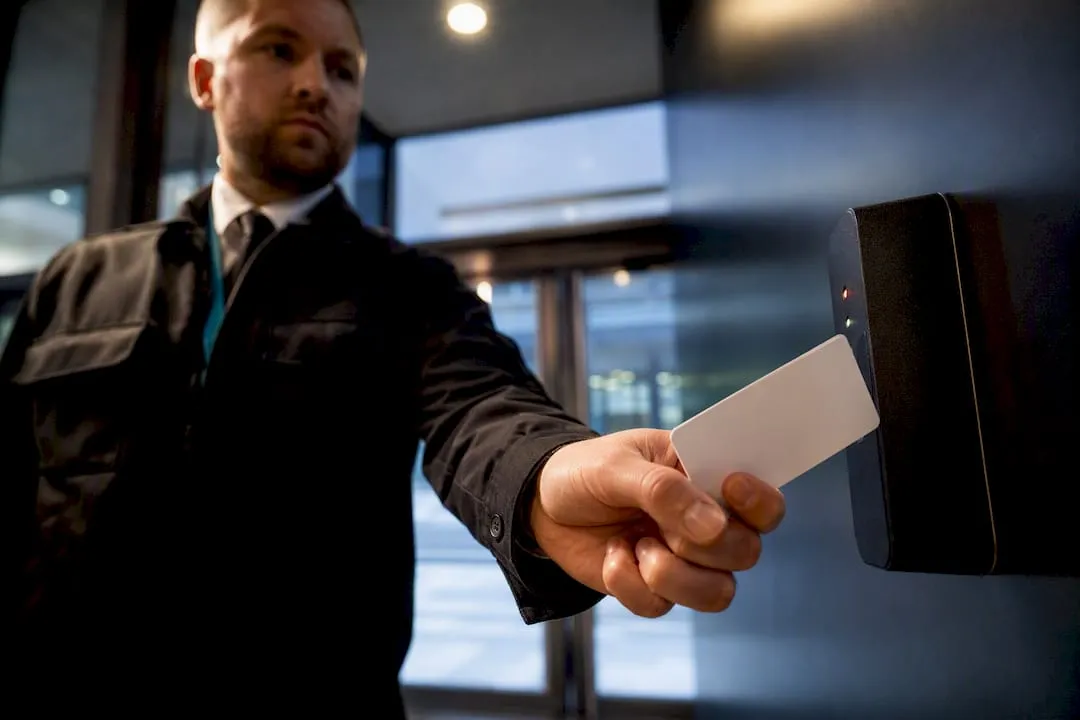
In this context, “computer security” means the world of licensed, regulated security work in the UK. It covers roles such as security guards, door supervisors and CCTV operators, all governed by the Security Industry Authority (SIA) and supported by the British Security Industry Association (BSIA). If you’re hiring or job hunting in this sector, the first move is simple: check whether the role needs an SIA licence, then search a specialist platform like Security Jobs Board.
TL;DR:
- Only security roles involving contract-based licensable activities require an SIA licence, not all job titles like in-house staff performing similar duties.
- The licensing process involves completion of approved training, obtaining a recognized certificate, creating an SIA account, and passing identity and criminal checks before approval.
- Employers verify right to work, licence status, criminal record, and role-specific experience, making clear licence category requirements crucial in job ads.
- Security operations rely on physical controls, procedural discipline, and licensed staff, with ongoing training and policies essential for maintaining standards.
- Targeted, sector-specific job platforms improve the chance of qualified matches, simplifying recruitment for licensed security roles and reducing legal risks.
Table of Contents
- Which security jobs need an SIA licence?
- How do you get an SIA licence, step by step?
- What do employers check, and how do you make your profile stand out?
- Where do you actually find security jobs in the UK?
- What are the core principles behind computer security standards?
- What threats do security operations face day to day?
- What basic measures keep a security operation protected?
- How does this differ from IT cybersecurity?
- Why do policies and training matter as much as the licence itself?
- Why targeted recruitment matters more than volume
- Post a job or find your next role with Security Jobs Board
- Sources
- FAQ
Which security jobs need an SIA licence?
Not every security job needs a licence, and getting this wrong wastes weeks of training and application fees. The trigger isn’t the job title. It’s whether you’re carrying out licensable activity under a contract for services, rather than working as a directly employed, in-house member of staff.
The roles most commonly covered include:
- Security guard (manned guarding, front line licence usually required)
- Door supervisor (licensable in nearly all pub, club and venue settings)
- CCTV operator (public space surveillance typically requires a licence)
- Close protection operative (specialist front line licence with additional training)
- Cash-in-transit officer (licensable when moving valuables for third parties)
- Key holder (licensable in most contracted key holding arrangements)
- Vehicle immobiliser (a distinct licensable category under SIA rules)
The SIA splits licences into front line and non-front line categories. Front line licences apply to anyone in direct contact with the public while doing licensable work, such as a guard on patrol or a door supervisor checking IDs. Non-front line licences cover supervisory or managerial roles that don’t involve hands-on public contact but still sit within a licensable business.
A common misconception is that in-house staff always need a licence. Gov clarifies that employees working directly for one employer, rather than under a contract for services to a third party, usually fall outside the licensing requirement, even when their duties look identical to a licensed contractor’s. If you’re unsure which category your role or vacancy falls into, the SIA and GOV.UK pages are the definitive check, not a job advert or a recruiter’s assumption.
How do you get an SIA licence, step by step?
Getting licensed is a sequence, not a single application. Miss a step and you’ll likely delay your start date by weeks.
- Complete the required training. Front line roles need licence-linked qualifications covering conflict management, physical intervention (where relevant) and often a first-aid element.
- Get your certificate from a recognised awarding body. Training must match the SIA’s published training specifications — a course that looks similar but isn’t accredited won’t count.
- Create your SIA online account and confirm your qualification appears against your profile before you go further.
- Apply directly, or have your employer link the application if they’re sponsoring you, which is common for door supervisor and guarding roles.
- Submit identity evidence, pass criminal record checks, and pay the licence fee as set out in Gov.
- Wait for approval, then keep your licence details current, since renewals need planning well ahead of the expiry date.
Pro Tip: Confirm your training certificate is loaded into your SIA account before you pay any fee or book an interview. Applying for the wrong licence category, or applying before your qualification is recognised, is one of the most common causes of delay.
What do employers check, and how do you make your profile stand out?
Employers in this sector aren’t just filling shifts. They’re managing legal exposure, so checks tend to be thorough and non-negotiable.
Expect employers to verify:
- Right to work in the UK, checked before any offer is confirmed
- SIA licence status and category, matched against the specific role
- Criminal record history, appropriate to the licensable activity
- References, particularly for close protection and cash-in-transit roles
- Role-fit, including physical requirements, shift flexibility and site-specific experience
If you’re a candidate, your profile or CV should lead with your SIA licence number and category, followed by relevant training certificates and shift availability. Vague CVs that bury licence details on page two get skipped.
If you’re hiring, write adverts that state the exact licence category needed, whether the role is front line or non-front line, and any site-specific requirements (retail, construction, events). A precise advert filters out unqualified applicants before they apply, saving your team time on screening calls that go nowhere.
Where do you actually find security jobs in the UK?
Security recruitment runs through four main channels: specialist job boards, employer career sites, recruitment agencies, and direct applications to security companies. Each has trade offs, but for a licensed, compliance-heavy sector, a specialist board tends to outperform general job sites on match quality.
What a sector-focused board should offer:
- Targeted listings filtered by licence type and region, not buried among unrelated vacancies
- A searchable CV database so employers can find licensed candidates quickly
- Job alerts that notify candidates the moment a matching role appears
- GDPR compliance and BSIA affiliation, both signals that the platform takes data handling and industry standards seriously
Using a board typically follows four steps: create a profile, upload your CV, set job alerts for your licence category and region, then apply directly to roles that match. Industry commentary points to a decline in first-time SIA licence applications in recent years, which has put pressure on employers trying to fill front line roles quickly. That pressure is exactly why targeted platforms, rather than generic job boards, matter more in this sector than in most others.
What are the core principles behind computer security standards?
Every licensing and compliance framework in the security sector rests on three principles: confidentiality, integrity and availability. These terms originate in formal security standards, but they map directly onto how the industry protects information and people.
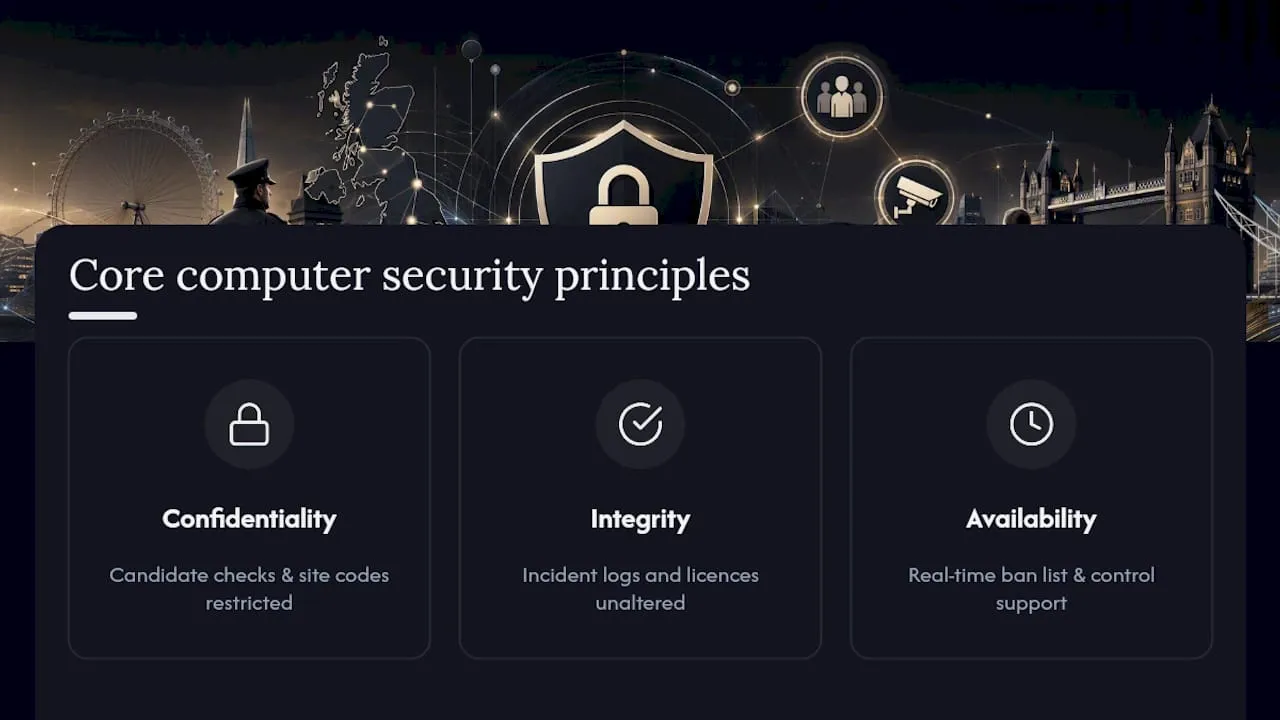
Confidentiality means sensitive information, whether it’s a candidate’s criminal record check or a client’s site access codes, stays restricted to those who need it. A CCTV operator handling footage of a incident, for example, works under strict rules about who can view or share that footage.
Integrity means information stays accurate and unaltered unless changed by someone authorised to do so. A tampered incident log or an altered licence record undermines the entire point of having a record in the first place.
Availability means the right people can access the right information when they need it. A door supervisor needs to verify a ban list in real time, not after a ten-minute system delay. A guard needs to reach control room support instantly during an incident.
These three principles explain why licensing bodies, employers and platforms handling candidate data all build their processes around restricted access, accurate record-keeping and dependable systems. They’re not abstract IT jargon. They’re the backbone of how trust gets built between employers, staff and the public in a regulated industry.
What threats do security operations face day to day?
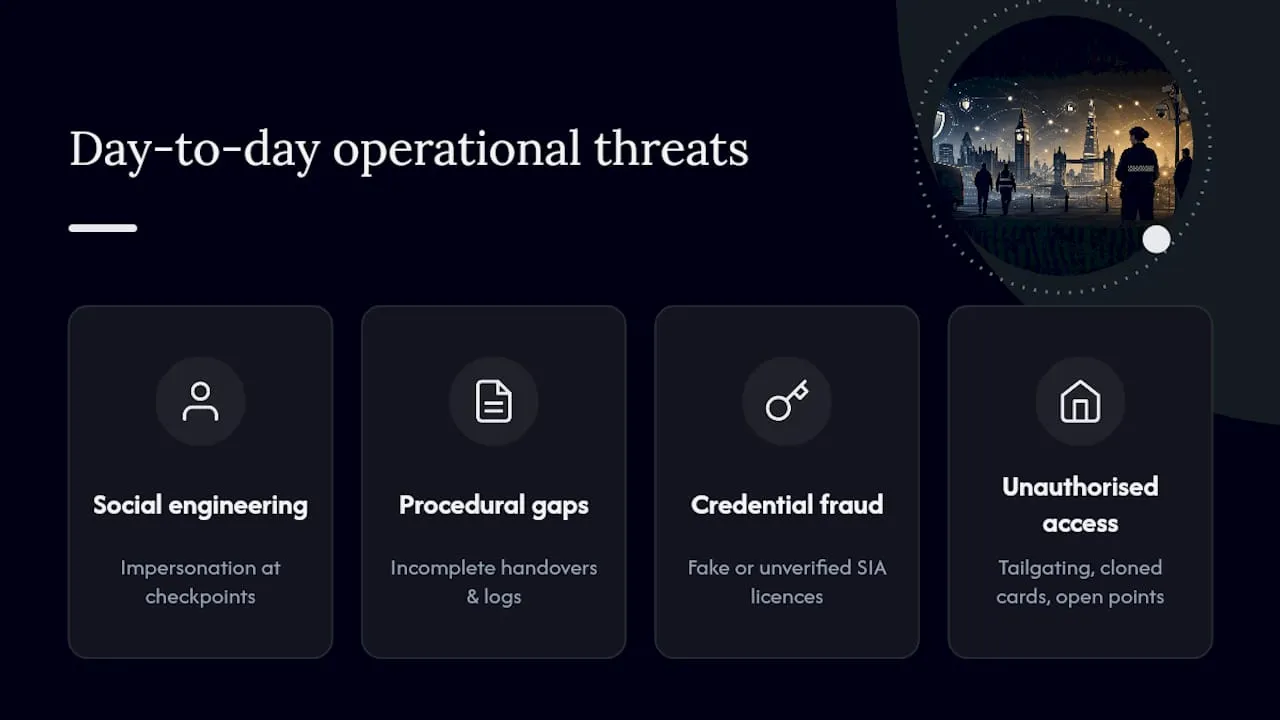
Security staff face threats that are physical and procedural, not digital in the way the term “security threat” gets used elsewhere. The most common categories are worth naming plainly.
Social engineering is a persistent risk in access control. Someone claiming to be a delivery driver, a contractor, or “forgotten” staff member talks their way past a checkpoint. Door supervisors and reception-based security roles face this constantly, and it’s one of the hardest threats to train against because it exploits politeness, not weakness.
Procedural gaps happen when handover notes are incomplete, incident logs go unrecorded, or shift changes lack proper briefing. A gap in the record is a gap in accountability, and it’s often where liability disputes originate after an incident.
Credential and licence fraud is a real, if less discussed, threat. Employers who don’t verify SIA licence numbers directly against the SIA register risk placing unlicensed individuals into licensable roles, which carries legal consequences for the business, not just the individual.
Unauthorised access attempts, whether through tailgating, cloned access cards, or unattended entry points, remain the most common operational failure point across guarding and CCTV roles. Training that addresses these scenarios directly, rather than generic awareness talks, tends to produce staff who actually catch the attempt before it becomes an incident.
What basic measures keep a security operation protected?
Strong protection in this sector combines physical controls, procedural discipline and staff competence, and none of the three works well alone.
Access control systems, including key holding protocols and controlled entry points, function as the physical equivalent of a firewall: a defined boundary that only authorised people cross. Verification checks, from ID badges to visitor sign-in logs, act like an authentication layer, confirming someone is who they claim to be before they’re granted access.
Accurate record-keeping protects the integrity of incident logs and handover notes, much as data integrity checks protect digital records. A guard who logs every incident consistently, with timestamps and clear detail, creates a defensible record if a dispute or investigation follows.
Strong, enforced procedures, rather than ad hoc judgement calls, are the sector’s equivalent of a strong password policy: consistent, non-negotiable, and hard to bypass through convenience. This includes clear escalation paths when an incident exceeds a guard’s authority, and mandatory reporting timeframes that don’t get skipped under pressure.
None of this works without licensed, trained staff carrying it out. A perfectly designed procedure means nothing if the person applying it hasn’t completed the SIA’s licence-linked training, which is precisely why the licensing system exists in the first place.
How does this differ from IT cybersecurity?
The two fields share vocabulary, but they protect different things using different tools. IT cybersecurity protects computer systems, networks and data from unauthorised digital access. The security sector this article covers protects people, premises and physical assets, using licensed personnel, access control and procedural discipline rather than software.
Where the two genuinely overlap is in modern CCTV and access control systems, which increasingly run on networked, IP-based technology. A CCTV operator today often manages digital footage storage, remote monitoring feeds and access logs that sit on a company network, meaning basic digital hygiene, like not sharing login credentials, has become part of the job. But the core discipline, the licence requirement, the training, and the regulatory body remain entirely separate from IT cybersecurity roles. An SIA licence has no relationship to a cybersecurity certification, and confusing the two during a job search wastes time on the wrong training path entirely.
If you’re job hunting and see “computer security” in a vacancy title, check the job description carefully. In the physical security sector, the phrase almost always points to guarding, monitoring or access control work, not IT.
Why do policies and training matter as much as the licence itself?
A licence proves someone met a minimum standard once. Policies, ongoing training and awareness are what keep that standard applied consistently, shift after shift, year after year.
Written site procedures matter because they remove ambiguity during high-pressure moments. A guard who knows the exact escalation process for a suspected shoplifter, rather than improvising, responds faster and more defensibly. Employers who invest in clear, written protocols reduce liability and reduce the chance of an incident being handled inconsistently across different shifts.
Ongoing awareness training matters because threats evolve. Social engineering tactics change, new access technologies get introduced, and refresher training keeps staff sharp rather than relying on knowledge from a course completed years earlier. The BSIA’s role in promoting sector best practice exists partly to keep this kind of guidance current across the industry, rather than leaving individual employers to work it out alone.
For employers, building a culture where staff report near misses and procedural gaps, rather than staying silent to avoid blame, tends to catch small problems before they become serious ones. That culture doesn’t come from a licence. It comes from consistent, visible commitment to training and clear expectations, reinforced by management on every site.
Why targeted recruitment matters more than volume
Hiring pressure in this sector isn’t about a shortage of applicants. It’s about a shortage of the right applicants, licensed, trained and genuinely available for the shift patterns employers need. That distinction gets lost when employers post on general job sites and end up sorting through unqualified applications.
Compliance and targeted recruiting go together for a reason: an employer who verifies SIA licence status and training before shortlisting saves time and avoids the legal exposure that comes with placing an unlicensed candidate into a licensable role. Security Jobs Board is built around that principle, with BSIA affiliation and GDPR-compliant handling of candidate data built into how the platform operates, not bolted on as an afterthought.
If you want to understand the wider hiring pressures shaping this, our piece on the UK security industry job market and career outlook covers it in more depth.
— Rob
Post a job or find your next role with Security Jobs Board
A specialised security-sector job board offers listings, CVs and alerts built around SIA licence categories and sector-recognised standards, helping employers and candidates focus on qualified matches.

Employers can post a job, browse a CV database filtered by licence type, or run a multi-role campaign package when filling several positions at once through the employer pages. Candidates create a profile, upload a CV, set alerts for their licence category and location, and apply in a couple of clicks, entirely free of charge. The BSIA affiliation and GDPR-compliant handling of candidate data give both sides a reason to trust the process. If you’re ready to hire or ready to apply, head to Security Jobs Board and get your listing or profile live today.
Sources
For licence requirements and eligibility, check SIA’s Get Licensed guidance and GOV.UK’s licence checker. For the application process, see GOV.UK’s apply guidance. For sector standards, visit the BSIA.
FAQ
Do I need an SIA licence for every security job?
No. You need an SIA licence when carrying out licensable activity under a contract for services, such as manned guarding or door supervision for a third-party client. In-house staff performing similar duties for a single employer often fall outside the requirement, as GOV.UK’s guidance explains.
How long does it take to get an SIA licence?
Timing depends on how quickly you complete licence-linked training and submit accurate evidence with your application, since incomplete submissions cause the most common delays. Following the step-by-step process on GOV.UK’s application page and confirming your qualification is loaded into your SIA account first helps avoid setbacks.
What’s the difference between front line and non-front line licences?
Front line licences cover roles with direct public contact during licensable work, such as door supervision or manned guarding. Non-front line licences cover supervisory or managerial roles within a licensable business that don’t involve direct public-facing duties.
How much does it cost to post a job on Security Jobs Board?
Pricing details for posting a job, accessing the CV database, or running a campaign package are available directly on the employer pages. Candidate profiles, CV uploads and job alerts remain free of charge.
Why does BSIA affiliation matter when choosing a job board?
BSIA affiliation signals that a platform or employer aligns with recognised sector standards and best practice, which the BSIA promotes across the industry. For jobseekers and employers alike, it’s a practical trust signal that the platform takes compliance seriously.


