How do I get a job in homeland security? Your UK SIA route

The fastest way into UK private security work is to get the right SIA licence linked qualification, then apply for your Security Industry Authority licence before you approach employers. If a firm agrees to sponsor you, they can even submit that application on your behalf. Book an approved training course this week, register for an SIA online account, and start browsing live vacancies on Security Jobs Board while your paperwork moves through the system.
Key Takeaways
Getting a UK security job requires the correct SIA licence linked qualification, a completed licence application, and a fast, high volume approach to job hunting.
| Point | Details |
|---|---|
| Licence comes before applications | Confirm whether your target role is licensable, then complete training before approaching employers. |
| Follow the SIA process in order | Training, notification to the SIA, identity checks, and application submission must happen in sequence. |
| Apprenticeships suit low-budget entry | The Level 2 apprenticeship route takes roughly one to two years and avoids upfront training costs. |
| Speed wins hires | Apply widely, follow up within 48 hours, and answer unknown numbers promptly. |
| Security Jobs Board speeds the match | Candidates get free profiles and alerts; employers filter by licence type at Securityjobsboard. |
Table of Contents
- Do I need an SIA licence for a security job?
- How do you get a job with homeland security in the UK? The licence steps
- Apprenticeships and other ways into security work
- What’s the best way to job hunt in UK security roles?
- Will my background stop me getting an SIA licence?
- What should employers check before hiring security staff?
- Why we built this checklist the way we did
- Get hired faster with Security Jobs Board
- Sources
- FAQ
Do I need an SIA licence for a security job?
It depends entirely on whether your role counts as front line licensable activity. Working without a required licence is a criminal offence, so this is the first thing to check before you spend a penny on training.
Roles that generally need an SIA licence include:
- Manned guarding (static or mobile security officer duties)
- Door supervision at pubs, clubs and licensed venues
- CCTV and public space surveillance operation
- Close protection work
- Key holding
- Cash and valuables in transit
- Vehicle immobiliser work in Northern Ireland
In-house security roles are usually exempt from licensing, with door supervision and Northern Ireland vehicle immobilisation being the notable exceptions. The distinction hinges on whether you’re directly employed by the business you’re protecting or working under a contract for services through a security company.
Pro Tip: Ask any recruiter directly whether the role is “in-house” or “contracted.” It changes whether you need a licence before your first shift, and it’s a fair question that shows you already understand the industry.
How do you get a job with homeland security in the UK? The licence steps
Getting licensed follows a set order, and skipping ahead usually costs you time and money.
- Choose the right licence-linked qualification for your target role (Security Guarding, Door Supervision, or CCTV, for example).
- Book training with an approved provider. Only SIA-recognised courses count towards a licence application.
- Complete any required first aid element, which is built into most front line licence-linked qualifications.
- Wait for the awarding organisation to notify the SIA of your pass. This step catches people out; your licence application cannot proceed until it appears on your SIA account.
- Gather identity documents and right to work evidence.
- Create an SIA online account and submit your application, including payment of the application fee unless an employer is applying for you.
- Track your application status through SIA “next steps” messaging.
Front line qualifications carry a three-year validity window, so training and application timing matter if you’ve had a gap since your course.
Delays typically cluster around three points: course availability (some training providers book up weeks ahead), the awarding body notification lag, and SIA identity or criminal record checks. Budget for training costs, a first aid element if it’s not bundled in, and the licence application fee, then expect several weeks rather than days between booking your course and holding a licence.

Apprenticeships and other ways into security work
Not everyone wants to pay for training up front, and you don’t always have to. There are workable alternatives if you’re starting from nothing.
- Professional Security Operative Level 2 apprenticeship combines paid work with structured training, typically over one to two years.
- In-house employment with a retailer, venue, or corporate site, where a licence often isn’t required for the role itself.
- Internal employer training schemes, where larger security firms sponsor your SIA course as part of onboarding.
Apprenticeship vacancies are usually listed on the government’s Find an apprenticeship service, alongside employer-specific listings. Combining a short licence-linked course with an entry-level application often beats waiting for the “perfect” apprenticeship slot to appear.
Pro Tip: If funds are tight, search for employers who explicitly mention “will sponsor SIA training” in their job adverts. Several larger contract security firms build this into their recruitment to fill rota gaps quickly.
What’s the best way to job hunt in UK security roles?
Volume and speed win more often than a perfectly polished application. Recruiters in this sector frequently hire by phone and prioritise candidates who can start immediately with a clean attendance record.
- Create a candidate profile on Security Jobs Board and upload your CV alongside your SIA licence details.
- Set job alerts so new vacancies reach you the moment they’re posted.
- Apply to more roles than feels comfortable. This sector moves fast, and a wide net catches shifts you wouldn’t have found through a single application.
- Follow up within 48 hours if you haven’t heard back. Recruiters often move to the next candidate quickly when a role needs covering urgently.
When you write your CV, lead with your SIA licence type and number, first aid certification, and immediate availability. If you’ve come from the police, military, or retail loss prevention, put that experience near the top; it tells an employer you already understand conflict de-escalation and site awareness.
Before any interview, pack a small readiness kit:
- Printed CV and licence card
- Photo ID
- Evidence of your DBS check if you’ve had one done previously
- Your phone charged and on, because unknown numbers are often recruiters calling to offer a shift
Pro Tip: Answer unknown numbers. A huge number of hiring decisions in this industry happen over a single phone call, and missing it can mean the shift goes to whoever picks up next.
Will my background stop me getting an SIA licence?
Not automatically, but it’s worth checking before you commit to training costs. The SIA runs criminal record checks as part of every licence application, and certain offences carry more weight than others depending on how recent and how relevant they are to security work.
- Use the SIA criminal records indicator before booking a course if you have any concerns about your history.
- Right to work checks sit alongside, not instead of, your licence application; holding an SIA licence doesn’t itself prove you’re allowed to work in the UK.
- Employers still need to see separate right to work documentation even from licensed candidates.
Pro Tip: Get clarity with a prospective employer early on who pays the licence application fee and whether they’ll apply on your behalf. It saves an awkward conversation once you’re already trained.
What should employers check before hiring security staff?
Hiring the wrong person in this sector carries real compliance risk, not just a bad fit. A short checklist at application and induction stage keeps you covered.
- Confirm the SIA licence type matches the role, and check it’s current, not expired.
- Verify right to work documentation independently of licence status.
- Confirm the licence-linked qualification is appropriate and, where relevant, that a DBS check has been completed.
- Decide early whether you’re applying for the licence on the candidate’s behalf, which shifts both cost and responsibility onto the employer.
Pro Tip: Prioritise candidates with up-to-date qualifications and a visible record of reliable attendance. On Security Jobs Board, you can filter applicants by licence type and availability to cut screening time significantly.
Why we built this checklist the way we did
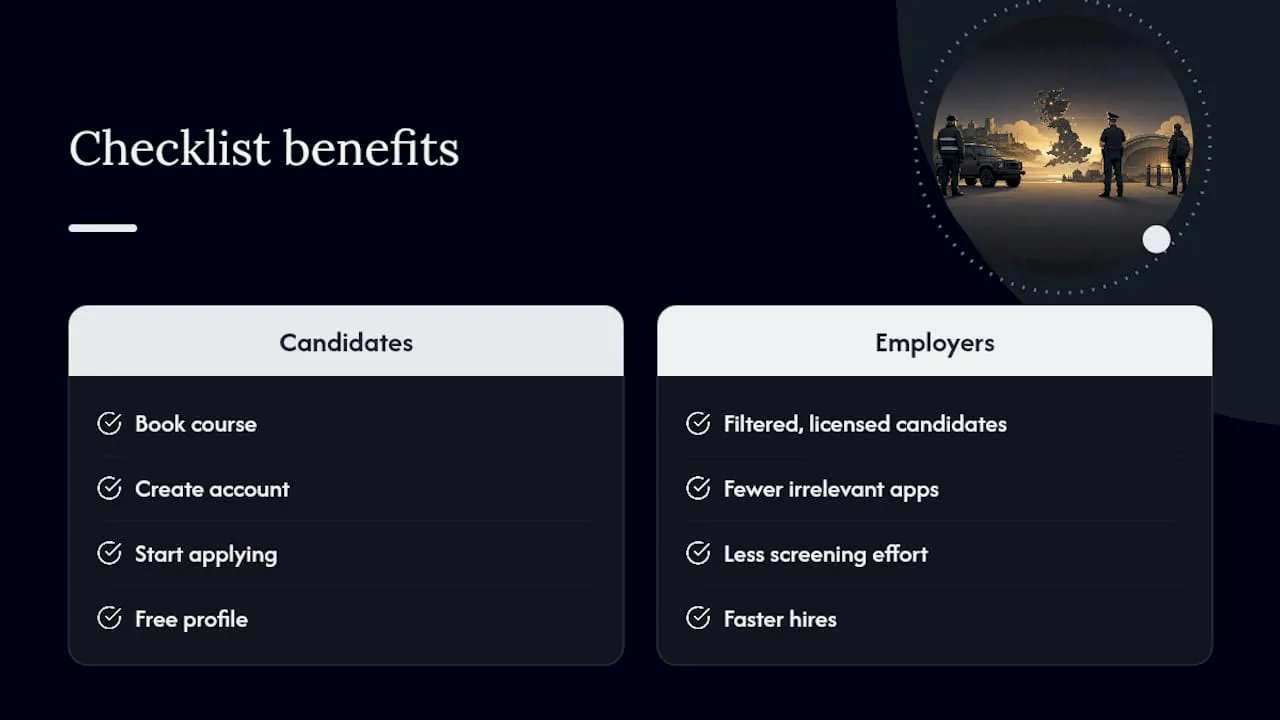
Most guidance on getting into security work reads like a list of rules copied from a government PDF. We wanted something a candidate could actually act on this week: book the course, create the account, start applying. Security Jobs Board exists because the gap between “qualified” and “hired” is usually about speed and visibility, not ability. Candidates get free profile creation, CV storage, and job alerts, while employers get a filtered pool of licensed, ready candidates without wading through unrelated applications.
Get hired faster with Security Jobs Board
Training providers and job forums can point you towards a licence, but turning that licence into an actual shift is a different problem, and it’s the one Security Jobs Board was built to solve. Candidates create a free profile, upload their CV and SIA licence details, set alerts for roles matching their qualification, and apply in a couple of clicks rather than repeating the same form on ten different sites.

Employers get the other half of that equation: post security specific vacancies, search a CV database filtered by licence type and location, and message candidates directly rather than sifting through generic job board noise. The platform’s BSIA affiliation gives hiring managers a layer of sector credibility that generalist job sites simply don’t offer. If you’re recruiting for guarding, door supervision, CCTV, or close protection roles anywhere in the UK, including Northern Ireland, the fastest next step is to post your first vacancy on Security Jobs Board and start browsing candidates today.
Sources
FAQ
Do I need an SIA licence to work as a security guard?
Yes, if your role involves manned guarding under a contract for services. In-house guarding roles are usually exempt, though door supervision always requires a licence regardless of employment type.
How long does it take to get an SIA licence?
There’s no fixed universal timescale, but expect several weeks between booking approved training and receiving your licence, factoring in course scheduling, awarding body notification, and SIA identity checks.
What qualifications do I need for homeland security style jobs in the UK private sector?
You need an SIA-recognised licence-linked qualification matching your target role, such as Door Supervision or CCTV, plus first aid training built into most front line courses.
Can I get a security job without an SIA licence?
Yes, through in-house roles that don’t require licensing, or via apprenticeship routes like the Professional Security Operative Level 2, which combine paid work with training towards a licence.
Where’s the quickest place to find UK security vacancies?
Security Jobs Board lists roles across guarding, door supervision, CCTV and close protection, with free profile creation and job alerts for candidates.


