UK physical security career path: your SIA licence guide

If you searched “comptia security path” looking for a route into UK physical security, you’re in the right place. Here, that phrase means the SIA front-line licence pathway: the structured career route that takes you from zero experience to working as a security guard, door supervisor or security manager in the United Kingdom. The three-step action plan is straightforward: complete your licence-linked qualification from an approved awarding organisation, register and apply through the SIA portal, then pass identity and suitability checks and start applying for roles.
Before you book anything, have these to hand:
- Proof you are aged 18 or over
- Evidence of your right to work in the UK
- A valid first-aid qualification (required before your licence-linked training)
- Your DBS (Disclosure and Barring Service) criminal record check
- National Insurance number and identity documents for the SIA application
Key takeaways
The most important action in the UK physical security career path is completing a valid first-aid qualification before your licence-linked training, then applying to the SIA promptly once your qualification appears on your portal account.
| Point | Details |
|---|---|
| First-aid comes first | A valid first-aid certificate is required before starting any licence-linked qualification. |
| Three-year renewal rule | Renew your SIA licence up to four months before expiry; a lapsed licence beyond three years requires the full qualification again. |
| Verify your qualification online | Check the SIA “My qualifications” page before submitting your application or it will be delayed. |
| Use the profession map for progression | The private security profession map capability bands give employers and operatives a concrete framework for promotion planning. |
| Securityjobsboard for roles | Free job search and CV upload for SIA-licensed candidates across the UK, including Northern Ireland vacancies. |
Table of Contents
- Who needs an SIA front-line licence?
- How to get your SIA front-line licence, step by step
- Which qualifications does the SIA accept?
- How to find and verify an approved training provider
- Licence renewal, refresher training and staying current
- How do you progress from guard to supervisor to manager?
- Employer checklist for verifying candidates and supporting development
- Practical next steps for jobseekers: what to do in the next 90 days
- What the UK security job market actually looks like right now
- Securityjobsboard: find your next security role or hire compliant staff
- Sources
- FAQ
Who needs an SIA front-line licence?
Anyone working in a licensable activity on a contracted basis must hold a valid SIA front-line licence. That covers security guards, door supervisors, CCTV operators (public space surveillance), vehicle immobilisers and close protection officers. If you are employed directly by a business to guard only that business’s own premises, an in-house exemption may apply, but most roles in the contracted security sector require a licence.
Core eligibility checks every applicant must satisfy:
- Age: minimum 18 years old at the point of application
- Right to work: you must have the legal right to work in the UK
- Criminal record: a DBS check is mandatory; certain convictions will bar an application
- Identity: valid photographic ID and proof of address
- Suitability: the SIA reviews character and conduct as part of its Get Licensed decision criteria
Managers and directors are not automatically exempt. If a manager personally performs a licensable activity at any point, or if they are a director of a company supplying security operatives, they must also hold a front-line licence.
Pro Tip: Employers: before offering a candidate a role, ask two questions. First, is the role contracted security work? Second, will the person physically perform a licensable activity? If both answers are yes, a front-line licence is required, not the non-front-line route.
How to get your SIA front-line licence, step by step
The full process runs from first-aid course to licence in hand, typically a few weeks for most candidates. Here is the sequence, drawn from GOV.UK’s application guidance:
- Complete a first-aid qualification from an approved provider (this must be valid before you start licence-linked training).
- Enrol with an approved training provider and complete the correct licence-linked qualification for your chosen role.
- Wait for your awarding organisation to notify the SIA — your qualification must appear on your SIA “My qualifications” page before you can apply.
- Create your SIA online account at the SIA portal.
- Submit your application and pay the licence fee (check the current fee on GOV.UK, as it is subject to change).
- Undergo identity and suitability checks — the SIA verifies your documents and criminal record.
- Receive your licence and begin applying for roles.
Timeline at a glance: First-aid training generally takes a short time. The licence-linked qualification length varies depending on the award. SIA application processing duration depends on application status. Total time from starting first-aid to holding a licence varies accordingly.
Employer-paid applications can be linked to an employer’s SIA account, which speeds up the verification stage. If your employer is funding the training and application, ask them to link the application to their account from the outset.
Which qualifications does the SIA accept?
The SIA requires a specific licence-linked qualification for each front-line licence type. That qualification must come from one of the accepted awarding organisations. The current recognised awarding organisations include:
- Highfield Qualifications
- QNUK
- BIIAB
- City & Guilds
- NOCN
- SFJ Awards
The qualification type you need depends on your situation:
| Situation | Qualification needed |
|---|---|
| First-time applicant | Full licence-linked qualification (e.g. Level 2 Award for Door Supervisors) |
| Renewing within three years | Level 2 refresher qualification (where available for your licence type) |
| Renewing after licence has lapsed beyond three years | Full qualification required again |
The first-aid pre-requisite applies to both the full qualification and the refresher. If your first-aid certificate has expired, renew it before booking your security training — this is one of the most common bottlenecks for new entrants and returning operatives alike. Older qualifications obtained before certain SIA rule changes may be accepted for renewal purposes; check the current GOV.UK guidance for your specific licence type before assuming yours qualifies.
How to find and verify an approved training provider
Training must come from a provider approved by one of the accepted awarding organisations. An unapproved course will not result in a valid qualification, and your SIA application will stall.
Checks to run before booking any course:
- Confirm the provider holds current approval from a recognised awarding organisation (ask for their approval reference number)
- Verify the specific qualification they deliver matches the SIA’s required award for your licence type
- Check that in-person assessment arrangements are included (remote-only courses are not accepted for all elements)
- Confirm the first-aid course they recommend or offer meets SIA validity requirements
- Ask when they notify the awarding organisation after course completion, as this triggers the SIA qualification update
Pro Tip: After completing your course, log into your SIA account and check the “My qualifications” page before submitting your application. If the qualification is not showing, contact your training provider immediately — applying without it visible will delay your licence.
The GOV.UK post-training guidance walks through exactly what to check at this stage.
Licence renewal, refresher training and staying current
SIA front-line licences are valid for three years. Renewal is not automatic, and leaving it late is a common and costly mistake.
Renewal steps and key timelines:
- Apply to renew up to four months before expiry to avoid a gap in your licence
- If your licence is still current, a Level 2 refresher qualification (where available for your licence type) is sufficient
- If your licence has lapsed for more than three years, you must complete the full qualification again
- The SIA fee applies at renewal just as it does for a first application
The three-year rule: plan your renewal training at least eight to twelve weeks before your licence expiry date to allow time for the course, awarding-organisation notification, and SIA processing.
Beyond the licence itself, continuing professional development keeps operatives employment-ready and supports promotion. The private security profession map from the Security Skills Board provides CPD frameworks that employers can use to structure staff development between renewals, linking training activity to capability bands rather than treating CPD as a box-ticking exercise.
How do you progress from guard to supervisor to manager?
The typical progression in UK physical security runs: front-line operative → team leader or supervisor → operations manager or head of security. Each step involves a combination of experience, qualifications and demonstrated competency.
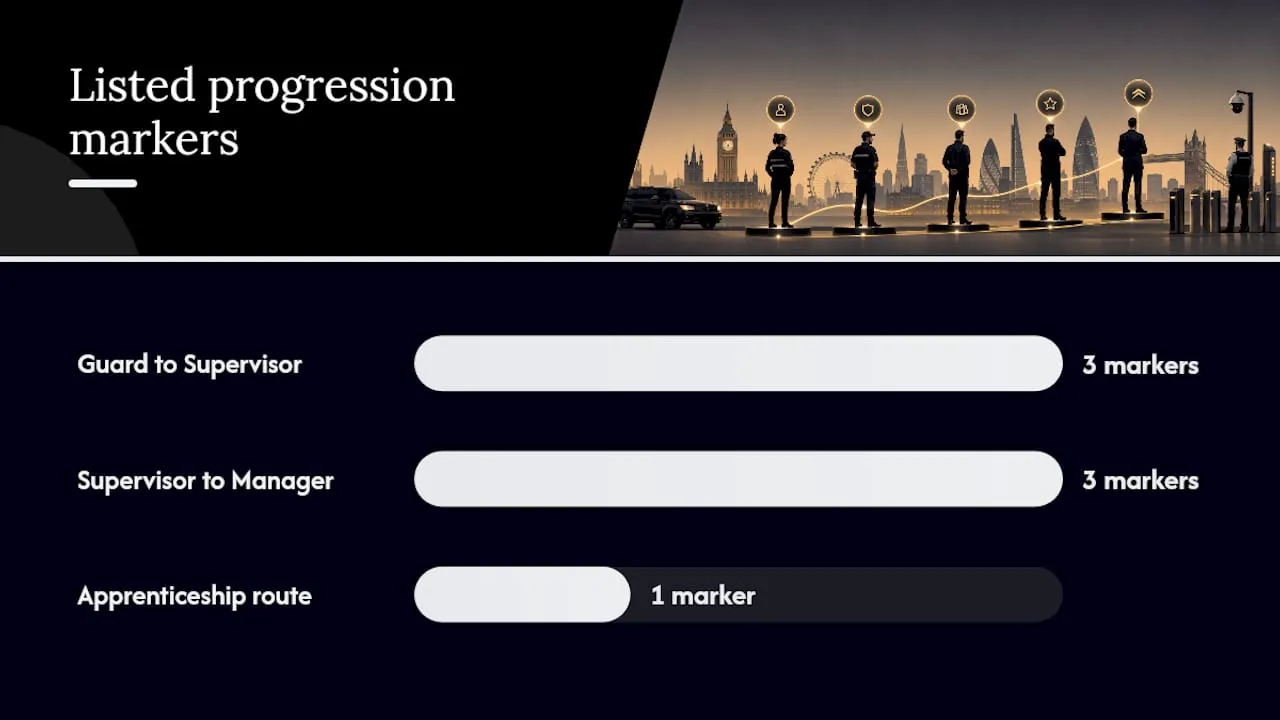
Common progression markers:
- Guard to supervisor: two or more years’ operational experience, strong incident-reporting record, and often a Level 3 Award in Security Supervision or an NVQ in Security Management
- Supervisor to operations manager: broader site or contract management experience, Level 4 or Level 5 study (such as a diploma in security management), and familiarity with contract compliance and staff scheduling
- Apprenticeship routes: the Security First Line Manager apprenticeship standard offers a structured employer-funded route to supervisor level
The Government Security Profession career framework maps skills and behaviours to role levels, giving both employers and individuals a shared language for promotion conversations. The Security Institute’s education and learning pathways clarify how RQF qualification levels align to career stages, and how workplace competence qualifications (NVQs) differ from academic awards.
Pro Tip: Use the private security profession map capability bands in your annual appraisal conversations. Mapping an operative’s current skills against the next band up turns a vague “you need more experience” into a concrete development plan with named qualifications and behaviours to evidence.
Employer checklist for verifying candidates and supporting development
Every employer hiring into a licensable role must complete these checks before a candidate starts work:
- Verify the SIA licence number on the SIA licence checker (gov.uk/check-sia-licence)
- Confirm the licence type matches the role (a door supervisor licence covers security guarding; a security guarding licence does not cover door supervision)
- Check the licence expiry date and flag renewals due within four months
- Confirm right to work in the UK with original documents
- Review the DBS certificate date and obtain a new one if it is more than three years old
- Ask the candidate to link their SIA account to your employer account for ongoing verification
For development planning, employers should also:
- Offer structured CPD aligned to the private security profession map capability bands
- Consider apprenticeship standards for supervisor-track candidates
- Use the Government Security Profession career framework to write role descriptions that reflect genuine skill levels
- Maintain records of training, qualifications and licence checks in line with GDPR obligations
Role description templates aligned to the career framework are available via Securityjobsboard’s job duties resource.
Practical next steps for jobseekers: what to do in the next 90 days
Single-sentence plan: book your first-aid course this week, choose an approved licence-linked course, complete both, verify your qualification on the SIA portal, then start applying.
Step-by-step checklist:
- Book a first-aid course with an SIA-accepted provider (one to two days)
- Choose your licence type (security guarding or door supervision for most new entrants) and find an approved training provider
- Complete the licence-linked qualification and confirm your awarding organisation has notified the SIA
- Log into your SIA account and check “My qualifications” shows the award
- Submit your SIA application with the correct fee and identity documents
- While waiting for your licence, prepare your CV and upload it to Securityjobsboard
- Set job alerts for your preferred region and apply to roles that offer employer-paid applications
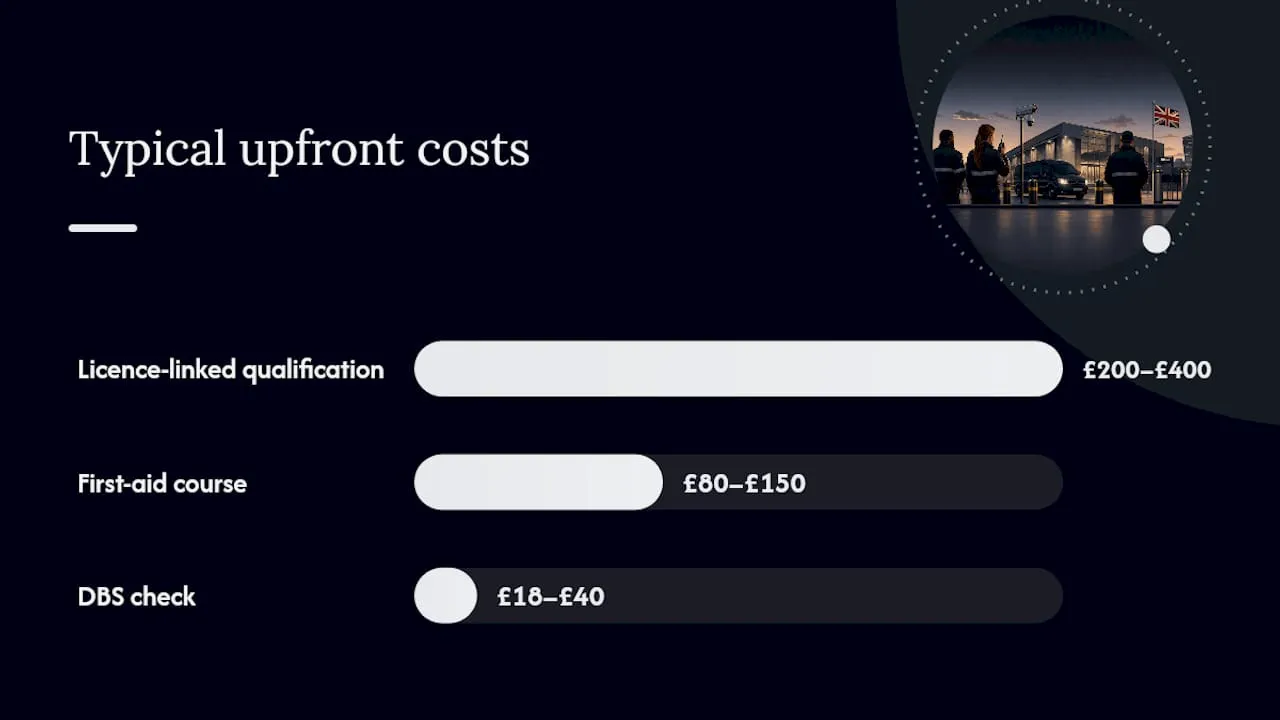
Budget to have ready:
- First-aid course: typically £80–£150
- Licence-linked qualification: typically £200–£400 depending on provider and course type
- SIA application fee: check the current fee on GOV.UK (fees are reviewed periodically)
- DBS check: typically £18–£40 depending on the route used
For a detailed entry-level checklist, the Securityjobsboard guide on becoming a security guard covers documents, timelines and common pitfalls in plain language.
What the UK security job market actually looks like right now
The gap between candidates who have done the paperwork correctly and those who have not is wider than most people expect. First-aid certificates are the single most common reason a training provider turns a candidate away on day one of their licence course. It is not a technicality — it is a hard prerequisite, and arriving without a valid certificate means rebooking and losing weeks.
For employers, the licence-checker step is non-negotiable, yet a surprising number of smaller operators still rely on a candidate’s word rather than running the official SIA check. A licence can be suspended or revoked after issue; checking at the point of hire and periodically thereafter is the only reliable method.
The SIA regulation and careers guide on Securityjobsboard covers the regulatory landscape in more depth for anyone who wants to understand how the SIA’s oversight affects day-to-day hiring decisions.
Securityjobsboard: find your next security role or hire compliant staff
Securityjobsboard connects SIA-licensed candidates with employers across the UK, free of charge for jobseekers. You can upload your CV, set regional job alerts and apply directly to vacancies, including roles that offer employer-paid SIA applications. Employers get a searchable CV database, security-specific job listings and the ability to link candidate SIA accounts for faster compliance checks — all built around GDPR-compliant processes and backed by BSIA affiliation.

If you are based in or looking for work in Northern Ireland, the security jobs in Northern Ireland page lists current vacancies by location. For roles across the rest of the UK, visit Securityjobsboard to create your free profile and start applying today.
Sources
FAQ
Who must hold an SIA front-line licence in the UK?
Anyone performing a licensable activity on a contracted basis must hold a valid SIA front-line licence. Managers and directors who personally carry out licensable work are also required to hold one.
How long does it take to get an SIA licence from scratch?
Most candidates complete the process in six to ten weeks: one to two days for first-aid, two to five days for the licence-linked qualification, and two to four weeks for SIA application processing.
What qualifications does the SIA accept for a security guard licence?
The SIA accepts licence-linked qualifications from approved awarding organisations including Highfield Qualifications, QNUK, BIIAB, City & Guilds, NOCN and SFJ Awards. The full list is published on GOV.UK.
How do I renew my SIA licence?
Apply up to four months before your licence expires. If your licence is still current, a Level 2 refresher qualification is typically sufficient; if it has lapsed beyond three years, you must complete the full qualification again.
Where can I find SIA-licensed security jobs in the UK?
Securityjobsboard lists security vacancies across the UK, including Northern Ireland, and is free for jobseekers to search, upload a CV and apply.


