What is a job in cyber security like in 2026?

TL;DR:
- Cyber security professionals defend systems and data from digital threats through continuous monitoring and analysis.
- Roles vary from shift-based SOC analysts to project-focused penetration testers and process-driven GRC specialists.
A cyber security job is the work of defending computer systems, networks, and data from digital threats through continuous monitoring, analysis, testing, and governance. The field spans dozens of distinct roles, from a Tier 1 SOC (Security Operations Centre) analyst triaging alerts on a night shift to a GRC (Governance, Risk and Compliance) analyst writing policy documentation during standard office hours. Understanding what is a job in cyber security like means recognising that no single description fits every role. Enterprise SOCs generate roughly 11,000 alerts per day, which shows the sheer operational scale professionals work within. This guide breaks down daily realities, work environments, required skills, and career paths so you can decide which direction suits you.
What does a typical day look like in a cyber security job?
The daily experience of a cyber security professional depends almost entirely on which role they hold. Three roles illustrate the range well: the SOC analyst, the penetration tester, and the GRC analyst.

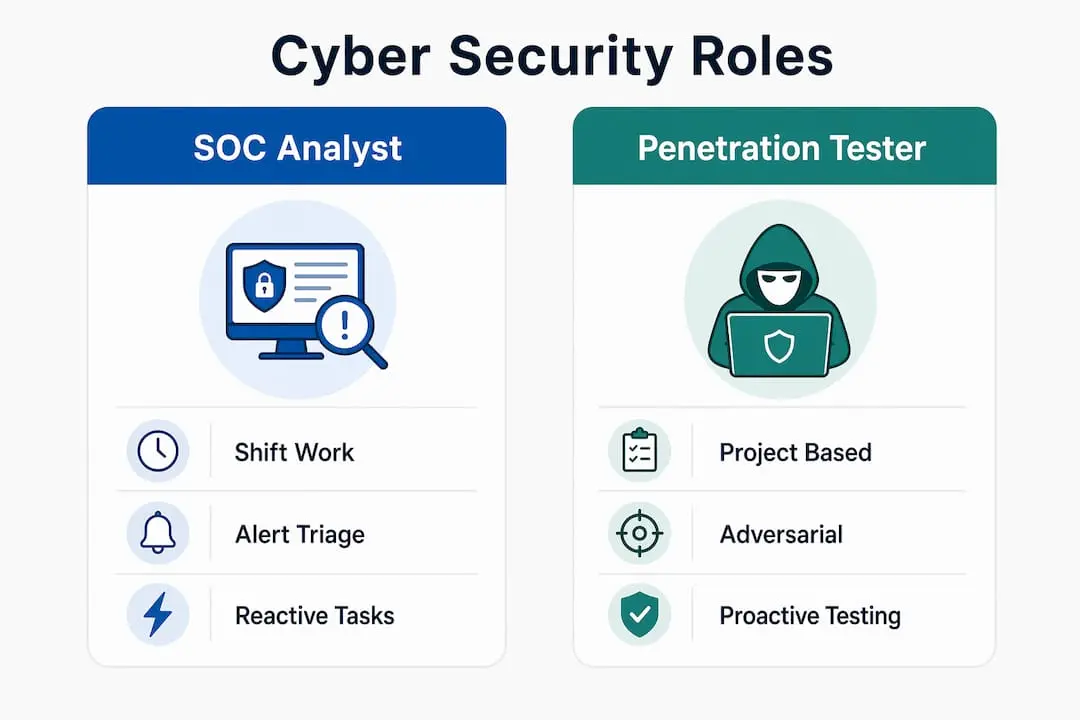
SOC analyst: shift work and alert triage
A Tier 1 SOC analyst starts each shift by reviewing the alert queue. SOC shifts run 8–12 hours in a reactive, round-the-clock schedule, covering nights, weekends, and bank holidays. A typical analyst processes 20–50 alerts per shift, classifying each as a genuine threat or a false positive. Many of those alerts turn out to be false positives. Entry-level analysts often handle 20–100 alerts per shift, and a large proportion require no escalation at all.
The core tools in a SOC include SIEM (Security Information and Event Management) platforms, which aggregate log data from across an organisation’s systems. Analysts use frameworks like MITRE ATT&CK to map suspicious behaviour to known attack techniques. When a genuine threat appears, the analyst escalates to a Tier 2 or Tier 3 colleague for deeper investigation.
Pro Tip: If you are considering a SOC role, practise reading log files and understanding common attack patterns before your first interview. Familiarity with MITRE ATT&CK gives you an immediate advantage.
Penetration tester: project-based adversarial work
A penetration tester’s day looks very different. Engagements typically run 1–2 weeks per project, with the tester attempting to breach a client’s systems using the same methods a real attacker would use. The technical exploitation phase is only part of the job. Report writing consumes 30–40% of engagement time for penetration testers, because the written report is the primary deliverable the client receives. A technically brilliant tester who writes poorly will struggle to progress.
GRC analyst: documentation and compliance
Vulnerability management and GRC roles are more structured and documentation focused than SOC work. A GRC analyst spends their day reviewing policies, mapping controls to frameworks such as ISO 27001 or Cyber Essentials, and preparing audit evidence. The pace is steadier, the hours are predictable, and the pressure is lower on any given day, though deadlines around audits and regulatory submissions can create concentrated periods of intense work.
- SOC analyst: reactive, shift-based, alert-driven, high volume
- Penetration tester: project-based, adversarial, report-heavy, varied clients
- GRC analyst: process-driven, documentation-focused, standard hours, audit-oriented
How do work environments differ across cyber security roles?
The environment you work in shapes your daily experience as much as the tasks themselves. Choosing a cyber security specialisation depends heavily on your preferred work environment, whether that is high-volume reactive monitoring, project-based adversarial testing, or process-driven governance work.
A SOC operates around the clock. The atmosphere is collaborative but pressured. Analysts sit together, share screens, and escalate issues in real time. The team dynamic is tight because everyone depends on each other during a live incident. Stress levels spike during active attacks and drop during quieter periods, creating an uneven rhythm that suits some people and exhausts others.
Penetration testing teams often work in consultancy structures, either in-house or for specialist firms. The work is intellectually stimulating and varied, with each client presenting a different environment to assess. Travel to client sites is common, particularly for physical security assessments. The social dynamic is smaller and more independent than a SOC.
GRC and compliance roles sit closer to traditional office environments. The work is methodical. You collaborate with legal, IT, and senior management rather than with fellow analysts watching the same screens. Structured triage and prioritisation skills matter in SOC work, but in GRC roles the equivalent skill is managing competing deadlines across multiple frameworks simultaneously.
Pro Tip: Shadow a professional in each environment before committing to a specialism. A single informational interview with a SOC analyst and a GRC analyst will tell you more than a month of online research.
What skills do you need to succeed in cyber security?
Technical skills get you through the door. Practical diligence and communication keep you employed and advancing. Early career SOC analysts often find that triaging false positives and managing alert queues require more practical diligence than advanced technical knowledge.
Technical skills by role
- SOC analyst: log analysis, SIEM operation, network protocol knowledge, incident classification
- Penetration tester: scripting (Python, Bash), network scanning, web application testing, exploitation frameworks
- GRC analyst: policy writing, risk assessment methodology, knowledge of ISO 27001, NIST, and Cyber Essentials frameworks
- Security engineer: system hardening, firewall configuration, cloud security architecture, identity and access management
Soft skills that separate good from great
Process orientation, communication, and documentation skills are undervalued but critical, especially in governance and compliance roles. A penetration tester who cannot explain a vulnerability clearly to a non-technical client creates no value. A SOC analyst who cannot write a concise incident report leaves the next shift without the context they need.
Decision-making under pressure is another skill that matters more than most job descriptions admit. Effective SOC analysts develop structured alert triage processes that let them decide quickly which alerts to escalate and which to close, managing volume without burning out. That judgement comes from experience, but it also comes from building good habits early. Securityjobsboard offers training and courses covering both technical and soft skills relevant to UK security employers. You can also read more about why soft skills matter in security careers specifically.
What career paths exist within cyber security?
Cyber security careers follow a clear progression from entry-level analyst roles through to senior technical positions and advisory leadership. The UK market is active, and demand for qualified professionals continues to outpace supply.
Entry-level roles include junior SOC analyst, vulnerability management assistant, and junior GRC analyst. These positions build foundational skills in monitoring, documentation, and risk assessment. Salaries at this level reflect the learning investment the employer makes in you, but progression is fast for those who pursue certifications and demonstrate initiative.
Mid-level roles include security engineer, incident responder, and threat intelligence analyst. These positions require two to four years of experience and often a relevant certification such as CompTIA Security+, CEH (Certified Ethical Hacker), or CISSP (Certified Information Systems Security Professional). Senior technical roles like security engineer average around $108,356 per year in the US market, with UK equivalents in the £60,000–£90,000 range for experienced professionals. Security specialists at mid-level average around $69,804 annually, reflecting the step up that comes with specialisation.
| Career stage | Typical roles | Key certifications |
|---|---|---|
| Entry level | Junior SOC analyst, GRC assistant | CompTIA Security+, Cyber Essentials |
| Mid level | Security engineer, incident responder | CEH, CISM, OSCP |
| Senior level | Lead analyst, security architect | CISSP, CISA |
| Advisory | Head of security, CISO | CISSP, MBA, board experience |
Securityjobsboard covers UK cyber security career pathways in detail, including routes for career changers and those without a traditional IT background. The field genuinely welcomes people from diverse starting points, provided they build the right skills and credentials.
Key takeaways
A cyber security career offers distinct paths across reactive, adversarial, and governance roles, each requiring a different combination of technical skill, temperament, and communication ability.
| Point | Details |
|---|---|
| Role variety is significant | SOC, penetration testing, and GRC roles differ in hours, pace, and required skills. |
| Alert volume is high in SOCs | Enterprise SOCs generate roughly 11,000 alerts per day; triage discipline prevents burnout. |
| Writing skills matter everywhere | Penetration testers spend 30–40% of their time on reports; GRC analysts write constantly. |
| Soft skills drive progression | Communication and documentation ability separate good analysts from great ones. |
| Career paths are structured | Entry-level roles lead to senior technical and advisory positions with clear certification milestones. |
The realities nobody tells you about cyber security careers
I have spoken with hundreds of security professionals over the years, and the most consistent thing they say is this: the job is nothing like they expected, and they are glad they took it anyway.
The expectation is that cyber security is all late-night hacking and dramatic incident response. The reality is that every correctly classified alert and contained threat prevents real harm to real people and organisations. That purpose is what keeps professionals in the field through the repetitive stretches. Purpose-driven work is a genuine motivating factor in cyber security careers, and it helps professionals endure the monotonous parts of alert monitoring that nobody puts in the job advert.
My honest advice is to choose your first role based on your personality, not just the salary or the job title. If you thrive on structure and predictability, GRC will suit you far better than a SOC night shift. If you love problem-solving and variety, penetration testing is worth the extra study. The field is wide enough to accommodate both. The professionals who struggle are those who pick a role for the wrong reasons and then resist the continuous learning the field demands. Cyber security changes faster than almost any other profession. Adaptability is not optional.
— Rob
Ready to find your cyber security role?
Securityjobsboard connects UK security professionals with employers who are actively hiring across all levels and specialisms, from entry-level SOC positions to senior GRC and engineering roles.

Whether you are exploring your first role or planning your next move, the platform gives you free access to live job listings, CV upload, and job alerts tailored to the security sector. Securityjobsboard is affiliated with the BSIA, which means the employers you find there are credible and serious about hiring. Start with the career advice hub to get clear on your direction, then browse current vacancies to see what the market looks like right now at Securityjobsboard.
FAQ
What do cyber security professionals actually do day to day?
Daily tasks depend on the role. SOC analysts triage security alerts, penetration testers attempt to breach client systems, and GRC analysts write policies and manage compliance documentation.
Is a cyber security job stressful?
SOC roles involve shift work and high alert volumes, which creates pressure. GRC and compliance roles are steadier. Stress levels vary significantly depending on the specialism you choose.
What qualifications do you need to start in cyber security?
Entry-level roles often accept CompTIA Security+ or Cyber Essentials alongside relevant experience. A degree is not always required, particularly for candidates who demonstrate practical skills through labs or certifications.
How long does it take to progress from entry level to senior roles?
Most professionals reach mid-level positions within two to four years, depending on certifications gained and the complexity of incidents they have handled.
What is the difference between a SOC analyst and a penetration tester?
A SOC analyst monitors and responds to threats in real time. A penetration tester is hired to simulate attacks on a client’s systems and report on vulnerabilities found.


