
TL;DR:
- Remote cybersecurity roles now span all levels, from entry-level SOC analysts to senior architects, with growing demand exceeding talent supply. Employers prioritize practical skills, certifications, and operational evidence over formal qualifications, and many remote roles require occasional travel or residency considerations. Candidates should tailor their applications to match job language, build operational portfolios, and verify travel requirements to succeed in the evolving remote cybersecurity market.
The assumption that remote cybersecurity job roles are limited to junior SOC analysts staring at dashboards from their spare bedroom is holding a lot of talented people back. In reality, the range of remote and telecommute cybersecurity positions available in 2026 spans malware reverse engineering, cloud security architecture, compliance consulting, and beyond. Demand is growing faster than the talent pipeline can fill it, and organisations are increasingly willing to hire remotely to access the skills they need. This guide covers what roles exist, what employers actually want, and how to position yourself to land them.
Table of Contents
- Key takeaways
- Remote cybersecurity job roles: what’s actually available
- Skills and qualifications for remote security roles
- Hiring trends shaping remote cybersecurity in 2026
- How to secure and thrive in remote cybersecurity roles
- My take on the realities of remote cyber careers
- Find your next remote security role with Securityjobsboard
- FAQ
Key takeaways
| Point | Details |
|---|---|
| Remote roles span all levels | From entry-level SOC analysts to senior security architects, remote cybersecurity positions exist across the full career spectrum. |
| Skills beat degrees | Employers prioritise documented, tool-specific skills and portfolio evidence over formal qualifications alone. |
| “Remote” rarely means no travel | Many remote-eligible roles still require occasional onsite visits or residency within a specific country. |
| Preference alignment matters | Matching your work style to an employer’s actual remote model correlates directly with job satisfaction and retention. |
| AI skills open new doors | Developing competency in AI-augmented security analysis is a career accelerant, not a threat, for remote professionals. |
Remote cybersecurity job roles: what’s actually available
The variety of online cybersecurity careers available remotely is wider than most job seekers realise. Here is a breakdown of the main categories you will encounter.
Entry-level roles
- Junior SOC analyst (Tier 1 and Tier 2 monitoring and triage)
- Junior penetration tester (with supervised assessments)
- Security support specialist or help desk with security focus
- Junior security consultant working on client frameworks
- GRC (Governance, Risk and Compliance) analyst
Mid and senior roles
- Incident response consultant
- Cloud security engineer
- Security architect
- Malware reverse engineer, including AI-augmented analysis roles
- Threat intelligence analyst
- Application security engineer
- Identity and access management specialist
Beyond traditional full-time contracts, part-time remote roles such as SOC shift work, bug bounty programmes, and compliance project consulting offer genuine flexibility. These suit experienced professionals who want to diversify income streams or re-enter the workforce gradually.
| Work arrangement | What it means in practice |
|---|---|
| Fully remote | No office requirement; all communication and work is distributed |
| Hybrid | Mixture of home and office, typically 1 to 3 days onsite per week |
| Remote-eligible | Primarily remote but with periodic mandatory travel to HQ or client sites |
| Project-based remote | Contract or freelance work delivered entirely online, often for a fixed scope |
One detail many applicants overlook: even roles advertised as remote carry residency and travel requirements. A real-world example is a senior malware reverse engineering position that requires up to four visits to headquarters annually and mandates that the successful candidate works within the primary country of operations. Read the small print before you apply.
Pro Tip: Filter job adverts by “remote” and then read the full role requirements carefully. Look for phrases like “remote-eligible,” “occasional travel required,” or “must reside in [country]” before investing time in an application.
Skills and qualifications for remote security roles
What employers actually want depends heavily on where you are in your career. Let’s be specific.
Entry-level expectations
- Foundational IT experience. Most entry-level remote security analyst roles expect 1 to 2 years of IT or help desk experience before you will be considered for a remote position. This is not a barrier, it is preparation.
- Core certifications. CompTIA Security+ remains the baseline. TryHackMe or Hack The Box completions carry real weight with hiring managers who know these platforms.
- A documented lab portfolio. Employers cannot watch you work remotely, so they need evidence. Document your home lab exercises, capture the flag write-ups, and tool configurations in a format that mimics operational reporting.
- Basic SIEM familiarity. Hands-on exposure to Splunk, Microsoft Sentinel, or similar platforms signals you can contribute from day one, even if your formal experience is limited.
Mid-level and senior requirements
Beyond the entry point, experienced remote IT security jobs demand a different calibre of proof. Certifications like CISSP, GIAC GCIA, or GCIH are expected at senior levels. But certification alone is not enough. Employers want to see that you understand how to align skills with operational outcomes, which means your CV needs measurable evidence. Think: “Reduced mean time to detect by 40% using custom SIEM correlation rules” rather than “Experienced in SIEM tools.”
Cloud security knowledge (AWS, Azure, GCP security services) and AI-augmented analysis skills are increasingly listed in senior job requirements. These are not future skills. They are current expectations. Candidates without them are already at a disadvantage in competitive shortlists.

Pro Tip: Mirror the exact language from the job description in your CV and cover letter. Applicant tracking systems filter on keyword matches, and hiring managers scan for specific tool names and frameworks. If the advert says “EDR” and you write “endpoint detection,” you may not pass the first screen.
For a fuller breakdown of certification pathways and experience requirements, the remote security jobs guide from Securityjobsboard covers the UK-specific landscape in useful detail.
Hiring trends shaping remote cybersecurity in 2026
The market for virtual security job openings is being shaped by three intersecting forces: persistent skill shortages, budget pressure, and the accelerating adoption of AI in security operations.
On staffing, the numbers are stark. Research from the ISC2 2025 Workforce Study found that only 23% of cybersecurity professionals currently work fully remote, yet 31% would prefer to. That gap represents genuine leverage for candidates who can demonstrate they work effectively without supervision. Organisations know remote talent pools are deeper, and many are adjusting their models accordingly.
“33% of organisations lack the resources to adequately staff their cybersecurity teams, and 29% cannot afford the skilled staff they need. This shortage is not easing. It is creating a sustained opening for qualified remote candidates.”
Budget constraints are also reshaping how organisations hire. Rather than building broad teams, many are focusing on specific skill gaps and hiring precisely for them. A security team might not be adding headcount broadly. They may be specifically seeking one cloud security engineer or one threat intelligence specialist who can work remotely. Understanding this helps you pitch more precisely.
AI adoption adds another layer. The ISC2 research is clear that AI is creating new specialised roles rather than eliminating them, and professionals who develop AI-relevant security skills are positioning themselves well for the next five years. Sectors with complex AI and data security requirements, such as those covered in depth at NullVector Insights, offer a useful window into where advanced remote roles are heading.
Understanding these dynamics helps you track UK remote security job trends before they show up in the volume of advertised roles.
How to secure and thrive in remote cybersecurity roles
Landing a remote role takes more than a good CV. Here is what actually moves the needle.
Clarify your own working preferences first. The ISC2 Workforce Study found a direct link between preference alignment and job satisfaction. If you apply to a hybrid role because it is well paid but you genuinely want full remote, you are setting yourself up for frustration within six months. Know what you need and filter accordingly.
Build a portfolio that behaves like operations. Entry-level candidates in particular should treat their portfolio as a substitute for work experience. Document home lab setups, incident response playbooks you have written, and SIEM query libraries you have built. Recruiters at remote-first organisations are trained to assess asynchronous operational capability, which means evidence that you can produce quality output independently.
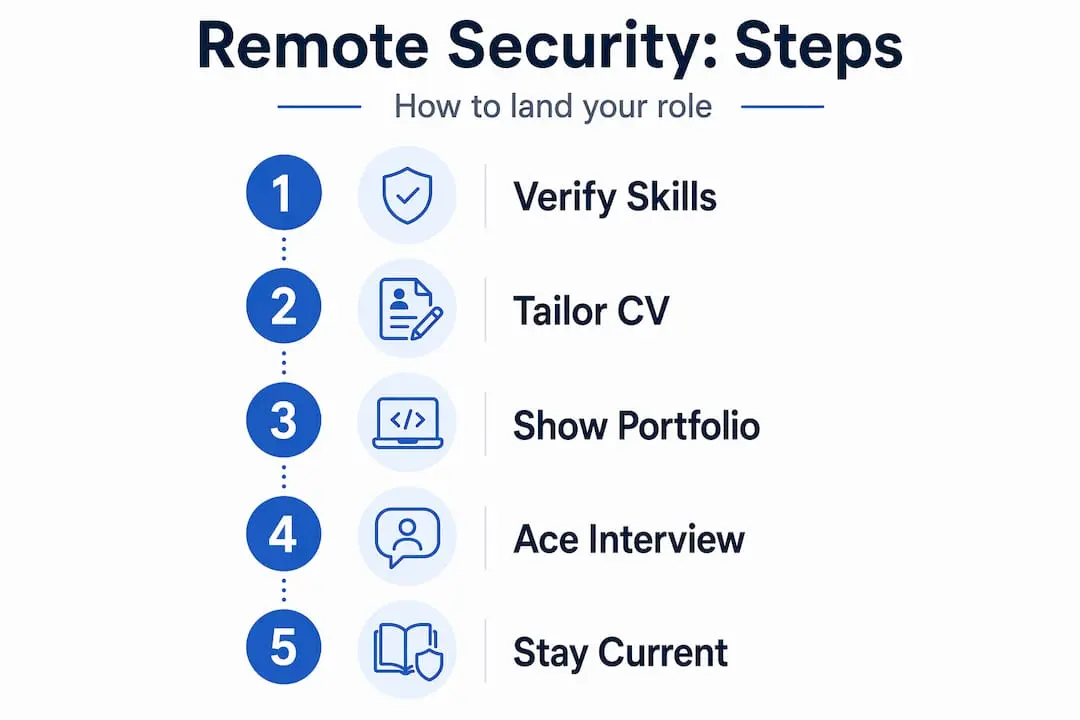
Check country and travel requirements before applying. This is one of the most common time-wasters in remote job searches. A role that appears fully remote may require you to hold specific security clearance, reside in a particular country, or commit to quarterly travel. Verifying this before you apply saves everyone time.
Talk to people inside the organisation. A five-minute LinkedIn conversation with a current employee can tell you more about an organisation’s actual remote culture than any job advert. Ask specifically whether the team communicates asynchronously, how often they expect you onsite, and what the onboarding process looks like for remote hires.
- Keep your certifications current and add AI and cloud security skills to your portfolio progressively
- Set up job alerts on specialist platforms so you see new virtual security job openings before the wider market
- Track your achievements numerically so you can update your CV with fresh evidence regularly
- Practise remote-specific interview formats, including async video assessments and take-home technical challenges
Pro Tip: When you contact current employees for insight, do not ask vague questions like “What is it like to work there?” Instead, ask: “How does the team handle incident response co-ordination when everyone is remote?” That specificity shows you are already thinking like a practitioner.
My take on the realities of remote cyber careers
I have seen a lot of professionals pour energy into applications for roles labelled “remote” only to discover, mid-interview, that they would be expected onsite two days a week or that the entire team is based in a city three hours away. The label is aspirational. The reality is operational. Read every job description as if you are a lawyer reviewing a contract, because the terms matter enormously to your quality of life.
What I have also noticed is that the candidates who thrive in work-from-home cybersecurity roles are not just technically capable. They are disciplined communicators. In a remote SOC or incident response team, the ability to write a clear, concise incident report or escalation summary is worth as much as knowing the syntax for a Splunk query. Technical skills get you hired. Communication keeps you trusted.
The AI question comes up constantly. My view is straightforward: professionals who treat AI tools as a threat to their roles will find that view self-fulfilling. Those who invest time in learning how AI augments detection, triage, and threat intelligence workflows will find themselves in higher demand, at higher rates, in roles that simply did not exist three years ago.
Remote cybersecurity careers are genuinely rewarding when the role fits your working style. Burnout in this field is real, and remote isolation compounds it if you are not proactive about your professional connections and learning. Build both, and you will go far.
— Rob
Find your next remote security role with Securityjobsboard
Whether you are just starting out or looking to move into a senior remote position, having access to the right listings makes a significant difference to how quickly you land something worth doing.

Securityjobsboard is the UK’s dedicated security sector job board, connecting candidates with employers who are actively hiring across the full range of security disciplines. The platform is free to use, mobile-friendly, and lets you set up targeted job alerts so you never miss a relevant opening. If you are based in or open to roles in the region, browsing security jobs in Northern Ireland is a strong starting point for remote-eligible UK opportunities. For the full range of available positions, the Securityjobsboard main portal gives you direct access to current UK security vacancies across every specialism and level.
FAQ
What qualifications do I need for remote cybersecurity jobs?
Entry-level remote roles typically require 1 to 2 years of IT experience, a CompTIA Security+ certification, and a documented hands-on portfolio. Senior roles expect CISSP or GIAC-level certifications alongside measurable evidence of operational impact.
Are remote cybersecurity roles fully remote or hybrid?
Many roles advertised as remote are actually “remote-eligible,” meaning they may require occasional travel to headquarters or client sites, sometimes up to four times per year. Always read the full job description before applying.
What skills are most in demand for remote security analyst roles?
Cloud security (AWS, Azure), SIEM tool proficiency (Splunk, Microsoft Sentinel), incident response, and increasingly AI-augmented analysis skills are at the top of employer wish lists in 2026.
How do I stand out when applying for cybersecurity work from home?
Build a portfolio documenting labs, playbooks, and SIEM configurations that demonstrate you can work independently. Tailor your CV to mirror the exact language and tool names listed in each job description to pass applicant tracking systems.
Does the cybersecurity skill shortage make it easier to get hired remotely?
Yes, in a meaningful way. With 33% of organisations unable to adequately staff their teams, employers are increasingly willing to consider remote candidates who demonstrate the right skills, even without traditional office-based experience.


