What does a security consultant do: a career guide

TL;DR:
- A security consultant advises organizations on improving security by identifying risks and ensuring compliance. They perform assessments, testing, and policy development while maintaining ongoing advisory relationships. Success depends on technical skills, communication, trust, and continuous learning to adapt to evolving threats.
A security consultant is an external expert who advises organisations on improving their security posture by identifying risks, ensuring compliance, and creating strategic plans. The role sits at the intersection of technical analysis and business strategy, making it one of the most varied careers in the security sector. If you are considering this path, understanding what does a security consultant do in practice will help you decide whether it fits your skills and ambitions. Consultants work across common frameworks including NIST CSF, ISO 27001, SOC 2, PCI DSS, HIPAA, and CMMC, applying them across industries from finance to healthcare.
What does a security consultant do day to day?
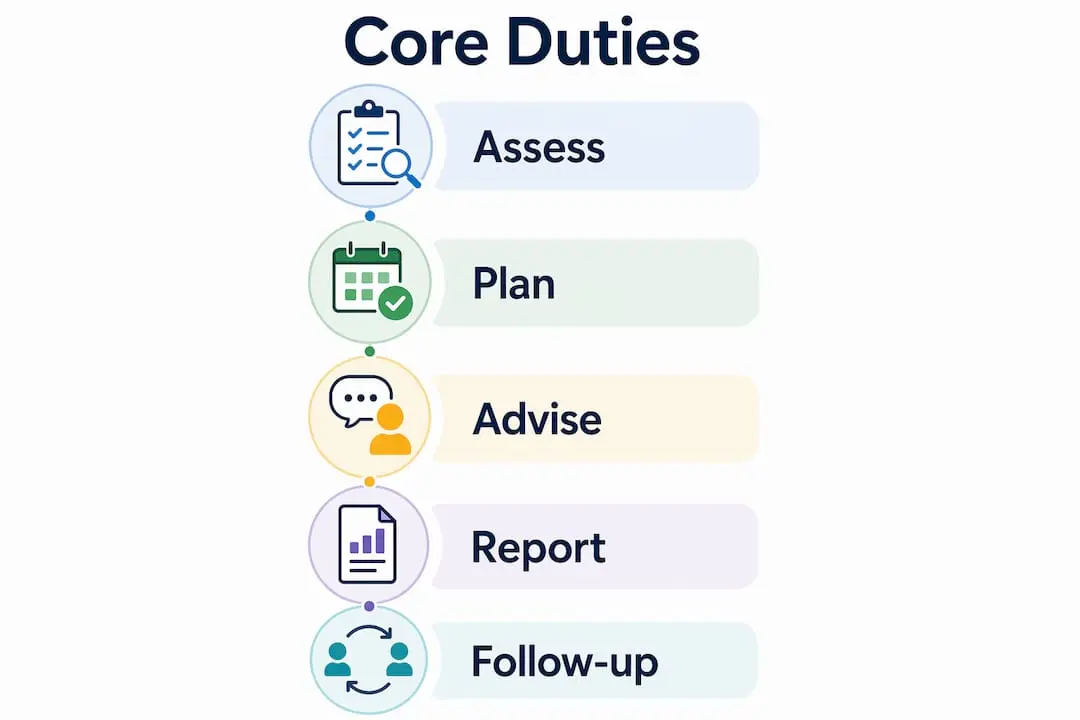
A security consultant assesses an organisation’s vulnerabilities, manages compliance obligations, and builds security roadmaps. The role is advisory by nature. Consultants do not run day-to-day security operations. They plan and prevent rather than enforce or respond operationally. That distinction matters when you are choosing between a consulting career and an in-house security role.

Core duties and responsibilities
The daily work of a security consultant varies significantly depending on the engagement. Some days involve deep technical analysis. Others involve presenting findings to a board of directors. The breadth is what attracts many people to the role.
Typical security consultant duties include:
- Risk assessments and vulnerability identification. Consultants use tools such as Burp Suite, Metasploit, and Nmap to scan infrastructure, applications, and cloud environments for weaknesses.
- Compliance audits. Consultants conduct gap analyses against standards including SOC 2, PCI DSS, and HIPAA, then produce remediation plans for clients.
- Penetration testing and red team exercises. These simulate real attacks to expose weaknesses before malicious actors find them.
- Security policy development. Consultants write and review incident response plans, access control policies, and data handling procedures.
- Cloud security and identity management. As organisations migrate to cloud platforms, consultants review configurations, access controls, and privilege management.
- Ongoing advisory support. Many engagements extend beyond a single report into recurring advisory relationships.
Pro Tip: Keep a personal library of anonymised engagement notes. Patterns across clients reveal systemic industry weaknesses that sharpen your advice and make you a stronger consultant over time.
The ongoing advisory role is often underestimated by those new to the field. Recurring contracts provide more stable income than one-off projects and produce better outcomes for clients who benefit from continuity.
What skills and qualifications does a security consultant need?
The most effective security consultants combine deep technical knowledge with strong communication skills. Neither alone is sufficient. A consultant who cannot explain a critical vulnerability to a non-technical CEO fails the client just as much as one who cannot find the vulnerability in the first place.
Technical skills
- Penetration testing. Proficiency with tools like Metasploit, Burp Suite, and Nmap is standard for technical engagements.
- Risk assessment methodology. Understanding frameworks such as NIST CSF and ISO 27001 allows consultants to structure findings consistently.
- Cloud security knowledge. Familiarity with AWS, Microsoft Azure, and Google Cloud configurations is increasingly expected.
- Compliance expertise. Knowing the requirements of SOC 2, PCI DSS, and HIPAA allows consultants to guide clients through audits efficiently.
- Incident response planning. Consultants must design plans that work under pressure, not just on paper.
Soft skills and professional conduct
Managing multiple clients with different threat models demands rapid context-switching between technical analysis and executive communication. One morning you may be reviewing firewall rules. That afternoon you may be presenting a risk summary to a finance director. Both require full competence.
Documentation is the consultant’s primary product. Translating technical findings into business language for CEOs and boards is what separates good consultants from great ones. Poor reporting limits career longevity regardless of technical skill.
Consultants also need professional diplomacy. They regularly challenge management assumptions about risk posture. Doing so without damaging the client relationship requires tact and credibility built over time.
Certifications that strengthen a consultant’s profile include CISSP (Certified Information Systems Security Professional), CISM (Certified Information Security Manager), and CEH (Certified Ethical Hacker). These are widely recognised by employers and clients across the UK.
Pro Tip: Take a vendor-neutral approach to certifications and tool recommendations. Clients trust consultants who vet multiple vendors rather than those who push a single product or platform.
How do different security consulting engagements compare?
Security consulting services cover a wide spectrum. Understanding the differences helps you decide which type of work suits your skills and career goals.
| Engagement type | Typical tasks | Key deliverable |
|---|---|---|
| Technical assessment | Vulnerability scanning, penetration testing, red team exercises | Technical risk report with remediation priorities |
| Compliance audit | Gap analysis against SOC 2, PCI DSS, or HIPAA | Compliance readiness report and remediation roadmap |
| Strategic advisory | Cloud migration review, security roadmap, CISO support | Executive security strategy document |
| Incident response support | Post-breach investigation, containment planning | Incident report and updated response plan |
| Ongoing advisory partnership | Monthly reviews, policy updates, emerging threat briefings | Retained advisory relationship with regular reporting |
Technical engagements use automated scanning tools alongside manual analysis of infrastructure and cloud configurations. They tend to be shorter and more defined in scope. Compliance-focused work often runs longer because it involves iterative remediation cycles before an audit deadline.
Strategic advisory roles sit closest to the CISO function. Consultants in this space advise on long-term security investment, organisational structure, and risk appetite. These engagements suit consultants with broad experience across multiple sectors.
The key difference between consulting and managed security services is operational involvement. A managed security service provider monitors and responds to threats continuously. A consultant advises on planning and prevention and hands execution back to the client or their operational team. Understanding that boundary is critical when scoping any engagement.
For a deeper look at how these engagements are structured in practice, the security consulting process guide from Securityjobsboard covers current best practices in detail.
What career paths are open to security consultants?
Security consulting offers clear progression routes and genuine specialisation options. The career is not a single track. It branches in several directions depending on your interests and the depth of expertise you build.
Entry-level consultants typically start in junior analyst or associate consultant roles. They support senior consultants on assessments, write sections of reports, and build familiarity with client environments. Within two to four years, most move into independent consultant or senior consultant positions where they lead engagements.
From there, the paths diverge:
- Principal or lead consultant. Senior technical experts who manage complex engagements and mentor junior staff.
- Security architect. Consultants who move into permanent internal roles designing security infrastructure for large organisations.
- CISO (Chief Information Security Officer). A natural destination for consultants with broad strategic experience across multiple sectors.
- Compliance specialist. Consultants who focus exclusively on regulatory frameworks such as GDPR, PCI DSS, or HIPAA, often working with legal and finance teams.
- Cloud security specialist. A growing specialisation as organisations accelerate cloud adoption across the UK and globally.
- Incident response leader. Consultants who focus on breach investigation, forensics, and crisis management.
Implementing solutions rather than simply identifying problems is what separates consultants who build lasting client relationships from those who produce reports that gather dust. Clients remember consultants who helped them fix things, not just those who found them.
Networking within the UK security sector accelerates career growth significantly. Organisations such as the BSIA (British Security Industry Association) provide access to industry events, peer groups, and employer networks. Securityjobsboard is affiliated with the BSIA, which gives candidates on the platform direct visibility with credible employers.
Pro Tip: When choosing a consultancy firm or employer, prioritise those that expose you to multiple sectors and engagement types early in your career. Breadth of experience in the first five years is worth more than depth in a single vertical. You can find practical guidance on choosing the right employer for career development on the Securityjobsboard blog.
Key takeaways
A security consultant’s value lies in combining technical expertise with clear business communication to help organisations identify risks and act on them.
| Point | Details |
|---|---|
| Core role is advisory | Consultants assess, plan, and advise. They do not run day-to-day security operations. |
| Frameworks drive structure | NIST CSF, ISO 27001, SOC 2, and PCI DSS are the standard frameworks consultants apply across engagements. |
| Communication is as critical as technical skill | Translating findings into business language for boards and executives determines long-term career success. |
| Engagement types vary widely | Technical assessments, compliance audits, and strategic advisory roles each require different skills and produce different deliverables. |
| Ongoing relationships build stable careers | Recurring advisory contracts provide better client outcomes and more consistent income than one-off projects. |
What actually makes a security consultant stand out
The consultants I have seen succeed long-term share one quality that no certification teaches: they treat every client as if the problem is genuinely theirs to solve. Not just to document.
Most people entering security consulting underestimate how much of the job is about trust. Clients are inviting you into their most sensitive systems and processes. They need to believe you are objective, that you are not selling them a product, and that your recommendations reflect their situation rather than a template. Vendor objectivity is not a nice-to-have. It is the foundation of every credible consulting relationship.
The technical skills matter enormously. But I have watched technically brilliant consultants lose clients because they could not explain a critical finding without resorting to acronyms. And I have watched consultants with average technical depth build exceptional careers because they were trusted advisors who communicated clearly and followed through.
The other thing worth saying plainly: this career rewards continuous learning. The threat environment shifts constantly. A consultant who stops studying becomes irrelevant within a few years. The best in the field treat education as a permanent part of the job, not something they did before they qualified.
If you are considering this path, read the benefits of security consulting for UK businesses to understand the commercial context you will be working within. Knowing why clients hire consultants makes you a better one.
— Rob
Security consulting roles available now on Securityjobsboard
Securityjobsboard is the UK’s specialist platform for security sector careers, affiliated with the BSIA and trusted by candidates and employers across the country. Whether you are looking for your first consulting role or ready to step into a senior advisory position, the platform connects you directly with employers who are hiring now.

Candidates can create a free profile, upload a CV, and set job alerts tailored to consulting roles. If you are open to opportunities across the UK, security jobs in Northern Ireland are currently listed on the platform, covering a range of experience levels and specialisations. Securityjobsboard makes it straightforward to find roles that match your skills without the noise of a general job board.
FAQ
What does a security consultant do in simple terms?
A security consultant advises organisations on how to protect their systems, data, and processes by identifying vulnerabilities, managing compliance, and building security plans. The role is advisory rather than operational.
What qualifications do you need to become a security consultant?
Certifications such as CISSP, CISM, and CEH are widely recognised by UK employers. A background in IT, networking, or risk management provides a strong foundation alongside these credentials.
How does a security consultant differ from an in-house security analyst?
A security consultant works externally across multiple clients and focuses on assessment, planning, and advice. An in-house analyst manages day-to-day security operations within a single organisation.
What types of companies hire security consultants?
Security consultants work with organisations across finance, healthcare, retail, government, and technology sectors. Any organisation handling sensitive data or facing regulatory requirements is a potential client.
Is security consulting a good long-term career?
Security consulting offers strong long-term prospects. Ongoing advisory relationships provide career stability, and specialisations in cloud security, compliance, and incident response are in growing demand across the UK.


