Security engineer learning path: your 2026 career guide

TL;DR:
- Breaking into cybersecurity can be achieved through multiple structured paths without requiring a degree, emphasizing hands-on practice and certifications. Entry routes such as help desk roles, self-study, or bootcamps lead to foundational skills, with certifications like Security+ and OSCP shaping progression. Practical experience, portfolio building, and understanding specific specializations are crucial for advancing to security engineering roles across diverse domains.
Cybersecurity is one of the most in-demand professions on the planet, yet breaking in feels deceptively unclear. The global deficit of 4.8 million professionals sounds like an open door, but entry-level roles are fiercely competitive and the security engineer learning path looks different depending on who you ask. Degree or bootcamp? Cloud or AppSec? Security+ first or straight to OSCP? This guide cuts through that noise. Whether you are starting from scratch, pivoting from IT support, or a developer looking to specialise, you will find a realistic, structured route forward here.
Table of Contents
- Key takeaways
- What a security engineer actually does
- Choosing your entry route
- Your practical learning roadmap
- Specialisations and where they lead
- Career development beyond the classroom
- My honest take on this career path
- Find your next security engineering role
- FAQ
Key takeaways
| Point | Details |
|---|---|
| No degree required | Certifications, labs, and demonstrable skills often carry more weight than formal qualifications in hiring. |
| Multiple valid entry routes | From IT help desk to self-study stacks, several paths lead to a security engineer role with varying time investments. |
| Certifications follow a clear sequence | Begin with Security+ or Network+, progress to CEH or OSCP, then consider CISSP or CISM at senior level. |
| Hands-on practice matters most | CTF competitions, home labs, and documented projects give employers stronger hiring signals than paper credentials alone. |
| Specialisation shapes your roadmap | Cloud, AppSec, and penetration testing each require distinct skills; choose based on your existing background and interests. |
What a security engineer actually does
Before you commit to a learning path, it helps to understand precisely what the role involves. Security engineers design, build, and maintain systems that protect an organisation’s infrastructure and data. They are not just watching dashboards. They are writing security policies, reviewing code for vulnerabilities, configuring firewalls, running threat models, and responding to incidents when things go wrong.
The foundational knowledge areas are consistent across most employers:
- Networking fundamentals. You need a solid grasp of TCP/IP, DNS, HTTP/S, VPNs, and firewall logic. Without this, security concepts float without context.
- Operating systems. Linux command line proficiency is close to non-negotiable. Windows Active Directory knowledge matters just as much in enterprise environments.
- Scripting and programming. Python and Bash are the workhorses. You do not need to be a software developer, but you must be able to automate tasks, parse logs, and understand code well enough to spot flaws.
- Security frameworks and attack concepts. Familiarity with MITRE ATT&CK and the Cyber Kill Chain helps you think like an attacker, which is exactly how defenders need to think.
Pro Tip: Set up a home lab before you sit a single exam. A free tool like VirtualBox lets you run Linux and Windows virtual machines on your existing hardware. Practising in a controlled environment accelerates learning faster than any textbook.
The 48% of security engineers who hold only an associate degree, and the 46% with a bachelor’s, tells you that academic pedigree is not the gating factor most people assume. Skill demonstration matters far more.
Choosing your entry route
There is no single correct starting point, which is both liberating and confusing. Here is a clear comparison of the main routes available:
| Pathway | Typical duration | Best suited to | Key certifications |
|---|---|---|---|
| IT help desk to security | 12–24 months | Career starters with no tech background | CompTIA A+, Security+ |
| Self-study and cert stack | 6–12 months | Motivated self-learners with some IT knowledge | Security+, CEH, OSCP |
| Cybersecurity bootcamp | 5–9 months | Career changers needing structured fast-tracking | Varies by provider |
| Computer Science degree | 36–48 months | School leavers with time to invest | Degree plus Security+ |
| Internal transfer or security champion | 6–18 months | Existing IT or dev staff within an organisation | Depends on specialisation |
| Cloud security specialisation | 12–24 months | Cloud or DevOps engineers pivoting to security | AWS Security, AZ-500 |
For career changers with five or more years of experience in any IT role, bridge roles offer better returns than going back to education. A system administrator who transitions into a security-focused role gains paid experience while building a credible CV. That combination is far more attractive to hiring managers than a fresh bootcamp certificate with no operational history behind it.
The internal transfer route is equally underrated. Employers trust existing staff with demonstrated security aptitude, particularly when that person has already been raising vulnerabilities, proposing fixes, and building relationships across the business. If you are in a developer, QA, or sysadmin role right now, you are closer to a security engineering position than you think.
Your practical learning roadmap
A structured progression prevents the common mistake of jumping straight to advanced material before the foundations are solid. Here is a realistic sequence for most aspiring security engineers:
-
Months 1 to 3: Build your foundation. Study networking with CompTIA Network+ content, set up a home lab, and begin working through free platforms like TryHackMe. Get comfortable with the Linux terminal daily.
-
Months 3 to 6: Earn your first certification. CompTIA Security+ is the industry-recognised starting point and widely requested in UK job postings. It covers risk management, cryptography, network security, and incident response at a level appropriate for entry-level roles.
-
Months 6 to 12: Develop hands-on depth. Start participating in Capture the Flag competitions on HackTheBox or TryHackMe. Begin documenting your work publicly, either on GitHub or a personal blog. Consider the Certified Ethical Hacker (CEH) if you are leaning towards offensive security, or explore cloud security content if infrastructure is your interest.
-
Months 12 to 18: Specialise and pursue intermediate credentials. The OSCP certification is the gold standard for penetration testers and demands genuine technical skill rather than multiple-choice recall. For AppSec roles, the Burp Suite Certified Practitioner (BSCP) carries significant weight. Cloud engineers should pursue AWS Certified Security Specialty or Microsoft’s AZ-500 at this stage.
-
18 months onwards: Senior-level credentials and leadership. CISSP and CISM are not entry-level certifications. They require years of practical experience to sit and are designed to validate leadership and strategic thinking, not technical skills alone.
Pro Tip: When you complete a CTF challenge or build something in your home lab, write it up. A well-documented write-up on GitHub shows employers your thought process, not just your result. This portfolio evidence often carries more weight than the cert itself.
Hands-on personal lab work and documented projects consistently produce stronger hiring signals than certifications in isolation. Recruiters in the UK security market increasingly request links to portfolios or GitHub profiles at application stage.

You can also explore the cybersecurity certification progression guide on Securityjobsboard to cross-reference which credentials align with specific UK job requirements.
Specialisations and where they lead
Security engineering is not a single path but a cluster of specialties, each with its own technical depth and learning requirements. Understanding the main branches early helps you tailor your study rather than trying to learn everything at once.
Application security (AppSec) suits developers, QA engineers, and testers. The QA-to-security transition is particularly natural because the mindset is already built around finding edge cases and documenting failures. AppSec engineers work with OWASP frameworks, conduct threat modelling, review code, and integrate security testing into development pipelines.
Cloud security engineering is the fastest-growing specialisation. If you have worked with AWS, Azure, or Google Cloud, you already have transferable knowledge. Cloud security paths typically span five levels, from identity and access management through to AI-driven security controls. The cloud security learning path covers Identity, infrastructure, data, application, and AI security in sequence.
Penetration testing carries the most glamour but demands the deepest foundation. Transitioning to offensive security typically requires three to five years of defensive or development experience first. Jumping straight to pentesting without that grounding is a common and costly mistake. Tools like Burp Suite, Metasploit, and Nmap are learnable quickly. Understanding why vulnerabilities exist and how to chain them together takes years.
Here is a summary of specialisation requirements:
| Specialisation | Recommended background | Key tools and frameworks | Primary certifications |
|---|---|---|---|
| Application security | Developer, QA, or SDET | Burp Suite, OWASP, SAST/DAST | BSCP, CEH, OSWE |
| Cloud security | Cloud or DevOps engineer | AWS IAM, Azure Defender, Terraform | AWS Security Specialty, AZ-500 |
| Penetration testing | Defensive security, sysadmin | Metasploit, Nmap, Kali Linux | OSCP, CEH |
| Security operations | IT support, analyst | SIEM platforms, Splunk, EDR tools | CompTIA CySA+, GCIH |
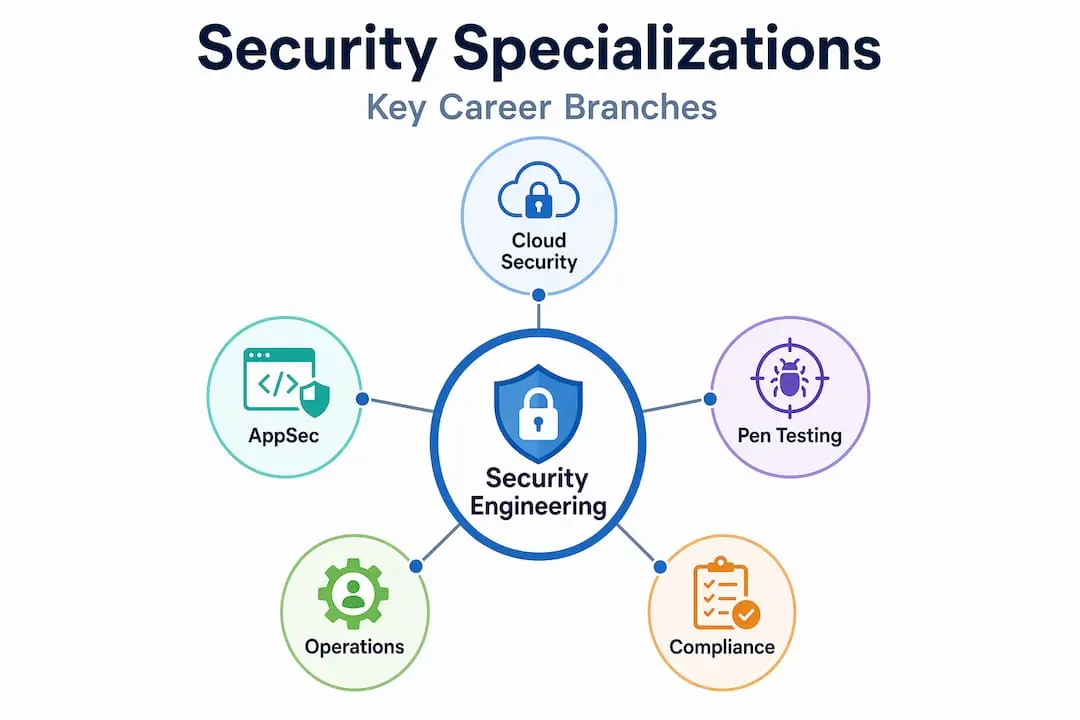
The NICCS framework recognises these as distinct communities within cybersecurity, each with its own vertical and horizontal career mobility. Choosing the right one early saves years of misdirected study.
Career development beyond the classroom
Studying is only part of the picture. How you present your progress and leverage your current position matters enormously.
- Pursue internal opportunities first. If you work in IT, development, or even customer support at a company with a security team, make your interest known. Propose a small security improvement, write it up formally, and present it to your manager. This kind of initiative frequently leads to project involvement or an internal transfer.
- Build in public. Document your home lab builds, your CTF write-ups, and any security tools you create. A GitHub profile with ten meaningful projects tells a recruiter more than a CV with ten bullet points describing responsibilities.
- Treat certifications as milestones, not destinations. A certification opens a conversation. Your ability to discuss the concepts in depth closes it.
- Stay current without burning out. Subscribe to one or two quality threat intelligence feeds, follow relevant UK-focused communities, and review the 7 career paths in security guide periodically to reassess where your skills sit relative to the market.
Pro Tip: When preparing for interviews, practise explaining what you have built in your lab as if you are presenting it to a senior engineer who will interrogate your choices. Employers want to see how you think under scrutiny, not just what tools you have used.
Avoiding common pitfalls also matters. Certification collection without hands-on practice is one of the most frequently cited interview red flags in the UK security hiring market. Recruiters notice when a candidate can recite definitions but cannot explain a scenario from their own experience.
My honest take on this career path
I have spoken with enough security professionals and watched enough hiring patterns to say this clearly: the people who make it into security engineering are almost never the ones who waited until they felt fully ready.
In my experience, the candidates who stand out are the ones who started building something, even if it was imperfect. A messy home lab write-up with genuine insight beats a pristine CV with a stack of certifications and no story behind them. Curiosity consistently matters more than credentials. Employers can teach tools. They cannot teach the instinct to ask “but what if someone tried this instead?”
What I have also learned is that existing skills transfer further than most people give them credit for. A QA engineer already thinks in failure modes. A sysadmin already understands access controls and network topology. The bridge from QA to security is shorter than it looks, and the same applies across most IT disciplines.
Do not wait for perfect readiness. Take the next concrete step this week, whether that is registering on TryHackMe, setting up a virtual machine, or reading about the UK security engineer career path to understand where the market is heading.
— Rob
Find your next security engineering role
Ready to put your learning into practice? Securityjobsboard connects aspiring and experienced security engineers with UK employers actively hiring right now.

Whether you are searching for your first security role, looking to specialise, or ready to move into a senior position, you will find relevant vacancies across the UK on the platform. Explore security jobs in Northern Ireland or browse the full range of UK security careers to see what employers in your region are looking for right now. Securityjobsboard is free for jobseekers, GDPR-compliant, and built specifically for the UK security sector. If you are an employer looking to connect with qualified candidates, visit the employer services page to find out how the platform can support your recruitment.
FAQ
What is the fastest route into security engineering?
Bootcamps combined with CompTIA Security+ typically take five to nine months and represent the fastest structured entry point. Self-study with a focused certification stack can achieve similar results in six to twelve months for motivated learners.
Do I need a degree to become a security engineer?
No. CyberSeek data shows that nearly half of practising security engineers hold only an associate degree, and demonstrated skills through labs and certifications are frequently more valued than academic qualifications during hiring.
Which certification should I get first?
CompTIA Security+ is the standard starting point and is widely recognised by UK employers. Pair it with Network+ content to build the networking knowledge that supports everything else in your security engineer skill development.
How long does it take to become a security engineer?
Timelines vary from six months for career changers with strong IT backgrounds to four years for those starting from scratch via a degree route. Most self-study and certification-focused paths achieve entry-level readiness within twelve to eighteen months.
Can I move into security from a non-IT background?
Yes, though the journey takes longer. Starting with an IT help desk role or a technical support position builds the foundational knowledge hiring managers expect, and bridge roles provide paid experience that accelerates entry into security engineering significantly.


