Right to Work Checks: What Security Staff Need UK

Misunderstanding right to work checks remains a serious issue for many british security professionals starting a new job hunt. Getting these checks wrong can lead to missed opportunities and even legal troubles, as employers face fines of up to £20,000 per illegal worker. Knowing what documents count and how british law applies is the difference between a smooth application process and unnecessary delays. This guide breaks down the facts, tackles common myths, and highlights what you need for safe, successful UK security job applications.
Table of Contents
- Right To Work Check: Core Definition And Myths
- Types Of Right To Work Checks In The UK
- Step-By-Step: How Checks Are Carried Out
- Legal Requirements Under UK Law (2026)
- Risks, Penalties, And Common Errors
- What Security Jobseekers And Employers Must Do
Key Takeaways
| Point | Details |
|---|---|
| Importance of Right to Work Checks | Right to work checks are essential for ensuring legal employment and avoiding severe penalties for non-compliance. |
| Methods of Verification | Employers can choose between manual document checks and online verification systems tailored for non-British applicants. |
| Legal Responsibilities | Employers must conduct thorough checks and maintain records to protect against potential liabilities. |
| Engagement of Jobseekers | Jobseekers should prepare valid documentation and promptly update employers about any changes to their immigration status. |
Right to Work Check: Core Definition and Myths
In the security recruitment landscape, right to work checks are a critical legal requirement for employers. These checks ensure that job applicants are legally permitted to work in the United Kingdom. Verification process involves examining original documents or using an online verification system to confirm an individual’s employment eligibility.
Contrary to popular misconceptions, right to work checks are not designed to discriminate but to maintain legal workforce standards. British and Irish citizens automatically have the right to work, while other individuals must demonstrate their eligibility through specific documentation such as work visas, settled status, or other immigration permissions. Immigration status matters significantly in determining employment authorization.
Security professionals must understand that these checks protect both employers and employees. Employers can face substantial civil penalties for knowingly or unknowingly employing individuals without legal work permissions. The process requires careful document examination, including verifying:
- Passport validity
- Visa type and duration
- Biometric residence permits
- Evidence of immigration status
Quick tip: Always request and verify original documents directly from the candidate, and maintain a systematic record of your right to work checks to demonstrate due diligence.
Types of Right to Work Checks in the UK
Employers in the security sector have access to multiple approaches for conducting right to work checks, each with distinct characteristics and legal requirements. Manual document verification remains a fundamental method where security professionals physically inspect original documentation such as passports, visas, and biometric residence permits to confirm an applicant’s legal working status.
The UK government provides two primary verification pathways. The first involves manual checks where employers directly examine physical documents in the applicant’s presence, meticulously verifying authenticity and validity. The second method utilises digital verification through online share code systems, which offer a more streamlined approach for non-British nationals. Online verification services enable quick confirmation of an individual’s right to work status without extensive paperwork.
Right to work checks can be categorised into two primary document lists that determine verification complexity:
-
List A Documents: Provide unrestricted right to work
- British passports
- Indefinite leave to remain documentation
- Permanent residence cards
-
List B Documents: Indicate time-limited work permissions
- Work visas
- Student visas with work provisions
- Temporary residence permits
Security organisations must carefully select the appropriate verification method based on the candidate’s specific immigration status and documentation.
Pro tip: Maintain a standardised internal checklist for right to work verification to ensure consistent and legally compliant documentation processes across all recruitment activities.
To help understand the main verification options, here’s a summary of right to work check methods in the UK:
| Method | Who It Applies To | Key Advantages | Limitations |
|---|---|---|---|
| Manual document check | All candidates | Immediate confirmation | Requires physical presence |
| Online share code | Non-British nationals | Convenient and efficient | Not available for all statuses |
| Home Office verification | Applicants with complex statuses | Official government approval | May take additional processing time |
Step-by-Step: How Checks Are Carried Out
Conducting a comprehensive right to work check requires meticulous attention to detail and a systematic approach. Document verification process involves multiple critical stages that security professionals must follow precisely to ensure legal compliance and organisational protection.
The standard procedure encompasses three fundamental steps. First, employers must request original documentation directly from the job applicant, which might include passports, biometric residence permits, or immigration status documents. Online verification methods provide an additional digital pathway for confirming work eligibility, particularly useful for non-British candidates.
The comprehensive verification process requires employers to:
-
Request Original Documents
- Passport or national identity card
- Biometric residence permit
- Immigration status documentation
-
Physical Document Inspection
- Check document authenticity
- Verify photograph matches applicant
- Confirm document hasn’t been tampered with
- Validate expiration dates and work permissions
-
Documentation Recording
- Make clear, legible copies
- Record date of initial check
- Retain copies throughout employment
- Schedule follow-up checks for time-limited permissions
Pro tip: Develop a standardised internal checklist with specific validation criteria to ensure consistent and thorough right to work documentation across all recruitment processes.
Legal Requirements Under UK Law (2026)
The legal landscape surrounding right to work checks in the United Kingdom is governed by stringent statutory requirements designed to protect both employers and workers. Immigration employment regulations specifically mandate that organisations must conduct comprehensive verification processes before employing any individual, with potential significant financial and legal consequences for non-compliance.

Under the Immigration, Asylum and Nationality Act 2006, employers bear a critical responsibility to prevent illegal working. The law provides a statutory excuse mechanism that protects organisations from liability, provided they conduct thorough and consistent right to work checks. Legal compliance framework outlines specific obligations that include document verification, non-discriminatory practices, and meticulous record-keeping.
Key legal requirements for employers encompass several crucial elements:
- Mandatory pre-employment document checks
- Non-discriminatory verification processes
- Retaining copies of documents for two years post-employment
- Conducting follow-up checks for time-limited work permissions
Financial penalties for non-compliance can be substantial, including:
- Civil penalties up to £20,000 per illegal worker
- Potential criminal prosecution
- Revocation of business licences
- Reputational damage
Pro tip: Implement a robust internal audit system that regularly reviews right to work documentation to ensure ongoing compliance and minimise potential legal risks.
Risks, Penalties, and Common Errors
Navigating right to work checks requires vigilance and precision, as employers face substantial legal consequences for non-compliance. Employment compliance risks can result in significant financial penalties and potential criminal prosecution, making thorough documentation essential for security sector organisations.
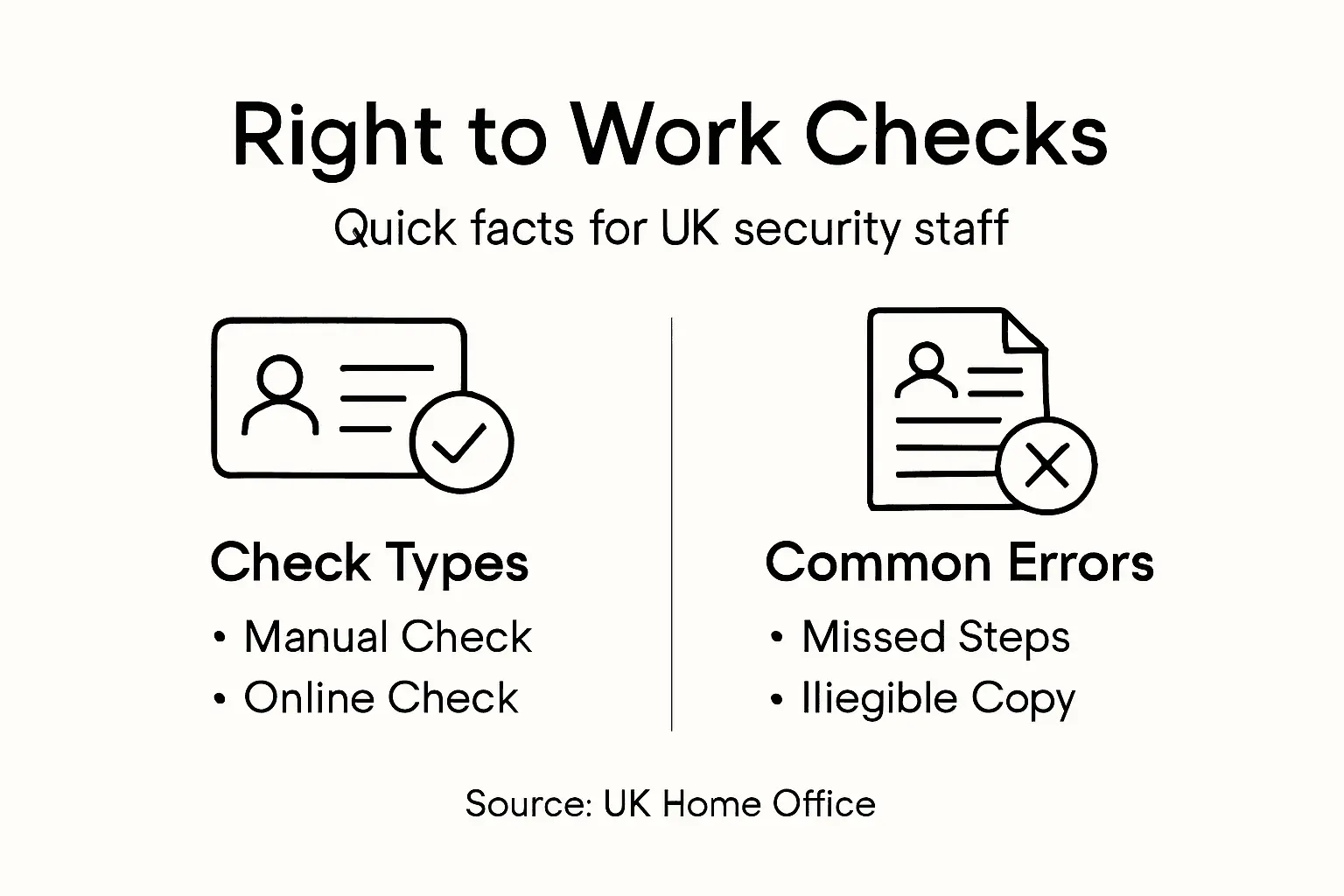
The potential risks extend far beyond simple administrative oversights. Employer verification challenges encompass a wide range of potential errors that can compromise an organisation’s legal standing. Security professionals must be acutely aware of the nuanced requirements to avoid inadvertent legal breaches.
Common errors that can trigger severe penalties include:
- Accepting photocopies instead of original documents
- Failing to verify document authenticity
- Incomplete or inconsistent record-keeping
- Neglecting follow-up checks for time-limited permissions
- Discriminatory verification practices
Potential consequences for improper right to work checks:
- Civil penalties up to £20,000 per illegal worker
- Criminal prosecution
- Potential imprisonment
- Revocation of business licences
- Significant reputational damage
- Permanent ban from employing workers
Pro tip: Develop a comprehensive internal training programme that provides regular updates on right to work check requirements and ensures all recruitment staff understand the critical importance of meticulous documentation.
Below is a comparison of potential risks versus preventative strategies for employers conducting right to work checks:
| Risk Type | Example Scenario | Preventative Strategy |
|---|---|---|
| Record-keeping error | Lost or unclear document copies | Use digital and paper backups |
| Document fraud | False or altered identification | Train staff to spot forgeries |
| Missed follow-up checks | Expired visa overlooked | Set reminders for follow-ups |
| Discriminatory practice | Unequal treatment of applicants | Standardise checklists and steps |
What Security Jobseekers and Employers Must Do
Right to work checks demand active participation and clear responsibilities from both security jobseekers and potential employers. Employment verification processes require careful collaboration to ensure legal compliance and smooth recruitment experiences in the security sector.
Security jobseekers must proactively prepare documentation that comprehensively demonstrates their legal right to work. Compliance preparation strategies involve gathering and maintaining up-to-date original documents such as passports, biometric residence permits, and immigration status evidence. Employers, conversely, bear the critical responsibility of meticulously verifying these documents before finalising any employment arrangements.
Specific obligations for jobseekers include:
- Maintaining current and valid documentation
- Providing original documents for inspection
- Generating online share codes when applicable
- Updating employers about changes in immigration status
- Responding promptly to verification requests
Employer responsibilities encompass:
- Conducting comprehensive right to work checks
- Verifying document authenticity
- Making and retaining clear document copies
- Performing follow-up checks for time-limited permissions
- Maintaining non-discriminatory verification practices
Pro tip: Create a dedicated document portfolio with certified copies and digital backups of all work eligibility documentation to streamline the verification process and demonstrate professional preparedness.
Simplify Right to Work Checks with Expert Security Recruitment Support
Navigating the complexities of right to work checks can be challenging for both security employers and jobseekers. The legal requirements around document verification, non-discriminatory practices, and ongoing compliance often cause delays, confusion, and risking costly penalties. At Security Jobs Board, we understand these challenges and provide a tailored platform designed specifically for the UK security sector. By connecting verified candidates with trusted employers, we help ensure that your recruitment process honours all legal obligations and reduces the burden of compliance.

Start your journey today with Security Jobs Board where candidates can upload valid documentation details confidently and employers can post vetted vacancies that prioritise right to work compliance. Discover how a dedicated security recruitment portal can streamline hiring while protecting your organisation from legal risks. Explore our user-friendly site and take advantage of our expert support to find or fill security roles swiftly and securely.
Frequently Asked Questions
What are right to work checks?
Right to work checks are legal requirements for employers to ensure that job applicants are legally permitted to work. This involves examining original documents or using an online verification system to confirm an individual’s employment eligibility.
What documents are required for a right to work check?
For a right to work check, employers typically require original documentation such as passports, biometric residence permits, work visas, or immigration status evidence to verify an applicant’s legal right to work.
What are the consequences of failing to conduct proper right to work checks?
Failing to conduct proper right to work checks can lead to significant civil penalties of up to £20,000 per illegal worker, potential criminal prosecution, and reputational damage to the organisation.
How can employers ensure compliance with right to work check regulations?
Employers can ensure compliance by conducting thorough pre-employment document checks, maintaining non-discriminatory practices, keeping clear records of checks, and performing follow-up checks for time-limited permissions.
Recommended
- Security Screening: Crucial Checks for UK Security Roles|BM
- Security Checks Explained: Essential Guide for UK Industry|BM
- What Is Security Screening? Complete Overview UK | Brainiac Media
- Why Choose Security Jobs: Complete Guide UK | Brainiac Media
- Preventing Workplace Injuries: Essential Safety Steps – WorkWearComfort


