What physical security analysts do: UK job guide

TL;DR:
- In the UK, security roles include guards, door supervisors, CCTV operators, and managers, focusing on deterrence and incident response. All must hold a valid SIA license, verified before employment, with specific licenses for different duties. Employers prioritize soft skills like composure, communication, and lawful judgment for effective performance.
In this article, “what cyber security analyst do” refers to the physical security roles the UK security industry actually recruits for: security guard, door supervisor, CCTV operator, and security manager. These roles share a common daily purpose — deterring threats, controlling access, monitoring premises, and responding to incidents. Here is what that looks like in practice:
- Foot patrols and perimeter checks
- Access control and visitor management
- CCTV monitoring and alarm response
- Written incident reporting and liaison with emergency services
Three bodies govern these roles in the UK: the Security Industry Authority (SIA), the British Security Industry Association (BSIA), and awarding bodies such as City & Guilds and Highfield.
Table of Contents
- What does a security analyst do day to day?
- Which SIA licence do you need for each role?
- What skills and behaviours do employers actually look for?
- What qualifications and training do you need?
- What does the pay and shift pattern look like?
- How to apply and how to write a job advert
- Interview questions and pre-employment screening
- How do you progress in the UK security industry?
- Key takeaways
- The reality of hiring in physical security
- Securityjobsboard: post a role or find one today
- Useful sources
- FAQ
What does a security analyst do day to day?
The core duties of a security professional vary by role, but the table below maps the most common tasks to each position.
| Role | Primary duties | Real-world example |
|---|---|---|
| Security Guard | Foot patrols, access control, alarm response, incident reporting, visitor sign-in | Retail officer spots organised theft and detains suspect lawfully pending police arrival |
| Door Supervisor | Crowd management, bag searches, entry refusals, physical intervention, venue liaison | Nightclub supervisor manages an intoxicated patron and coordinates with first aiders |
| CCTV Operator | Camera monitoring, recording management, incident escalation, written logs | Operator identifies a suspicious package and alerts police and site management |
| Security Manager | Shift coordination, Assignment Instruction oversight, staff briefings, client reporting | Manager coordinates multi-team incident response during a large public event |
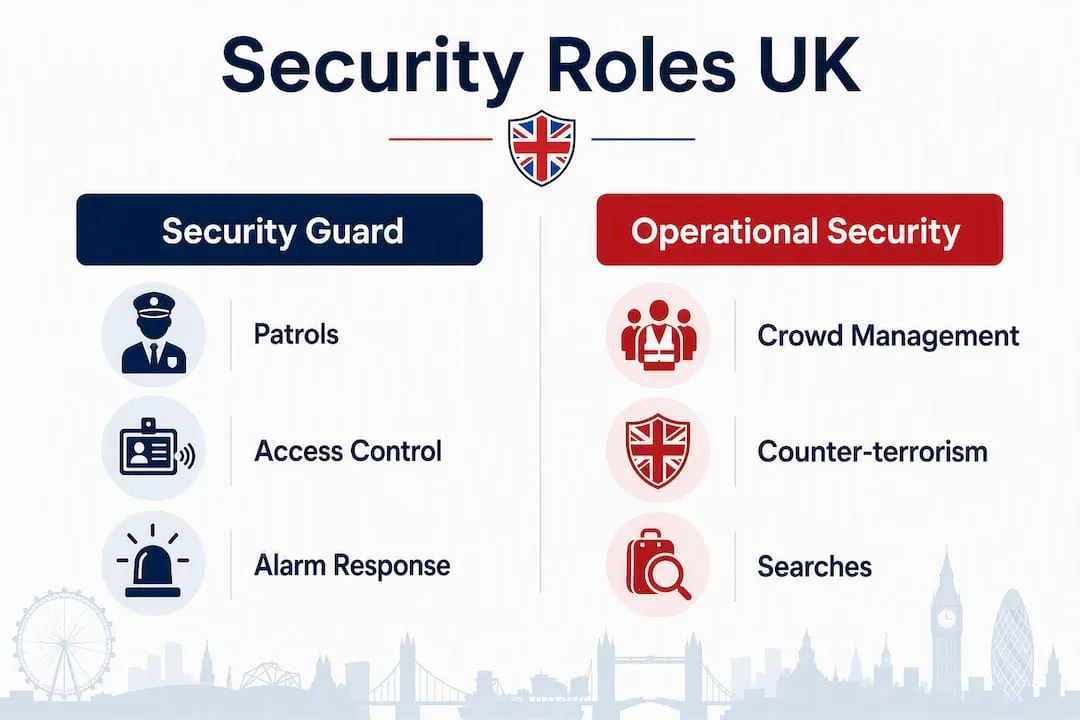
Security officers routinely patrol premises, manage access, operate CCTV, and produce written reports; the site-specific Assignment Instruction (AI) defines the exact duties for each contract. Where duties overlap, the AI is the controlling document, not the generic job description.
Operational security operatives also support counter-terrorism activity through layered searches, scanning, crowd management, and emergency procedures — particularly relevant for transport hubs, stadiums, and government buildings.
Which SIA licence do you need for each role?
All commercial security operatives must hold an SIA licence under the Private Security Industry Act 2001. The licence type determines where and how you can legally work.
- Security Guard licence — permits guarding of non-licensed premises; does not include physical intervention training or work at venues licensed to sell alcohol.
- Door Supervisor licence — a superset of the Security Guard licence; includes physical intervention training and permits work at licensed premises such as pubs, clubs, and event venues.
- CCTV Operator (Public Space Surveillance) licence — required for public-facing CCTV monitoring; not needed for internal-only camera systems.
- Close Protection licence — required for personal protection work; involves specialist training beyond standard guarding.
Typical licence application process:
- Complete SIA-approved training with a recognised provider
- Obtain a Basic Disclosure (DBS) certificate
- Submit the SIA licence application online with proof of training, identity, and right to work
- Allow approximately 6–10 weeks from training completion to licence issue (indicative)
Pro Tip: The Assignment Instruction is the legally controlling site document. Failing to follow it can expose both the contractor and the client to liability and insurance disputes. Always read the AI before your first shift on any new contract.
Understanding why security training is required for UK professionals helps applicants appreciate that licencing is not a formality — it is a legal prerequisite.
What skills and behaviours do employers actually look for?
Composure under pressure, clear communication, and lawful judgement are the behaviours employers value most. Everything else sits beneath those three.
Soft skills: conflict de-escalation, situational awareness, customer service. Security roles combine enforcement with customer service — the officer’s manner affects client reputation as much as incident handling does. An officer who is firm but polite is far more valuable than one who defaults to confrontation.
Hard skills: report writing (accurate, timestamped logs protect clients’ insurance positions), CCTV operation where licenced, first aid, and knowledge of legal boundaries such as citizen’s arrest and appropriate use of force.
Interview red flags for employers to watch:
- Vague or incorrect answers about SIA licence requirements
- Dismissive attitude towards customer service (“I’m there to stop trouble, not chat”)
- Unrealistic expectations about physical intervention (“I’d just remove them”)
- No examples of written incident reports or handover logs
For applicants: prepare two or three concise examples that show composure in a difficult situation, a time you de-escalated conflict, and a report you wrote that led to a positive outcome.
What qualifications and training do you need?
Training routes depend on the licence you are pursuing. All SIA-approved training must be delivered by a provider on the SIA’s approved list — check the SIA website before booking.
- Security Guard training: — typically several days; covers legal powers, patrol techniques, access control, fire safety, and report writing; assessed by City & Guilds or Highfield
Indicative costs range from a few hundred pounds for Security Guard training to over £1,000 for Door Supervisor pathways, depending on the provider and location. Always confirm the provider holds current SIA approval before paying.
CPD refreshers are not formally mandated between licence renewals (every three years), but many employers require updated first aid and conflict management certificates. Explore UK security career pathways for a broader view of how training stacks up over a career.
What does the pay and shift pattern look like?
Pay and hours vary considerably by role, employer, and region. Pay figures are indicative.
Most security roles are covered by direct employment, agency/umbrella arrangements, or zero-hours contracts. Zero-hours workers retain statutory holiday pay and pension entitlement under UK employment law — employers should treat them fairly.
Pro Tip: Before posting a role, check current local rates on the UK security job market to offer competitive pay and attract candidates.
How to apply and how to write a job advert
For applicants: CV checklist
- SIA licence number, type, and expiry date — put this at the top
- Relevant certificates (first aid, conflict management, CCTV award)
- Two or three concise incident examples with outcomes
- Right-to-work status (British citizen, settled status, visa type)
- Two referees, ideally previous security employers
On Securityjobsboard, create a free profile at https://www.securityjobsboard.co.uk, upload your CV, and set a job alert for your preferred role and location. Applications go directly to employers.
For employers: sample job advert template
[Role title] — [Location] Salary/Rate: [£X per hour / £X,000 per annum] Shift pattern: [Days / Nights / Rotating]
We are recruiting a [role title] to join our team at [site/client name]. You will be responsible for [2–3 key duties from the role table above].
Required: Valid SIA [licence type] licence, right to work in the UK, [first aid certificate if applicable].
To apply: Submit your CV and SIA licence details to [contact/platform link].
Post the role directly via https://www.securityjobsboard.co.uk to reach a targeted audience of licenced security professionals. Always state the SIA licence requirement in the advert — it filters out unqualified applicants before they apply.
Interview questions and pre-employment screening
Screening checklist
| Check | Method | Pass threshold |
|---|---|---|
| SIA licence | Verify on SIA licence checker | Valid, correct type, not expired |
| Right to work | Original documents, Home Office online check | Confirmed before offer |
| DBS (where required) | Basic or Enhanced via registered body | Role-dependent; Enhanced for vulnerable-person sites |
| References | Two written references, at least one from security employer | Satisfactory |
| Medical/PPE | Role-specific (lone working, height, PPE requirements) | Site AI specifies |
Structured interview questions:
- “Describe a situation where you had to de-escalate a confrontation. What did you do and what was the outcome?”
- “What would you do if you arrived at an alarm activation and found signs of a confirmed break-in?” (correct answer: external observation, do not enter, wait for police)
- “Walk me through how you would complete an incident report.”
- “What does the Assignment Instruction mean to you, and what would you do if a colleague ignored it?”
For roles involving vulnerable people or high-value assets, make the AI available at interview stage and include any site-specific safeguarding requirements in the offer letter.
How do you progress in the UK security industry?
The typical career ladder runs: security officer → shift supervisor → area manager → client security manager. Specialist paths branch off at each stage.
Explore the career progression workflow for UK security for a structured view of how each step maps to training and experience. Common specialist routes include:
- Alarm response supervisor — often combines Security Guard experience with vehicle-based response skills
Supervisor and management roles generally expect two or more years of operational experience, a clean licence record, and evidence of report-writing and team coordination. Commercial specialisms such as events, retail loss prevention, and construction security each have their own promotional criteria — retail loss prevention, for instance, often values covert surveillance skills and civil recovery knowledge alongside the standard SIA licence.
Key takeaways
Physical security roles in the UK require a valid SIA licence, site-specific Assignment Instruction compliance, and a combination of composure, communication, and lawful judgement to perform effectively.
| Point | Details |
|---|---|
| SIA licence is mandatory | Every commercial security operative must hold the correct SIA licence type before starting work. |
| Assignment Instruction controls the job | The AI overrides generic job descriptions; read it before your first shift on any new contract. |
| CV must lead with licence details | Put your SIA licence number, type, and expiry date at the top of your CV. |
| Pre-employment checks are non-negotiable | Verify SIA licence, right to work, and DBS (where required) before making any offer. |
| Securityjobsboard connects both sides | Post roles or search vacancies at https://www.securityjobsboard.co.uk — free for jobseekers, targeted for employers. |
All pay figures and timelines above are indicative. Confirm current rates and official requirements with the SIA and your employer.
The reality of hiring in physical security
The most common mistake I see in security recruitment is treating the SIA licence check as an afterthought. Employers shortlist on personality, then discover the candidate’s licence has lapsed or is the wrong type for the site. That single oversight can delay a deployment by weeks and leave a client exposed.
My practical advice: verify the SIA licence number on the SIA’s own checker before you pick up the phone to invite anyone to interview. It takes thirty seconds and it tells you everything you need to know about whether the conversation is worth having. The rest of the interview — the de-escalation scenarios, the report-writing examples, the attitude towards customer service — matters enormously, but only once the licence is confirmed.
Securityjobsboard: post a role or find one today
Securityjobsboard is built specifically for the UK physical security sector. Every listing reaches an audience of licenced security professionals — guards, door supervisors, CCTV operators, and managers — rather than a generic job board audience where your advert competes with unrelated roles.

For employers, the platform offers targeted job categories with SIA licence fields built into listings, a searchable CV database, and a GDPR-compliant application flow. For jobseekers, creating a profile and uploading a CV is free, and job alerts mean you hear about relevant roles as soon as they are posted.
Whether you are filling a vacancy or looking for your next shift, visit https://www.securityjobsboard.co.uk — post a job, create a profile, or search current security vacancies in Northern Ireland and across the UK right now.
Useful sources
- Security Industry Authority — SIA licence-linked training specifications (Official) — the authoritative source for what each SIA licence requires.
- National Careers Service — Door Supervisor profile (Official) — duties, entry requirements, and pay guidance for door supervisors.
- National Careers Service — Security Officer profile (Official) — career ladder, qualifications, and salary ranges.
- Skills England — Professional Security Operative occupational map (Official) — knowledge and skills standards for operational security roles.
- British Security Industry Association (BSIA) (Industry) — industry guidance, member standards, and sector news.
- City & Guilds (Industry) — awarding body for SIA-linked security qualifications.
- Securityjobsboard — UK-focused job board for security sector roles, affiliated with the BSIA.
FAQ
Do you need an SIA licence to work as a security guard in the UK?
Yes. All commercial security operatives must hold a valid SIA licence under the Private Security Industry Act 2001 before starting work.
What is the difference between a Door Supervisor and a Security Guard licence?
A Door Supervisor licence includes physical intervention training and permits work at licensed premises; a Security Guard licence covers non-licensed environments only and does not include that training.
How long does it take to get an SIA licence?
From starting training to receiving your licence, allow approximately 6–10 weeks (indicative), including training completion, DBS check, and SIA processing time.
What pre-employment checks must employers run before hiring security staff?
Verify the SIA licence on the SIA checker, confirm right to work, obtain a DBS certificate where the role requires it, and take up at least two references before making an offer.
Where can employers post security jobs and find licenced candidates in the UK?
Securityjobsboard at https://www.securityjobsboard.co.uk is a UK-specific platform with SIA licence fields built into listings and a searchable database of security professionals.


