Skills needed for remote security: your 2026 career guide

TL;DR:
- Remote security professionals need strong competencies in identity management, cloud security, incident response, and effective communication. Building hands-on artefacts, such as detection rules and incident reports, alongside relevant certifications enhances employability in this field. Success requires mastering both technical skills and soft skills like clear communication, self-management, and decision-making under pressure.
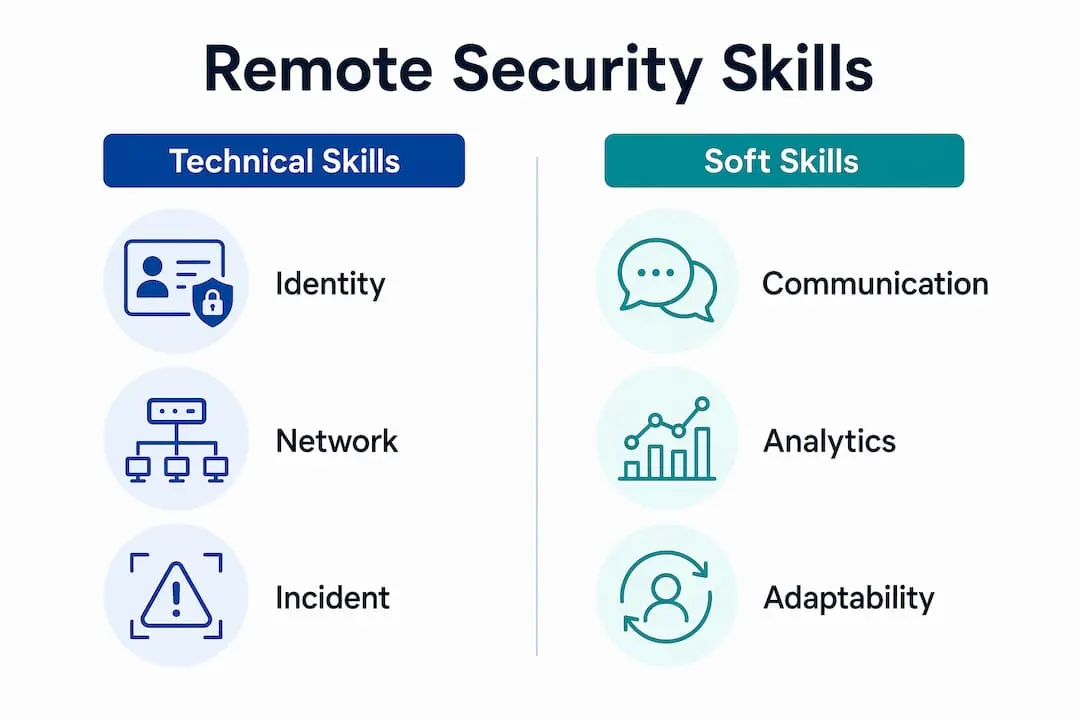
Remote security skills are defined as the combined technical, analytical, and interpersonal competencies required to protect distributed IT environments without physical access to the infrastructure being defended. The skills needed for remote security span identity and access management, cloud security, incident response, and the communication abilities that keep distributed teams coordinated under pressure. Demand for professionals who hold this blend of capabilities is accelerating across the UK, with employers increasingly specifying tools like Microsoft Sentinel, Splunk, and AWS in their job descriptions. If you are preparing for a virtual security role, understanding exactly which competencies matter and how to demonstrate them will determine whether your application stands out.
What technical competencies are vital for remote security professionals?
Identity and access management is the single most critical technical domain for remote security work. Without physical perimeter controls, identity becomes the primary line of defence, and employers expect candidates to understand zero trust architecture, phishing-resistant multi-factor authentication, and device posture verification. Tools like Microsoft Entra ID and Conditional Access policies appear regularly in UK job postings, so familiarity with these is a practical requirement rather than a bonus.
Network security knowledge remains equally important. You need to understand VPN configuration, network segmentation, and intrusion detection systems to prevent lateral movement once a credential is compromised. VPN plus MFA alone is insufficient without session monitoring and segmentation, which means candidates who only understand the basics will struggle to satisfy modern job requirements.
Cloud security is now a baseline expectation across remote cybersecurity requirements. The three major platforms, AWS, Azure, and Google Cloud Platform, each have distinct security models, and hiring managers want to see that you can configure security groups, manage IAM roles, and interpret cloud-native logging. Microsoft’s cloud security credentials and AWS Security Specialty certification are both recognised signals of this capability.
Scripting and automation skills separate productive remote analysts from those who are constantly overwhelmed by alert volume. Key competencies here include:
- Python for building custom detection scripts and automating repetitive triage tasks
- PowerShell for Windows environment management, highlighted in job postings alongside Microsoft Entra ID
- Bash for Linux-based log parsing and scheduled task automation
- API integration for connecting security tools and feeding data into SIEM platforms like Splunk or Microsoft Sentinel
Pro Tip: Set up a free Azure tenant and practise configuring Conditional Access policies and Entra ID roles. This gives you a concrete, demonstrable artefact that directly maps to what employers are asking for in 2026.
How do incident response and threat detection skills support remote security?
Incident response is the operational core of most remote security analyst roles. You need to understand the full lifecycle from initial alert triage through containment, eradication, and post-incident review. Cisco’s SOC training advises building networking fundamentals before advancing to SIEM and incident response tooling, which reflects the layered nature of the skill set employers expect.
SIEM, SOAR, and XDR platforms are the daily working environment for remote security analysts. Proficiency in Microsoft Sentinel, Splunk, or IBM QRadar means more than knowing how to run a query. Employers want candidates who can tune detection rules, build automated response playbooks, and reduce alert fatigue by maintaining low false-positive rates. Detection engineering roles specifically prioritise candidates who can write high-fidelity signatures aligned to the MITRE ATT&CK framework.
Forensics and packet capture skills are valuable even for analysts who are not in dedicated forensics roles. Understanding Wireshark output, interpreting Windows Event Logs, and knowing how to preserve evidence integrity during an investigation all contribute to faster, more accurate incident resolution. These skills also demonstrate depth to hiring managers reviewing your application.
Key incident response competencies to develop and document include:
- Familiarity with SOC playbooks and escalation procedures
- Experience tuning SIEM use cases to reduce noise
- Understanding of MITRE ATT&CK tactics and techniques
- Packet capture analysis using Wireshark or similar tools
- Ability to write clear, structured incident reports for technical and non-technical audiences
Pro Tip: Document every detection rule or playbook you build in a home lab environment. Hiring managers in detection engineering roles respond well to candidates who can show a GitHub repository or portfolio of real artefacts rather than listing tool names on a CV.
Which soft skills enhance effectiveness in remote security roles?
Technical ability gets you to the interview. Soft skills determine whether you get the offer and keep the role. Remote security professionals operate without the informal communication channels that office environments provide, which makes deliberate, structured communication a professional requirement rather than a nice-to-have.

Clear technical writing is one of the most undervalued competencies in this field. Incident report documentation and communication with executives and legal teams are core analyst tasks, yet many candidates cannot produce a concise, well-structured report under time pressure. Practising this skill through home lab exercises and writing up your own investigations will differentiate you from candidates who only list tool proficiencies.
Self-management and discipline are non-negotiable for remote work. Remote security roles involve shift work, independent prioritisation, and escalation decisions made without a manager nearby. Employers assess this through interview questions about how you organise your workday, how you handle competing priorities, and how you decide when to escalate an incident.
The following capabilities round out the soft skill profile employers look for in remote security candidates:
- Analytical thinking. The ability to identify patterns across large volumes of log data and distinguish genuine threats from noise is the core cognitive skill of security analysis.
- Cross-functional collaboration. Remote analysts regularly work with IT operations, legal, HR, and senior leadership. Knowing how to adapt your communication style for each audience is a measurable skill.
- Decision-making under pressure. Cybersecurity incidents do not wait for convenient moments. Practising tabletop exercises and incident simulations builds the composure that remote roles demand.
- Written communication. Producing clear, structured reports and status updates without verbal clarification is harder than it sounds and worth practising deliberately.
- Time management. Remote monitoring roles require consistent output across shifts, and employers want evidence that you can sustain performance without external structure.
What certifications and continuous learning paths strengthen remote security employability?
Certifications serve as a permission to work in many remote security hiring processes. They validate that you have covered a defined body of knowledge, but they carry the most weight when paired with hands-on artefacts that demonstrate applied skill. The following table compares the most relevant certifications for remote security roles in 2026.
| Certification | Best suited for | Key focus area |
|---|---|---|
| CompTIA Security+ | Entry-level analysts | Broad security fundamentals and compliance |
| CompTIA CySA+ | SOC analysts | Threat detection, SIEM, and behavioural analytics |
| CISSP | Senior professionals | Security architecture and governance |
| CEH (Certified Ethical Hacker) | Penetration testers | Offensive techniques and vulnerability assessment |
| GIAC GCIA / GCIH | Incident responders | Intrusion analysis and incident handling |
| Microsoft SC-200 | Azure-focused analysts | Microsoft Sentinel and Defender operations |
Certifications like CompTIA Security+, CISSP, and GIAC are frequently listed as requirements rather than preferences in UK remote security job postings. This means treating them as optional extras will limit your application pool significantly.
Hands-on learning through home labs and capture-the-flag challenges is equally important. Building a home lab and participating in CTF competitions gives you practical experience that complements theoretical certification knowledge. Platforms like TryHackMe and Hack The Box provide structured environments where you can practise the exact skills remote employers test for in technical interviews.
Continuous learning matters because the threat environment shifts faster than any certification syllabus. Subscribing to threat intelligence feeds, following CISA advisories, and engaging with the UK Cyber Security Council’s resources keeps your knowledge current between formal qualifications.
How can job seekers practically prepare and demonstrate remote security skills?
Preparation for remote security roles requires more than studying for certifications. You need to build a visible record of applied skills that maps directly to the language used in job descriptions. The UK remote security job market rewards candidates who can demonstrate specific tool experience and show evidence of independent problem-solving.
Practical steps to build and demonstrate your capabilities:
- Audit your skill gaps against three to five target job descriptions and create a structured learning plan to address each gap within a defined timeframe.
- Build a home lab using free-tier cloud accounts and open-source tools to practise SIEM configuration, log analysis, and incident response workflows.
- Create a portfolio of incident reports, detection rules, and automation scripts that you can share during interviews or link from your CV.
- Tailor every application to the specific tools and frameworks mentioned in the job description. Generic CVs perform poorly against applicant tracking systems used by UK security employers.
- Engage with the security community through LinkedIn groups, local ISACA or (ISC)² chapter events, and virtual conferences to build referral networks that open doors to unadvertised roles.
Your transferable skills from adjacent roles in IT support, networking, or compliance are more relevant than most candidates realise. Frame them explicitly in terms of security outcomes rather than leaving hiring managers to make the connection themselves.
Key takeaways
Succeeding in remote security requires mastering identity and access management, cloud security, incident response tooling, and the communication skills to operate effectively without physical oversight.
| Point | Details |
|---|---|
| Identity is the new perimeter | Zero trust, phishing-resistant MFA, and device posture checks are baseline technical requirements for remote roles. |
| Certifications need artefacts | CompTIA Security+, CISSP, and GIAC credentials carry most weight when paired with a portfolio of hands-on work. |
| Soft skills are assessed formally | Communication, self-management, and decision-making under pressure are evaluated in interviews, not just technical tests. |
| Scripting accelerates your value | Python and PowerShell automation skills directly reduce alert fatigue and are frequently listed in UK job postings. |
| Continuous learning is non-negotiable | Threat environments shift faster than certification syllabuses, so ongoing engagement with threat intelligence is part of the role. |
Why the identity gap is the real challenge in remote security careers
Most candidates preparing for remote security roles focus heavily on certifications and tool lists. That is understandable, but it misses the deeper challenge that experienced practitioners know well. The operational seams between identity, device, and network controls are where most real-world breaches occur, not in the gaps that any single tool was designed to cover.
What I have observed consistently is that candidates who understand this seam problem stand out immediately in technical interviews. They talk about how a compromised credential can move laterally even when VPN and MFA are in place, because session monitoring was not configured to flag anomalous behaviour. They understand that behavioural baselines and anomaly detection are not advanced concepts reserved for senior roles. They are practical skills that any analyst working in a remote SOC should be able to apply.
The other pitfall I see regularly is candidates who treat soft skills as secondary. In a remote role, your written communication is your professional presence. If your incident reports are unclear, your escalations are vague, or your stakeholder updates require follow-up questions, you become a liability rather than an asset. The analysts who progress fastest in remote security careers are the ones who invest as deliberately in their writing and communication as they do in their technical tooling.
My honest advice: build the technical foundation, earn the certifications, but spend equal time practising how you explain what you find. That combination is rare, and employers notice it immediately.
— Rob
Find your next remote security role with Securityjobsboard

Securityjobsboard connects UK security professionals with employers who are actively hiring for remote and hybrid roles. Whether you are targeting a SOC analyst position, a detection engineering role, or a cloud security specialist vacancy, the platform lists opportunities across the UK including dedicated security jobs in Northern Ireland. You can create a free profile, upload your CV, and set targeted job alerts so that relevant vacancies reach you directly. Securityjobsboard is affiliated with the BSIA, which means the employers listing roles are credible, vetted organisations looking for serious candidates. Start your search today at Securityjobsboard and put the skills you have built to work in a role that matches your career goals.
FAQ
What are the core skills needed for remote security roles?
The core skills needed for remote security include identity and access management, cloud security, SIEM and SOAR platform proficiency, scripting in Python or PowerShell, and strong written communication. Employers also assess self-management and analytical thinking as formal competencies during the hiring process.
Which certifications are most valued for remote cybersecurity roles?
CompTIA Security+, CompTIA CySA+, CISSP, CEH, and GIAC certifications such as GCIA and GCIH are the most frequently requested in UK remote security job postings. Microsoft’s SC-200 is increasingly listed for roles involving Azure and Microsoft Sentinel.
How do I demonstrate remote security skills without prior job experience?
Build a home lab, practise on platforms like TryHackMe or Hack The Box, and document your work in a portfolio of incident reports, detection rules, and automation scripts. Hands-on artefacts paired with certifications are more persuasive to hiring managers than qualifications alone.
Why is identity and access management so important for remote security?
Identity is the primary control boundary in remote environments where there is no physical perimeter. Phishing-resistant MFA, zero trust architecture, and continuous session monitoring are required to prevent lateral movement after a credential is compromised.
How important are soft skills for remote security analyst roles?
Soft skills are formally assessed in remote security hiring, not treated as secondary. Clear technical writing, self-discipline for shift-based remote work, and decision-making under pressure are evaluated through structured interview questions and practical exercises.


