Navigate UK remote security job trends for career success

TL;DR:
- Only about 6.5% of UK cyber security jobs are fully remote, with most roles requiring some on-site presence.
- Remote availability fluctuates yearly and is driven by economic conditions, organizational culture, and incident activity.
- To succeed, candidates should tailor applications, demonstrate operational skills, and understand the distinctions between flexible, hybrid, and fully remote roles.
Only around 26% of UK cyber security jobs are advertised as remote or UK-wide, which means the fully flexible, work-from-anywhere career many professionals imagine is far less common than job boards might suggest. If you have been applying exclusively for remote roles and wondering why the shortlists are thin, the data tells a clear story. This article unpacks what the UK security and cyber job market actually looks like in 2026, how remote availability shapes your pay and progression, what is driving employer behaviour, and what practical steps will genuinely improve your chances of landing the hybrid or remote role you are after.
Table of Contents
- Setting the scene: The UK remote security job landscape
- How remote security job trends influence pay and career progression
- Beyond the numbers: What’s driving employer demand for remote security talent?
- Smart strategies for jobseekers: Navigating remote and hybrid security roles
- The uncomfortable truth about remote security jobs in 2026
- Find your next remote or hybrid security role
- Frequently asked questions
Key Takeaways
| Point | Details |
|---|---|
| Remote job growth is cyclical | The share of remote and hybrid security postings in the UK rises and falls each year, so you should check new benchmarks regularly. |
| Hybrid roles outnumber fully remote | Most UK security positions with flexibility are hybrid or require some on-site work, rather than being fully remote. |
| Benchmark pay expectations wisely | Compare multiple sources for remote salaries as pay bands, medians, and London premiums can change quickly. |
| Skills trump location | UK employers prioritise operational skills and evidence of incident response readiness above simple location flexibility. |
Setting the scene: The UK remote security job landscape
To understand the current reality, let us look at what the numbers around remote security jobs in the UK actually reveal.
The first thing to acknowledge is that “remote” covers a spectrum. In the UK security sector, you will encounter three distinct categories on job boards: fully remote (meaning the role can be performed entirely off-site), flexible (meaning some degree of location choice is offered, often without strict on-site requirements), and hybrid (meaning a blended arrangement with regular on-site days). These distinctions matter enormously when you are planning your search.
According to current market analysis, 31.2% of UK cyber roles are either remote at 6.5% or flexible at 24.7%, with the significant majority of roles still requiring on-site presence. That statistic deserves a moment’s reflection. Fewer than one in fifteen advertised cyber and security positions are genuinely fully remote. The rest expect you to show up, either permanently or on a regular rota.
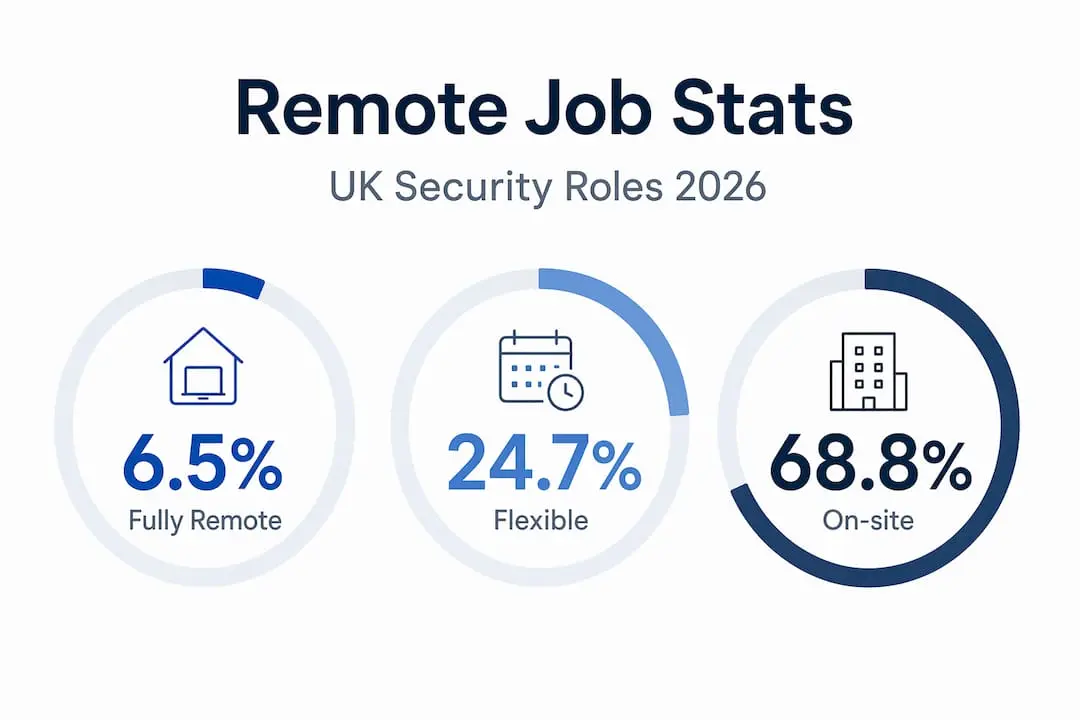
| Work arrangement | Estimated share of UK cyber security jobs |
|---|---|
| Fully remote | 6.5% |
| Flexible/hybrid | 24.7% |
| On-site (in-person) | ~68.8% |
Remote posting shares have also fluctuated historically, moving from 13% in 2020, up to a peak of 28% in 2022, dropping to 22% in 2023, and recovering to approximately 26% in the most recent reporting period. That trajectory is not a steady upward climb. It is volatile, shaped by economic conditions, employer confidence, and the operational demands of specific security functions.
For UK security professionals tracking UK security job trends, this pattern reveals something important: remote availability is linked to broader labour market cycles, not a permanent structural shift. Organisations that rushed to advertise remote roles during 2021 and 2022 have since pulled some of those listings back, particularly for roles involving physical security, access control, and incident co-ordination.
Understanding the difference between remote, flexible, and hybrid is not just semantics. A “flexible” role might require two or three days per week on-site at a central London security operations centre. A “hybrid” role in the North West might mean attending a client site fortnightly. Neither is the same as a fully remote position where geography is genuinely irrelevant. For a realistic assessment of the security industry job outlook, treating all three categories as interchangeable will distort your expectations from the outset.
Key points to carry forward from this section:
- Fully remote roles account for roughly 6.5% of the cyber security job market
- Flexible and hybrid combined bring the figure to just under a third
- Remote share peaked in 2022 and has not consistently recovered
- Most roles in physical security, guarding, and operational functions remain on-site by necessity
How remote security job trends influence pay and career progression
With a clear view of job type availability, the next question is how this translates to earning potential and promotion prospects.
Pay benchmarking in this sector is often done poorly. Security professionals either rely on informal conversations with peers or use salary surveys that aggregate all sectors together. Neither approach gives you the precision you need. For remote and hybrid cyber roles specifically, the numbers are more nuanced than a headline figure suggests.
Current data from the IT jobs market shows that for permanent remote or hybrid cyber security positions, the median salary sits at £63,076, with three-quarters of professionals earning up to £88,750. Contract roles show even wider variation, with day rates influenced heavily by clearance level, specialism, and proximity to government or financial services clients.

| Role type | Median salary | 75th percentile |
|---|---|---|
| Permanent remote/hybrid cyber | £63,076 | £88,750 |
| Contract cyber (daily rate) | Varies significantly | Clearance-dependent |
| Junior cyber analyst (remote eligible) | £35,000 to £45,000 | £52,000 |
| Senior SOC analyst (hybrid) | £58,000 to £72,000 | £85,000+ |
The London premium remains real but has narrowed. Remote security salaries in London now carry roughly an £11,000 premium over the UK average for comparable roles, down from a wider gap in previous years. This narrowing reflects both regional market maturation and employer willingness to hire talent outside the capital when the role genuinely supports remote delivery.
Seniority is the single strongest predictor of remote eligibility. Junior and entry-level roles in security almost always require on-site presence, particularly in the first six to twelve months. Employers cite onboarding, culture building, and access to mentorship as reasons. By contrast, senior analysts, threat intelligence leads, cloud security architects, and security consultants are far more likely to negotiate hybrid or remote terms from the outset.
Pro Tip: Before applying for a role, research the seniority band carefully. If you are at a junior or mid-level, targeting “flexible” roles rather than “fully remote” dramatically expands your viable pool whilst still offering meaningful location flexibility. Use the insights in our guide to remote security jobs to calibrate your expectations for your specific level and specialism.
Career progression in remote roles also warrants attention. Professionals working fully remotely report that visibility to senior leadership can be harder to maintain, particularly in organisations where culture still rewards physical presence. This is not a reason to avoid remote roles, but it is a reason to be deliberate about your communication, output documentation, and relationship-building even when working from home.
Beyond the numbers: What’s driving employer demand for remote security talent?
Of course, job search trends do not exist in a vacuum. They reflect what employers need and what is happening in the real world of cyber security incidents.
Breach activity is running high. In the most recent reporting cycle, 43% of businesses and 28% of charities experienced cyber security breaches or attacks in the preceding twelve months. That level of incident activity is creating urgent, sustained demand for skilled security professionals, and urgency often accelerates flexibility in hiring terms.
When organisations need to fill a senior incident response or threat detection role quickly, they are more willing to negotiate hybrid or remote terms to access a wider talent pool. Location becomes a secondary concern when the alternative is leaving a critical function understaffed. This is why attracting top security talent has become a strategic priority for UK employers in both the private and public sectors.
Retention is an equally pressing issue. Just 34% of cyber security professionals plan to remain with their current employer, which represents a significant flight risk for security teams. Flexible and hybrid working models are widely cited as a tool for improving retention, though they are not a silver bullet. Pay, career development, and team culture remain the primary drivers of whether talent stays or leaves.
Key reasons employers are hiring remote and hybrid security staff:
- Acute skills shortages mean geography can no longer limit candidate pools
- High breach frequency creates immediate demand for detection and response capability
- Retention pressures push employers to offer flexibility as a differentiator
- Cloud-native security architectures are genuinely location-agnostic, removing the traditional reason for on-site presence
- Cost efficiency in some regions makes remote hiring from lower cost-of-living areas attractive to employers
“Operational agility is the real driver. Employers are not offering remote work as a perk — they are doing it because the talent is not always where the office is, and the threat landscape does not wait for commutes.”
That said, certain functions will always lean heavily on-site. Physical security management, CCTV operations, access control, and roles tied to government or defence environments with specific classification requirements are not moving to fully remote models in any meaningful way. Understanding which function you are in shapes which flexibility is realistic for your career.
Smart strategies for jobseekers: Navigating remote and hybrid security roles
So if employer behaviour is complex and definitions shift, what can you do as a jobseeker to boost your odds?
The first and most important step is to stop treating “remote” as a single search term. As the market data confirms, role definitions vary significantly between employers and even between job boards. Searching only for “remote” will miss the substantial pool of flexible and hybrid opportunities that may suit your lifestyle just as well and carry better pay or progression prospects.
Tailor every application to the specific arrangement advertised. If a role is labelled hybrid, explicitly reference your ability to work within that model. Mention your home office setup, your experience with remote collaboration tools such as Microsoft Teams or Slack, and any prior success delivering security outcomes in a distributed team environment. Employers want to know that remote working will not reduce your effectiveness.
Practical steps to strengthen your position:
- Evidence your home-office readiness by describing your workspace, internet reliability, and secure remote access practices in your covering letter
- Highlight incident response and detection skills specifically, as these are the functions most associated with remote-eligible roles
- Search using “hybrid”, “flexible”, and “remote” as separate terms to avoid missing large parts of the advertised market
- Benchmark your salary expectations using up-to-date sources such as the authoritative GOV.UK surveys rather than forums or aggregator sites with stale data
- Avoid over-specifying location restrictions in your profile — many platforms allow you to indicate willingness to travel occasionally even if your base is remote
Pro Tip: Use a structured approach when reviewing your applications. For each role, identify whether it is fully remote, hybrid, or flexible, and then adjust your personal statement to reflect the specific arrangement. A generic application that does not acknowledge the working model signals to hiring managers that you have not read the advert carefully.
Following our remote hiring step by step guide will walk you through the process from profile setup to offer negotiation, with specific guidance for the UK security context. If you are also considering longer-term career development, mapping out your trajectory through our resource on UK cyber security career pathways will show you which specialisms are most likely to unlock remote or hybrid flexibility at senior levels.
The uncomfortable truth about remote security jobs in 2026
Stepping back, let us be direct about why “remote” is not as straightforward as it seems for security professionals in 2026.
The popular narrative is that remote work is an ever-expanding option that savvy professionals can simply claim if they position themselves correctly. The data does not support this. The share of remote and hybrid postings fluctuates year on year and is shaped by economic cycles, security incident trends, and organisational culture shifts that have nothing to do with individual candidate quality. The drop from 28% in 2022 to 22% in 2023 happened not because candidates became less qualified but because employer priorities shifted.
What this means in practice is that building your career around a single working arrangement is strategically fragile. If the remote share drops again, you want skills that are valuable enough to give you leverage in negotiations, not a job search strategy built entirely on filtering for one tick box.
The roles that consistently attract hybrid and remote eligibility are those where the employer trusts the professional to operate independently under pressure. Detection engineering, cloud security architecture, threat intelligence analysis, and security operations are the functions where “defensibility at distance” is a real and demonstrable skill set. If you can show evidence of running incident response remotely, managing SIEM tooling from a home environment, or contributing to red team exercises in a distributed setup, you become categorically more attractive to employers who are weighing up remote arrangements.
Our perspective, informed by working closely with UK security employers, is that the professionals who secure the best hybrid and remote arrangements are not those who ask for flexibility first. They are the ones who demonstrate such clear operational capability that flexibility becomes the employer’s way of keeping them. Focusing your development on effective security talent strategies and understanding what employers genuinely value is a more reliable route to the working arrangement you want than chasing the label alone.
Find your next remote or hybrid security role
If you are ready to put these strategies into action, here is how to start moving your career forward.
The Security Jobs Board is the UK’s specialist platform for security industry roles, and it is built specifically for professionals like you who need accurate, up-to-date listings rather than generic job aggregators. Whether you are searching for a fully remote cyber security analyst position, a hybrid SOC role in the Midlands, or a flexible contract in the South East, the filtering tools let you search by arrangement, location, and specialism in one place.

Create your free profile, upload your CV, and set up job alerts so you never miss a relevant opening. If you are based outside the major cities, check out Northern Ireland security jobs as a starting point for regional opportunities that often carry more flexible terms than London-centric roles. Employers on the platform are actively hiring, and your application could move quickly when your profile is complete and searchable.
Frequently asked questions
What percentage of UK security jobs are truly fully remote in 2026?
Around 6.5% of cyber security jobs are advertised as fully remote, with a further 24.7% listed as flexible or hybrid, meaning the majority of roles still require some on-site presence.
Are remote cyber security salaries lower than London or on-site roles?
Remote roles are genuinely competitive, though the London salary premium for security roles has narrowed to approximately £11,000 above the UK average rather than the wider gap seen in earlier years.
Do remote job opportunities increase every year?
No. The share of remote and hybrid postings fluctuates year on year, moving from 13% in 2020 to a peak of 28% in 2022 before dropping and partially recovering, which makes ongoing market monitoring essential.
What skills make candidates most attractive for remote or hybrid security jobs?
Skills in incident response, detection engineering, and home-office operational readiness are highly valued, as employers prioritise candidates who can deliver security outcomes independently without requiring constant on-site supervision.


