Security shift work tips to beat fatigue and stay sharp
TL;DR:
- Working night shifts in security requires sustained vigilance, quick decision-making, and physical readiness amidst fatigue.
- Effective shift patterns, strategic breaks, and optimized environments are essential for maintaining alertness and reducing risks.
Working nights in security isn’t just about staying awake. It demands sustained vigilance, sharp decision-making, and physical readiness during the hours when your body is actively fighting against you. Night shifts increase accident and injury incidence, with risks climbing sharply after successive shifts, long hours, or inadequate breaks. Standard advice to “get more sleep” barely scratches the surface for security professionals managing irregular rotas, lone working, and high-stakes environments. This article cuts through the generic guidance and delivers practical, evidence-based strategies tailored specifically for UK security workers who need to perform when it matters most.
Table of Contents
- Understanding security shift fatigue and its risks
- Optimal shift patterns and scheduling for security professionals
- Smart rest and break practices: staying sharp on night duty
- Maximising your work environment for alertness
- What most advice on security shift work misses
- Advance your security career with the right support
- Frequently asked questions
Key Takeaways
| Point | Details |
|---|---|
| Limit consecutive nights | Work no more than three to five night shifts in a row to reduce risk and boost performance. |
| Prioritise breaks and naps | Short, regular breaks and strategic napping can significantly improve alertness and safety. |
| Enhance your workspace | Adjust lighting and provide healthy snacks to stay awake and focused during all-night duty. |
| Embrace forward rotation | Switching shifts from mornings to nights is less exhausting than the reverse, supporting better circadian health. |
Understanding security shift fatigue and its risks
Fatigue in night security isn’t simply tiredness. It’s a physiological state that impairs judgement, slows reaction times, and creates dangerous gaps in concentration. For security professionals, those gaps can mean missed threats, failed responses, or serious accidents.
“Night workers experience lighter, shorter day sleep due to noise and light, leading to sleep debt and fatigue that compounds over time.”
The problem runs deeper than one bad night’s sleep. Cumulative sleep debt builds quietly over weeks, and many security workers don’t recognise how impaired they’ve become until an incident forces the issue. Microsleeps, those brief involuntary lapses lasting just a few seconds, are particularly dangerous during patrol or monitoring duties. You might not even notice them happening.
Common signs of fatigue that security staff should recognise in themselves and their colleagues include:
- Difficulty concentrating on CCTV feeds or access logs for more than a few minutes
- Slower verbal responses during radio check-ins
- Increased irritability or poor decision-making under pressure
- Yawning repeatedly, heavy eyelids, or blurred vision during the 2am to 5am window
- Making small errors on written logs or access records
The UK’s Health and Safety Executive takes a firm position on this. Employers must manage fatigue as a genuine workplace hazard, which means conducting risk assessments, creating policies that limit excessive overtime and informal shift-swapping, and actively monitoring working hours. For security managers, understanding employment law compliance around working time regulations is not optional. It’s a legal duty. And for individual security officers, knowing your rights around rest periods is equally important. Fatigue management also plays a direct role in retaining security staff, since exhausted workers leave roles far more quickly than those who feel supported.
Optimal shift patterns and scheduling for security professionals
Getting the shift structure right is the single most powerful lever for reducing fatigue. No amount of coffee or cold water can compensate for a fundamentally broken rota.
Research is clear on the key principles. Design shifts to limit consecutive nights, prefer forward rotation, ensure at least 11 hours of rest between shifts, and cap consecutive night shifts at three to five maximum. The 11-hour minimum isn’t just good practice. It’s the legal baseline under the Working Time Regulations 1998, and it exists for good reason.
Forward rotation means moving from morning shifts to afternoon shifts to night shifts, rather than backwards. This aligns more naturally with the body’s circadian rhythm, which generally finds it easier to stay up later than to sleep earlier. Backward rotation, jumping from nights straight to early mornings, is significantly harder on the body and should be avoided wherever possible.
Here’s a practical comparison of common shift types and their impact on fatigue and performance:
| Shift type | Fatigue risk | Productivity impact | Notes |
|---|---|---|---|
| Fixed nights (permanent) | High long-term | Moderate short-term | Body adjusts, but health suffers over years |
| Forward-rotating shifts | Moderate | Higher than backward rotation | Best balance for most workers |
| Backward-rotating shifts | Very high | Low | Hardest on circadian rhythm |
| Split shifts | High | Variable | Poor rest quality between splits |
| Extended shifts (12hr+) | Very high | Drops sharply after hour 8 | Increase error rates significantly |
Interestingly, consistent night shifts during the natural sleep window between midnight and 3am reduce productivity by 5.5%, while consistent daytime shifts boost it by 9%. This tells us that even when night work is unavoidable, consistency matters enormously. Irregular or unpredictable rotas are far more damaging than a stable night pattern.
For security managers thinking about shift scheduling impact on their teams, here’s a practical approach to implementing better patterns:
- Audit your current rota for consecutive night shifts exceeding three days and flag these immediately.
- Introduce a minimum 48-hour recovery period after a block of four or more consecutive nights.
- Switch to forward-rotating patterns where operationally feasible, trialling them over a 12-week period.
- Track near-miss incidents and fatigue-related complaints before and after changes.
- Involve your team in the process. Officers who understand why the rota is structured as it is are far more likely to support it.
Pro Tip: Run a simple incident log alongside any rota change. Even informal notes on near-misses, response delays, or concentration lapses will give you real data to justify further improvements to management. Training for security shifts should also cover fatigue awareness, so officers recognise the signs in themselves before performance deteriorates.
Smart rest and break practices: staying sharp on night duty
Even the best rota can’t eliminate fatigue entirely. What happens during your shift, specifically how you manage breaks and nutrition, determines whether you finish your shift sharp or struggling.
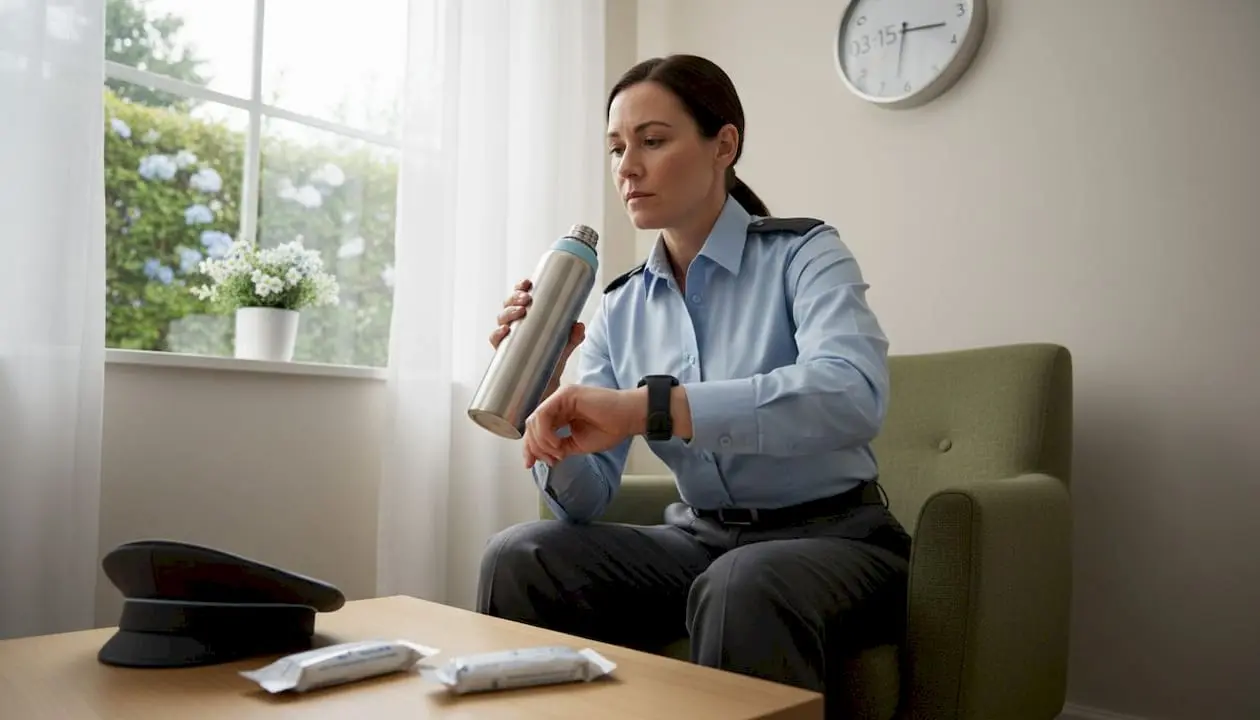
The research on power napping is compelling and underused in UK security. Power naps optimal at under 20 minutes or a full 90-minute sleep cycle are most effective. The reason is sleep architecture. If you wake during deep sleep (which typically kicks in after 20 to 25 minutes), you’ll feel groggy and disoriented, a state called sleep inertia. A short nap keeps you in lighter sleep stages, from which waking is easy and refreshing. If time allows a longer rest, completing a full 90-minute cycle lets you wake naturally at the end of a cycle, feeling restored rather than foggy.
For managing tired watchmen and drowsy security during shifts, the following break practices make a measurable difference:
- Take a 10 to 15-minute break every 90 minutes during low-activity periods rather than waiting for a single long break
- Use the circadian dip window (2am to 5am) for your most structured rest period if operationally possible
- Combine caffeine with a protein-based snack during this window. Caffeine takes 20 to 30 minutes to take effect, so consuming it just before a short nap and waking to its peak effect is a well-documented technique
- Avoid high-sugar snacks during the dip. They cause a brief spike followed by a sharper energy crash
- Drink water consistently. Dehydration accelerates fatigue and is easily overlooked during cold nights
The environment of your break area matters too. A warm, dimly lit room with a comfortable chair will send you into deep sleep faster than intended. Well-lit, ventilated break areas with cooler temperatures actively support alertness recovery. This is particularly important for lone worker safety, where there’s no colleague to prompt you back to alertness.
Pro Tip: Use a discreet wearable alarm or a simple alertness app set to vibrate at regular intervals during quieter periods. This acts as a gentle reset for your attention without disturbing colleagues or alerting the public. Several apps designed for shift workers can also track your alertness patterns over time.
Understanding your night work legal breaks entitlement is also worth knowing. Night workers are entitled to a free health assessment, and breaks must be structured in line with Working Time Regulations. If you’re hiring for night security roles, making break entitlements clear from the outset sets a positive tone for fatigue management from day one.
Maximising your work environment for alertness
Your physical environment during a night shift either works for you or against you. Most sites are designed for daytime use, which means the default setup actively undermines night worker alertness. A few targeted adjustments can make a significant difference.
The circadian dip between 2am and 5am heightens micro-sleep risk in security workers. Counter this with lighting, caffeine and protein combinations, and structured breaks. Lighting is particularly powerful. Cool-toned, bright lighting (in the 5000 to 6500 Kelvin range) suppresses melatonin production and signals wakefulness to the brain. Warm, amber-toned lighting does the opposite, which is fine for a designated rest area but counterproductive at a monitoring station.
Here’s a practical comparison of common environmental factors and their fatigue-fighting effectiveness:
| Environmental factor | Fatigue impact | Recommended adjustment |
|---|---|---|
| Warm, dim lighting | Increases drowsiness significantly | Switch to cool-toned LED lighting at workstations |
| Poor ventilation | Raises CO2, causes lethargy | Open windows or use fans to circulate air |
| Background silence | Can trigger microsleeps | Use low-level ambient noise or radio |
| High ambient temperature | Strongly promotes sleepiness | Keep work areas at 16 to 19°C where possible |
| Dehydration | Accelerates fatigue | Keep water accessible at all times |
Simple modifications for your site include:
- Replace warm-toned bulbs at monitoring stations with cool-toned LEDs
- Use a small fan or open a window during the 2am to 5am window to lower room temperature
- Keep a supply of healthy snacks such as nuts, fruit, and wholegrain crackers at the workstation
- Use low-level background noise, such as a radio or white noise, to prevent the silence-induced drowsiness that can affect lone workers
- Ensure your break area is separate and darker than your work area, so your brain associates the two spaces differently
Lone worker workspace safety is particularly relevant here, since lone workers can’t rely on social interaction to stay alert. The qualities employers seek in security staff increasingly include self-awareness around fatigue, which means demonstrating that you actively manage your environment is a genuine professional differentiator.
What most advice on security shift work misses
Here’s the uncomfortable truth that most fatigue management guides won’t tell you. No single shift pattern works for every person, and the research on forward rotation versus fixed nights reflects population averages, not individual biology. Some security officers genuinely function better on fixed nights after an adjustment period. Others find any rotation disruptive regardless of direction. Forward-rotating shifts are preferred over backward to align with circadian rhythms, and rotating schedules reduce long-term health risks compared to fixed nights. But “preferred” and “universally better” are not the same thing.
The real gap in most advice is the absence of self-experimentation. Track your own alertness, incident rates, sleep quality, and mood across different patterns. What the data shows at a population level may not match your individual response. Fixed nights harm productivity and sleep long-term, but rotation disrupts adjustment. The balance requires honest feedback from the people actually doing the shifts.
Workplace culture is the second overlooked factor. A team where officers feel comfortable flagging fatigue to a supervisor is fundamentally safer than one where admitting tiredness feels like a weakness. Peer support during the 3am low, a simple check-in system between colleagues, and a culture that normalises fatigue as a physiological reality rather than a personal failing can do more than any rota redesign alone.
The third gap is bottom-up feedback. Shift schedules are almost always designed by managers who aren’t working nights. Involving officers in rota reviews, even informally, surfaces practical problems that data alone won’t reveal. If you’re looking to build these skills and advocate for better conditions in your role, exploring real-world security training that covers professional development alongside operational skills is a strong starting point.
Advance your security career with the right support
Managing fatigue effectively isn’t just about surviving your current shift. It’s about building a sustainable career in a demanding industry. Security professionals who understand their own performance patterns, advocate for sensible shift structures, and maintain their wellbeing are the ones who progress into supervisory and management roles.

The Security Jobs Board exists specifically to support UK security professionals at every stage of their career. Whether you’re looking for roles with more manageable shift patterns, seeking employers who take fatigue management seriously, or exploring progression opportunities, the platform connects you with opportunities that match your experience and priorities. Browse security career advice for practical guidance on CV building, interview preparation, and navigating the UK security job market. Creating a free profile takes minutes and puts you in front of employers who are actively recruiting right now.
Frequently asked questions
How many consecutive night shifts are safe for security staff?
Limit consecutive nights to no more than five, and ideally no more than three, to minimise fatigue and reduce the risk of errors. Shift design should cap nights at 3 to 5 and ensure at least 11 hours of rest between each shift.
What is the best way to stay alert during a night shift?
Take regular short breaks, nap strategically for under 20 minutes, use bright cool-toned lighting, eat healthy snacks, and stay well hydrated throughout your shift. Regular breaks, well-lit spaces, and healthy snacks are among the most effective practical tools for night security workers.
Why are night shifts riskier for security workers?
Night shifts disrupt the body’s natural sleep cycle, reduce the quality and duration of daytime rest, and create cumulative sleep debt that impairs judgement and reaction time. Night workers experience lighter, shorter sleep due to environmental noise and daylight, which compounds fatigue over successive shifts.
Are power naps effective for night shift security?
Yes, power naps of under 20 minutes or a full 90-minute sleep cycle can restore alertness without the grogginess that comes from waking during deep sleep. Power naps optimal at under 20 minutes or a full cycle are the most effective rest strategy for shift workers.


