How to retain security employees and reduce turnover

TL;DR:
- UK security staff turnover is 25 to 30 percent annually, costing up to £3,200 per leaver.
- Effective retention requires a focus on pay, flexible schedules, career development, and strong communication.
- Long-term engagement relies on recognition, progression opportunities, supportive management, and building trust.
Staff turnover in the UK security industry runs at a staggering 25 to 30% per year, meaning roughly one in four of your officers could be gone within twelve months. For security company owners and HR managers, that is not just an inconvenience; it is a direct threat to operational continuity, client satisfaction, and profit margins. The good news is that the causes of turnover are well understood, and the fixes are entirely within your control. This guide sets out practical, evidence-backed strategies to help you keep your best people and build a workforce that stays.
Table of Contents
- Understanding the turnover challenge in UK security
- Preparing your business for retention: culture, onboarding, and communication
- Implementing core retention strategies: pay, flexibility, and development
- Maintaining long-term engagement: recognition, progression, and support
- Why most security retention advice misses what matters
- Resources to support your security workforce retention
- Frequently asked questions
Key Takeaways
| Point | Details |
|---|---|
| High security staff turnover | The UK security industry faces staff attrition as high as 30% annually, with significant business impacts. |
| Retention starts with culture | Building a culture of engagement, recognition, and strong onboarding lays the groundwork for loyalty. |
| Competitive pay is crucial | Salary and benefits remain the main drivers influencing security employees to stay or leave. |
| Career growth sustains loyalty | Development programmes, progression opportunities, and continuous recognition maintain long-term employee commitment. |
| Effective retention is multifaceted | A blend of structured onboarding, regular feedback, flexibility, and a supportive environment delivers the best staff retention results. |
Understanding the turnover challenge in UK security
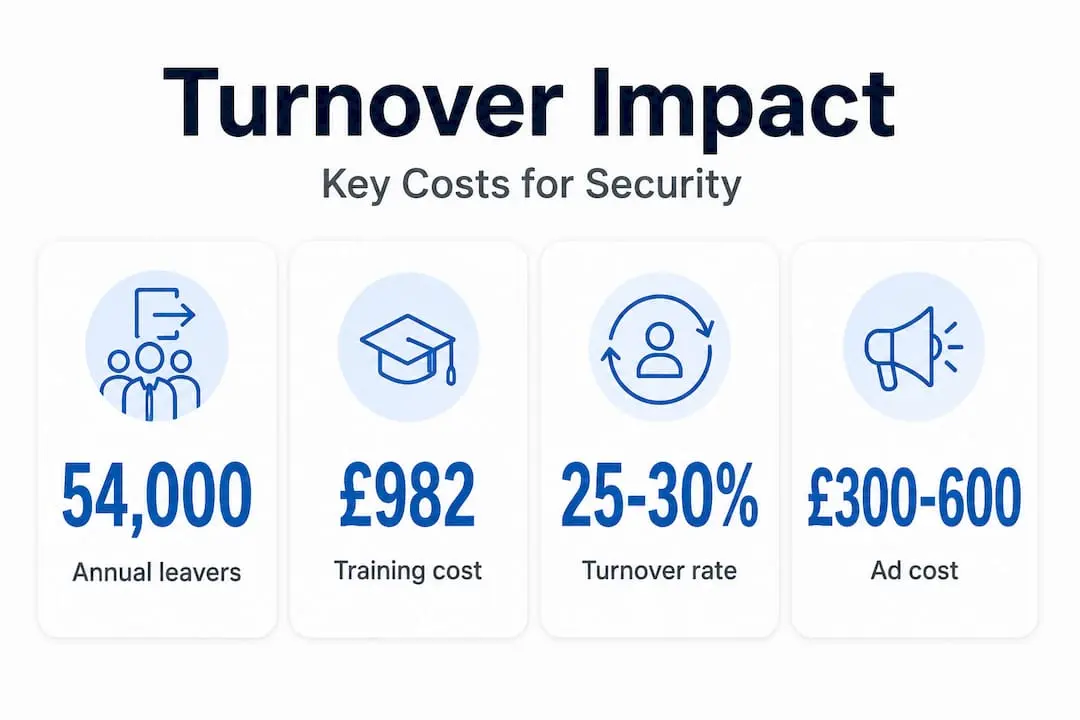
Before you can solve the problem, you need to understand its true scale. The UK security sector loses approximately 54,000 employees every year to turnover. That is a workforce churning at a rate most other industries would consider a crisis. And yet many security firms treat it as simply the cost of doing business. It is not.
The causes are well documented. Security roles are physically demanding, often involve lone working, unsociable hours, and irregular shift patterns that make family life difficult. Pay has historically lagged behind inflation, and opportunities for career progression have been poorly communicated or simply absent. The result is a workforce that feels undervalued and under-supported.
The financial impact is severe. Consider the following breakdown of costs associated with replacing a single security officer:
| Cost category | Estimated cost per leaver |
|---|---|
| Recruitment advertising and agency fees | £300 to £600 |
| SIA licence verification and vetting | £100 to £200 |
| Training and induction | £982 average |
| Lost productivity during handover | £500 to £1,000+ |
| Management time spent on replacement | £200 to £400 |
| Total estimated cost per leaver | £2,000 to £3,200+ |
Multiply that by 54,000 leavers and you begin to see why turnover is one of the sector’s most expensive problems. And those are just the direct, measurable costs. The indirect costs, such as reduced site coverage, lower team morale, and damaged client relationships, are harder to quantify but equally damaging.
The root causes of turnover cluster around three themes. First, pay: 71% of security workers cite salary as the primary reason they resign. Second, job fulfilment: many officers feel their work goes unacknowledged and their contributions ignored. Third, a lack of progression: without a clear path forward, talented staff eventually look elsewhere.
Retention, then, is not about perks and gestures. It is about addressing the structural reasons people leave.
Preparing your business for retention: culture, onboarding, and communication
Retention does not begin the day someone resigns. It begins on day one, and the groundwork you lay in the first weeks of employment shapes whether someone stays for three months or three years. Getting your security recruitment guide right is only the beginning; what follows that hire matters just as much.
A retention-first culture rests on three foundations: respect, clarity, and opportunity. Respect means treating every officer as a professional, not just a body filling a shift. Clarity means setting expectations from the first day and communicating regularly thereafter. Opportunity means making it visible that there is a future for people who commit to your organisation.
Here is how to build that foundation systematically:
- Conduct a structured, consistent induction programme that covers not just procedures, but your company values and how each officer’s role supports them.
- Assign a named mentor or buddy for every new starter during the first 90 days.
- Schedule a formal one-to-one check-in at 30, 60, and 90 days to catch problems early.
- Create an internal communication channel (whether a team app, WhatsApp group, or intranet) that gives officers a voice and keeps them informed.
- Make leadership visible. Senior managers who walk sites, greet staff by name, and respond to concerns create a sense that the company cares.
The results of structured onboarding are remarkable. Ashridge Group achieved a 95% retention rate through a deliberate combination of structured engagement, onboarding processes, and genuine recognition of staff contributions. That figure is not accidental; it is the product of consistency and intention.
Pro Tip: A two-way communication culture is more powerful than most retention initiatives. If officers feel heard, they are far less likely to walk. Build formal channels for upward feedback, not just top-down announcements.
Compare two common approaches to onboarding and you will see quickly where many firms fall short:
| Approach | Typical outcome |
|---|---|
| Ad hoc induction, no mentor, infrequent check-ins | High early attrition (within 6 months) |
| Structured onboarding, assigned mentor, regular one-to-ones | Significantly higher 12-month retention |
If you are revisiting your hiring process alongside your retention strategy, the guidance on security staff hiring expert steps is worth reviewing to ensure the two are aligned.
Implementing core retention strategies: pay, flexibility, and development
Once your culture and onboarding are in place, the focus shifts to the tangible strategies that keep people motivated month after month. These are the areas where the data is clearest and where investment pays back fastest.
Pay remains the single strongest lever. There is no way around it. 71% of security workers cite pay as their reason for leaving, and 61% say a lack of job fulfilment is a close second. If your wages sit below the Living Wage or the market rate for your region, no amount of team-building days will compensate. Conduct a pay benchmarking exercise at least once a year.
Samsic UK, a major facility services provider, tackled this directly. They implemented the London Living Wage, introduced early wage access for officers who needed financial flexibility, and redesigned shift patterns to better accommodate personal commitments. The outcome was measurable improvement in retention figures across their security workforce. These are not expensive luxury programmes; they are practical changes that demonstrate genuine respect for employees’ financial wellbeing.
Flexibility is increasingly non-negotiable. Modern security officers, particularly those with caring responsibilities or second jobs, need predictable and adaptable shift patterns. Fixed rotas published well in advance, the ability to swap shifts without bureaucratic hurdles, and part-time or compressed hours options all reduce the friction that pushes people to leave.

Development and progression are often the deciding factor. Many security officers would stay in the sector if they could see a way up. 65% of UK security employees say they are excited about learning new skills, and 74% say they are ready to adapt. That is an enormous opportunity for employers willing to invest.
Practical development actions include:
- Sponsoring SIA licence renewals and specialist endorsements such as CCTV or door supervision.
- Creating a clear internal progression structure: officer, senior officer, supervisor, operations manager.
- Partnering with training providers to offer first aid, conflict resolution, and counterterrorism awareness qualifications.
- Introducing a mentorship programme that pairs experienced officers with newer recruits.
- Recognising professional achievements publicly, whether in team briefings or a company newsletter.
Pro Tip: Early wage access schemes cost very little to implement but have an outsized impact on financial wellbeing and loyalty. Platforms such as Wagestream or Hastee integrate directly with payroll systems and are used widely in the sector.
For managers looking to align their recruitment and retention practices, reviewing recruitment best practices will help ensure you are attracting candidates who are more likely to stay from the outset.
Maintaining long-term engagement: recognition, progression, and support
Getting staff through the front door and keeping them engaged for the first few months is one challenge. Keeping them motivated, loyal, and performing well for years is another entirely. Long-term retention requires deliberate, ongoing effort.
Recognition is often the most underutilised tool in security management. A simple thank-you from a line manager, a shout-out in a team briefing, or an employee of the month scheme costs almost nothing. But the impact on morale is disproportionately large. When people feel genuinely valued, they become advocates for your organisation rather than passengers waiting for the next opportunity.
TCFM, a facilities management and security contractor, achieved an 87.5% retention rate at a major leisure site by combining structured recognition, transparent career progression routes, and a deliberate focus on creating a positive working environment. Their approach was not complicated. It was consistent.
Here is a practical approach to building long-term engagement:
- Implement a formal recognition programme with monthly and annual awards, and ensure it is driven by both manager nominations and peer nominations.
- Publish clear role progression criteria so every officer knows exactly what they need to do to advance.
- Offer funded professional certifications linked to role progression so development and reward are connected.
- Create a mental health and wellbeing support offer, whether through an Employee Assistance Programme (EAP) or access to a confidential helpline.
- Train line managers in active listening and conflict resolution so that day-to-day concerns are resolved before they become resignation letters.
“Training, professional certification, and leadership support are not additional benefits; they are the core of what makes a security employer worth staying with.” Adapted from Ashridge Group’s retention framework.
The step-by-step hiring process for security firms is also relevant here, because long-term retention begins with hiring the right profile of candidate in the first place. Someone who values stability and development is far more likely to stay than someone who joined purely for convenience.
Support also means being responsive. If an officer raises a concern and it goes unanswered for two weeks, they will not raise the next one. They will update their CV instead. Build a culture where issues are acknowledged quickly, even if the resolution takes time.
Why most security retention advice misses what matters
Here is an uncomfortable truth: most retention guides focus on what is easy to measure and easy to sell. Pay rises, bonuses, gym memberships. And while competitive pay absolutely matters, it is not sufficient on its own. Many security firms have raised wages and still watch their best people leave.
The reason is straightforward. If your communication is poor, your leadership is invisible, and your officers feel like shift-fillers rather than professionals, no pay packet will compensate for long. Direct communication and active employee involvement are ranked alongside pay as core retention drivers, yet they receive a fraction of the attention in most companies.
What the highest-performing security employers actually do is listen consistently. They build feedback loops that are fast and visible. They respond to staff concerns before they become grievances. They give officers genuine input into shift patterns, equipment choices, and even site procedures. That sense of ownership is extraordinarily powerful and almost entirely free.
The other underestimated factor is manager quality. Security officers do not quit companies; they quit managers. A supervisor who is dismissive, uncommunicative, or inconsistent will drive turnover regardless of what the company’s HR policy says. Investing in frontline manager training is one of the highest-return retention investments available to you.
There is also a structural issue worth naming: many security firms treat retention as an HR problem when it is actually a business strategy problem. The companies that attract top security talent and keep them do so because their entire leadership team sees workforce stability as a commercial priority, not just an HR metric.
The lesson from the best performers in this sector is clear: blend structure with trust, respond quickly to concerns, and make every officer feel that their work matters. That combination outperforms any single retention tactic you can buy.
Resources to support your security workforce retention
Reducing turnover is both a people strategy and a recruitment strategy. Retaining your current team begins with attracting the right candidates in the first place, and that requires access to the right tools.

The Security Jobs Board is a UK-specific platform built for exactly this purpose. As a BSIA-affiliated job board, it connects security employers with pre-qualified candidates who are actively seeking roles in the sector. You can post vacancies, browse a dedicated CV database, and communicate with candidates quickly and efficiently, all within a GDPR-compliant environment. Whether you are filling a single site supervisor vacancy or building an entire regional team, the platform’s flexible employer plans make it straightforward to scale your recruitment without overspending. Pairing a strong retention strategy with a reliable talent pipeline ensures that when vacancies do arise, you fill them with people who are genuinely committed to the industry.
Frequently asked questions
What is the average staff turnover rate in the UK security industry?
The average security staff turnover rate in the UK is 25 to 30% per year, with more than 50,000 employees leaving the sector annually. This makes retention one of the most commercially significant challenges for security employers.
Which strategy is most effective for retaining security employees?
No single strategy works in isolation. Competitive pay, flexible schedules, training, and career progression combined with strong internal communication consistently deliver the best retention outcomes across the sector.
How much does staff turnover cost security companies?
Training and development alone costs an average of £982 per employee, before accounting for recruitment fees, vetting, lost productivity, and management time. Total replacement costs can easily exceed £3,000 per leaver.
What onboarding practices improve new security employee retention?
Structured onboarding with clear expectations, an assigned mentor, and regular one-to-one check-ins in the first 90 days is highly effective. Ashridge Group achieved 95% employee retention through a consistent programme of onboarding, communication, and recognition.
Do security staff value training and development opportunities?
Strongly, yes. 65% of UK security employees are excited about learning opportunities and 74% say they are ready to adapt their skills, making development investment one of the most welcomed retention tools available to employers.


