Protective security officer job description: 2026 guide
TL;DR:
- A protective security officer is a trained professional responsible for safeguarding people, property, and assets through surveillance, access control, and incident response. Their roles involve digital reporting, patrolling, access management, and emergency response in high-risk environments, requiring advanced qualifications and site-specific knowledge. The industry’s standards have risen, emphasizing digital skills, certifications, and professional conduct for career progression in high-stakes security roles.
A protective security officer is defined as a trained professional responsible for safeguarding people, property, and assets through surveillance, access control, and incident response. Known in the industry as a PSO, this role sits above standard guarding in terms of responsibility, training requirements, and the environments it covers. Whether you are considering your first security role or looking to step up from general guarding, understanding the full protective security officer job description will help you decide if this career path fits your goals.
What does a protective security officer do each day?
Security officer tasks in a PSO role follow the core mantra of “observe, deter, and report”, but the execution in 2026 goes well beyond a clipboard and a torch. Officers now use digital verification tools and reporting software to log observations, flag anomalies, and produce audit-ready records. That shift from paper to digital has raised the baseline expectation for every candidate entering the field.
The core duties performed across most PSO postings include:
- Routine patrols: Walking or driving assigned routes to deter unauthorised access and identify hazards before they escalate.
- Access control: Verifying visitor credentials, managing key registers, and operating electronic entry systems.
- Alarm and incident response: Attending activated alarms, medical emergencies, and disturbances, then coordinating with emergency services as required.
- CCTV monitoring: Watching live feeds and reviewing footage to support investigations or confirm suspicious activity.
- Incident documentation: Writing accurate, time-stamped reports that can be used in legal proceedings or insurance claims.
Security officers routinely perform patrols, access control, alarm response, CCTV monitoring, and incident documentation, with the specific mix varying by sector. A PSO at a corporate headquarters will spend more time on visitor management, while one deployed at a government facility will focus heavily on perimeter integrity.
Pro Tip: Situational awareness is the skill hiring managers test hardest. Before your interview, practise describing a scenario where you noticed something others missed and explain what you did about it.

What skills and licences do you need as a PSO?
The job requirements for a security officer in a PSO role are more demanding than those for a standard guard posting. In the UK, the Security Industry Authority (SIA) licence is the legal minimum. Without it, you cannot work in a licensable role. Beyond that baseline, employers in 2026 typically prefer CPR, First Aid, and AED certifications alongside the SIA licence. These qualifications signal that you can manage a medical emergency without waiting for an ambulance.
The professional skills for security officers that consistently appear in PSO job adverts include:
- Situational awareness: Spotting changes in the environment before they become threats.
- Calmness under pressure: Maintaining clear judgement during confrontations or emergencies.
- Written and verbal communication: Producing reports that hold up to scrutiny and briefing colleagues or police accurately.
- Physical fitness: Meeting the demands of long patrols, standing shifts, and occasional physical intervention.
- Digital literacy: Using reporting platforms, access control software, and CCTV systems confidently.
Hiring managers prioritise candidates who demonstrate situational awareness, calmness under pressure, and measurable impact. That last point matters more than most candidates realise. Listing “patrolled premises” on your CV tells an employer nothing. Stating “reduced unauthorised access incidents by 30% over six months through revised patrol routes” tells them everything.
For specialist or armed PSO roles, additional credentials apply. These include advanced tactical training, conflict management qualifications, and in some cases, enhanced security clearances. The essential training guide from Securityjobsboard covers the full certification pathway for UK security professionals in detail.
Pro Tip: Candidates who demonstrate quantifiable achievements on their CVs consistently outperform those who list general duties. Replace every vague duty with a result you can measure.
How do psos differ from general security officers?
The distinction matters when you are choosing which role to pursue. A general security officer covers standard guarding tasks at lower-risk sites. A protective security officer operates in environments where the consequences of a security failure are significantly higher. Sites using PSOs typically require enhanced vigilance for high-value assets, sensitive operations, or controlled environments.
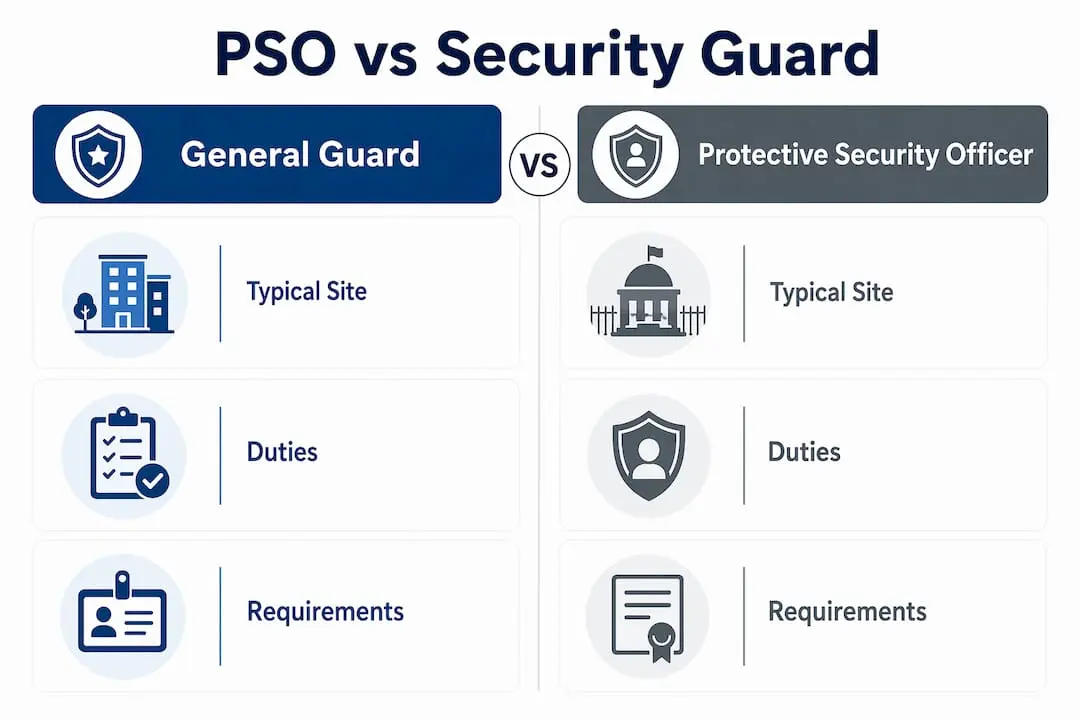
In federal or government contexts, the gap widens further. PSOs in federal roles hold advanced clearances and undergo extensive firearm and defensive tactics training, often with arrest authority. That level of vetting and ongoing training is uncommon in standard commercial guarding.
The table below sets out the practical differences you will encounter in job adverts and role specifications.
| Factor | General Security Officer | Protective Security Officer |
|---|---|---|
| Typical site | Retail, car parks, events | Government buildings, corporate HQ, high-value estates |
| Training level | SIA licence, basic induction | SIA licence, First Aid, tactical or specialist training |
| Clearance required | Standard DBS check | Enhanced DBS, possible security vetting |
| Arrest authority | None | Possible in federal or specialist roles |
| Reporting tools | Paper logs or basic software | Digital platforms, CCTV integration |
| Salary range | Lower end of security pay scale | Higher pay in specialist roles |
The choice of which role to target depends on your existing qualifications, your appetite for responsibility, and the type of environment you want to work in. PSO roles offer stronger career progression, but they demand more from you from day one.
What does a typical PSO shift actually look like?
The protective security job details that rarely appear in formal job adverts are the ones that determine whether you will enjoy the work. A PSO shift typically runs 8–12 hours, covering days, nights, or rotating patterns depending on the site. Physical demands vary. A corporate posting may involve mostly desk-based monitoring with periodic patrols. A large estate or government facility will require sustained walking across significant distances.
Effective daily performance depends on onboarding, field training, and adherence to site-specific post orders. Post orders are legally binding, site-specific instructions that dictate precise procedures for officers. They cover everything from how to greet a visitor to the exact steps to follow when an alarm activates. Every PSO must know their post orders as well as they know their own name.
A typical shift might include:
- Start of shift briefing: Reviewing handover notes, checking equipment, and confirming any site-specific alerts for the day.
- Scheduled patrols: Completing timed routes and logging findings digitally.
- Access management: Processing arrivals and departures, verifying credentials, and managing vehicle access.
- Incident response: Attending any alarm activations, disturbances, or medical events and completing the required documentation.
- End of shift report: Summarising all activity and flagging anything requiring follow-up.
Professional conduct including de-escalation, accurate reporting, and customer service are critical on every shift. PSOs interact with senior executives, members of the public, and emergency services, sometimes within the same hour. The ability to adjust your communication style across those interactions is what separates a competent officer from an outstanding one.
Combining digital tools with strong interpersonal skills significantly improves security outcomes, according to experienced professionals in the field. That combination is the clearest marker of a PSO who will progress quickly.
Pro Tip: Learn your post orders before your first shift, not during it. Officers who arrive knowing the site procedures stand out immediately to supervisors and clients alike.
Key takeaways
A protective security officer role demands more than vigilance. It requires verified qualifications, site-specific knowledge, and the professional conduct to manage high-pressure situations across demanding environments.
| Point | Details |
|---|---|
| Core duties | PSOs perform patrols, access control, CCTV monitoring, and incident documentation daily. |
| Mandatory licence | An SIA licence is the legal minimum; CPR and First Aid certifications strengthen your application. |
| PSO vs. general guard | PSOs serve higher-risk sites, require more training, and often hold enhanced clearances. |
| Post orders are critical | Site-specific post orders are legally binding and define your exact operational responsibilities. |
| Measurable achievements win jobs | CVs that show quantifiable results consistently outperform those listing generic duties. |
The security industry is raising its standards. are you ready?
The PSO role has changed more in the past five years than in the previous two decades. When I look at the job adverts coming through Securityjobsboard now compared to those from 2019, the shift is clear. Employers are asking for digital reporting competency, conflict management qualifications, and evidence of continuous professional development as standard. The days of listing “patrolled premises” and expecting a callback are gone.
What I find most interesting is how the qualities employers seek in security staff have evolved. Technical skills matter, but the officers who progress fastest are those who treat every shift as a professional performance. They know their post orders. They write reports that read clearly. They de-escalate before situations require physical intervention.
My honest view is that the candidates who struggle in PSO roles are not those lacking physical capability. They are the ones who underestimate the administrative and interpersonal demands of the job. If you are considering this career, invest in your First Aid certification before you apply. Learn how digital access control systems work. Practise writing clear, factual incident reports. Those three steps will put you ahead of the majority of applicants before you have even attended an interview.
The career progression available within protective security is genuinely strong. PSO roles lead to supervisory positions, contract management, and specialist assignments in close protection or government security. The entry point is demanding, but the ceiling is high for those who commit to developing their skills continuously.
— Rob
Find your next PSO role on Securityjobsboard

Securityjobsboard lists protective security officer vacancies across the UK, from corporate sites in London to government and healthcare facilities in the regions. If you are based in or open to relocating, you can browse security jobs in Northern Ireland alongside hundreds of other active listings. Creating a free profile takes minutes and lets you set job alerts so the right roles come to you. For guidance on improving your qualifications, building a stronger CV, and navigating the application process, the career advice section covers every stage of your journey into protective security. Start your search today at Securityjobsboard.
FAQ
What qualifications do you need to become a PSO?
The SIA licence is the legal minimum for working in a licensable security role in the UK. Employers also prefer CPR, First Aid, and AED certifications, with specialist roles requiring additional tactical training or security clearances.
What is the difference between a security guard and a PSO?
A protective security officer operates in higher-risk or more sensitive environments than a standard security guard, typically requiring enhanced training, vetting, and in some cases, specialist authority. General guards cover lower-risk sites with standard SIA licensing.
What is the typical salary for a protective security officer?
The median annual wage for security officers sits in the high-£30,000 range, with higher pay available in healthcare, corporate, and armed or specialist PSO roles.
What are post orders and why do they matter?
Post orders are legally binding, site-specific instructions that define exactly how a PSO must operate at a given location. They cover patrol routes, access procedures, alarm responses, and reporting requirements, and every officer must follow them precisely.
Can a PSO make an arrest?
In standard commercial roles, PSOs have no formal arrest authority beyond the citizen’s arrest powers available to any member of the public. In federal or government-designated roles, some PSOs hold statutory arrest powers, but these require advanced vetting and specialist training.


