How to fill urgent vacancies in UK security: 2026 guide

TL;DR:
- Filling urgent security vacancies quick requires pre-vetted, licensed candidates, complete site details, and a structured compliance process.
- Specialist agencies use verified candidate pools and real-time license checks to deploy officers within 24 to 48 hours.
Filling urgent security vacancies is defined as the rapid deployment of SIA-licensed, pre-vetted personnel to open roles within hours rather than weeks. The UK security industry faces a persistent staffing pressure: sites cannot operate without licensed officers, and gaps in cover create both legal and operational risk. Knowing how to fill urgent vacancies quickly and compliantly requires more than posting a job advert. It demands access to verified candidate pools, structured compliance checks under the Security Industry Authority’s licensing framework, and a clear process from first contact to first shift.
How to fill urgent vacancies: what you need before you start
Preparation is the single biggest factor in how fast an agency can deploy a candidate to your site. Complete client information enables agencies to match and deploy compliant officers quickly. Without it, even the best agency will lose hours going back and forth on basic details.
Before you contact any recruitment agency or platform, have the following ready:
- Site address and postcode. Agencies use this to filter candidates by travel distance and regional availability.
- Shift pattern and hours. Include start and finish times, days required, and whether the role is temporary or ongoing.
- Licence type required. Specify whether you need a Door Supervisor licence, Security Guard licence, CCTV Operator licence, or another SIA category.
- Number of officers needed. A single gap and a full team deployment require very different responses.
- Risk level of the site. A retail unit differs significantly from a licensed venue or a construction site. Agencies need this to assess suitability.
- Compliance documentation. Confirm whether your site requires BS 7858 vetting records, right-to-work evidence, or specific insurance certificates before an officer can start.
Pro Tip: Prepare a one-page site brief you can send by email the moment you call an agency. It removes the back-and-forth and can cut your response time by several hours.
The step-by-step recruitment process for security firms shows that employers who provide full site details upfront consistently receive faster shortlists. Agencies are not slow by nature. They are slow when they are missing information.

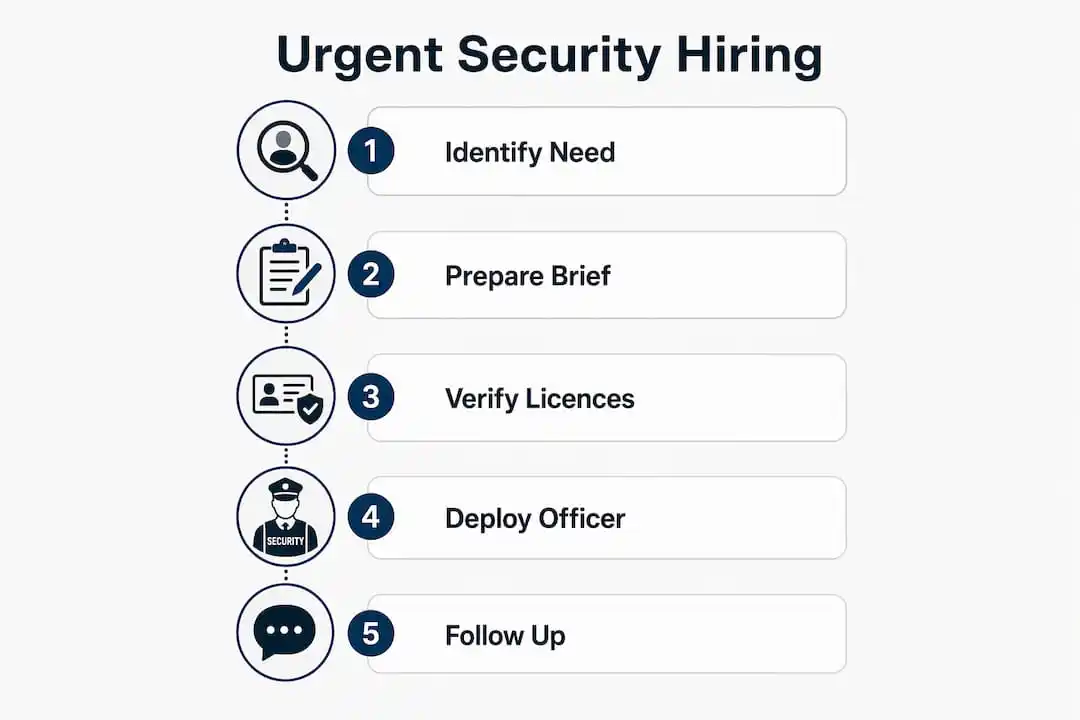
How do specialist agencies deploy SIA officers so quickly?
Specialist recruitment agencies maintain pools of screened, available candidates with validated licences and DBS checks, enabling them to present suitable personnel within days rather than weeks. That speed comes from a structured workflow, not luck.
The typical rapid deployment process works as follows:
- Needs assessment. The agency takes your site brief, confirms the licence type, shift pattern, and risk level, and identifies the correct candidate profile.
- Database search. The agency searches its pre-vetted pool for officers whose SIA licence is current, whose right-to-work documentation is verified, and who are available for your shift.
- Licence and compliance check. Each candidate’s SIA licence status is confirmed in real time. BS 7858 screening, including identity verification and DBS checks, is applied even in rapid deployment contexts.
- Candidate shortlist. The agency presents two or three confirmed candidates, not a long list of speculative CVs.
- Deployment confirmation. Once you approve a candidate, the agency coordinates the start time, site induction details, and any paperwork.
Urgent deployment of SIA-licensed security personnel is achievable within 24 hours in major UK cities and typically within 48 hours in regional areas when using pre-vetted agency databases. That timeline assumes all compliance criteria are met. It is not a guarantee from every provider, so ask your agency directly what their current deployment window is.
Platforms that provide real-time licence validation and live availability status improve hiring speed and reduce the risk of deploying unlicensed officers. The technology removes a manual bottleneck that used to take hours.
| Deployment method | Typical timeline | Compliance assurance |
|---|---|---|
| Pre-vetted agency database | 24–48 hours | Licences and DBS pre-checked |
| Open job board posting | 5–14 days | Employer must verify independently |
| Direct walk-in or referral | Variable | Employer must verify independently |
Pro Tip: Ask any agency whether their platform shows live SIA licence expiry dates. If it does not, you are relying on manual checks that introduce delay and risk.
For employers comparing their options, the job board vs employment agency breakdown explains where each approach works best for UK security hiring.
What are the most common pitfalls in emergency hiring?
The emergency hiring process fails most often not because of a shortage of candidates, but because of avoidable errors on the employer’s side. Understanding these pitfalls is the fastest way to avoid them.
Traditional post-and-wait job board approaches are ineffective for urgent security hiring. Job boards frequently show unlicensed or unavailable applicants, creating compliance risks and wasted time. Posting a vacancy and waiting for applications is not a strategy for urgent cover.
The most common mistakes employers make include:
- Accepting unverified candidates. Deploying an officer without confirming their SIA licence is active is a criminal offence under the Private Security Industry Act 2001. Always verify before the first shift, not after.
- Relying on outdated CVs. A candidate who was available three months ago may have taken a permanent role. Agencies with live availability data solve this. Generic job boards do not.
- Providing incomplete site information. As covered earlier, missing details slow every step of the process. Agencies cannot match candidates to roles they do not fully understand.
- Skipping BS 7858 vetting under time pressure. BS 7858 screening is a legal and professional requirement. Time pressure does not remove that obligation. Agencies with pre-vetted pools have already completed this work.
- Poor communication after initial contact. Approving a candidate and then going quiet causes no-shows. Confirm start times, site access details, and uniform requirements in writing.
Cutting corners on compliance during urgent hiring does not save time. It creates liability. A single unlicensed deployment can result in prosecution, contract termination, and reputational damage that takes far longer to recover from than the original vacancy took to fill.
The security recruitment workflow guide covers the full compliance sequence in detail, which is worth reviewing before your next urgent hire.
Strategies for urgent hiring that also build long-term resilience
The best strategies for urgent hiring are not purely reactive. Employers who rarely face genuine crises have usually built systems that reduce the frequency of urgent gaps in the first place.
- Maintain an ongoing agency relationship. Agencies prioritise clients they know. A standing account with a specialist security recruiter means your urgent request goes to the front of the queue, not into a general inbox.
- Use flexible, short-term contracts for emergency cover. Temporary contracts let you fill a gap immediately while you run a proper process for a permanent hire. They also give you time to assess a candidate before committing.
- Build an employer brand that attracts licensed officers. SIA-licensed security professionals have choices. Clear job descriptions, fair pay rates, and prompt communication make your roles more attractive than a competitor’s vague posting. Platforms like Securityjobsboard let you post roles directly to an audience of verified security professionals across the UK.
- Forecast your staffing needs. Review your contract calendar monthly. If you know a large event or new site is coming in six weeks, start recruiting now. The employers who never face a 24-hour crisis are the ones who spotted the gap at the six-week mark.
- Consider rapid staffing solutions in specialist sectors. For transport hubs and high-footfall environments, flexible security staffing models used across Europe show that pre-registered, available workers can be deployed at very short notice when the right systems are in place.
The underlying principle is straightforward. Urgency is expensive. Preparation is cheap.
Key takeaways
Filling urgent security vacancies quickly and compliantly requires pre-vetted candidate pools, complete site information, and a structured compliance process from the first call to the first shift.
| Point | Details |
|---|---|
| Preparation accelerates deployment | Provide full site details upfront so agencies can match and deploy officers without delay. |
| Pre-vetted pools are fastest | Agencies with screened, licensed candidates deploy within 24–48 hours; job boards cannot match this. |
| Compliance is non-negotiable | BS 7858 vetting and SIA licence checks apply even under time pressure. |
| Technology reduces risk | Platforms with real-time licence validation prevent unlicensed deployments and cut manual checking time. |
| Prevention beats reaction | Ongoing agency relationships and forward planning reduce the frequency of genuine hiring crises. |
Why I think most employers make urgent hiring harder than it needs to be
The employers I see struggling most with urgent vacancies share one trait: they treat recruitment as something that only starts when a gap appears. By that point, they have no agency relationship, no site brief ready, and no idea which candidates are currently available and licensed. They post on a general job board, wait two days, and then panic.
The security sector is not short of licensed officers. What it is short of is employers who have done the groundwork. A pre-vetted agency database can deploy same-day for many roles, including door supervisors, when all compliance criteria are met. That is a remarkable capability. Most employers never access it because they have not built the relationship that makes it available to them.
The other mistake I see regularly is treating compliance as a barrier to speed. It is not. Agencies that have already completed BS 7858 screening and SIA licence verification on their candidate pool have removed that barrier entirely. The compliance work is done before you even call. What slows things down is employers who try to shortcut the process themselves and then discover mid-deployment that a candidate’s licence has lapsed.
My honest advice: call a specialist security recruiter today, not when you have a gap. Set up an account, share your typical site requirements, and ask what their current deployment window looks like. That single conversation is worth more than any amount of reactive job posting.
— Rob
Securityjobsboard: your specialist platform for urgent security roles
Security employers across the UK use Securityjobsboard to reach verified, SIA-licensed candidates fast. The platform is built specifically for the security sector, which means every candidate profile is relevant and every job posting reaches the right audience.
Whether you need to post a security vacancy today or build a pipeline for future roles, Securityjobsboard gives you direct access to a database of licensed security professionals. Employers can browse CVs, set up alerts for new candidates, and communicate directly with applicants. For regional needs, the platform covers the full UK, including a dedicated listing of security jobs in Northern Ireland for employers operating in that region. Securityjobsboard is affiliated with the BSIA, which means the platform carries the credibility your compliance team expects.
FAQ
How quickly can I fill an urgent security vacancy?
Deployment within 24 hours is achievable in major UK cities when using a specialist agency with a pre-vetted candidate pool. Regional areas typically require 48 hours.
Do compliance checks still apply for urgent hires?
Yes. BS 7858 vetting and SIA licence verification are legal requirements regardless of how quickly you need to fill a role. Agencies with pre-screened pools have completed this work in advance.
Why do job boards fail for urgent security hiring?
Job boards show unlicensed or unavailable candidates and rely on applicants responding to adverts, which takes days. Specialist agencies with live availability data are the only reliable route for same-day or next-day cover.
What information do I need to give an agency for a fast response?
Provide the site address, shift times, licence type required, number of officers, and risk level. Complete site information allows agencies to match and deploy appropriate candidates without delays.
What is the difference between an SIA Door Supervisor and a Security Guard licence?
A Door Supervisor licence permits work at licensed premises and includes physical intervention training, while a Security Guard licence covers static guarding roles. The SIA licence guide explains both categories and their requirements in full.


