Job board vs employment agency: Best route for UK security hiring

TL;DR:
- Job boards offer faster, cost-effective volume hiring with high employer control.
- Agencies provide deeper vetting, targeting senior or urgent security roles.
- A hybrid approach using both channels is the most effective strategy for UK security recruitment.
Choosing between a job board and an employment agency for security recruitment is rarely as straightforward as it seems. Many HR professionals default to agencies out of habit, assuming they deliver superior candidates faster. Yet the landscape has shifted considerably, and that assumption deserves scrutiny. The UK security sector carries unique compliance demands, urgent staffing pressures, and a candidate pool that behaves differently from general labour markets. Understanding which recruitment channel genuinely serves your organisation better, and when, can mean the difference between a costly hire and a confident one.
Table of Contents
- Understanding recruitment options in the UK security sector
- Comparing job boards and employment agencies: Pros and cons
- Efficiency, cost and control: What matters most for security hiring?
- Which is best for your organisation’s security hiring needs?
- Why the smartest security employers blend approaches
- Streamline your security hiring today
- Frequently asked questions
Key Takeaways
| Point | Details |
|---|---|
| Clear role differences | Job boards offer direct access and cost savings while agencies excel with specialist, urgent, or highly regulated roles. |
| No one-size-fits-all | Blended strategies often yield the best recruitment outcomes in the UK security sector. |
| Efficiency hinges on need | Choosing the right solution depends on whether speed, cost, or compliance is your organisation’s top priority. |
| Data-driven decision | Regularly review hiring outcomes to refine and optimise your recruitment mix over time. |
Understanding recruitment options in the UK security sector
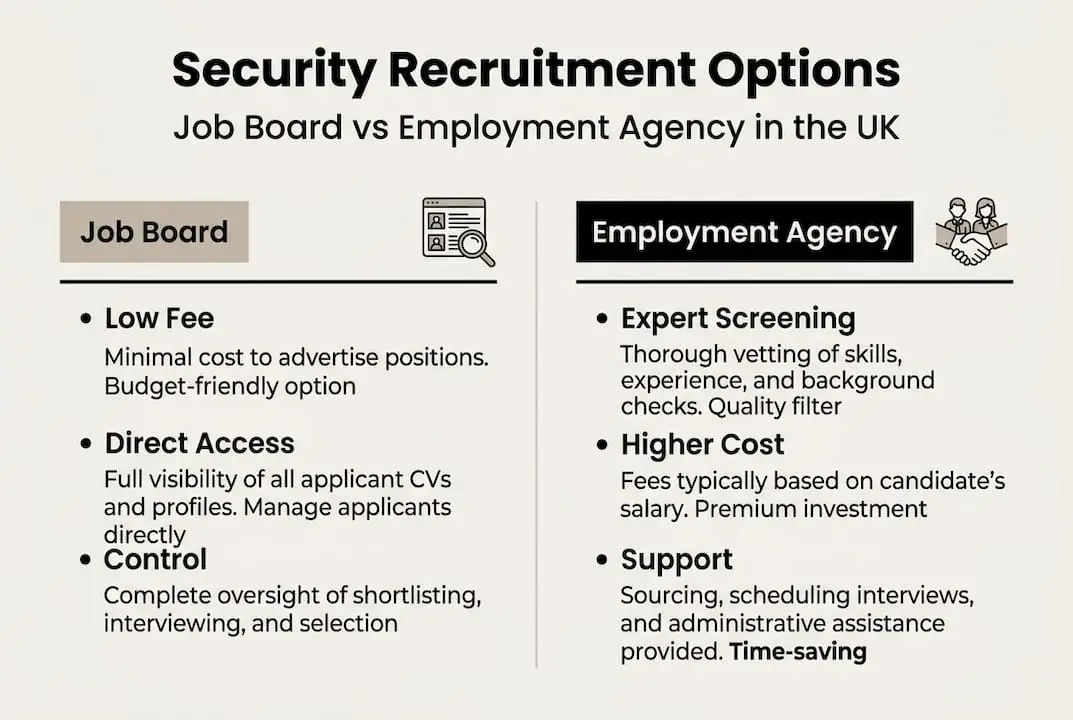
Before comparing the two, it helps to be precise about what each option actually involves. A job board is an online platform where employers post vacancies and candidates apply directly. A security-focused job board goes further, attracting candidates who already hold or are pursuing SIA licences, relevant training, and sector experience. An employment agency, by contrast, acts as an intermediary. You brief them on a role, they source and screen candidates, and you pay a fee, typically a percentage of the hire’s salary, upon successful placement.
The process differs significantly between the two. With a job board, you write the advert, set the criteria, and manage incoming applications yourself. With an agency, much of that administrative burden transfers to their team. Both approaches have their place, but the security recruitment platforms you choose will shape your entire hiring experience.
As noted in expert analysis, UK security hiring requirements often differ from general hiring trends due to compliance and urgency. That distinction matters enormously when you are filling roles that require SIA licensing, DBS checks, or specific site clearance.
Here is where the two channels diverge most sharply:
- Reach: Job boards can attract a broad pool of active candidates quickly, while agencies draw from a pre-screened, often passive talent pool.
- Speed: Job boards can generate applications within hours of posting; agencies may take days to present a shortlist.
- Cost: Job boards charge a flat posting fee; agencies charge percentage-based placement fees, often 10 to 20 percent of first-year salary.
- Control: Job boards give you full control over screening and selection; agencies handle much of this on your behalf.
- Compliance support: Specialist security job boards increasingly offer compliance guidance, though agencies often provide deeper vetting as standard.
Using a solid job board optimisation guide can help you maximise the return from a posting, particularly if your team is new to managing direct applications in the security sector.
Comparing job boards and employment agencies: Pros and cons
Digital job boards now provide access to over 70% of active security job seekers in the UK, which makes them a genuinely powerful channel for most hiring scenarios. But raw reach is not the only metric that counts.
| Factor | Job board | Employment agency |
|---|---|---|
| Cost | Low flat fee | 10 to 20% of salary |
| Speed to applications | Hours | Days to weeks |
| Candidate quality | Variable, self-screened | Pre-screened by agency |
| Market reach | Very broad | Targeted and niche |
| Screening support | Limited to platform tools | Full service |
| Employer control | High | Low to medium |
The table makes one thing clear: neither option wins across every category. The right choice depends on your specific role, timeline, and budget.
Pro Tip: Use an agency for urgent, high-risk, or senior security roles where vetting depth matters most. Use a job board when you need volume, speed, or want to keep costs predictable. Exploring security employer platforms that offer flexible pricing can help you scale your approach.
Some common misconceptions worth clearing up:
- Agencies are not always faster. For volume roles, a well-optimised job board advert can outperform an agency shortlist by days.
- Job boards are not only for junior roles. Specialist platforms attract experienced, licensed security professionals actively seeking their next position.
- Agency fees are not always justified. For straightforward roles with a clear candidate profile, paying a placement fee may add cost without adding value.
A hybrid approach, using a job board for most roles and an agency for exceptions, is increasingly the norm. Flexible pricing job boards make this easier to manage without blowing your recruitment budget.
Efficiency, cost and control: What matters most for security hiring?
Three factors consistently drive recruitment decisions in the security sector: efficiency, cost, and control. Each one deserves a closer look.
On efficiency, shortlisting speed is increasingly the defining measure of recruitment performance. A role left unfilled costs money in overtime, contractor cover, or missed contracts. Job boards, when used well, can dramatically compress time-to-fill for standard security officer roles. Agencies may be faster for niche positions where their existing candidate relationships give them an edge.
Top three priorities for security hiring managers in 2026:
- Time-to-fill: Every day a post sits vacant has a direct operational cost. Boards typically surface candidates faster for active job seekers.
- Cost per hire: Agency fees on a £25,000 security officer role can reach £3,500 to £5,000. A job board posting may cost a fraction of that, often under £300.
- Candidate compliance: SIA licence verification, DBS checks, and right-to-work confirmation are non-negotiable. Your channel must support these requirements.
On cost, the maths is straightforward for most roles. A job board posting offers a predictable, fixed spend. Agency fees scale with salary and can accumulate rapidly if you are filling multiple positions. That said, a bad hire costs far more than an agency fee, so the cheapest option is not always the wisest one.
On control, job boards hand you the steering wheel. You write the brief, you screen the CVs, you decide who progresses. That is an advantage if your team has the capacity and expertise. If not, it can become a bottleneck. Reviewing your security job posting workflow before committing to a channel can highlight where your process is strong and where it needs support.

Using the right best hiring tools alongside your chosen channel can close many of the gaps between what job boards and agencies offer.
Which is best for your organisation’s security hiring needs?
Over 60% of UK security companies now use both job boards and agencies for different hiring stages, which tells you something important: the binary choice is largely a false one. The smarter question is not which channel to use, but when to use each.
| Scenario | Recommended channel | Reason |
|---|---|---|
| Volume hiring for security officers | Job board | Speed, cost, broad reach |
| Specialist or senior security role | Agency | Vetting depth, niche networks |
| Urgent replacement within 48 hours | Agency | Existing candidate relationships |
| Ongoing talent pipeline building | Job board | CV database access, lower cost |
| Remote or regional roles | Job board | Wider geographic reach |
“The most effective security employers treat recruitment channels as tools in a toolkit, not as competing philosophies. Matching the channel to the role type consistently outperforms any single-channel strategy.” — Security Recruitment Expert, 2026
Pro Tip: Review your last 12 months of hires. Which roles filled fastest? Which cost most? Which produced the best retention? That data will tell you far more about your ideal channel mix than any general benchmark.
A practical checklist for deciding your approach:
- Is the role urgent? If yes, consider an agency with an existing pool.
- Is the role volume-based? If yes, a job board will likely be faster and cheaper.
- Does the role require deep vetting? Agencies may offer more thorough compliance checks.
- Is your internal team resourced to manage applications? If not, agency support reduces pressure.
- What is your budget? Job boards offer more predictable costs for most roles.
Exploring job matching platforms and security job board alternatives alongside agency options gives you the full picture before committing your budget.
Why the smartest security employers blend approaches
Here is an uncomfortable truth: rigid loyalty to one recruitment channel is usually a sign that a company has stopped questioning its own processes. The security employers consistently achieving the best hiring outcomes are not the ones who always use agencies or always use job boards. They are the ones who treat each role as its own problem to solve.
We have seen companies cut their cost per hire by 40% simply by shifting volume security officer roles to a specialist job board while retaining their agency relationship for control room supervisors and senior management positions. That is not a revolutionary strategy. It is just honest evaluation of what works.
The security employer platforms analysis available today makes this kind of informed decision-making far more accessible than it was even three years ago. Candidate feedback, time-to-fill data, and cost tracking are all within reach. The employers who use that data to adapt their approach will consistently outperform those who do not.
Streamline your security hiring today
Whether you are managing volume recruitment across multiple sites or searching for a specialist to fill a critical role, having the right platform behind you makes a measurable difference. Security Jobs Board is built specifically for the UK security sector, offering BSIA-affiliated credibility, GDPR-compliant processes, and a candidate pool of actively seeking, licensed professionals.

From posting your first vacancy to browsing a curated CV database, the platform supports every stage of your hiring process. Whether you recruit across England, Scotland, Wales, or need to find security jobs in Northern Ireland, Security Jobs Board connects you with the right candidates, faster and at a fraction of agency costs. Start your next search today.
Frequently asked questions
Are job boards or agencies faster for hiring in the UK security sector?
Job boards often yield faster results for volume and entry-level roles, while agencies are typically quicker for specialist or hard-to-fill positions. Time-to-fill varies significantly based on the role type and channel chosen.
Which recruitment method is more cost-effective?
Job boards are usually more cost-effective for most roles, but agencies justify their fees for complex or urgent placements. Agency fees versus posting costs can differ substantially depending on salary level and role complexity.
Can job boards handle strict vetting or compliance required in security hiring?
Many security-focused job boards support initial compliance checks, but agencies may offer deeper vetting as part of their service. Job boards providing compliance support are increasingly common in the specialist security sector.
Is a blended approach common among UK security employers?
Yes, over half of UK security companies now combine job boards and agencies across different stages of their recruitment process.


