How job boards unlock UK security roles: steps and tips

TL;DR:
- UK security job seekers face fierce competition, with over 250 applications per position.
- Niche security-specific job boards offer targeted features like SIA license filters and employer vetting.
- Personalising applications, setting alerts, and following up increase chances of success in a crowded market.
Landing a security job in the UK is not as simple as browsing a few listings and hitting apply. With over 250 applications chasing a single position in some corners of the sector, the competition is fierce and unforgiving. Job boards have become the primary battleground for security jobseekers, yet most candidates use only a fraction of what these platforms offer. This guide walks you through exactly how job boards work, how to choose the right one, and how to apply in a way that actually gets results in the UK security industry.
Table of Contents
- What is a job board and how has it evolved?
- How UK security job boards work: step-by-step
- Comparing job boards: key features and pitfalls
- Making your application count: strategies for UK security jobseekers
- Why job boards are essential, but not a silver bullet
- Explore security job opportunities with confidence
- Frequently asked questions
Key Takeaways
| Point | Details |
|---|---|
| Job boards power discovery | Modern UK security job boards offer more than listings—they personalise and filter jobs for better matches. |
| Compliance is crucial | Having an SIA licence and clearances ready is essential for most applications in the security industry. |
| Competition is fierce | Over 250 applicants might compete for top roles, so tailored and persistent applications stand out. |
| Niche features help | Specialised security job boards offer advanced filters and employer vetting for better targeting. |
| Personalisation gets results | Using job board tools like alerts and direct messaging improves your response rate and visibility. |
What is a job board and how has it evolved?
A job board is an online platform where employers post vacancies and jobseekers search for, and apply to, relevant roles. That basic definition, however, sells the modern version dramatically short. Today’s platforms are sophisticated matching engines that connect the right candidate to the right employer, often before a human recruiter even gets involved.
As noted in research on the role of job boards, these platforms have evolved far beyond simple adverts into active recruitment tools with features that benefit both sides of the hiring process. For security jobseekers specifically, this evolution matters enormously.
Think back to how security roles were filled twenty years ago: word of mouth, newspaper adverts, and walking into a guarding company’s office with a printed CV. That world is largely gone. Digital platforms now handle the entire journey from discovery to shortlisting, and the best ones are built specifically for using security job boards to find licensed, vetted candidates.
Here is what a well-built security job board offers today:
- Advanced search filters that let you narrow by role type (door supervisor, CCTV operator, mobile patrol, close protection), location, salary band, and shift pattern
- Job alerts that notify you the moment a relevant vacancy goes live, giving you a head start on the competition
- Candidate profiles where you can showcase your SIA licence, DBS certificate, and experience in a structured format employers can scan quickly
- Application tracking so you always know where each application stands
- CV upload and storage that allows one-click applications without retyping your details every time
- Employer profiles that let you research a company before you apply, saving time on roles that are not a good fit
These features are not just conveniences. In a sector where speed and compliance matter, they are competitive advantages. The candidate who sets up alerts and applies within the first few hours of a vacancy going live is in a very different position to the one who stumbles across the same role three days later.
How UK security job boards work: step-by-step
With the basics of job boards established, here is the exact journey a UK security jobseeker should expect when using a dedicated platform.
- Register and create your profile. Sign up with your name, contact details, and a professional summary. Be specific about your experience: years in the industry, sectors covered, and any specialist skills such as CCTV monitoring or first aid.
- Upload your CV. Keep it current and tailored to security roles. Highlight your qualifications prominently at the top.
- Add your credentials. Most roles require candidates to hold an SIA licence and pass DBS checks, so make these visible on your profile. Employers filter by licence type, so missing this information will cost you opportunities.
- Set your job alerts. Choose your preferred role types, locations, and salary range. Let the platform do the searching for you.
- Use filters to find relevant roles. Do not scroll through hundreds of irrelevant listings. Filter by sector, contract type, and distance to surface only the roles worth your time.
- Apply promptly and consistently. Speed matters. Apply the same day a role appears where possible.
- Track your applications. Use the board’s tracking tools to follow up at the right moment.
Compliance is not optional in this sector. SIA licences and DBS checks are legal requirements for most professional security positions in the UK, and employers will discard applications that do not confirm these upfront. Knowing your obligations under security employment law in 2026 also helps you ask the right questions and avoid employers who are not operating correctly.

Pro Tip: Complete your profile to 100% before you start applying. Many platforms rank complete profiles higher in employer searches, meaning recruiters may find you before you even apply to their role.
Comparing job boards: key features and pitfalls
Knowing the journey is only half the challenge. Choosing the right board can save you time and significantly boost your chances.
The most important distinction is between general job boards and niche security-specific platforms. General boards see far more competition whereas niche boards cater specifically for licensed, qualified applicants in the security industry. That difference is not trivial.
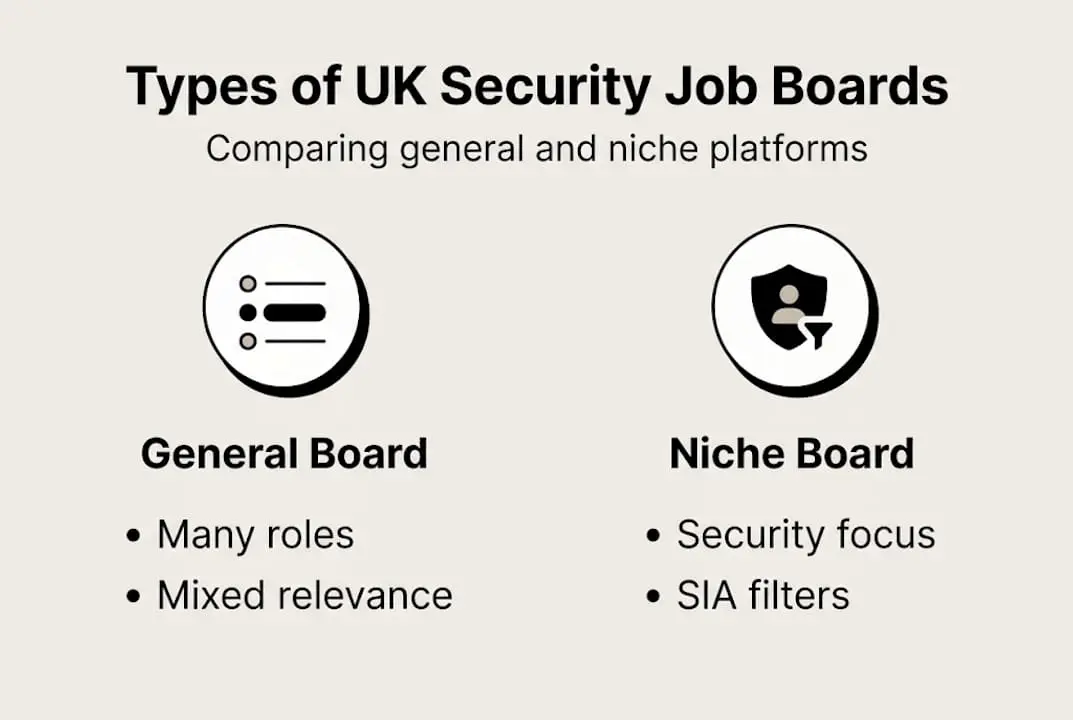
| Feature | General job board | Security niche board |
|---|---|---|
| Role relevance | Mixed, often off-topic | Security-specific only |
| SIA licence filter | Rarely available | Standard feature |
| Employer vetting | Minimal | Industry-focused screening |
| Competition per role | Very high | More targeted applicant pool |
| Sector knowledge | Generic | Built for security professionals |
| Support quality | Automated or outsourced | Often human and specialist |
| Application speed | Standard | Optimised for fast turnaround |
General boards like Indeed or Reed have their uses, but if you hold an SIA licence and are looking for roles in guarding, surveillance, or close protection, you are fishing in the wrong pond. The key job board features that matter most for security candidates, such as licence verification fields and sector-specific search, simply do not exist on most general platforms.
Pitfalls to watch for on any board include outdated listings that have already been filled, roles that do not specify whether an SIA licence is required (a red flag for legitimacy), and boards with no employer verification process. Reading niche board comparisons before committing your time to a platform is a smart move.
Pro Tip: If a job listing does not mention SIA requirements and the employer has no verifiable profile on the board, proceed with caution. Legitimate security employers in the UK will always specify licensing requirements.
Making your application count: strategies for UK security jobseekers
Once you have chosen where to apply, the next challenge is breaking through the noise on crowded platforms.
Recruiters in the security sector look for specific things immediately. Your application needs to confirm:
- SIA licence type and expiry date (door supervisor, security guard, CCTV operator, etc.)
- DBS certificate status (enhanced disclosure for most roles)
- Relevant experience in the specific environment the employer operates in (retail, events, corporate, transport, etc.)
- Any additional qualifications such as first aid, conflict management, or CCTV operation certificates
- Availability and flexibility including willingness to work nights, weekends, or bank holidays
Tailoring your CV and cover letter to each specific role is not optional. A generic application that could have been sent to any employer will be spotted immediately and discarded. Read the job description carefully, mirror the language used, and address the specific requirements mentioned.
Automated screening systems, known as applicant tracking systems (ATS), scan applications before a human sees them. Use straightforward formatting, avoid tables or graphics inside your CV document, and include the exact keywords from the job listing.
“With positions drawing over 250 applications, personalisation and follow-up make all the difference between being seen and being overlooked.”
One strategy many candidates ignore is the follow-up message. Most job boards include a messaging function. After applying, send a brief, professional message to the employer confirming your interest and highlighting one or two specific reasons you are a strong fit. This small action separates you from the vast majority who apply and wait passively. Guidance on optimising security job applications can help you refine this approach further.
Why job boards are essential, but not a silver bullet
Job boards give you access and breadth that no other channel can match. In a single session, you can view dozens of live vacancies, compare employers, and apply to multiple roles. That reach is genuinely valuable, particularly for those new to the sector or relocating within the UK.
But here is the uncomfortable truth most guides skip over: the candidates who land roles fastest are rarely those who rely on boards alone. Personal networking, direct contact with security companies, and referrals from colleagues still move faster than most digital applications. A job board gets you in the door; your reputation and relationships often determine what happens next.
Many candidates also leave significant value on the table by ignoring the tools built into the platforms themselves. Alerts go unset. Profiles sit at 60% completion. Filters are never used. These are not small oversights. They are the difference between being visible and being invisible to employers actively searching for candidates.
The sector is also becoming more demanding. Growing competition and stricter SIA and DBS requirements mean that qualifications alone are no longer sufficient to stand out. Continuous professional development, additional certifications, and a well-maintained online presence on a job posting site all contribute to long-term employability. Persistence matters as much as strategy. Rejection is part of the process, and the candidates who keep refining their approach are the ones who eventually succeed.
Explore security job opportunities with confidence
If you are ready to put this advice into practice, the Security Jobs Board is built specifically for UK security professionals like you.

Browse current vacancies on the full security jobs board and filter by location, role type, and licence requirement in seconds. If you are based in Northern Ireland, you can explore security jobs in Northern Ireland directly. Registration is free, and uploading your CV takes minutes. You can also browse security employers’ listings to research companies before you apply. With BSIA affiliation and human support behind the platform, this is where serious security jobseekers start their search.
Frequently asked questions
Why do some security jobs require an SIA licence?
The SIA licence demonstrates that you have completed mandatory training and passed the background checks required by UK law for professional security work. Without it, most employers cannot legally hire you for frontline roles.
What makes a job board ‘niche’ for UK security?
A niche board focuses exclusively on security roles and includes features like SIA licence filters and employer vetting. Niche boards serve licensed applicants far more effectively than general platforms because every listing and every employer is relevant to the sector.
How can I improve my chances of getting noticed on a busy board?
Customise every application to the specific role, set up alerts so you apply early, and send a follow-up message after submitting. Personalisation and follow-up consistently improve response rates in high-competition security recruitment.
Are all security job boards free to use?
Most security job boards allow free registration, profile creation, and job applications. Some offer optional premium features such as CV highlighting or priority placement, but the core functions are typically free for jobseekers.


