The essential guide to screening candidates for security roles

TL;DR:
- Proper, role-based candidate screening is essential to prevent security breaches and liability.
- Combining automated tools with experienced human review ensures thorough and compliant vetting.
- Addressing bias and maintaining legal standards protects fairness and avoids costly legal risks.
Getting candidate screening wrong in the security industry is not just an inconvenience. It can expose your clients, your business, and the public to serious harm. A bad hire costs up to 30% of an employee’s first-year salary, and in the security sector, the consequences extend well beyond financial loss. This guide gives UK security HR professionals and hiring managers a clear, practical framework for building a screening process that is thorough, compliant, and efficient. From defining what checks to run, to avoiding bias and deploying the right technology, every stage is covered here.
Table of Contents
- Understanding the essentials of candidate screening
- Preparing for the candidate screening process
- Executing comprehensive screening: checks, tools and technologies
- Ensuring fairness, compliance and quality in candidate vetting
- Our perspective: why balancing speed and human oversight is critical
- Find expert support for security hiring and vetting
- Frequently asked questions
Key Takeaways
| Point | Details |
|---|---|
| Role-based screening is critical | Tailoring checks by position greatly reduces security risk and follows industry best practice. |
| AI improves efficiency, not judgement | Technology can speed up candidate vetting, but final decisions need human oversight. |
| Mistakes add up fast | A single bad hire could cost nearly a third of their first-year salary, making thorough screening essential. |
| Compliance and fairness matter | Structured processes and awareness help prevent costly legal, ethical, or reputational issues. |
| Expert resources boost outcomes | Leveraging dedicated industry support and tools results in better hires and streamlined recruitment. |
Understanding the essentials of candidate screening
Screening and vetting are terms often used interchangeably, but they are not the same thing. Screening refers to the initial process of evaluating candidates against minimum job requirements, typically involving document checks, work history review, and basic eligibility verification. Vetting goes deeper and includes risk assessment, financial probity checks, and sometimes psychological or character profiling. In the security sector, both are essential, and the line between the two blurs quickly.
The reason security roles carry higher screening demands than most industries comes down to access and trust. Security personnel often guard sensitive sites, handle confidential information, operate near vulnerable individuals, or carry out tasks where a lapse in judgement could result in serious harm. Unlike an administrative role where a bad hire is largely recoverable, a poorly vetted security officer creates systemic risk.
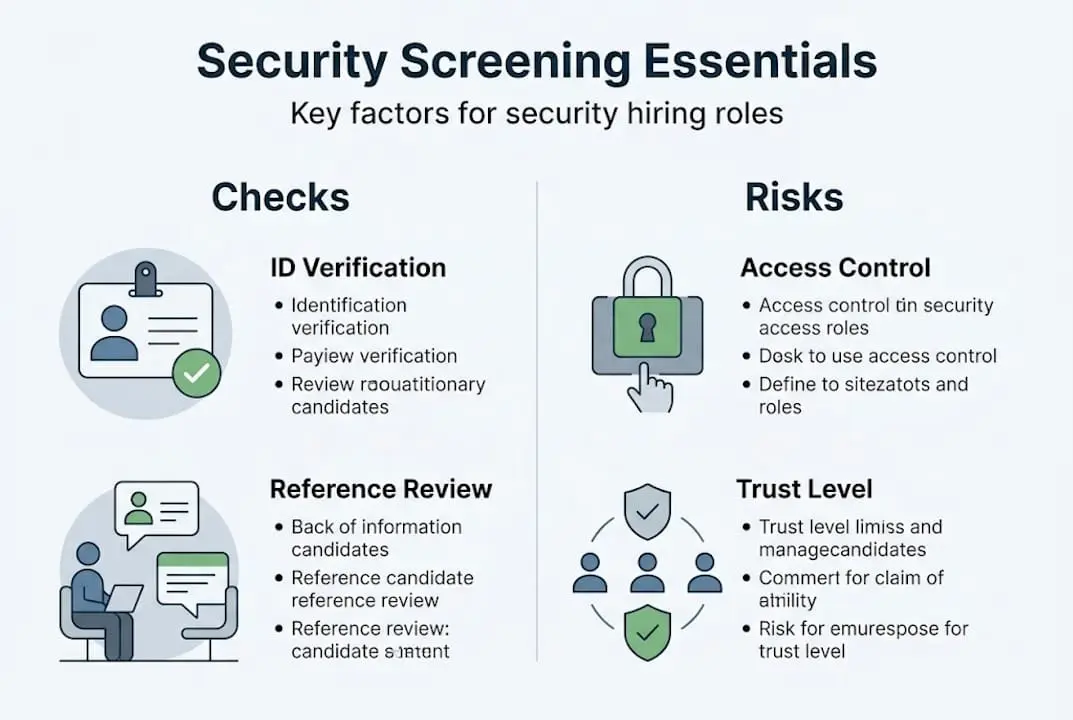
The NPSA recommends role-based risk assessment to determine what level of screening applies to each position. Their guidance specifies that checks should include identity verification, employment and education history, criminal record checks, financial background, and professional references. Critically, not every role requires the same depth of scrutiny. A door supervisor at a pub venue and a close protection officer guarding a senior executive need very different levels of vetting.
Here is a summary of how screening demands typically vary across common security roles:
| Role type | Risk level | Key checks required |
|---|---|---|
| Door supervisor | Medium | SIA licence, identity, criminal record |
| CCTV operator | Medium | SIA licence, identity, employment history |
| Close protection officer | High | All of the above plus financial, references, security clearance |
| Security manager | High | All checks plus leadership background, character references |
| Event security staff | Low to medium | Identity, SIA licence, basic employment history |
For a solid grounding in security vetting essentials, it is worth reviewing the full scope of checks relevant to your business before you begin.
- Always confirm a candidate holds a valid SIA licence before anything else
- Match your screening intensity to the role’s access level and risk profile
- Keep clear records of every check performed and the outcome
Pro Tip: Do not apply a one-size-fits-all screening template across all roles. A risk-based approach means your highest-access positions get the most rigorous vetting, while lower-risk roles are processed more efficiently without cutting corners that matter.
Preparing for the candidate screening process
Before a single application lands in your inbox, your screening infrastructure must be ready. Skipping this preparation is one of the most common and costly mistakes security businesses make. Rushing into screening without a clear framework leads to inconsistent decisions, compliance gaps, and expensive re-hires.
A robust security recruitment workflow starts with a thorough job analysis. You need to understand exactly what the role involves, what access it grants, and what the consequences are if something goes wrong. From this analysis, you assign a risk classification, which then determines your screening pathway.

Here is a comparison of how high-risk and low-risk screening pathways typically differ:
| Factor | High-risk pathway | Low-risk pathway |
|---|---|---|
| Identity verification | Biometric or in-person | Document copy acceptable |
| Criminal record check | Enhanced DBS | Standard DBS |
| Financial checks | Full credit and bankruptcy search | Not typically required |
| Reference depth | Minimum 3 professional references, verified | 1 to 2 references, standard |
| Time frame | 4 to 6 weeks | 1 to 2 weeks |
| Data retention | Extended period, strictly documented | Standard GDPR-compliant period |
The cost of getting this wrong is significant. As noted earlier, a poor hiring decision can cost up to 30% of a first-year salary, and in security that figure rises when you factor in client contract risk and potential liability.
Follow these steps to get your preparation right before screening begins:
- Complete a detailed job analysis covering role duties, access levels, shift patterns, and potential risk scenarios.
- Assign a risk classification based on what the role involves and who or what the postholder will be responsible for protecting.
- Define your required documentation list for each risk level, including what is mandatory versus what is best practice.
- Set up your GDPR-compliant data handling processes, including consent forms, secure storage, and clear retention policies.
- Brief your recruiting team on the screening criteria so decisions are consistent regardless of who is processing the applications.
- Schedule your checks in the right sequence, typically identity first, then work history, then criminal and financial checks, to avoid wasting time on candidates who fail early gates.
GDPR compliance is non-negotiable. Any personal data collected during screening must be processed lawfully, with explicit candidate consent, and stored securely. Make sure your team understands what they can and cannot retain after a hire is made or declined.
Strong preparation also makes your job listings more targeted. When you understand exactly what you need, posting security job roles becomes far more precise, which reduces the volume of unsuitable applicants you have to screen in the first place.
Executing comprehensive screening: checks, tools and technologies
With your framework in place, it is time to run the actual screening process. This is where most teams either gain or lose time, and where the right tools make a measurable difference.
The core screening steps for security roles should follow this order:
- Identity verification: Confirm the candidate is who they claim to be using government-issued documents. For higher-risk roles, in-person document checks or digital biometric verification add an important layer of assurance.
- SIA licence check: Every front-line security role in the UK requires a valid SIA licence. Verify this directly through the SIA licence checker before progressing the candidate further.
- Employment and education history: Verify every role listed on the CV, including gaps. Unexplained employment gaps in a security candidate are a significant red flag.
- Criminal record check: Use the appropriate level of DBS check for the role. Roles involving vulnerable people require an Enhanced DBS, and some regulated positions require additional checks.
- Financial background check: For roles involving cash handling or access to high-value assets, run credit and bankruptcy checks through a specialist provider.
- Professional references: Contact referees directly and ask structured questions rather than accepting written letters. A scripted reference call reveals far more than an email response.
Technology is transforming how quickly teams can move through these stages. AI in security hiring now includes tools for automated CV sifting, digital document verification, and intelligent scheduling of checks. The efficiency gains are real: AI reduces time-to-hire by 30 to 50%, which matters in a sector where the average time-to-fill runs between 36 and 45 days. Cutting that window gives you a competitive edge in securing quality candidates before other firms do.
Digital document verification platforms can confirm identity documents in minutes rather than days, and applicant tracking systems (ATS) designed for regulated industries can flag compliance issues automatically. For a practical overview of what is available, explore the leading security hiring tools and consider how they map to your current process.
That said, automation does not replace judgement. Use a background check checklist to ensure nothing is missed between automated stages, and always assign a trained human reviewer to interpret results before a decision is made.
Signs that your screening process is working well include consistent turnaround times across similar roles, zero instances of missed statutory checks, a clear audit trail for every candidate, and hiring manager satisfaction with the quality of shortlisted candidates.
Pro Tip: Set a clear handoff point between your automated tools and your human reviewers. AI is excellent at flagging anomalies and organising data, but deciding whether a candidate’s complex criminal history is relevant to a specific role requires a trained professional with contextual knowledge.
Ensuring fairness, compliance and quality in candidate vetting
A screening process can be technically thorough and still produce unfair or legally problematic outcomes. This is one of the most underappreciated risks in security hiring, and one where businesses are increasingly exposed.
Bias is a real and documented problem in candidate vetting. Experimental research shows that ethnic minorities face lower approval rates in complex vetting scenarios, indicating that unconscious bias can shape outcomes even when the checks themselves are objective. If your screening process relies on human judgement at multiple points, bias can enter the system without anyone intending it.
“A screening process that is consistent on paper but biased in practice is not a compliant process. It is a legal liability.” This is a principle every security HR team should embed into their culture, not just their policy documents.
Practical steps to reduce bias and strengthen compliance include:
- Standardise your decision criteria by using structured scoring rubrics at each stage so every candidate is assessed against the same benchmarks
- Train all screening staff in unconscious bias awareness and ensure this training is refreshed regularly, not just completed once at onboarding
- Conduct regular audits of your screening outcomes, looking for patterns by demographic group that might indicate systemic bias
- Keep comprehensive records of every decision made during the screening process, including the rationale behind any rejection
- Separate screening stages so the person reviewing criminal records does not also know the candidate’s name or personal details where possible
- Use structured reference calls with pre-agreed questions so the information gathered is consistent and comparable across all candidates
Common compliance errors include failing to obtain proper consent before running checks, retaining candidate data longer than necessary, applying Enhanced DBS checks to roles that do not legally require them, and making blanket exclusions based on criminal records without individual assessment.
The UK’s Rehabilitation of Offenders Act 1974 requires that spent convictions are not used against candidates in most roles. Security employers must understand which roles are exempt from this act (such as those requiring Enhanced DBS) and apply the rules correctly. Blanket policies that exclude anyone with any conviction are both legally problematic and unnecessarily restrictive.
For a broader view of how these principles connect to your wider hiring strategy, reviewing security recruitment best practices will help you build a process that is both competitive and compliant.
Quality control checks to run at the end of every hire cycle should include reviewing whether all required checks were completed and documented, whether decisions are defensible if challenged, and whether the new hire’s first 90 days suggest the screening process correctly identified a suitable candidate.
Our perspective: why balancing speed and human oversight is critical
The security industry is under real pressure to fill roles quickly. Contracts come with headcount requirements, rosters need to be covered, and clients expect seamless service. That pressure pushes recruitment teams towards automation, and the time savings AI delivers are genuinely significant.
But speed without oversight is how serious vetting failures happen.
We have seen situations where over-automated processes approved candidates that a trained reviewer would have flagged immediately, simply because the system was not designed to handle edge cases. A gap in employment that an algorithm categorises as acceptable might, in context, represent a period of undisclosed custodial sentence. A reference that reads positively on a standard template might, when called directly, reveal a very different story.
The guidance to prioritise human review for high-risk decisions despite AI efficiency gains exists for good reason. Technology surfaces information; experienced professionals interpret it.
Our view is that the best screening processes treat AI as a powerful assistant, not a decision-maker. Build a robust recruitment workflow where automation handles volume and speed, and your most experienced reviewers handle the moments where nuanced human judgement actually matters. That balance is not a compromise. It is the standard.
Find expert support for security hiring and vetting
Taking these strategies from theory to practice often means turning to expert support. The Security Jobs Board connects UK security employers with pre-qualified candidates who understand the sector’s specific demands, making the early stages of your screening process far more targeted and efficient.

Whether you are filling roles across security jobs in Northern Ireland or building a national roster, our platform gives you direct access to a CV database, compliant job listings, and tools designed specifically for security recruitment. Candidates can access career advice for security professionals so the people applying to your roles arrive better prepared and informed. Visit The Security Jobs Board to post your next vacancy or browse available candidates today.
Frequently asked questions
What are the minimum legal checks required to screen a candidate for a UK security job?
Core checks required include identity, employment and education history, criminal record, financial status, and references, following NPSA guidance on role-based risk assessment.
How much can a poor hiring decision cost a UK security business?
A bad hire can cost up to 30% of the person’s first-year salary, accounting for recruitment, training, and associated risk management expenses.
How long does the typical screening process take in the UK security sector?
Security sector roles typically have a time-to-fill of 36 to 45 days due to the complexity of vetting requirements involved.
Can AI fully replace manual candidate review for security positions?
No. While AI speeds up initial screening, human review remains essential for complex or high-risk decisions where contextual judgement is required.
How can I reduce bias in candidate vetting for security jobs?
Apply structured scoring processes and deliver regular bias awareness training, as experimental studies show that vetting bias can reduce approval rates for ethnic minorities in complex scenarios.


