Defining event security for UK event planners
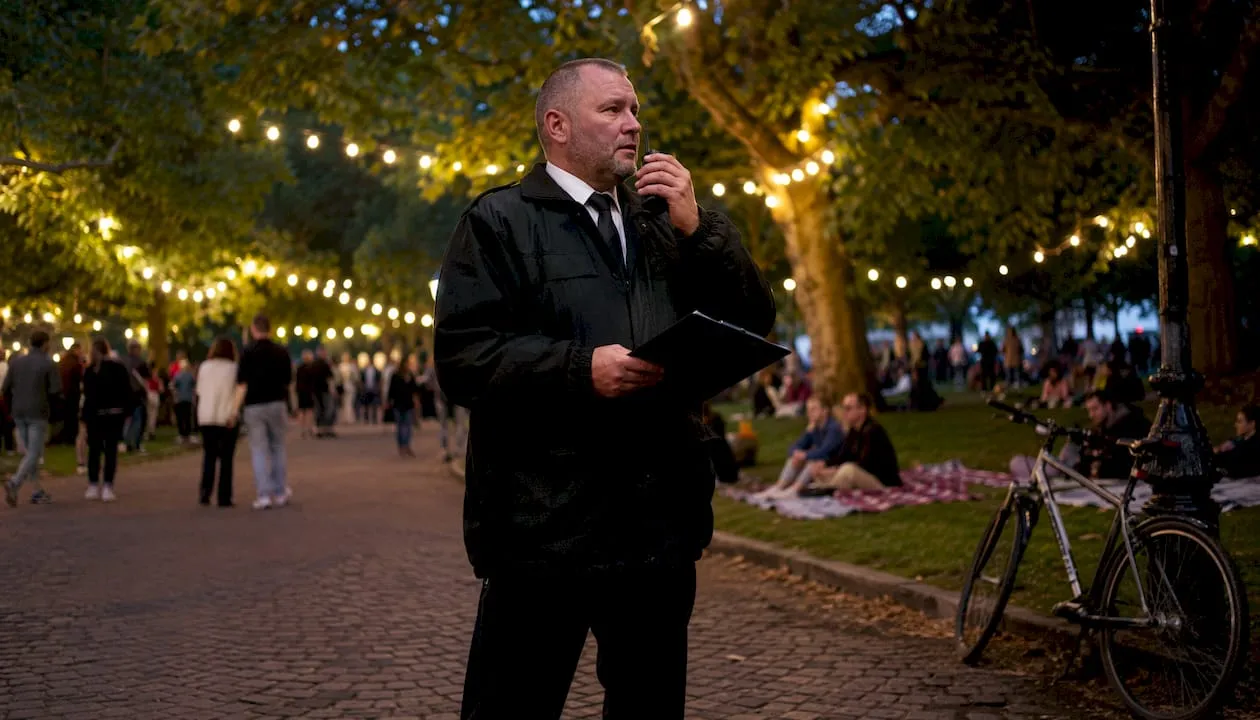
Event security is the proportionate combination of physical measures, trained personnel, communications, and governance that protects people, property, and the event’s purpose against assessed threats. Get it right and attendees barely notice it. Get it wrong and you are managing a crisis instead of an event.
The core components are:
- Physical measures: barriers, access control, hostile vehicle mitigation, CCTV
- Personnel: SIA-licensed officers, stewards, medics, control room operators
- Communications: visitor-facing messaging, staff radio networks, emergency protocols
- Cyber and operational technology: ticketing systems, CCTV infrastructure, comms redundancy
- Planning and governance: TVRA, RAMS, security plan, emergency plan, stakeholder sign-off
Three UK bodies set the standards every organiser must know: the National Protective Security Authority (NPSA), the Security Industry Authority (SIA), and local police. Their guidance, not generic checklists, is the authoritative baseline.
Table of Contents
- What does effective event security actually achieve?
- How do you decide what security measures you actually need?
- What roles must you specify in contracts and plans?
- UK legal and licensing checklist every organiser must complete
- Planning timeline and essential documents
- Operational measures: what to use and when
- Hiring security contractors: a due diligence checklist
- What drives event security costs?
- Incident response and command structure
- Post-event review and lessons learned
- Where to find vetted UK event security staff
- Key takeaways
- The part most organisers get wrong
- Securityjobsboard: post a role or find vetted candidates today
- Useful sources and further reading
- FAQ
What does effective event security actually achieve?
The primary objectives, as the NPSA frames them, are to deter adversaries, prevent prohibited items from entering the venue, detect and delay any attempted attack, support emergency response, and preserve the visitor experience throughout.
Those objectives shift depending on event type and phase:
- Build phase: perimeter control, contractor vetting, asset protection for equipment on site
- Event phase: access control, crowd management, incident response, communications
- Load-out phase: reduced staffing, asset security, site clearance
A corporate awards dinner and an outdoor music festival share the same objectives but need very different measures. The dinner needs discreet access control and close protection awareness; the festival needs hostile vehicle mitigation, mass screening, and a full control room operation.
Pro Tip: Visible security reassures; oppressive security alienates. The NPSA explicitly notes that well-designed security enables the event’s functioning rather than obstructing it. Brief your officers on hospitality as well as enforcement.
How do you decide what security measures you actually need?

A Threat, Vulnerability and Risk Assessment (TVRA) specific to the event is the correct starting point, not a copy-paste from last year’s plan. The NPSA confirms that a TVRA done for the event footprint, not a building’s steady-state profile, is the proper basis for specifying the mix of human and technical controls.
Factors that change your risk profile:
- Attendance size and crowd density
- Site topology: open field versus enclosed arena
- High-value assets: performers, VIPs, cash
- Public profile and media attention
- Licensed areas where alcohol is served
- Proximity to transport hubs or public roads
Pro Tip: Small layout changes, such as repositioning entry lanes or adding clear signage, often reduce queuing friction and security incidents more cheaply than deploying additional officers. Run the TVRA before you finalise the site plan, not after.
What roles must you specify in contracts and plans?
Accountability gaps cause on-day failures. Every plan needs named individuals in each of these roles:
- Event organiser: overall customer lead and decision-maker
- Security manager: operational command of all security personnel
- Stewards: crowd flow, wayfinding, non-licensable customer service tasks
- SIA-licensed officers: door supervision, security guarding, CCTV, close protection where required
- Control room operator: CCTV monitoring, radio coordination, incident logging
- Medics: first aid and medical emergency response
- Operations liaison: interface between security, venue, police, and licensing authority
The security plan must be signed off by the venue, the organiser, and the relevant licensing authority or police. Post orders, shift handover procedures, and documented job descriptions are contractual requirements, not optional extras. For a clear breakdown of event security job types and how roles map to career paths, Securityjobsboard’s resource library is a practical reference.
UK legal and licensing checklist every organiser must complete
The events sector is worth £42.3 billion, and most events will require at least some SIA-licensed personnel. Critically, licensing depends on the activity performed, not the job title.
| Licensable activity | Licence required | Notes |
|---|---|---|
| Door supervision on licensed premises | Door Supervisor | Applies when alcohol or regulated entertainment is provided |
| Guarding on non-licensed premises (contract) | Security Guard | Contract for services only |
| CCTV monitoring of public space | Public Space Surveillance (CCTV) | Watching or identifying members of the public |
| Close protection | Close Protection | Bodyguard roles under contract |
| Key holding | Key Holding | Controlling access to locks or devices |
| Stewarding (directing, wayfinding) | None required | Non-licensable customer service tasks |
Additional compliance checks:
- Temporary Event Notice (TEN) or premises licence: required for alcohol and regulated entertainment; rules differ across England and Wales, Scotland, and Northern Ireland
- Public liability insurance: verify the contractor’s certificate before signing any contract
- DBS and vetting: confirm vetting levels match the event’s risk profile
- GDPR: CCTV footage and incident logs must be handled lawfully; retention periods must be documented
- HSE guidance: applies to crowd safety and welfare obligations
Trust signals to require from any contractor: current SIA licence verification, written RAMS and security plan, insurance certificates, documented training records, and at least two event-specific references.
Planning timeline and essential documents
“The development and implementation of a security communications strategy should start well before the event is scheduled to commence — to provide practical security information to visitors and to deliver deterrence messaging.” — NPSA
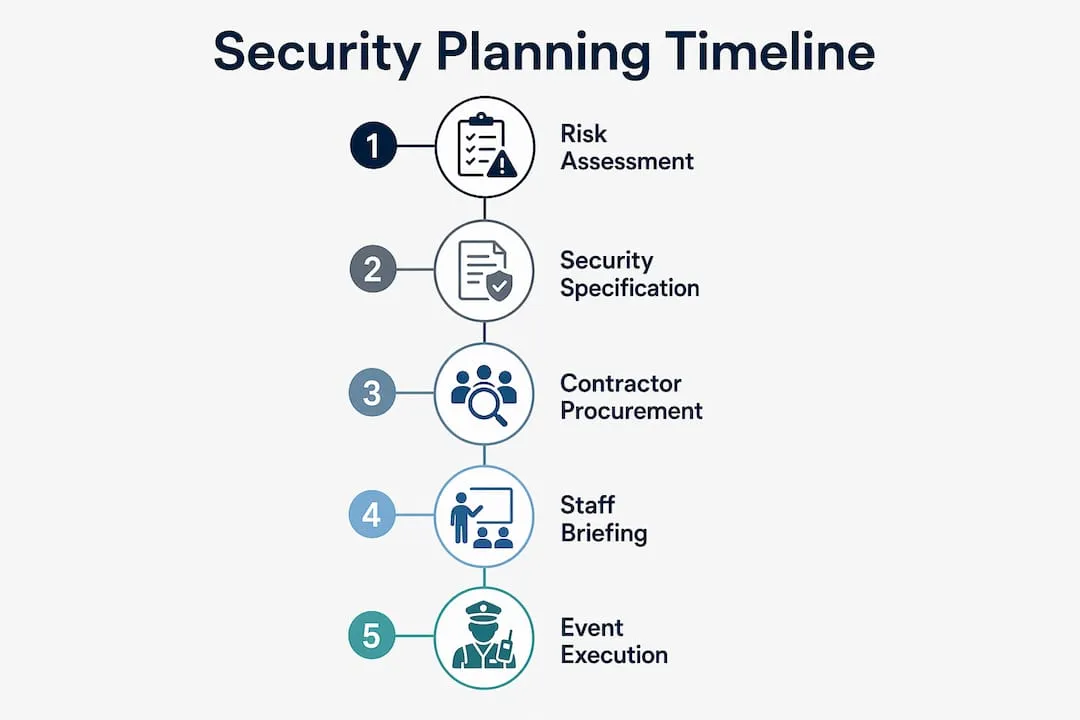
| Milestone | Owner | Typical timing |
|---|---|---|
| TVRA and initial security specification | Organiser / security manager | — |
| Contractor procurement and contract sign-off | Organiser | — |
| Security plan, RAMS and emergency plan finalised | Security manager | 4 weeks before |
| Stakeholder sign-off (venue, police, licensing) | Organiser | — |
| Site-specific briefings and equipment checks | Security manager | typically one to two weeks before |
| Staff manifest and contact tree distributed | Security manager | — |
| Post-event debrief | Organiser + security manager | Within 5 days after |
Essential documents: TVRA, security plan, RAMS, post orders, staff manifest, contact tree, emergency plan, and communications plan. None of these are optional if you want stakeholder sign-off and adequate insurance cover.
Pro Tip: Build the communications plan at the same time as the security plan. Visitor-facing messaging about bag searches, prohibited items, and arrival times reduces queuing pressure and deters opportunistic threats before doors open.
Operational measures: what to use and when
Physical and technical measures should follow the TVRA, not a standard template:
- Barriers and crowd management infrastructure: pedestrian barriers, queue management systems, sterile zones around stages
- Hostile vehicle mitigation (HVM): concrete blocks, water-filled barriers, or specialist HVM assets for open-access events near roads
- Search and screening: handheld wands for lower-risk events; walk-through metal detectors or x-ray for higher-risk or high-profile events; random screening as a proportionate middle ground
- CCTV: fixed and PTZ cameras covering entry points, crowd areas, and backstage; monitored in real time from the control room
- Signage: clear prohibited items lists and search policy notices at every entry point
- Communications: encrypted radios for security staff, dedicated channels per zone, backup comms plan if primary network fails
For ticketing and operational technology, build in redundancy. A ticketing system failure at peak entry creates crowd pressure and security risk simultaneously.
Hiring security contractors: a due diligence checklist
Verifying an SIA badge is the floor, not the ceiling. The SIA’s buyer guidance is explicit: organisers must confirm role-specific training, relevant event experience, and vetting, not just licence status.
Checklist before signing any contract; consider accessing bijverdieners gezocht voor je event to find reliable event staff,
- Confirm SIA licence type and current status for every deployed operative
- Request public liability insurance certificate and employer’s liability insurance
- Ask for references from events of comparable size and type
- Verify vetting levels and DBS checks match your risk profile
- Request a draft mobilisation plan and site-specific post orders
- Confirm training records, including any specialist training (HVM, first aid, conflict management)
- Specify capability in the contract: CCTV monitoring, HVM, search and screening, not just officer numbers
The NPSA notes that an SIA licence does not guarantee site competence. Contractually requiring site-specific briefings and a mobilisation period is the practical fix. Securityjobsboard’s step-by-step hiring guide walks through the full procurement workflow.
Pro Tip: Require a minimum mobilisation period in the contract, typically one to two weeks before the event, so staff can walk the site, learn evacuation routes, and receive venue-specific briefings. Officers who know the site perform better under pressure.
What drives event security costs?
Budget conversations go better when you understand what actually moves the price:
- Event size and duration: more attendees and longer events require more personnel hours
- SIA-licensed staff ratio: door supervisors and close protection officers cost more than stewards
- Specialist equipment hire: HVM assets, walk-through detectors, and CCTV infrastructure add significant cost
- Public profile: high-profile events attract higher threat assessments and therefore more resource
- Mobilisation and briefing time: contractually required site training adds cost but reduces on-day risk
For temporary events, the NPSA confirms that increasing the guard force is often more cost-effective than installing permanent technology. Build a contingency reserve into the security budget, and always request written quotes that specify capability rather than officer numbers alone.
Incident response and command structure
A clear command structure is the difference between a managed incident and a chaotic one:
- Incident controller: overall command during an incident
- Security manager: operational security response
- Safety officer: crowd safety and welfare
- Police liaison: handover to emergency services and evidence preservation
- Medical lead: triage and ambulance coordination
Immediate actions on any serious incident: activate the emergency plan, notify the control room, secure the scene, preserve evidence, and prepare for handover to police or ambulance services. Agree rendezvous points with local police before the event, share comms channels in advance, and establish a single point of contact for emergency services. Early liaison with local police, ideally at the planning stage, prevents coordination failures on the day.
Post-event review and lessons learned
A debrief within five days captures detail that fades quickly. Collect incident reports from the private security company (PSC), police, and medics. Suggested KPIs to review:
- Number and type of incidents logged
- Average response time to incidents
- Visitor flow and screening throughput at peak entry
- Stakeholder satisfaction (venue, police, licensing authority)
Update the TVRA and contract requirements based on findings. Retain all records, including CCTV footage, incident logs, and debrief notes, for insurance and audit purposes. The NPSA recommends formal debriefs with the PSC and all partners as standard procurement practice.
Where to find vetted UK event security staff
For posting roles and finding vetted candidates, Securityjobsboard is the UK’s specialist security recruitment platform. It is BSIA-affiliated, GDPR-compliant, and built specifically for the security sector, which means candidates on the platform understand SIA licensing, post orders, and event-specific roles before they apply.
Official guidance to bookmark:
- NPSA major events protection guidance: proportionality, TVRA methodology, and control room design
- SIA events buyer guidance: due diligence obligations, licence verification, and role-specific competence
- GOV.UK supplier guidance: licensable activities mapped by task, not job title
- HSE and local police liaison pages for crowd safety and emergency planning
“While event organisers will often pay particular attention to crowd safety and a positive visitor experience, it is helpful to regard effective and efficient security measures as a key enabler.” — NPSA, Protection at Major Events
Pro Tip: Use Securityjobsboard’s CV database to shortlist candidates who already hold the SIA licence type your event requires. Filtering by licence type at the search stage saves significant time during due diligence.
Key takeaways
Effective event security in the UK requires a TVRA-led, proportionate approach backed by SIA compliance, written plans, and vetted contractors, not a generic headcount.
| Point | Details |
|---|---|
| Start with a TVRA | Base every security decision on a threat, vulnerability and risk assessment specific to your event footprint. |
| Verify SIA licences by activity | Licensing depends on the task performed, not the job title; confirm the correct licence type for each role. |
| Require written plans and RAMS | Insist on a security plan, RAMS, post orders, and emergency plan before any contractor begins work. |
| Contract for capability, not numbers | Specify CCTV monitoring, HVM, and search capability in the contract rather than officer headcount alone. |
| Use Securityjobsboard to recruit | Post roles or browse vetted, SIA-aware candidates at Securityjobsboard to reduce due diligence time. |
The part most organisers get wrong
The single most common procurement mistake is treating SIA licensing as the finish line. An organiser confirms the badge, signs the contract, and assumes competence. Then on the day, officers do not know the evacuation routes, cannot locate the control room, and have never seen the post orders.
The NPSA is clear on this: a licence proves an individual has met a baseline training standard, not that they know your site. The fix is contractual. Require a mobilisation period, site-specific briefings, and signed post orders as deliverables, not nice-to-haves. If a contractor resists those terms, that tells you something important before you have committed any budget.
The other gap is the debrief. Most events get a verbal wash-up and nothing more. A written debrief, with incident logs and updated TVRA, is what turns one event’s hard lessons into the next event’s better plan.
Securityjobsboard: post a role or find vetted candidates today
Finding SIA-licensed event security staff should not take weeks of cold calls and badge checks. Securityjobsboard gives UK event organisers direct access to a database of vetted security candidates who already understand the sector’s licensing requirements and operational expectations.

Post a vacancy, browse CVs filtered by SIA licence type, and communicate with candidates directly, all within a GDPR-compliant platform built for the UK security industry. Whether you need door supervisors for a licensed venue or a security manager for a multi-day festival, the platform matches you with candidates who fit the role, not just the headcount. Browse current security roles in Northern Ireland or post your vacancy at https://www.securityjobsboard.co.uk to start receiving applications from qualified candidates today.
Useful sources and further reading
- NPSA: Protection at Major Events: the authoritative UK guide to proportionate security planning, TVRA methodology, and control room management for large events
- SIA: Events guidance for buyers of security: covers buyer due diligence obligations, licence verification, and role-specific competence checks
- GOV.UK: Events guidance for suppliers of security: maps licensable activities to specific tasks; essential for understanding when a Door Supervisor versus Security Guard licence applies
- GOV.UK: Check if you need an SIA licence to work at an event: plain-language licence checker for individual roles and activities
- HSE: Managing crowds safely: crowd safety obligations and welfare planning for event organisers
“You need to be sure that any security services you supply are compliant with the law. This means ensuring that individuals are properly licensed where necessary.” — SIA, Events guidance for suppliers of security
This article provides general information for UK event organisers and does not constitute legal or regulatory advice. Confirm current licensing requirements with the SIA, your local licensing authority, and a qualified legal adviser for your specific event.
FAQ
What is event security in the UK?
Event security is the proportionate combination of SIA-licensed personnel, physical measures, and documented planning that protects attendees, staff, and assets before, during, and after an event.
When is an SIA licence required at an event?
An SIA licence is required when an individual performs a licensable activity under contract, such as door supervision on licensed premises, security guarding, CCTV monitoring, or close protection. The activity performed determines the licence type, not the job title.
What documents must an event security contractor provide?
At minimum: a written security plan, RAMS, post orders, public liability insurance certificate, SIA licence verification for all deployed staff, vetting records, and documented training records.
How early should event security planning begin?
The TVRA and initial security specification should be completed three to six months before the event. Contractor procurement typically follows six to twelve weeks before, with site-specific briefings completed one to two weeks prior.
Where can UK organisers find vetted event security staff?
Securityjobsboard at https://www.securityjobsboard.co.uk is a UK-specialist platform where organisers can post vacancies and search candidates by SIA licence type, with GDPR-compliant tools built for the security sector.


