Crowd Management: Ensuring Event Safety in the UK

Managing crowds at busy United Kingdom events is never as simple as keeping people in line. Security professionals face the challenge of balancing safety, communication, and dynamic crowd movements in environments ranging from city festivals to national stadiums. Insights from UK government research reveal that crowd behaviour is largely rational and shaped by social connections, highlighting the need for a smarter, human-focused approach. This guide helps you decode common myths and equips you with practical strategies to strengthen your crowd management expertise.
Table of Contents
- What Crowd Management Involves And Common Myths
- Key Types And Approaches In The UK
- Legal Requirements And Industry Standards
- Core Responsibilities For Security Personnel
- Risks, Challenges And Common Mistakes
Key Takeaways
| Point | Details |
|---|---|
| Understanding Crowd Dynamics | Effective crowd management hinges on recognising that crowds are often rational and socially influenced rather than chaotic. |
| Proactive Strategies | Security professionals must implement flexible management plans that can adapt to changing crowd behaviours. |
| Strategic Risk Assessments | Conducting comprehensive pre-event risk assessments is crucial for identifying potential hazards and ensuring safety. |
| Legal Compliance | Staying updated with legal requirements and industry standards is essential for maintaining safety during events. |
What Crowd Management Involves and Common Myths
Crowd management is a sophisticated security discipline far more nuanced than many people understand. Contrary to popular belief, it’s not simply about controlling large groups of people, but about understanding human behaviour, anticipating potential risks, and creating safe environments for collective gatherings.
The UK government’s research on understanding crowd behaviours reveals several critical insights about crowd dynamics that challenge common misconceptions:
- Crowd behaviour is rational, not inherently chaotic
- Social connections significantly influence group movement
- Individuals in crowds maintain personal decision-making capabilities
- Psychological factors play a substantial role in crowd interactions
Most security professionals mistakenly view crowds through a lens of potential disorder. However, psychological research demonstrates that crowds typically self-regulate and demonstrate remarkable organisational capabilities when given appropriate guidance and spatial design.
Key myths about crowd management include:
- Crowds are unpredictable and dangerous
- Force is the primary method of crowd control
- Individuals lose their individual reasoning in large groups
- All crowds require identical management strategies
In reality, effective crowd management requires a nuanced understanding of group psychology, strategic spatial planning, and proactive communication strategies. Professional crowd managers must assess each situation’s unique contextual factors, including venue layout, event type, participant demographics, and potential environmental challenges.
Crowd management is not about suppression, but about facilitating safe, smooth collective movement through intelligent design and anticipatory strategies.
Pro tip: Always conduct thorough pre-event risk assessments and develop flexible management plans that can adapt to changing crowd dynamics.
Key Types and Approaches in the UK
Crowd management in the United Kingdom involves sophisticated strategies tailored to diverse event environments. Understanding the classification of crowd types is fundamental to developing effective safety protocols.
Primary crowd types encountered in UK events include:
- Casual crowds: Loosely connected individuals with minimal interaction
- Cohesive crowds: Groups with strong social connections and shared objectives
- Spectator crowds: Assembled to observe a specific event or performance
- Expressive crowds: Gathered for collective emotional or political expression
- Potentially aggressive crowds: Groups with heightened emotional tension
Each crowd type requires a nuanced approach to management, recognising that one-size-fits-all strategies are ineffective. Professional crowd managers must assess the specific dynamics, potential risks, and psychological characteristics of each collective gathering.
Modern UK crowd management approaches emphasise:
- Comprehensive risk assessment
- Strategic spatial design
- Proactive communication strategies
- Technology-enabled monitoring
- Flexible response mechanisms
Effective crowd management is about understanding human behaviour, not just controlling movement.
Contemporary techniques increasingly integrate advanced technologies like AI and IoT to enhance monitoring and response capabilities. These technological solutions enable real-time crowd flow analysis, predictive risk assessment, and more precise intervention strategies.

To clarify the types of crowd management approaches in the UK, here is a comparative summary:
| Approach Type | Description | Key Strength |
|---|---|---|
| Risk Assessment | Systematic identification of hazards | Prevents issues |
| Spatial Design | Planning crowd movement and space usage | Reduces bottlenecks |
| Technological Monitoring | Use of AI and IoT for real-time analysis | Enables quick response |
| Proactive Communication | Regular and clear event updates | Enhances cooperation |
| Flexible Response Mechanisms | Adaptable plans for evolving situations | Increases resilience |
Pro tip: Develop a flexible crowd management plan that can adapt to changing group dynamics and unexpected scenarios.
Legal Requirements and Industry Standards
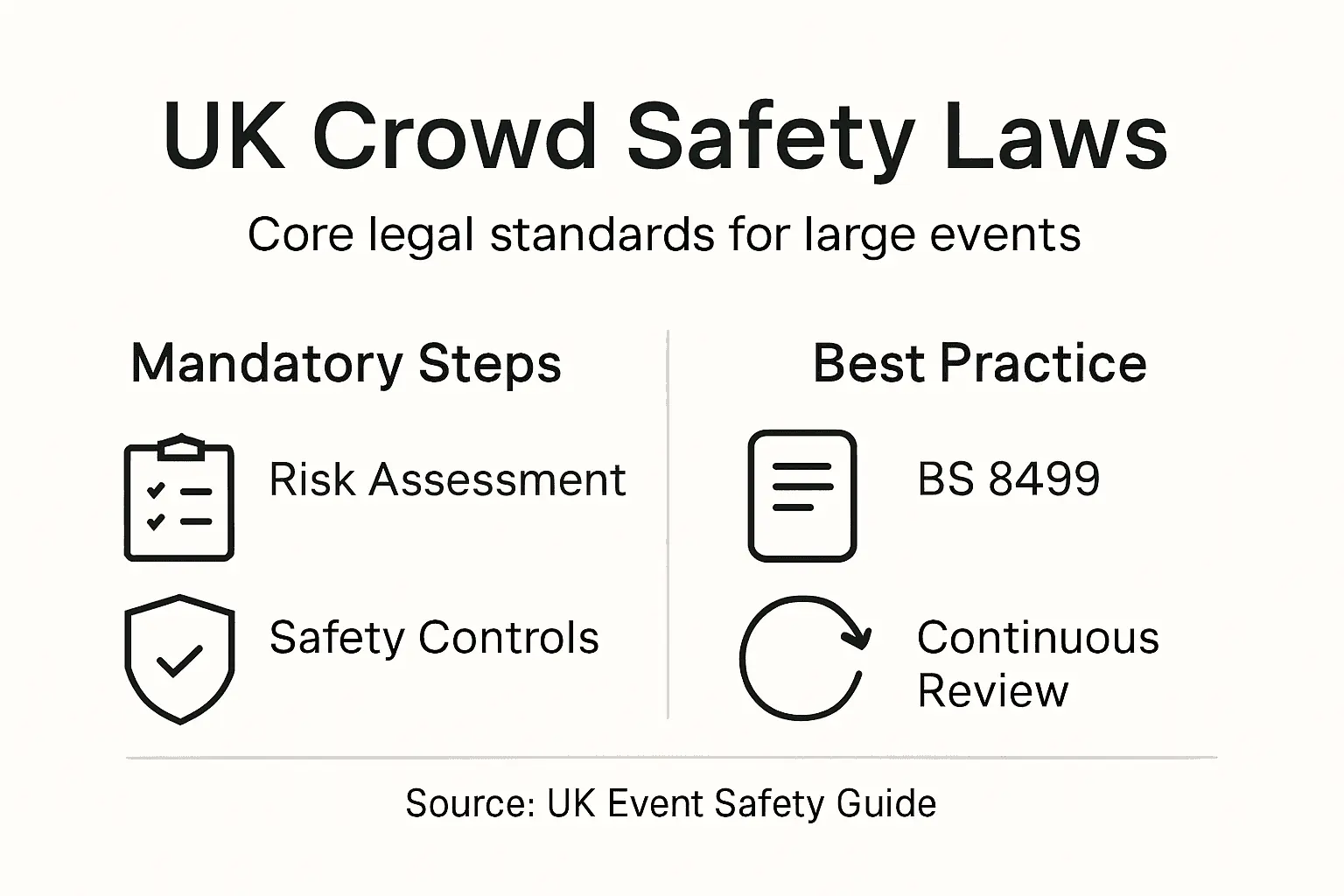
Crowd management in the United Kingdom is governed by a complex framework of legal requirements and industry standards designed to ensure public safety. The Health and Safety Executive guidelines establish critical legal obligations for event organisers and security professionals.
Key legal responsibilities for crowd management professionals include:
- Conducting comprehensive risk assessments
- Implementing appropriate safety controls
- Ensuring clear communication protocols
- Appointing competent crowd management personnel
- Maintaining detailed documentation of safety procedures
The primary legislative frameworks governing crowd management in the UK encompass:
- Health and Safety at Work Act 1974
- Safety of Sports Grounds Act 1975
- Fire Safety Regulations
- Licensing Act 2003
- Civil Contingencies Act 2004
British Standards play a crucial role in defining industry best practices, with BS 8499 providing comprehensive guidance for security risk management. These standards offer structured approaches to assessing, planning, and implementing crowd management strategies across various event types.
Below is a summary of major UK legislative acts and related crowd management duties:
| Legislation | Main Requirement | Typical Application |
|---|---|---|
| Health and Safety at Work Act | Ensure overall event safety | All public events |
| Safety of Sports Grounds Act | Secure sports venues and fans | Football matches |
| Fire Safety Regulations | Establish exit and fire safety systems | Indoor and outdoor events |
| Licensing Act | Obtain correct event licences | Concerts and festivals |
| Civil Contingencies Act | Plan for large-scale emergencies | Major national events |
Legal compliance is not just about following rules, but about creating a proactive safety culture that protects both participants and organisers.
Professional crowd managers must continuously update their knowledge, as regulatory requirements evolve to address emerging safety challenges and technological advancements in crowd monitoring and control.
Pro tip: Regularly review and update your crowd management documentation to ensure ongoing compliance with the latest legal standards and industry guidelines.
Core Responsibilities for Security Personnel
Security personnel play a critical role in maintaining public safety during events, with specific responsibilities defined by industry guidelines. Their duties extend far beyond simple observation, requiring a comprehensive approach to risk management and incident prevention.
Key core responsibilities include:
- Conducting detailed pre-event risk assessments
- Monitoring crowd dynamics and potential tension points
- Maintaining clear communication channels
- Controlling access and egress points
- Responding swiftly to emerging incidents
- Coordinating with emergency services
- Implementing de-escalation techniques
Professional security personnel must demonstrate exceptional situational awareness and adaptability. This requires a multi-faceted skill set that combines physical presence, psychological understanding, and technical knowledge.
The primary operational responsibilities can be categorised into several critical domains:
- Preventative Risk Management
- Real-time Crowd Monitoring
- Emergency Response Coordination
- Legal Compliance Enforcement
- Post-Event Documentation and Analysis
Effective crowd management is not about control, but about creating an environment of safety and mutual respect.
Successful security professionals understand that their role involves more than physical intervention. They must balance assertiveness with empathy, using communication and strategic positioning to prevent potential conflicts before they escalate.
Pro tip: Develop continuous professional training that emphasises both technical skills and interpersonal communication strategies.
Risks, Challenges and Common Mistakes
Crowd management involves navigating complex challenges that can rapidly escalate if not managed professionally. Understanding potential risks is fundamental to preventing safety incidents during events.
Common critical risks and challenges include:
- Unexpected crowd surge dynamics
- Communication breakdowns
- Insufficient emergency planning
- Inadequate staff training
- Technological monitoring failures
- Psychological crowd tension triggers
- Complex spatial management issues
Fundamental mistakes in crowd management often stem from oversimplified assumptions about group behaviour. Security professionals frequently underestimate the complexity of crowd psychology, leading to reactive rather than proactive strategies.
Principal challenges security personnel encounter involve:
- Predicting unpredictable crowd movements
- Maintaining calm during high-stress situations
- Balancing assertiveness with empathy
- Managing diverse crowd demographic interactions
- Implementing rapid response protocols
Effective crowd management requires anticipation, not just reaction.
Professional crowd managers must develop nuanced strategies that recognise crowds as dynamic, intelligent systems rather than uncontrolled masses. This requires continuous training, technological integration, and sophisticated psychological understanding.
Pro tip: Conduct regular scenario-based training that simulates complex crowd behaviour to improve adaptive response capabilities.
Elevate Crowd Safety with Expert Security Talent
Managing the complexities of crowd behaviour and ensuring event safety in the United Kingdom demands more than reactive measures. As highlighted in the article, specialised knowledge in risk assessment, psychological understanding, and flexible response is essential to prevent incidents before they arise. If your organisation aims to build a resilient crowd management team that excels in communication, real-time monitoring, and emergency coordination, sourcing the right security professionals is critical.

Discover skilled crowd management security personnel ready to meet your unique event challenges on The Security Jobs Board. Whether you need experts proficient in legal compliance, technological monitoring, or preventative risk management, our platform connects you quickly with top talent committed to excellence. Start enhancing your event safety protocols today by visiting The Security Jobs Board and take the first step towards smarter, more effective crowd control solutions.
Frequently Asked Questions
What is crowd management?
Crowd management involves understanding human behaviour, anticipating potential risks, and creating safe environments for gatherings, rather than just controlling large groups of people.
What are the key types of crowds in event management?
Key types of crowds include casual crowds, cohesive crowds, spectator crowds, expressive crowds, and potentially aggressive crowds, each requiring specific management strategies.
What legal requirements govern crowd management?
Legal requirements include conducting risk assessments, implementing safety controls, and ensuring clear communication protocols, guided by various legislative frameworks such as the Health and Safety at Work Act 1974.
What are common mistakes made in crowd management?
Common mistakes include underestimating crowd psychology, inadequate emergency planning, and insufficient staff training, which can lead to ineffective and reactive management strategies.


