Insurer Ready UK Site Checklist: CDM 2015 Mapping and Audit Templates
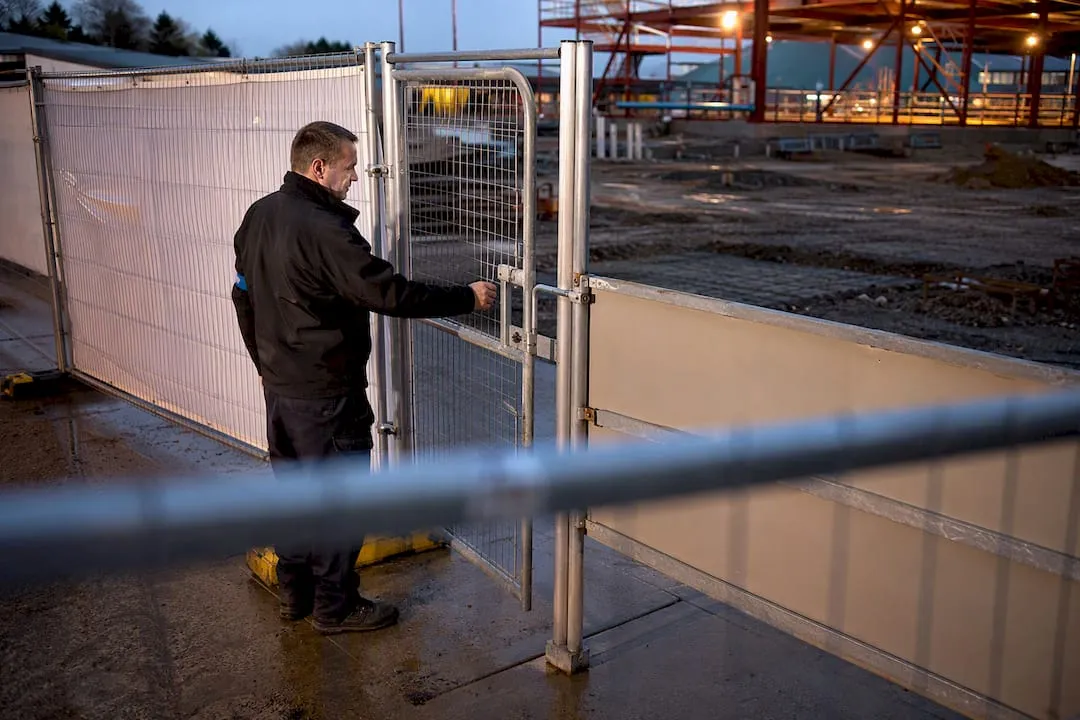
The essential controls are layered, not singular: a written risk assessment, a single controlled entry point, hoarding at least 2.4 metres high, CCTV covering access and storage, immobilised plant, and a documented end-of-day shutdown. Start with the risk assessment. Every other measure on this construction site security checklist flows from what it identifies, and CDM 2015 already makes the client and principal contractor responsible for getting it right.
TL;DR:
- The risk assessment must be reviewed regularly, especially after incidents, phase changes, or high-value asset arrivals, to ensure security measures remain effective.
- Hoarding should be at least 2.4 meters high where justified, with no alcoves, and fitted with anti-tamper locks to prevent forced entry.
- Access control relies on a single entry point with photo ID sign-in, inductions, and removing or immobilising plant and equipment when not in use.
- CCTV cameras should be positioned for recognition-quality footage at key points, avoiding glare and ensuring proper footage retention, with remote monitoring weighed against onsite response.
- Ongoing site security requires regular checks, logging, staff briefings, and a strict end-of-day shutdown process to keep the site secure over time.
Table of Contents
- What should a construction site security checklist cover on a walkthrough?
- Why does a written security risk assessment matter most?
- Perimeter controls: hoarding, fencing, gates and signage
- How do you control who enters a construction site?
- Where should CCTV, alarms and lighting go?
- Securing plant, tools and materials on site
- Manned guarding and patrols: what actually works
- End-of-day and out-of-hours shutdown checklist
- Legal duties, CDM 2015 alignment and insurer expectations
- Where Security Jobs Board’s templates fit into your audit
- Primary sources to keep in your health and safety file
- What the checklist gets wrong if you follow it blindly
- Sources
- FAQ
What should a construction site security checklist cover on a walkthrough?
A walkthrough should follow the same order every time, so nothing gets skipped when you’re rushing between site meetings. Run this sequence daily, and repeat the fuller version weekly or whenever the site changes phase.
- Check perimeter hoarding or fencing for gaps, damage or climbable stacked materials nearby.
- Confirm hoarding height meets the recommended standard where risk assessment justifies it.
- Test every gate lock and hinge for tampering or forced entry.
- Walk the lighting circuit at dusk to spot dead zones around gates and compounds.
- Verify CCTV cameras are aimed correctly and lenses are clean.
- Check that all plant has keys removed, batteries isolated or immobilisers engaged.
- Confirm tool and materials stores are locked and stock matches the asset register.
- Review the sign-in log for gaps or unregistered visitors.
- Inspect site office doors, windows and the fire safe.
- Confirm alarm systems are armed and communicating with the monitoring centre.
Daily checks cover locks, lighting and sign-in. Weekly checks add hoarding integrity and CCTV alignment. Phase changes (groundworks to superstructure, for example) demand a full re-walk. A supervisor should initial and date every check in a logbook, because that record becomes evidence for insurers if something goes wrong.
Why does a written security risk assessment matter most?
CDM 2015 puts the legal weight behind this. The regulations require dutyholders, meaning the client, principal contractor and individual contractors, to prepare and keep under review a construction phase plan that includes proportionate measures against unauthorised access, as HSE’s L153 guidance sets out. A verbal plan does not satisfy that duty. A dated, revisable document does.
The assessment should record:
- Local crime patterns and proximity to footpaths, schools or busy roads
- The resale value and portability of plant and materials on site
- Previous incidents at this or nearby sites
- Site layout weaknesses, such as blind corners or unlit access routes
Review triggers matter more than a calendar date. Reassess after any theft or attempted break-in, at every major phase change, and whenever high-value plant or materials arrive. Security specialists increasingly treat this as a dynamic discipline rather than a one-off exercise, and sites that revisit their assessment at each phase report fewer opportunistic losses than those that file it once and forget it.
Pro Tip: Keep the risk assessment in the same folder as your incident log and asset register. When an insurer asks for evidence after a claim, having all three documents cross-referenced saves days of chasing paperwork.
Perimeter controls: hoarding, fencing, gates and signage
Perimeter design sets the tone for everything else. Metropolitan Police guidance for construction sites recommends treating security as a lifecycle running from hoarding installation through to handover, with hoarding built to at least 2.4 metres where the risk assessment justifies it.
- Avoid alcoves or recessed sections in hoarding lines. They create hiding points for anyone trying to force entry unseen.
- Protect gate hinges with anti-tamper shrouds and fit shrouded, high-security locks rather than standard padlocks.
- Site materials stacks away from the perimeter fence line, since stacked pallets or spoil heaps become makeshift ladders.
- Where the boundary uses fencing rather than solid hoarding, look for products carrying Secured By Design or Sold Secure accreditation, which the police service recognises as preferred standards.
- Post clear signage stating CCTV is in operation and naming the principal contractor, both to deter opportunists and to meet the perimeter identification duty under the regulations.
Regulation 18 of CDM 2015 requires the site perimeter to be identified by suitable signs or fenced off, proportionate to risk, as set out in the Construction (Design and Management) Regulations 2015. A flimsy fence with no signage rarely satisfies that “reasonably practicable” test if challenged after an incident.
How do you control who enters a construction site?
One controlled entry point is the single most effective access control decision you can make. Every other rule here supports that one choice.
- Fit a sign-in system, whether a physical book or a digital tablet app, and require photo ID from every visitor and worker before entry.
- Run inductions for all new starters and contractors, referencing CDM 2015 regulation 13’s requirement that workers be given site-specific information before starting.
- Issue visitor passes with visible expiry, and require a permanent staff member to supervise anyone in a restricted area.
- Check delivery paperwork against the day’s expected schedule before opening gates, and use ANPR cameras at the entrance where vehicle theft or unauthorised deliveries are a known risk.
- Retire access credentials the day a contractor finishes their work package, not weeks later.
A structured onboarding checklist makes this consistent across shifts, particularly on larger sites where several supervisors rotate through gate duty.
Where should CCTV, alarms and lighting go?
Camera placement matters more than camera count. Aim for recognition-quality footage, meaning a face or number plate is identifiable, not just a moving shape, at every access point, materials compound and plant parking area. Metropolitan Police guidance on construction site CCTV recommends positioning cameras to work with lighting rather than against it.
- Cover gates, compound entrances and plant parking first; peripheral fence lines come second.
- Avoid floodlighting that creates glare and white-out on camera footage, particularly with infrared-capable units.
- Decide footage retention periods in line with data protection obligations and the Surveillance Camera Commissioner’s operational guidance before you install anything, not after a theft when you need the recording.
- Weigh remote monitoring against an on-site alarm response. Remote monitoring cuts false-alarm callouts but adds a response delay.
- Log every alarm activation, genuine or false, since a pattern of false alerts often signals a fault worth fixing before it masks a real intrusion.
Plant theft carries costs far beyond the machine itself. Industry white paper analysis found that a single plant theft incident can exceed £250,000 once programme delays and contractual penalties are added to the replacement cost. That figure alone justifies the investment in decent camera coverage over a compound gate.
Securing plant, tools and materials on site
Containers and compounds need the same discipline as the main perimeter. Group high-value tools and materials into a single lockable compound rather than scattering storage boxes across the site, and keep a running inventory with serial numbers against every item.
- Remove batteries or fit wheel clamps and immobilisers on excavators, dumpers and rollers overnight.
- Fit GPS trackers to high-value plant where the asset value justifies the ongoing subscription cost.
- Apply forensic marking such as SmartWater or SelectaDNA, and display the warning decals, since visible forensic marking deters opportunistic theft even before recovery becomes relevant.
- Photograph new deliveries against the asset register the day they arrive.
Pro Tip: Rotate stored materials so the highest-value items sit furthest from the compound gate. Thieves working against the clock target whatever’s nearest the exit first.
Manned guarding and patrols: what actually works
Static guarding, mobile patrols, or a mixed model each suit different sites, and the right choice depends on layout and risk level rather than budget alone. A single static guard on a compact urban site with one entrance often outperforms an unpredictable patrol pattern across a sprawling groundworks site.
- Randomise patrol timing rather than running a fixed hourly loop, since predictable rounds are easy for anyone watching the site to work around.
- Check every third-party guard’s licence under the Private Security Industry Act 2001, since SIA-licensed status is a legal requirement for most contracted guarding roles, though in-house staff can fall under different rules.
- Brief guards clearly on escalation procedures, key contacts and what counts as reportable versus routine.
- Use a guard-tracking or digital logging app so patrol times, findings and incidents are timestamped and auditable later.
A clear supervisor briefing structure keeps this consistent when guarding is handled in-house rather than contracted out.
End-of-day and out-of-hours shutdown checklist
- Lock all gates and confirm hoarding sections are undamaged from the day’s work.
- Secure containers and compounds, and store keys in the site safe, not left with individual operators.
- Remove plant batteries or engage immobilisers across the fleet.
- Arm the alarm system and confirm it’s communicating with the monitoring centre.
- Sign and date the shutdown log, kept alongside the daily walkthrough records.
For extended shutdowns over holidays, add mobile CCTV units, which a deployable surveillance trailer can provide without a permanent installation, remote monitoring subscriptions, and, on high-risk sites, a licensed K9 patrol unit.
Legal duties, CDM 2015 alignment and insurer expectations
Responsibility for security doesn’t sit with one person. Clients, principal designers, principal contractors and individual contractors each hold distinct duties under CDM 2015, and HSE’s L153 guidance expects a proportionate, documented approach rather than a box-ticking gesture.
- Regulation 18 requires perimeter identification by fencing or signage, scaled to risk, not a blanket standard for every site.
- Regulation 13 requires site induction covering hazards and site-specific rules before anyone starts work.
- Keep photographs, incident logs and CCTV footage retained for a sensible period, since insurers routinely ask for this evidence before settling a theft or damage claim.
- BSIA’s own guidance for security procurement is a useful benchmark when specifying manned guarding contracts or technical installations, particularly for larger schemes with multiple subcontractors.
Where Security Jobs Board’s templates fit into your audit
Security Jobs Board’s career advice resources include practical induction and daily-check templates you can adapt directly for site audits, incident logging and end-of-day sign-off. The platform’s GDPR compliance and BSIA affiliation back its credibility for anyone recruiting or briefing security staff. If you’re hiring SIA-licensed guards or supervisors to run these checks, security staff training standards are worth reviewing before you finalise a contract, and roles in Northern Ireland are listed if you’re recruiting locally.
Primary sources to keep in your health and safety file
- NBCC/Metropolitan Police construction site security guidance, the fullest practical lifecycle guide available
- HSE’s L153, for CDM 2015 dutyholder obligations
- BSIA guidance, for procurement and technical standards
- Secured By Design, for police-preferred product specifications
What the checklist gets wrong if you follow it blindly
Most site security guidance treats the checklist as the finish line. It isn’t. A laminated sheet pinned to the site office wall means nothing if nobody revisits the risk assessment when the site moves from groundworks to steel erection, when the compound fills with copper cable, or when a neighbouring site gets hit twice in one month.
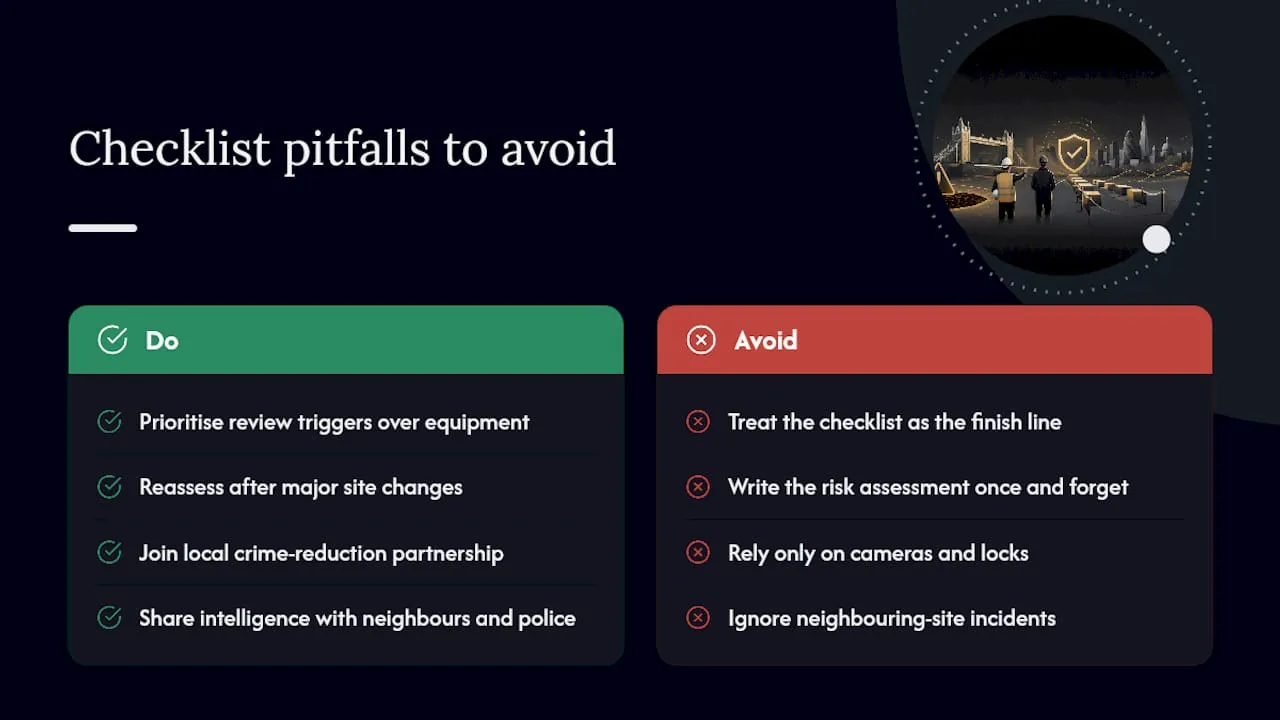
The conventional advice underrates two things: intelligence sharing and review cadence. Joining a local business crime reduction partnership and swapping notes with neighbouring sites and police improves detection of organised theft groups far more than another camera ever will, yet it barely gets a mention in most guides. And a risk assessment written once at project kickoff is close to useless by month six.
If you take one thing from this, prioritise the review trigger over the equipment list. Buy the locks, fit the cameras, brief the guards, but build in a habit of reassessing every time the site changes shape. That’s where insurers, and frankly where thieves, tell you the real gaps sit.
— Rob
Sources
- Construction Site Security guidance (NBCC / Metropolitan Police)
- Managing health and safety in construction (L153) — HSE
- New white paper reveals hidden six-figure cost of plant theft on UK construction
FAQ
What are the security requirements for a construction site?
At minimum, sites need a written risk assessment, a controlled perimeter with signage or fencing under CDM 2015 regulation 18, and proportionate measures against unauthorised access as required by HSE’s L153 guidance.
What are the key items to include in a construction site safety checklist?
Perimeter integrity, gate locks, lighting coverage, CCTV alignment, plant immobilisation, secure storage for tools and materials, a visitor sign-in log, and a documented end-of-day shutdown sequence.
What are the basic safety rules for construction sites?
Core rules include controlled single-point access, mandatory induction before starting work, secured and immobilised plant, monitored CCTV and alarms, locked storage for tools and materials, and daily logged checks signed by a supervisor.
What is the checklist used on a construction site?
It typically covers perimeter hoarding and fencing, access control and sign-in, CCTV and lighting placement, plant and materials security, guarding or patrol records, and an end-of-day shutdown log, all reviewed against the project’s written risk assessment.


