Avoid wasted training: 5 step SIA licence path for UK, not CompTIA
To work as a security guard, door supervisor or CCTV operative in the UK, you need an SIA recognised licence-linked qualification, the right first-aid certificate where the role demands it, and a completed SIA application that clears identity, criminal-record, and right-to-work checks. This article covers that UK physical security licensing route, not CompTIA’s IT and cybersecurity certifications, which are a separate qualification system for computer security professionals.
TL;DR:
- Most licensable roles require a valid SIA front-line license, except for some in-house staff guarding only their employer’s premises, which may not always need a license.
- Candidates must choose the correct qualification, ensure their training and first-aid certificates meet specific standards, and verify their qualification appears on the SIA’s accepted list before applying.
- Renewal now requires mandatory refresher training for security guards and door supervisors, with a valid first-aid certificate needed before starting the process.
- Employers should verify candidates’ qualifications by requesting screenshots of their SIA online accounts and confirm face-to-face first-aid certification before hiring.
- Using dedicated security recruitment platforms, like Security Jobs Board, helps find candidates who can already prove their valid SIA license status quickly and reliably.
Table of Contents
- Which SIA licence you need and when
- Step-by-step pathway: training, first aid, application, checks and timing
- Choosing and checking a training provider and qualification
- Renewals, refresher training and licence switching
- What employers should check before hiring or listing a candidate
- Career progression beyond frontline licensing
- An editorial take on where candidates actually go wrong
- Find compliant security staff faster with Security Jobs Board
- Where to check the rules yourself
- Sources
- FAQ
Which SIA licence you need and when
Not every security role needs a licence, and getting this wrong wastes time and money on the wrong course. The Security Industry Authority splits licensable work into front-line activities, where you interact directly with the public while guarding, patrolling, or supervising licensed premises, and non-front-line roles, such as running a control room without public contact. Gov sets out the full detail, but the practical breakdown looks like this:
- Security guarding: patrolling premises, guarding property, or protecting people, whether uniformed or not.
- Door supervision: controlling entry to pubs, clubs and licensed venues.
- CCTV (public space surveillance): monitoring cameras covering public areas, even remotely.
- Cash and valuables in transit: moving cash or valuables between locations.
- Close protection: guarding a specific individual.
There’s an important exception: in-house staff employed directly by a single business to guard only that business’s own premises don’t always need a licence for certain activities, though door supervision almost always requires one regardless. The SIA issues two licence types, front-line and non-front-line, and most roles advertised through Security Jobs Board sit firmly in the front-line category.
Step-by-step pathway: training, first aid, application, checks and timing
The order matters here. Get it wrong and you’ll pay for training that leaves you unable to apply.
- Pick your licensable activity and confirm the qualification. Decide whether you’re going for security guarding, door supervision or CCTV, then check the SIA’s list of accepted licence-linked qualifications before booking anything, because not every course marketed as “SIA approved” actually appears on that list.
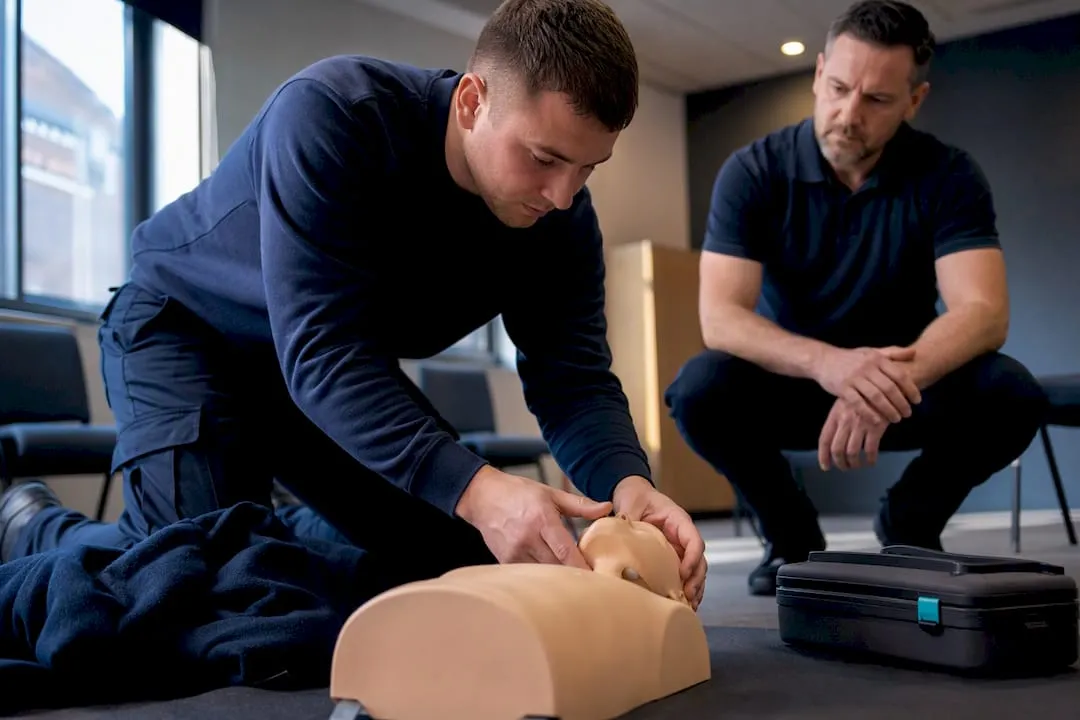
- Secure the correct first-aid certificate. Door supervisors and security guards need a valid Emergency First Aid at Work certificate, delivered face to face with a practical assessment, covering life-threatening bleeding and airway opening as mandatory content.
- Complete your training and confirm it’s recorded. Once finished, check the qualification appears in your SIA online account before applying. It won’t show instantly, so build in a few days’ buffer.
- Apply online and pay the fee. The SIA updated some licensing and ACS fees in 2026, so check the current rate on GOV.UK before you submit, rather than budgeting from an old figure.
- Clear the checks. The SIA runs identity verification, a criminal-record check and a right-to-work check. Meeting all three, alongside holding the right qualification and being 18 or over, is the baseline for any front-line licence.
Pro Tip: Book your first-aid course before your licence-linked training, not after. Turning up to a licensing course without a valid first-aid certificate already in hand is one of the most common reasons candidates delay their own application by weeks.
Decision timescales vary by application volume and how cleanly your documents check out, so treat “a few weeks” as a working estimate rather than a promise, and never assume approval is automatic once you’ve submitted.
Choosing and checking a training provider and qualification
The phrase “SIA approved” gets thrown around loosely by training providers, and it means very little on its own. What matters is the exact qualification title, the awarding organisation, and the date it was awarded, because the SIA’s accepted list changes and can exclude qualifications from certain awarding bodies after a given date — BIIAB awards from mid-2026 onwards being a current example.
Before you hand over any money, run through this:
- Cross-check the precise qualification title against the SIA’s published accepted list, word for word.
- Confirm the awarding organisation is still listed and hasn’t been given a cut-off exclusion date.
- Ask whether practical elements are delivered face to face, since some assessment formats aren’t accepted for licensing purposes.
- Request written confirmation of the qualification title, award date and awarding body, and keep it on file.
Pro Tip: Don’t accept a provider’s word that a course is “fully compliant.” Ask them to point you to the specific line on the SIA’s accepted list, then check it yourself. It takes five minutes and can save you a wasted course fee.
Renewals, refresher training and licence switching
Renewal isn’t just a formality anymore. Refresher training became mandatory in stages: introduced on 1 October 2024 and compulsory for all security guard and door supervisor renewals from 1 April 2025.
A few things to know before you renew:
- Your first-aid certificate needs to be in place and valid before you start refresher training, not after.
- Door supervisors can switch to a security guard licence at renewal if that better fits their next role, without starting the licence-linked training from scratch.
- The SIA generally works to a three-year currency rule on qualifications, and where a previous licence expired less than three years ago, older qualifications may still be accepted for a renewal application.
- If your original qualification isn’t on the current accepted list, the SIA can consider an equivalent substitute, but it will assess recency and equivalence rather than accept it automatically.
What employers should check before hiring or listing a candidate
Hiring someone who can’t legally work a licensable role is an expensive mistake, and it’s entirely avoidable with a few checks before an offer goes out.
- Verify the qualification directly. Ask the candidate for a screenshot of their SIA online account showing the qualification recorded under “My qualifications.” This is the only reliable instant proof that the training has actually registered with the SIA, rather than just been completed.
- Check first-aid validity and delivery mode. Confirm the certificate is current and was delivered face to face with practical assessment, not purely online.
- Confirm licence status and who pays what. Establish whether the licence is already active or pending, and agree upfront who covers the application fee if it’s outstanding.
- Retain ID and right-to-work documents. Keep copies on file as part of your own compliance record, separate from what the SIA holds.
Career progression beyond frontline licensing
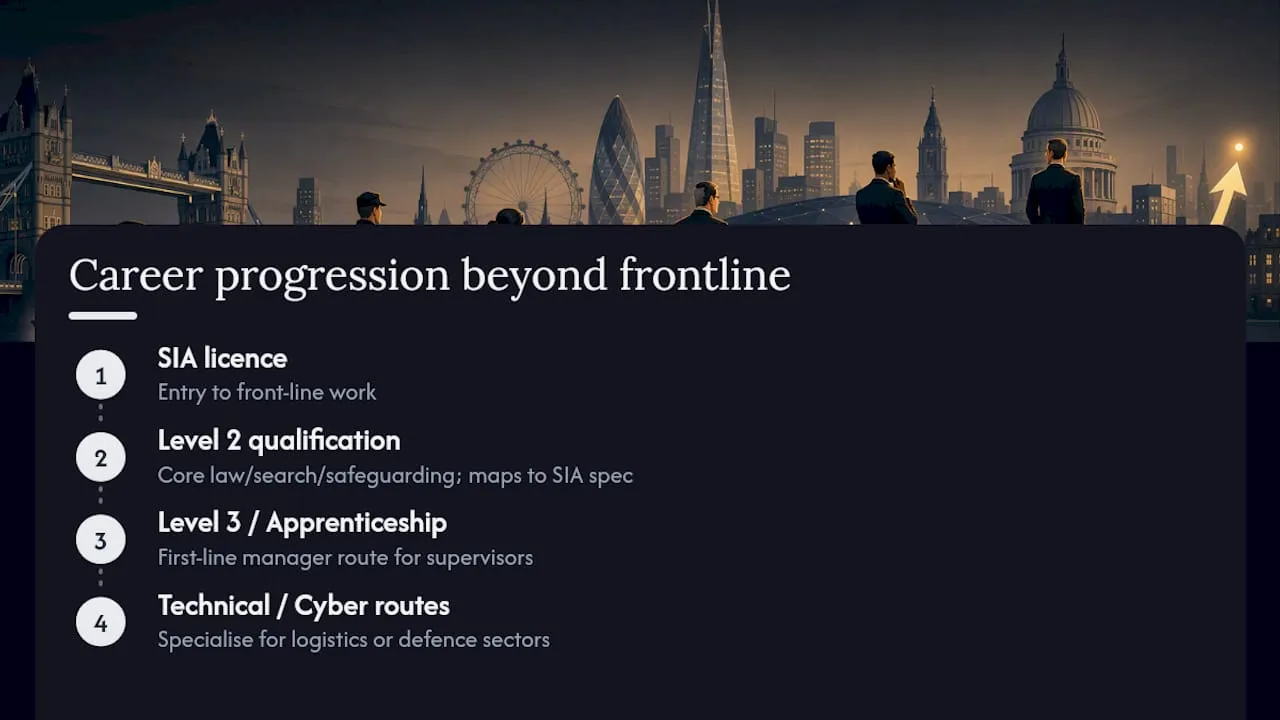
An SIA licence gets you into front-line work, but it isn’t the ceiling. Level 2 security operative qualifications build the same core knowledge, covering law, search procedures, emergency response and safeguarding vulnerable people, and they map onto the SIA’s common knowledge and skills specification that underpins licence-linked training in the first place.
For anyone aiming at supervisory or management roles, Level 3 first-line manager qualifications and the professional security operative apprenticeship standard offer a structured route upward. These don’t replace your licence-linked qualification for front-line work. They sit alongside it, and they matter most for control room supervision, cash-in-transit team leadership, or general management progression. Some operatives also move toward more technical security disciplines entirely, where cyber-facing certification routes for logistics and defence sectors become relevant.
An editorial take on where candidates actually go wrong
The paperwork trips people up more often than the training does. Most candidates who fail to get licensed on time haven’t skipped a step through laziness. They’ve assumed a course was accepted because the provider said so, or booked first aid after their licensing course rather than before it, and ended up stuck waiting on evidence that should have been sorted weeks earlier.
The direction of travel is towards more consistency: mandatory refreshers, tighter first-aid content rules, and awarding-organisation cut-off dates that punish anyone who didn’t check the accepted list. Upload your qualification evidence the moment it’s available, don’t wait for an employer to ask. If you’re hiring, use Security Jobs Board to find candidates who can already show that evidence, or list your vacancy requirements clearly so applicants know exactly what they need before they apply.
— Rob
Find compliant security staff faster with Security Jobs Board
Security Jobs Board is the alternative to sifting through generic job sites for candidates who can actually prove their SIA licence status. Every profile on the platform sits within a sector built specifically for security recruitment, so you’re not filtering out hospitality CVs and warehouse applications to find one door supervisor with a valid licence.

Candidates create a free profile, upload their CV, set job alerts, and apply directly to roles like security guard positions while they’re still finishing licensing steps. Employers get access to Standard listings, Featured ads, and multi-role campaign packages on the employer landing page, plus a CV access plan for browsing candidates directly. The platform’s BSIA affiliation and GDPR-compliant design give both sides a level of trust that generic job boards don’t offer. If you’re recruiting for licensable roles, post your vacancy on Security Jobs Board today and start reviewing candidates who already understand what evidence you’ll need to see.
Where to check the rules yourself
Every requirement in this guide traces back to a specific official document, and it’s worth bookmarking these rather than relying on secondhand summaries. Start with GOV.UK’s guidance on applying for an SIA licence and the accepted training list, then check the first-aid training requirement document and the current fee notice. For sector context, see Security Jobs Board’s guide to the Security Industry Authority and UK regulation.
Sources
FAQ
Do I need a licence for every security job in the UK?
No. You only need an SIA licence for licensable activities such as security guarding, door supervision, CCTV monitoring of public spaces, cash in transit, or close protection. Some in-house roles guarding only your own employer’s premises are exempt from certain licence requirements, though door supervision almost always requires one regardless of employment type, as set out in GOV.UK’s licensing guidance.
How long does the SIA licence application take?
Timing depends on how quickly your qualification appears in your SIA online account and how smoothly your identity, criminal-record and right-to-work checks clear, so treat any fixed number with caution. Building in a buffer of several weeks between finishing training and needing to start work is sensible rather than assuming next-day approval.
What first-aid certificate do I need for a door supervisor or security guard licence?
You need a valid Emergency First Aid at Work certificate, delivered face to face with a practical assessment, covering content on life-threatening bleeding and airway opening. Purely online first-aid courses without a practical, in-person component aren’t accepted for this requirement.
Is refresher training compulsory for renewing my SIA licence?
Yes, for front-line security guard and door supervisor renewals. It was introduced on 1 October 2024 and became mandatory for renewals from 1 April 2025, and your first-aid certificate needs to be valid before you start the refresher.
Does Security Jobs Board help me confirm a candidate’s licence is genuine?
Security Jobs Board connects employers with candidates who have uploaded their profile and CV directly to the platform, giving you a clearer starting point than a generic job site. You should still ask candidates for a screenshot of their SIA online account showing the recorded qualification, since that remains the most reliable way to confirm licensing status before you hire, and you can post your requirements clearly via the employer page.


