Apply for Security Guard Jobs in the UK While Training

Yes, you can apply for a security guard job right now if you’re 18 or over, have the right to work in the UK, and hold (or are working towards) an SIA licence-linked qualification. Your first move should be booking a valid first aid certificate if you don’t already have one, then registering for an SIA online account so your training can be linked to it once complete. Some employers cover the licence fee or handle the application for you, which is worth asking about before you spend a penny.
TL;DR:
- Securing an SIA license requires booking a valid first aid course beforehand, registering an online account, and completing approved security training with recognized providers.
- Application processing usually takes about 25 working days, but delays often occur during DBS, identity, and address checks, making accuracy vital.
- Roles needing a front-line license include security guarding, door supervision, CCTV operation, cash and valuables transit, and key holding, with some supervisory positions requiring a non-front-line license.
- Applying early and building your CV while training can significantly speed up hiring, especially by using sector-specific job boards that filter roles by license type and location.
- Employers may cover license fees or apply on your behalf, and honesty about your identity and criminal record is critical to avoid application delays.
Table of Contents
- Ordered checklist: how to move from zero to application-ready
- What the SIA licence covers and who needs it
- Which qualifications and first aid you need before applying
- Practical guide to completing the SIA online application
- Where to search and how to apply so you win interviews
- How Security Jobs Board helps candidates
- Authoritative links to GOV.UK, SIA and internal how-to pages
- Why the standard advice on applying gets the order wrong
- Getting hired faster with the right platform behind you
- Sources
- FAQ
Ordered checklist: how to move from zero to application-ready
Getting from a standing start to a working SIA licence follows a fixed sequence, and skipping steps out of order almost always causes delays.
- Check eligibility. Confirm you’re 18 or over and can prove your right to work in the UK.
- Book first aid. Most licence-linked courses require a valid first aid certificate, such as Emergency First Aid at Work, before training starts.
- Enrol on a licence-linked course. Pick a course matched to the licence you need, front-line security guarding is the most common route.
- Wait for your qualification to register. Once training is complete, check your SIA online account until it appears under “My qualifications”, then submit your licence application.
- Complete the identity and payment steps. This includes a Post Office ID check, a DBS check, and paying the licence fee, unless your employer is covering it.
Straightforward applications typically take around 25 working days to process, though the SIA’s own Decision Timescale Indicator gives the most current estimate for your case. Employers who are SIA approved contractors sometimes apply on your behalf, which cuts out a chunk of this admin entirely.
What the SIA licence covers and who needs it
An SIA licence is the legal permission slip for working in most security roles in the UK. You must be at least 18, have the right to work in the UK, and hold a front-line SIA licence for the vast majority of manned guarding positions.
The licensable activities cover more ground than most people expect:
- Security guarding (retail, corporate, static site work)
- Door supervision (pubs, clubs, licensed venues)
- CCTV operation (“public space surveillance”)
- Cash and valuables in transit
- Key holding
- Vehicle immobilisation, though this one only applies in Northern Ireland
Not every role needs a front-line licence. Some management and supervisory positions in the security industry qualify for a non-front-line licence instead, which applies when you’re overseeing licensable activities rather than carrying them out yourself on site.
Before issuing any licence, the SIA runs its own checks regardless of which category you’re applying for: your age, your identity, your criminal record, and your right to work in the UK. These aren’t formalities; a failed check on any one of them stops the application dead, so it pays to get your paperwork right the first time rather than rushing the form.
Which qualifications and first aid you need before applying
The SIA doesn’t accept just any security course. It works from a defined list of licence-linked qualifications delivered through recognised awarding organisations, and Highfield, Pearson, QNUK, BIIAB, SFJ Awards, and NOCN are among the names you’ll see most often on GOV.UK’s approved list.
Before you can even start that training, you need a valid first aid certificate, usually Emergency First Aid at Work or an equivalent. It has to be current on the day training begins, not just current when you apply for the licence, so timing matters.
Two things trip people up here:
- Qualifications carry a three year validity window, after which refresher training is required to keep your licence current.
- Refresher training became mandatory on a phased basis between 2024 and 2025, so older certificates that used to slide through renewal may no longer qualify without it.
Pro Tip: Book your first aid course before you book your security training, not after. Training providers will often turn you away at the door if your first aid certificate hasn’t been issued yet, and last-minute bookings for both courses in the same week rarely line up.
Practical guide to completing the SIA online application
The SIA process runs entirely through your personal online account, and the order you do things in matters more than most guides let on.
- Register your account on the SIA services portal before you finish training, so it’s ready the moment your qualification lands.
- Wait until your qualification appears under “My qualifications” in that account. Applying before it shows up is one of the most common causes of a rejected application.
- Gather your documents: proof of identity, a five year address history, and your qualification certificate.
- Complete the Post Office identity step. You’ll likely need to attend in person with original documents and have a photo taken as part of the process.
- Decide who pays. Confirm with your prospective employer whether they’ll cover the fee or handle the application through their own SIA-approved contractor account, which avoids you submitting a duplicate application.
- Pay the fee and respond fast to “next steps” messages. Slow replies are a leading cause of applications stalling or being withdrawn.
Decision timescales sit around 25 working days for straightforward cases, but the DBS and address history checks are where most delays happen, mainly through minor inconsistencies rather than genuine problems. Being upfront and accurate about your address history and any record you’re declaring genuinely is the single biggest thing you control here.
Where to search and how to apply so you win interviews
Your CV for a security role doesn’t need to be long, it needs to lead with the right facts. Put your SIA licence status (or expected date), first aid certificate, and availability in the first few lines, then back it with one short evidence line about a relevant work situation you’ve handled well.
Skip the generic cover letter template. A two or three line cover note that mirrors the language in the job advert (shift patterns, site type, specific licence required) does more work than a full page of stock phrases.
On where to look:
- Specialist security job boards, such as Security Jobs Board, which list roles specifically matched to your licence type and location rather than burying them in generic listings.
- Direct applications to security contractors and in-house employer teams.
- Recruitment agencies that specialise in the sector.
Sector-focused boards tend to save time because every listing already assumes an SIA licence is part of the deal, so you’re not filtering out irrelevant retail or hospitality roles. For interview prep, expect ID and licence checks at the door and be ready to talk through a couple of scenario examples, how you’d handle a conflict situation or an access control breach, since that’s usually where interviewers focus.
How Security Jobs Board helps candidates
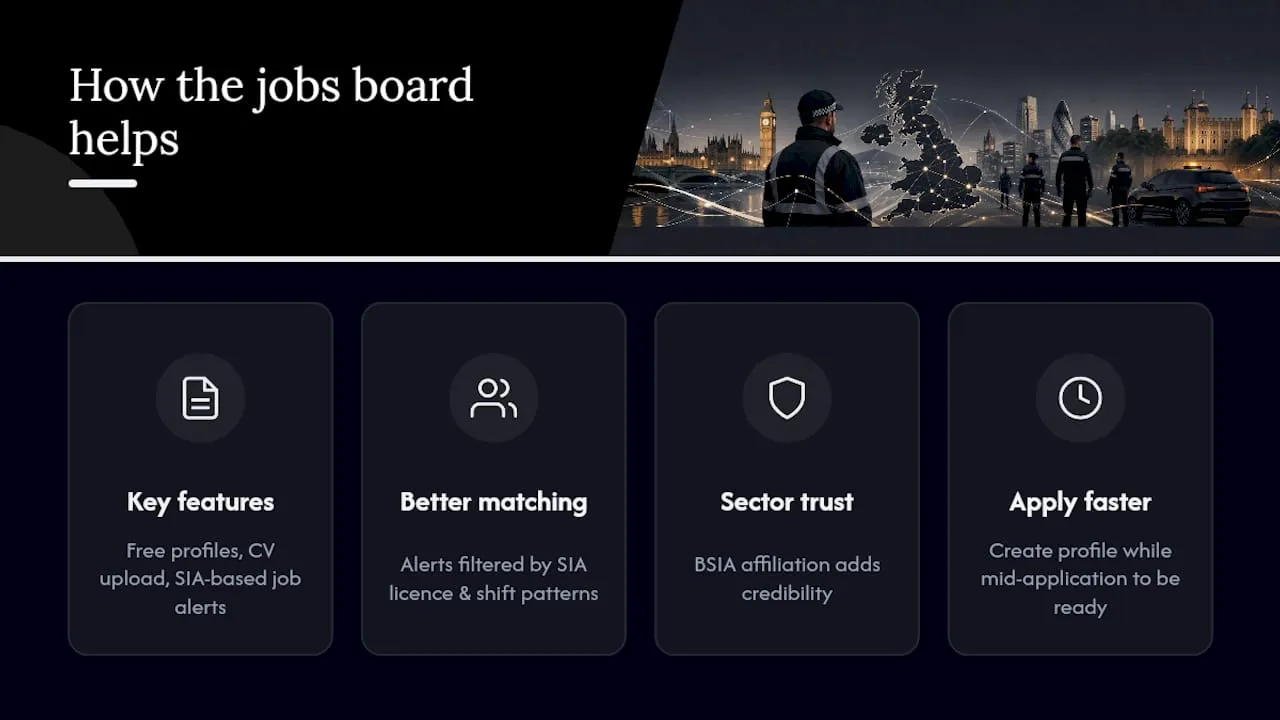
Specialist security job boards give jobseekers free profiles, CV upload, and job alerts built around SIA licence types and shift patterns, so listings better match qualifications rather than just postcode. The platform’s BSIA affiliation adds a layer of sector credibility that generic job boards can’t offer. If you’re mid-application for your licence, setting up a profile now means you’re ready to apply the moment your qualification lands.
Authoritative links to GOV.UK, SIA and internal how-to pages
Confirm every rule, fee, and timescale directly with the source before you act on it. Start with GOV.UK’s SIA licence guidance and the training requirements page, then register through the SIA services portal itself. For a step-by-step breakdown tailored to first-time applicants, Security Jobs Board’s own licence checklist and career advice guide cover the same ground in more practical detail.
Why the standard advice on applying gets the order wrong
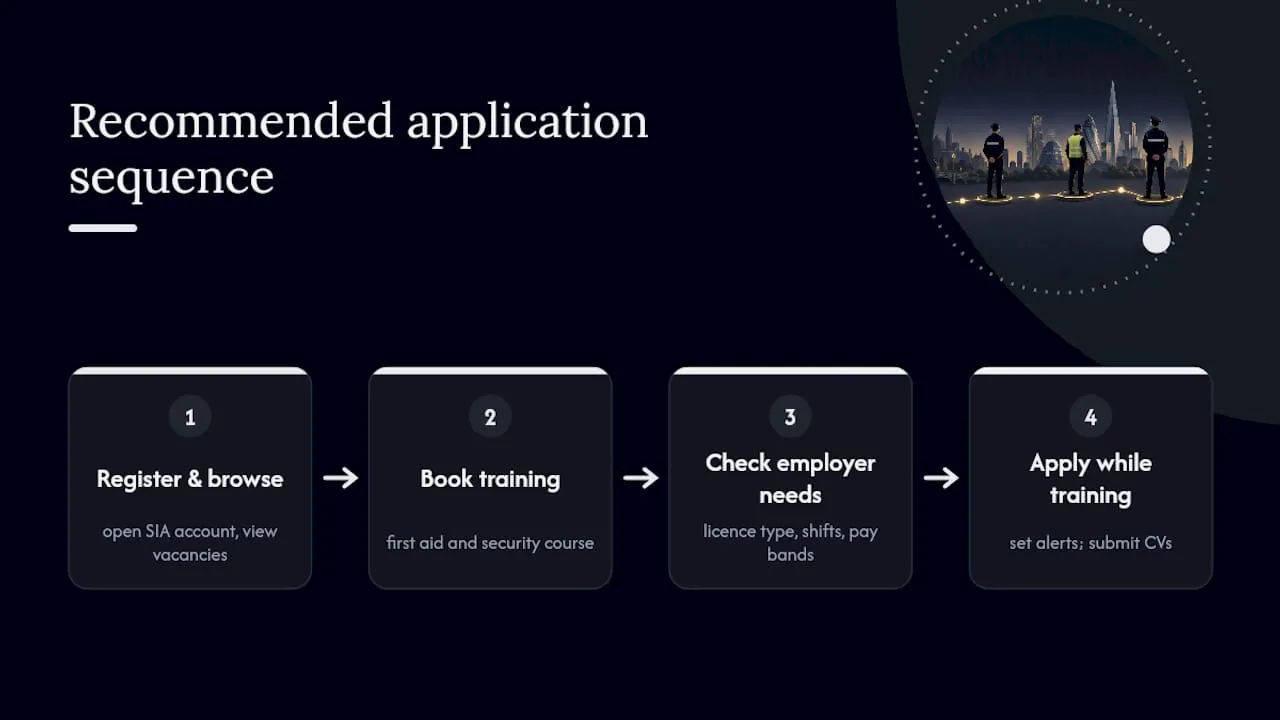
Most guides on this topic treat the SIA licence and the job search as two separate projects, sort your licence out, then go looking for work. That’s backwards for most candidates. The smarter sequence is to register your SIA account and start browsing live vacancies at the same time you’re booking first aid and training, because sector-focused job boards will show you exactly what employers in your area are asking for right now, licence type, shift patterns, pay bands.
The other thing conventional advice underplays is honesty on the DBS and address history checks. It’s treated as a formality in most articles, but inconsistencies here are one of the most common reasons applications stall for weeks. Get that paperwork accurate before you submit, not after a rejection forces a resubmission.
If there’s one priority above the rest, it’s this: don’t wait for your licence to arrive before you start applying. Build your CV, set up job alerts, and get in front of employers while your training is still in progress. The candidates who move fastest into work are usually the ones running both tracks at once, not waiting for a licence number before they lift a finger.
— Rob
Getting hired faster with the right platform behind you
Some specialist platforms are built specifically for candidates navigating this process, licensed and licence-in-progress alike, rather than general job sites where security roles can be hard to find.

Listings matched to SIA licence type and location rather than keyword guesswork can reduce time spent filtering irrelevant roles and increase time applying to suitable ones. Profile creation, CV upload, and job alerts are commonly free for candidates on specialist platforms, and affiliation with sector bodies can mean employers posting are recognised names, not anonymous listings. If you’re based in Northern Ireland, the site’s dedicated regional listings are worth checking directly given the added vehicle immobiliser licence category there. Set up your profile now and browse the career advice hub for guidance tailored to wherever you are in the licensing process.
Sources
FAQ
What qualifications do I need to become a security guard?
You need a licence-linked qualification from an SIA-approved awarding organisation such as Highfield, Pearson, or BIIAB, plus a valid first aid certificate completed before your training begins.
How do I start a career as a security guard?
Book first aid, enrol on a licence-linked training course, register for an SIA online account, and apply for your licence once your qualification appears under “My qualifications”.
How do I apply for security guard jobs in the UK?
Register a free profile on a specialist platform like Security Jobs Board, lead your CV with your SIA licence status and availability, and apply directly to roles matched to your licence type.
How do I write an application letter for a security guard role?
Keep it to two or three lines, state your licence status or expected date, your first aid certificate, and one short line of relevant evidence that mirrors the language used in the job advert.
How long does an SIA licence application take to process?
Straightforward applications typically take around 25 working days, though the SIA’s Decision Timescale Indicator gives the most current estimate for your specific case.


