Why flexible hiring matters for UK security employers

TL;DR:
- Flexible hiring improves recruitment and retention in the UK security sector by addressing barriers like low pay and unsociable hours. Implementing flexible practices and technology cuts vacancy days, reduces costs, and broadens the candidate pool including carers and returners. Proper legal checks and staged rollout ensure compliance while building workforce resilience and adaptability.
Flexible hiring materially improves recruitment, retention and operational resilience in the UK security sector. The GOV.UK sector profile identifies lack of flexibility as a direct barrier to recruitment and retention in security guarding, alongside unsociable hours and low pay. Tackle flexibility and you address two of those three barriers at once.
Three things to do right now:
- Audit your current roles for where flexibility is operationally feasible.
- Pilot one flexible model on a single site or role type for 60 days.
- Embed what works into contracts and rostering before scaling.
Pro Tip: State flexible working terms explicitly in job adverts. Roles that name shift-swap options or part-time availability attract applications faster than those that leave hours ambiguous.
Table of Contents
- Why does flexible hiring matter so much in UK security?
- What business benefits can employers expect from flexible hiring?
- Why does flexible hiring matter to security jobseekers?
- What does flexible hiring look like in practice for security roles?
- How can employers introduce flexible hiring step by step?
- What UK legal and compliance checks must you make first?
- What do recruiters and platform data show about flexible hiring?
- How do you measure whether flexible hiring is working?
- Key takeaways
- A perspective on flexible hiring in UK security
- Securityjobsboard helps you hire flexibly, without the agency fees
- Useful sources and further reading
- FAQ
Why does flexible hiring matter so much in UK security?
The security guarding sector carries structural pressures that make the importance of flexible hiring hard to overstate. Turnover in some organisations runs extremely high, and average hiring times stretch to several weeks — far too slow when a site needs cover by Monday morning. SIA licensing adds another constraint: the Security Industry Authority processes a large number of licence applications monthly, yet demand consistently outstrips supply, meaning quality candidates have options and will choose employers who move quickly.
Since the pandemic, hybrid working has become a baseline expectation for supervisory and administrative security roles; detailed examples of such flexibele werktijden in de industrie demonstrate practical applications in workforce management. Frontline guarding is different: a static guard cannot work from home, and the GOV.UK flexible working consultation explicitly acknowledges that not all flexibility is feasible in all roles. The practical opportunity lies in matching the right model to the right role type, rather than applying a blanket policy.
Key sector pressures driving the need to adapt hiring practices:
- High turnover inflates retraining and agency spend year on year.
- SIA licence scarcity means licensed candidates can be selective.
- Unsociable hours deter applicants unless offset by scheduling autonomy.
- Post-pandemic expectations have shifted permanently for office-based security functions.
What business benefits can employers expect from flexible hiring?
Employers who treat flexibility as a strategic operational necessity rather than emergency cover see measurable gains across three areas: cost, resilience and diversity.
Vacancy days fall when adverts are specific about flexible options, because the candidate pool widens immediately. Emergency and subcontractor rates can run significantly above standard employment costs; a pre-vetted on-demand pool cuts reliance on those rates. Over a 12-month horizon, lower churn also reduces the onboarding and retraining spend that quietly drains security budgets.
Resilience is the less-discussed advantage. A managed pool of pre-vetted, SIA-licensed staff who have already completed site inductions can be mobilised within hours, not weeks. That turns a Friday-afternoon sick-call from a crisis into a routine operational decision.
Flexibility also widens the candidate pool to include carers, returners and those seeking second incomes — groups that are often overlooked but bring reliability and commitment. Advertising roles with non-standard hours as a feature, not an afterthought, is one of the fastest ways to attract top security talent in a tight market.
Why does flexible hiring matter to security jobseekers?
From a candidate’s perspective, flexibility is often the deciding factor between two otherwise comparable roles. Carers, students and those managing second incomes need scheduling predictability or the ability to swap shifts without penalty. Part-time and term-time contracts open security work to people who simply cannot commit to full-time unsociable hours.
For those already in the industry, hybrid or part-time supervisory roles offer a genuine career step. Managing a small team two or three days a week while retaining frontline availability keeps skills current and builds a CV without requiring a full management transition.
What to look for in a flexible security job advert:
- Clear statement of contracted hours and any variation clause.
- Rostering policy: how far in advance shifts are confirmed.
- Training and induction support, especially for new sites.
- Whether SIA licence renewal costs are supported by the employer.
Pro Tip: If an advert says “flexible hours” without specifying what that means, ask at application stage. Employers who have thought it through will answer clearly; those who haven’t will tell you something useful about how they operate.
What does flexible hiring look like in practice for security roles?
The model has to fit the role. A one-size approach fails quickly in security, where operational requirements vary sharply between a static retail guard and a security operations centre analyst.
Shift-swapping and on-demand pools suit frontline guarding. The key is front-loading: pre-vetting, site-specific inductions and role checklists completed before anyone is deployed. Without that groundwork, speed comes at the cost of standards.

Part-time and term-time contracts work well for roles with predictable low-demand windows, such as corporate reception security during school holidays or weekend retail cover.
Job-share for static guarding is underused but viable where two officers share a post across a week, each holding full SIA licensing and site clearance. Handover protocols need to be written, not assumed.
Hybrid working for supervisors and security-ops roles is now a candidate expectation. For technical and supervisory positions, candidates expect no more than two or three days on-site; insisting on five will lose them to employers who don’t.
Technology makes all of this manageable. Real-time availability dashboards, automated SIA licence verification and digital credential stores reduce the administrative burden that puts many security managers off flexible models. See best hiring tools for the security industry for a current overview of platforms that support these functions.
How can employers introduce flexible hiring step by step?
A phased approach prevents the common mistake of rolling out flexibility across all roles simultaneously before the infrastructure is ready.
- Role audit (Week 1–2). Categorise every role by flexibility feasibility: full flexibility, partial (shift-swap only), or operationally fixed.
- Stakeholder consultation (Week 3–4). Talk to existing staff before announcing changes. Government guidance encourages employers to explore what is possible collaboratively rather than defaulting to refusal.
- Pilot design (Week 5–6). Select one site or role type. Define the model, the duration (60 days is workable) and the KPIs you will track.
- Contractual updates (Week 7–8). Amend contracts to reflect new arrangements. Take employment law advice before issuing changes to existing contracts.
- Rostering and tech setup (Week 8–10). Implement scheduling tools and licence-check automation before the pilot goes live.
- Training and induction (Week 10–12). Run site-specific inductions for all pool members in advance. Pre-vetting here is what separates a functioning flexible pool from an ad hoc scramble.
Track four KPIs weekly during the pilot: vacancy days, overtime spend, agency hours and retention rate. Review monthly against pre-pilot baselines. The short-term set-up cost — technology, legal review, additional induction time — is typically recovered within two to three months through reduced agency spend alone.
Pro Tip: Build a simple one-page brief for each flexible role type: hours range, site requirements, SIA licence category needed, and handover procedure. Distribute it to pool candidates before their first deployment.
What UK legal and compliance checks must you make first?
Changing working patterns without checking the legal framework first is a genuine operational risk.
- Flexible working rights. All employees have a statutory right to request flexible working. From 2027, a reasonableness test will require employers to accept requests that can reasonably be met. Employers must now consult before rejecting any statutory request.
- Working Time Regulations. Part-time and shift-swap models must comply with the 48-hour weekly limit (unless opted out), rest period requirements and holiday entitlement calculations. Check GOV.UK for current thresholds.
- SIA licensing. Every frontline officer must hold a valid SIA licence for the activity they perform. Licence category, expiry date and right-to-work status must be verified before each deployment, not just at hire.
- DBS checks. Enhanced DBS checks are required for many security roles. Confirm the correct level for each role type and build renewal reminders into your HR system.
- Data protection. Storing digital credentials and availability data requires GDPR-compliant systems. Confirm your platform’s data-handling policy before uploading candidate records.
- Contractual changes. Altering hours or location for existing employees requires their agreement. Unilateral changes can constitute a breach of contract.
For detailed guidance on flexible work in security, including contract and compliance considerations, consult a qualified employment solicitor alongside GOV.UK resources.
What do recruiters and platform data show about flexible hiring?
Recruiters are consistent on one point: salary is now table stakes. What differentiates an employer in 2026 is autonomy, career development and a credible flexible working offer. Candidates who receive two comparable salary offers will choose the employer whose advert was clearer about scheduling and whose hiring process was faster.
Securityjobsboard data reflects this. Adverts that state flexible working terms explicitly — shift-swap availability, part-time options, hybrid for supervisory roles — generate faster candidate matches than those that leave hours vague. Employers using the CV database filters to target candidates who have flagged availability for non-standard hours reach shortlists more quickly than those posting generic adverts and waiting.
A pattern seen repeatedly on the platform: a security company piloting part-time supervisory roles on a single contract site, with clear advert copy and a two-stage hiring process, reduced vacancy days significantly and retained those hires at a higher rate than their full-time equivalents over six months.
Pro Tip: Use candidate job alerts on Securityjobsboard to reach security professionals who are actively monitoring for flexible roles. They apply faster and convert at a higher rate than passive candidates reached through generic job boards.
How do you measure whether flexible hiring is working?
| KPI | What it tells you | Reporting cadence |
|---|---|---|
| Time-to-fill | Speed of hiring vs. pre-pilot baseline | Weekly |
| Vacancy days | Unfilled shift hours across the contract | Weekly |
| Agency spend | Cost of external cover as a percentage of total staffing | Monthly |
| Overtime hours | Indicator of understaffing or poor rostering | Weekly |
| Retention at 3/6/12 months | Whether flexible hires stay longer than standard hires | Monthly/quarterly |
| Candidate satisfaction | Exit survey or post-placement check-in score | Per hire |
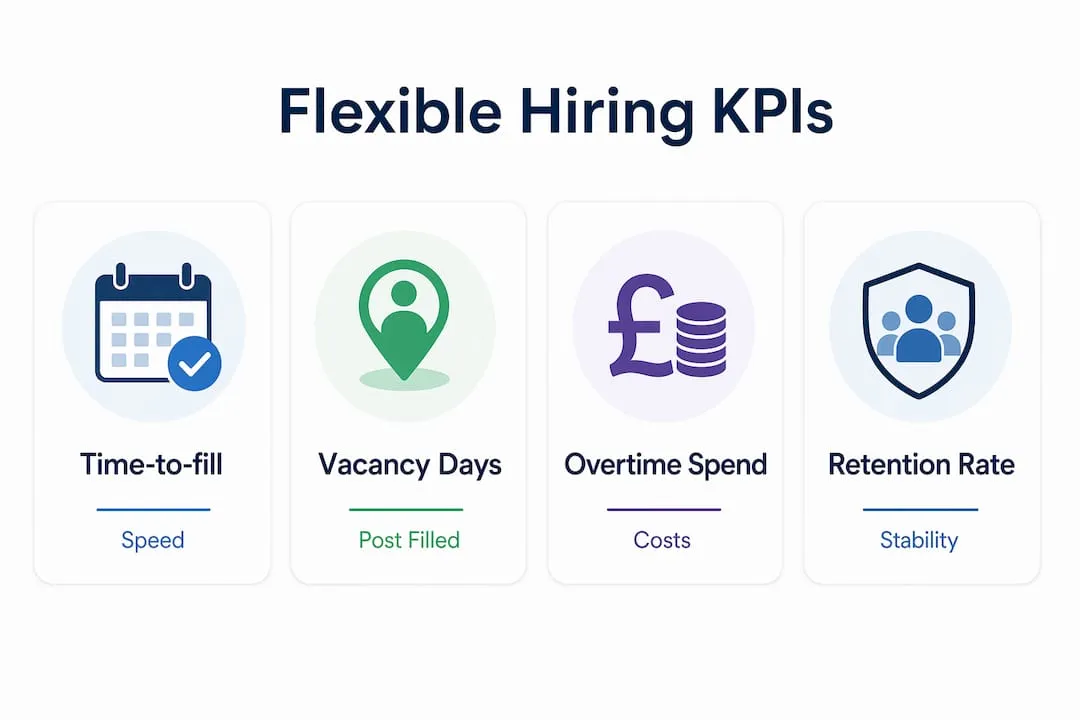
Interpret signals quickly. If vacancy days fall but overtime rises, the model is filling posts but not at sufficient volume. If retention at three months is strong but drops at six, the issue is likely rostering quality or lack of progression. Reallocate the agency spend you save into induction and scheduling technology — that is where the compounding return sits.
For practical tactics on reducing employee turnover in security roles, the Securityjobsboard blog covers the specific levers that move retention numbers.
Key takeaways
Flexible hiring reduces vacancy time, lowers agency spend and improves retention in the UK security sector when implemented with proper vetting, clear contracts and the right technology.
| Point | Details |
|---|---|
| Audit roles first | Not every security role suits the same flexibility model; categorise before piloting. |
| Front-load vetting | Pre-vetted, SIA-licensed pools deploy faster without compromising standards. |
| Legal check is non-optional | The 2027 reasonableness test and existing Working Time Regulations apply to all changes. |
| Measure four KPIs | Track vacancy days, agency spend, overtime and retention weekly during any pilot. |
| Securityjobsboard supports flexible hiring | Targeted adverts, CV filters and candidate alerts help employers fill flexible roles faster. |
A perspective on flexible hiring in UK security
The conversation about flexible hiring in security tends to get stuck in two unhelpful places: either it is treated as a crisis-management tool (scrambling for cover when someone calls in sick) or dismissed as impractical because “guards have to be on site.” Both framings miss the point.
The real opportunity is structural. Employers who build pre-vetted pools, write honest adverts and invest in scheduling technology are not just filling shifts faster. They are building a workforce that is harder to poach, cheaper to maintain and more resilient under pressure. The security companies still treating flexibility as an exception rather than a design principle will find themselves losing licensed candidates to those who have made it the default.
The GOV.UK reasonableness test arriving in 2027 will force the issue for employers who have been slow to act. Better to build the capability now, on your own terms, than to retrofit it under legal pressure.
Securityjobsboard helps you hire flexibly, without the agency fees
Posting a flexible security role through a generic job board means competing with thousands of unrelated listings and paying for candidates who have never held an SIA licence. Securityjobsboard is built specifically for the UK security sector: every candidate on the platform is there because they work in, or want to work in, security.

Employers can filter the CV database by licence type, availability and location, then reach candidates directly. Job alerts notify security professionals the moment a matching flexible role is posted, which cuts the time between advert and shortlist. Human support is available if you need help writing advert copy that attracts flexible candidates quickly. Pricing is transparent, with no long-term contracts required.
Post your first flexible role on Securityjobsboard and see how quickly a well-written, flexibility-forward advert fills.
Useful sources and further reading
- GOV.UK: Recruitment and retention in the security guarding sector — the authoritative sector profile identifying flexibility, pay and career pathways as the three levers for improving recruitment and retention.
- GOV.UK: Make Work Pay — flexible working consultation — full detail on the Employment Rights Act reforms, the reasonableness test due in 2027, and the new consultation process employers must follow.
- Security Industry Authority (SIA) — licence categories, application status, right-to-work checks and enforcement guidance. Consult before deploying any frontline officer.
- British Security Industry Association (BSIA) — industry standards, sector data and guidance on workforce management and vetting (including BS7858).
- Securityjobsboard — employer tools and flexible role adverts — CV database, targeted advert options and candidate alerts for the UK security sector.
This guide is general information for employers and jobseekers in the UK security industry. It is not a substitute for formal legal or employment advice. Confirm current Working Time Regulations, SIA licensing requirements and contractual obligations with GOV.UK or a qualified employment solicitor before making changes to working arrangements.
FAQ
Does flexible hiring apply to frontline security guarding roles?
Yes, though the models differ from office-based roles. Shift-swapping, part-time contracts and on-demand pools are all viable for frontline guarding when pre-vetting and site inductions are completed in advance.
What does the 2027 reasonableness test mean for security employers?
From 2027, employers must accept flexible working requests that are reasonable and feasible, and must explain in writing why any rejection is reasonable. The GOV.UK consultation sets out the eight permitted business reasons for refusal.
How quickly can flexible hiring reduce agency spend?
The short-term set-up cost of building a pre-vetted pool is typically recovered within two to three months through reduced reliance on emergency subcontractors, whose rates can run significantly above standard employment costs.
How does Securityjobsboard support flexible hiring?
Securityjobsboard offers CV database filters by licence type and availability, targeted flexible-role adverts and candidate job alerts, allowing employers to reach SIA-licensed candidates actively seeking flexible security work.
Do jobseekers need to hold an SIA licence to apply for flexible security roles?
For most frontline security activities in the UK, a valid SIA licence is a legal requirement. Jobseekers should confirm the licence category required for each role before applying, and check renewal timelines with the Security Industry Authority.


