Flexible work in security: what UK employers need to know

TL;DR:
- Flexible working in the UK security industry boosts recruitment, retention, and staff wellbeing by offering tailored shift options. Employing flexible arrangements improves operational coverage, diversifies the workforce, and supports regulatory compliance, leading to measurable benefits like reduced staff turnover and sickness. Proper implementation requires management commitment, legal adherence, suitable technology, and operational adjustments to ensure security standards remain high.
Flexible working is reshaping the UK security industry in ways that go well beyond shift swaps and part-time contracts. For employers and security professionals alike, the role of flexible work in security now touches recruitment, retention, operational coverage, and staff wellbeing. The Security Industry Authority has been direct about this: without genuine flexibility, the sector risks losing ground to retail, logistics, and hospitality, all of which offer comparable pay with friendlier hours. The good news is that practical, compliant flexible arrangements are achievable in almost every security setting, and the evidence from UK policing and guarding alike shows they deliver real results.
How flexible work shapes security roles and operations
Flexible working in a security context means changing when, where, or how a security professional carries out their duties. For frontline officers, that rarely means working from home. It more often means staggered shift starts, compressed hours, self-rostering, or part-time contracts that fit around caring responsibilities. Acas confirms that some form of flexibility can be built into almost all jobs, regardless of sector or organisation size.
The effects on security operations are tangible:
- Recruitment reach widens when roles accommodate carers, parents, and those returning to work after a break.
- Retention improves because staff on stable, flexible contracts are more likely to view security as a long-term career rather than a stopgap.
- Service delivery benefits from reduced sickness absence and higher morale among officers who feel trusted.
- Diversity increases when shift patterns align with school hours or allow part-time entry into the profession.
- Regulatory compliance is supported by the Employment Rights Act 1996, which gives every employee the right to request flexible working from day one. Employers must decide and communicate the result of a statutory flexible working request within two months.
The British Security Industry Association (BSIA) and the SIA both recognise that workforce stability depends on treating security as a genuine career, and flexible working is central to that shift.
What are the real benefits for security staff and employers?
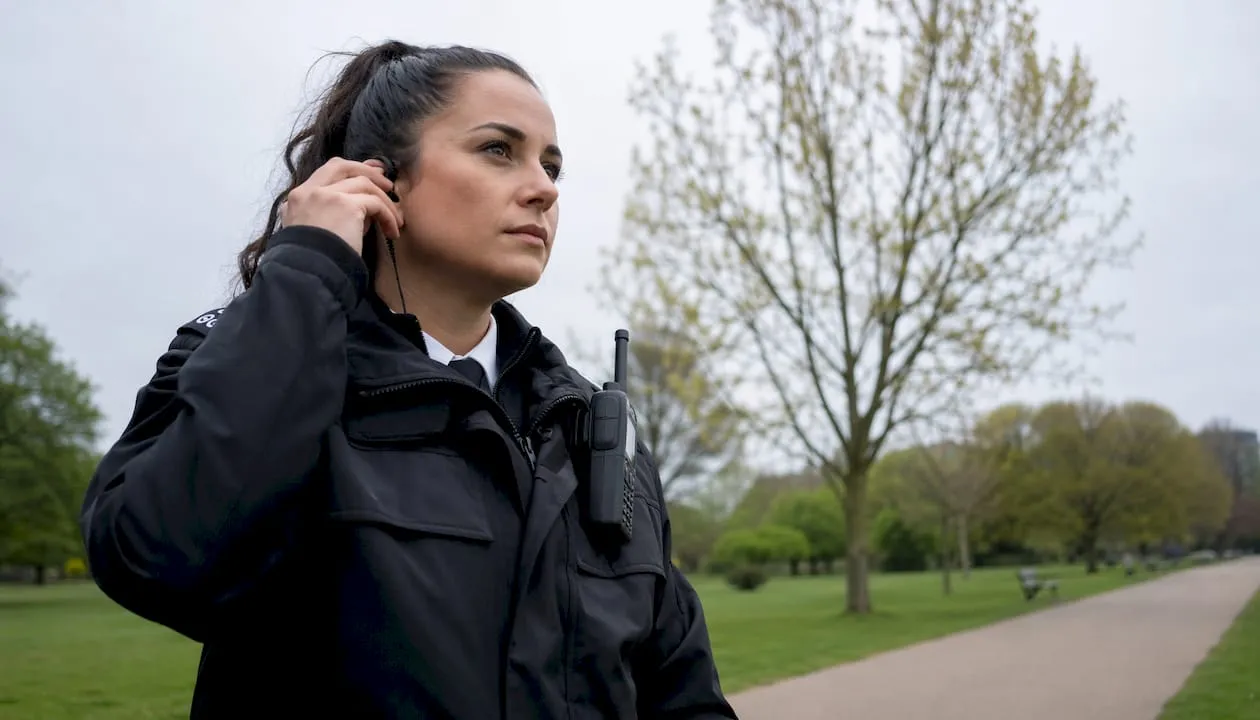
The case for flexible working in security is not just about wellbeing. It is also a commercial argument.
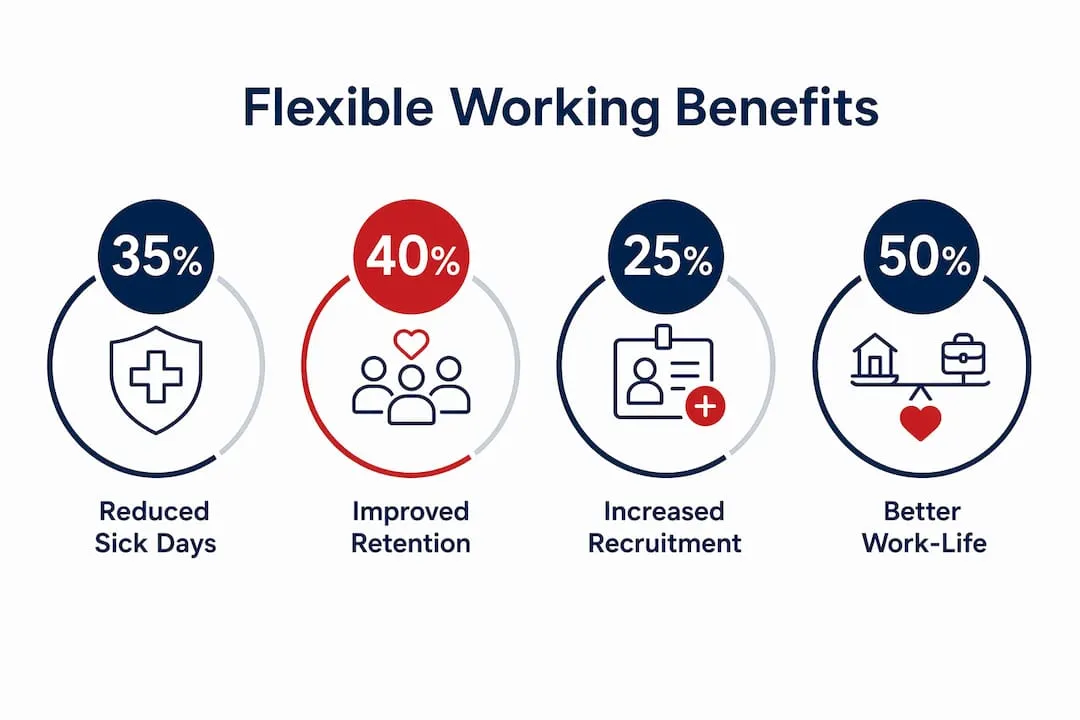
For security officers, flexibility addresses one of the sector’s most persistent problems: unsociable hours that drive people out. Staff on permanent or stable contracts with built-in flexibility are more likely to view security as a long-term career path rather than a temporary income source. That shift in mindset reduces the churn that costs employers time and money on repeated vetting, licensing, and induction.
For employers, the benefits are equally concrete:
- Talent attraction from groups currently underrepresented in security, including women and those with caring responsibilities.
- Reduced turnover, which cuts the recurring cost of SIA licence checks, training, and onboarding.
- Improved motivation, since flexible working helps keep workers engaged and reduces the disengagement that leads to poor performance.
- Operational agility, as flexible deployment models allow coverage to be matched to demand peaks rather than fixed rotas.
- Broader talent pools, particularly for hard-to-fill roles in regions where candidate supply is thin.
The British Transport Police (BTP) demonstrated this in practice. After introducing activity-based rostering and flexible shift timetabling, the service saw sickness and special leave fall by 47% and 84% respectively, saving a significant amount in staff time. Staff leavers dropped by 30% between 2019 and 2022.
What does UK law require from security employers?

Every employee has a statutory right to request flexible working from their first day of employment. This is not a probationary threshold. It applies immediately, and security employers need to handle requests properly or face legal exposure.
Key obligations under the Employment Rights Act 1996 and the Acas Code of Practice:
- Requests must be in writing and state that they are a statutory flexible working request.
- Employers must decide within two months, including any appeal, from the date the request is received.
- Consultation is mandatory unless the employer agrees to the request in full. Acas is clear that employers must talk and listen to the employee before rejecting a request.
- Refusal must cite a genuine business reason from the list set out in the Employment Rights Act 1996, such as inability to reorganise work, detrimental impact on performance, or insufficient work in the proposed hours.
- Disability-related requests must also be assessed under the Equality Act 2010, which imposes a separate duty to make reasonable adjustments.
Statutory callout: Employers must make a final decision on a flexible working request, including any appeal, within two months of receiving it.
For security employers, the most commonly cited business reason for refusal is operational coverage. That is a legitimate ground, but it must be genuinely assessed, not assumed. Acas recommends exploring modified versions of the original request or trial periods before outright refusal.
What types of flexible working actually work in security?
Not every flexible arrangement suits every security role. The key is matching the arrangement to the operational reality of the post.
- Part-time contracts work well for static guarding roles where coverage can be split across multiple officers.
- Compressed hours (for example, four 12-hour shifts instead of five shorter ones) suit officers who want longer blocks of time off.
- Staggered start times reduce the pressure of rush-hour commutes and can improve punctuality on long-distance sites.
- Self-rostering lets officers choose shifts within a defined framework, giving them control without compromising coverage. The BTP piloted this with positive results.
- Activity-based rostering matches staffing levels to demand patterns rather than fixed headcounts, reducing unsociable shifts and improving job satisfaction.
- Hybrid arrangements apply mainly to administrative, control room, and management roles within security companies, where some tasks can be completed remotely.
- Remote monitoring roles, including CCTV analysis and alarm response coordination, are increasingly suited to home-based or hub-based working with the right technology in place.
Acas advises that for frontline security roles where full remote working is not feasible, practical middle-ground solutions like staggered starts or self-rostering deliver meaningful flexibility without compromising operational standards.
How do you implement flexible working without compromising security?
The barriers are real. Traditional shift culture in security runs deep, and many managers associate flexibility with reduced accountability. Safety concerns are legitimate too: a site that needs two officers at all times cannot simply let one work from home.
Common barriers and how to address them:
- Coverage gaps: use activity-based rostering and minimum staffing parameters to guarantee cover at all times.
- Cultural resistance: the BTP found that even sceptical managers changed their views once flexible working was piloted and results were measured.
- Training demands: blended and remote training programmes can replace London-only or site-only sessions, widening access without reducing quality.
- Diversity stagnation: female representation in security officer roles increased by only 0.78% since December 2020, suggesting that surface-level flexibility policies are not enough. Real change requires operational flexibility, not just policy documents.
- Zero-hours dependency: staff on zero-hours contracts are less likely to view security as a career. Moving towards permanent or stable contracts with built-in flexibility addresses both retention and morale.
Pro Tip: Start with a pilot. Choose one site or team, introduce self-rostering or staggered shifts for three months, and measure sickness absence, retention, and coverage compliance before rolling out wider. The BTP’s Birmingham pilot is a useful model.
Transparent communication throughout any transition matters as much as the policy itself. Officers who understand why changes are being made, and who have input into how rotas are designed, are far more likely to engage positively.
How Securityjobsboard supports flexible security careers in the UK
Securityjobsboard is a specialist UK platform connecting security employers and job seekers, with a particular focus on the kind of role variety that flexible working demands. Its affiliation with the BSIA gives both employers and candidates confidence that listings meet industry standards.
For employers, the platform offers:
- CV database access to search for candidates open to flexible or part-time arrangements.
- Targeted job listings that specify shift patterns, helping attract candidates who actively want flexible roles.
- Fast application tools that reduce time-to-hire for hard-to-fill positions.
- Career advice resources covering flexible working in security and wider recruitment strategy.
For security professionals, the platform makes it straightforward to filter roles by location, hours, and contract type, which is particularly useful for those returning to work or managing caring responsibilities alongside a security career. Employers looking to reduce staff turnover will find that advertising genuinely flexible roles on a specialist platform reaches a more engaged candidate pool than general job boards.

What security risks come with flexible work environments?
Flexible working introduces specific security risks that physical guarding operations do not always face. Remote and hybrid arrangements for administrative and management roles within security companies create exposure that needs active management.
The risks are not theoretical. Phishing attempts, shadow IT, and unsecured home networks are the most common vulnerabilities in distributed security teams. For organisations where staff handle sensitive client data, access control systems, or incident logs remotely, the consequences of a breach extend beyond the company itself to the clients they protect.
Key mitigation strategies include:
- Multi-factor authentication (MFA) for all remote access to operational systems.
- Virtual private networks (VPNs) or zero-trust network access tools for any remote connection to control room or monitoring platforms.
- Clear data handling policies that specify what information can be accessed or printed outside a secure site.
- Regular phishing simulation training to keep remote staff alert to social engineering attempts.
- Device management policies that prevent personal devices from accessing sensitive operational data.
Surrey and Sussex Police’s agile working policy sets a useful benchmark: individuals working away from their base location must ensure that information on screen or in paper form cannot be seen by third parties, and sensitive documents must be shredded with a cross-cut shredder when no longer needed.
How does flexible work affect physical security measures on site?
When security officers work flexible or varied patterns, the physical security of the sites they protect must be reviewed to account for those changes. A site designed around a fixed two-officer rota may have coverage gaps if one officer switches to compressed hours without a corresponding adjustment to the schedule.
Access control systems need to reflect actual working patterns. If an officer’s shift starts two hours later under a staggered arrangement, their access credentials should activate and deactivate accordingly. Failure to update access permissions when working patterns change is one of the most common physical security vulnerabilities in flexible environments.
Visitor management, key handover protocols, and patrol schedules all need to be reviewed when rotas change. The principle is straightforward: flexibility in staffing must be matched by flexibility in the physical security plan, not just the HR policy.
Training and communication for flexible security teams
Dispersed and varied shift patterns make consistent training harder to deliver. The BTP addressed this by moving formerly London-only training programmes to hybrid and remote formats, which widened access without reducing quality. That approach is directly transferable to private security companies.
Effective communication protocols for flexible teams should include:
- Digital shift handover logs that every officer can access regardless of when their shift starts.
- Regular briefings via video call or messaging platforms for teams that rarely overlap in person.
- Mandatory completion tracking for online training modules, so managers can confirm that all officers are current on procedures regardless of their working pattern.
- Clear escalation paths that do not depend on a specific officer being on site at a specific time.
The SIA’s guidance on recruitment and retention identifies training access as a key factor in whether security staff view their role as a career. Making training genuinely accessible to officers on flexible patterns is not just good practice; it directly supports retention.
What technology enables secure flexible working in security?
The right tools make flexible working operationally viable rather than just theoretically possible. For security companies managing dispersed teams, technology investment is not optional.
Workforce management platforms that support self-rostering and activity-based scheduling allow managers to set coverage parameters while giving officers genuine choice within those constraints. Mobile patrol apps let lone workers log check-ins, report incidents, and receive instructions without needing to return to a base. For roles with a lone working dimension, automated check-in systems with escalation alerts are a practical safety requirement.
For administrative and hybrid roles within security organisations, cloud-based document management, encrypted communication tools, and endpoint detection software form the baseline. The BTP invested in technology that could be used securely from home as part of its flexible working rollout, and provided each worker with up to £350 to set up a suitable working environment. That investment paid back through the sickness and retention savings that followed.
Key takeaways
Flexible working in UK security roles improves retention, widens recruitment, and reduces sickness absence when implemented with clear operational parameters and genuine management commitment.
| Point | Details |
|---|---|
| Legal right from day one | Every employee can request flexible working immediately; employers must decide and communicate the result within two months. |
| Retention evidence | The BTP reduced staff leavers by 30% and saved over £3 million after introducing flexible rostering. |
| Diversity gap persists | Female representation in security officer roles rose by only 0.78% since December 2020, showing policy alone is insufficient. |
| Physical security must adapt | Access permissions and patrol schedules need updating whenever shift patterns change. |
| Technology underpins delivery | Workforce management platforms, mobile check-in apps, and MFA are practical requirements for flexible security teams. |
FAQ
Is security work flexible?
Security work can be flexible, though the extent depends on the role. Frontline guarding roles suit staggered shifts, compressed hours, and self-rostering rather than remote working, while control room, administrative, and management roles within security companies can often accommodate hybrid arrangements.
What is the purpose of flexible working?
Flexible working allows employees to change when, where, or how they work to better balance professional and personal responsibilities. For employers, it improves recruitment, retention, and staff engagement, particularly in sectors like security where unsociable hours are a known barrier to attracting diverse talent.
What are the basic duties and responsibilities of a security guard?
A security guard’s core duties include controlling access to premises, conducting patrols, monitoring CCTV, responding to incidents, and writing accurate reports. SIA licensing sets the minimum competency standard for all frontline security officers in the UK.
Can an employer refuse a flexible working request in security?
Yes, but only on specific grounds set out in the Employment Rights Act 1996, such as inability to reorganise staffing or a detrimental impact on service delivery. Acas requires employers to consult the employee before refusing and to explore modified or alternative arrangements first.
How does flexible working help security employers recruit?
Flexible arrangements attract candidates who cannot commit to fixed long shifts, including those with caring responsibilities, part-time workers, and those returning after a career break. The SIA identifies flexibility of working hours as one of the measures most likely to address recruitment and retention difficulties in the security guarding sector.


