How to reduce employee turnover in security roles

TL;DR:
- Employee turnover in the security industry is costly and driven mainly by poor management and insufficient onboarding. Implementing structured onboarding, proactive manager check-ins, and career development programs significantly improve retention. Regular feedback tools like stay interviews and real-time engagement monitoring help address issues before staff leave.
Employee turnover is defined as the rate at which staff leave an organisation and must be replaced, and in the security industry it represents one of the most costly and disruptive operational challenges a manager can face. Replacing an employee costs between 50% and 200% of their annual salary. That figure makes retention a direct budget issue, not just an HR concern. The good news is that 75% of departures are preventable, meaning most turnover is a fixable management problem rather than an inevitable fact of working life. Gallup research confirms that manager behaviour drives 70% of variance in employee engagement, placing the primary lever for reducing staff turnover firmly in the hands of line managers and HR teams. Securityjobsboard works with security employers across the UK and sees this pattern repeatedly: organisations that treat retention as a system, not a policy, keep their best people.
How to reduce employee turnover through structured onboarding
Onboarding is the single highest-return investment a security employer can make in retention. Structured onboarding programmes produce up to 82% higher one-year retention compared to informal inductions. That gap is enormous, and it is entirely within your control.

The security sector has a specific vulnerability here. Turnover spikes within the first 90 days when onboarding is limited to logistics: issuing uniforms, completing SIA licence checks, and running through site procedures. New officers who feel socially isolated or unclear about their role do not stay. The attrition looks like a bad hire. It is almost always a bad onboarding.
A structured programme addresses this directly. The 30/60/90 day plan is the industry standard framework. At 30 days, the focus is role clarity and social integration. At 60 days, the manager reviews performance expectations and addresses any friction. At 90 days, the officer has an early win on record and a clear picture of what progression looks like.
Pro Tip: Assign a peer buddy from day one. In shift-based security environments, a buddy who works the same pattern removes the social isolation that drives early resignations far more reliably than any induction document.
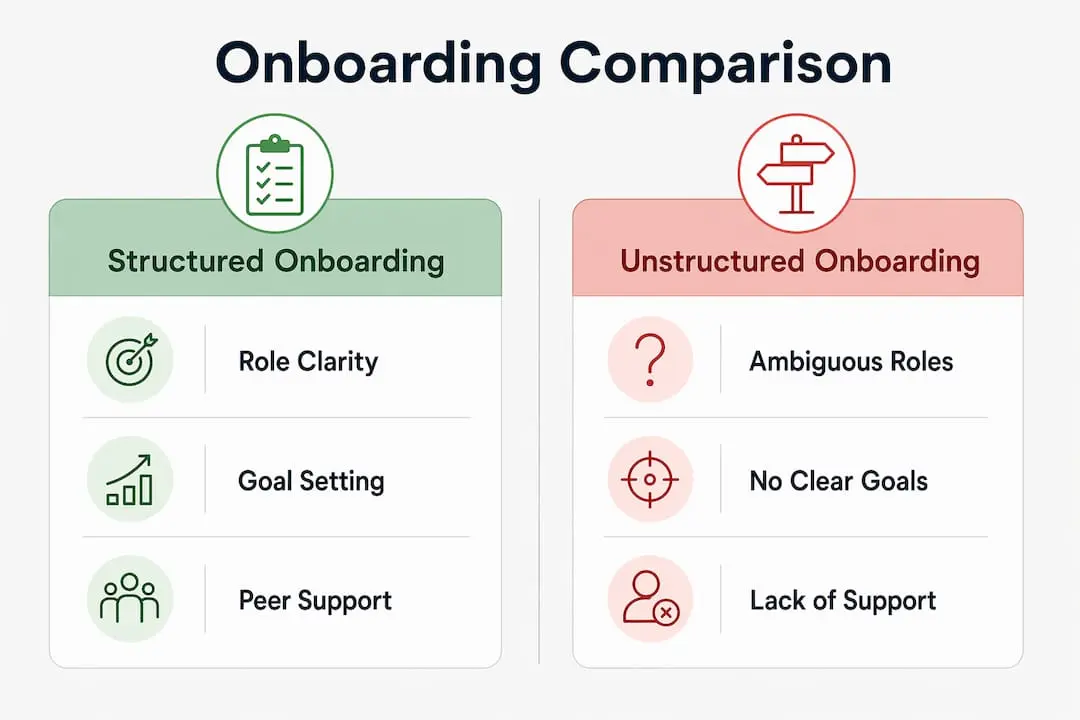
The table below shows what separates a structured programme from an unstructured one.
| Feature | Structured onboarding | Unstructured onboarding |
|---|---|---|
| Role clarity | Defined within first week | Assumed from job description |
| Manager check-ins | Weekly for first 90 days | Ad hoc or absent |
| Peer support | Assigned buddy | Left to chance |
| Early milestones | Planned wins at 30/60/90 days | No formal milestones |
| Social integration | Deliberate and scheduled | Incidental |
For more detail on building an effective induction process, Securityjobsboard has a dedicated guide for security employers.
Why manager behaviour determines whether staff stay or leave
The data on this is unambiguous. 42% of turnover is preventable through manager-led actions alone. Pay and perks rarely explain why a security officer resigns. Poor manager relations, unclear expectations, and unaddressed workload frustration are the real drivers.
Gallup’s research identifies specific manager behaviours that predict retention:
- Regular proactive 1:1s. Effective managers schedule routine 30-minute check-ins to surface friction before it becomes a resignation. These are not performance reviews. They are conversations about how the role is actually going.
- Workload and role clarity. Security officers working isolated shifts are particularly vulnerable to role drift, where their responsibilities expand informally without recognition or support.
- Career path discussions. Managers who never discuss progression signal to their team that there is no future in the role. That signal is heard clearly.
- Addressing daily frustrations early. Small operational irritants compound over months. A manager who listens and acts on them builds loyalty. One who ignores them accelerates departure.
Employee retention depends on manager quality more than compensation or perks alone. Perks like free meals or social events do not address role misalignment or manager friction. They are additions to a good working environment, not substitutes for one.
Pro Tip: Replace exit interviews with stay interviews. By the time someone is leaving, the conversation is too late. A stay interview asks the same questions six months earlier, when you can still act on the answers.
Manager training is not optional in a high-turnover sector. Equip your managers with conversation frameworks, not just performance management tools. The candidate experience during recruitment sets expectations that managers must then meet on the job.
Does career development actually reduce security staff turnover?
The answer is yes, and the data is specific. Internal mobility programmes produce 75% three-year retention for employees who move internally, compared to 56% for those who do not. That 19-percentage-point gap represents a significant number of experienced officers retained rather than replaced.
Security organisations often underestimate how much their staff want to progress. The path from door supervisor to site supervisor to operations manager exists in most companies. The problem is that it is rarely communicated clearly or supported actively. Officers who cannot see a route forward assume there is none.
Practical career development initiatives that work in security settings include:
- Transparent promotion criteria. Publish the competencies and experience required for each level. Remove ambiguity about what progression requires.
- Funded training pathways. Support staff in gaining additional SIA licences, first aid qualifications, or CCTV operator certifications. Each qualification is a retention investment.
- Internal job posting. Advertise vacancies internally before going external. Officers who see internal roles filled from outside conclude that loyalty is not rewarded.
- Mentoring programmes. Pair junior officers with senior staff. This builds capability and creates relationships that make leaving feel like a greater loss.
- Regular development conversations. Career discussions should happen at least twice a year, separate from performance reviews.
The link between career development and employee satisfaction is direct. Staff who feel they are growing within an organisation do not look elsewhere. Those who feel stagnant do.
How do you monitor engagement signals before staff resign?
The most effective retention programmes catch disengagement early. Distinguishing between hot data and cold data is the key skill here. Cold data is historical: absence rates, turnover figures, exit interview themes. Hot data is real-time: pulse survey results, manager observations, shift feedback. Relying only on cold data means you are always reacting to a problem that already happened.
Role drift is a strong predictor of resignation and is almost invisible in historical metrics. An officer whose responsibilities have quietly expanded, whose shift patterns have changed, or who feels their concerns are not heard will not flag this in an annual survey. They will simply leave.
The table below summarises the main feedback tools and what each one is designed to detect.
| Feedback tool | Frequency | What it detects |
|---|---|---|
| Pulse surveys | Monthly or fortnightly | Engagement trends and morale shifts |
| Stay interviews | Every 6 months | Individual retention risks and motivators |
| Manager 1:1s | Weekly or fortnightly | Workload frustration and role clarity issues |
| Sentiment analysis | Ongoing | Language patterns indicating disengagement |
| Exit interviews | At departure | Confirmed causes of turnover (retrospective) |
Stay interviews proactively uncover what might cause an employee to leave and what support they need to stay engaged. They are the most underused tool in security HR. Most managers only have the resignation conversation. The stay interview has it six months earlier, when the outcome can still change.
Pro Tip: Ask stay interview questions that are specific, not generic. “What would make you consider leaving?” gets a better answer than “Are you happy here?” The first question invites honesty. The second invites reassurance.
Building a proactive retention programme means combining data gathering with targeted manager conversations. Neither works well without the other. Data without conversation misses context. Conversation without data misses patterns.
Key takeaways
Reducing employee turnover in the security industry requires integrating structured onboarding, trained managers, clear career pathways, and real-time engagement monitoring into a single, connected system.
| Point | Details |
|---|---|
| Onboarding drives early retention | Structured 90-day programmes produce up to 82% higher one-year retention than informal inductions. |
| Managers are the primary lever | 42% of turnover is preventable through manager-led actions including regular check-ins and career conversations. |
| Career development retains experienced staff | Internal movers show 75% three-year retention versus 56% for those with no internal mobility. |
| Hot data catches problems early | Real-time feedback tools like pulse surveys and stay interviews detect disengagement before resignation. |
| Perks do not fix root causes | Role misalignment and poor manager relations drive turnover more than compensation or benefits. |
What I have learned about retention in the security sector
The security industry has a retention problem that most organisations treat as a recruitment problem. They keep hiring because they keep losing people, and they never stop to ask why the door keeps revolving.
After working closely with security employers across the UK, the pattern is consistent. The organisations with the lowest turnover are not the ones with the best pay rates or the most impressive benefit packages. They are the ones where managers have real conversations with their teams, where new starters feel part of something within their first month, and where there is a visible path forward for anyone who wants to progress.
Retaining top talent requires systems, not isolated policies. A great onboarding programme undone by a poor manager achieves nothing. A strong manager working with no career development tools hits a ceiling. These elements only work when they reinforce each other.
The uncomfortable truth is that most security employers know what they need to do. They know their managers need training. They know their onboarding is thin. They know they have never run a stay interview. The gap is not knowledge. It is prioritisation. Retention work feels less urgent than filling the next vacancy. Until the cost of constant replacement becomes impossible to ignore, and by then the damage is already done.
Start with your managers. Train them to have proactive conversations. Then build the onboarding structure around those conversations. Career development follows naturally once the foundation is in place. Measure everything, adapt regularly, and treat retention as a permanent operational priority, not a project with an end date.
— Rob
Securityjobsboard: supporting security employers with retention and recruitment
Reducing turnover starts with hiring the right people for the right roles, and that begins with reaching candidates who are genuinely committed to a career in security.

Securityjobsboard connects UK security employers with qualified candidates through a platform built specifically for the sector, with BSIA affiliation adding credibility to every listing. Whether you are recruiting for security roles in Northern Ireland or building a pipeline of talent across the UK, the platform gives you direct access to motivated jobseekers. For staff already in post, the career advice resources on Securityjobsboard support professional development and progression, two of the strongest retention drivers available to any security employer.
FAQ
What is the main cause of high turnover in security roles?
Poor manager support, lack of career development, and role misalignment are the primary causes. Pay is rarely the deciding factor when experienced officers resign.
How much does replacing a security employee actually cost?
Replacing a member of staff costs between 50% and 200% of their annual salary, covering recruitment, training, and lost productivity during the transition period.
What is a stay interview and why does it matter?
A stay interview is a structured conversation with a current employee to understand what would cause them to leave and what would make them stay. It identifies retention risks before a resignation occurs.
How long does it take for structured onboarding to show results?
The impact is measurable within the first year. Structured onboarding programmes produce up to 82% higher one-year retention compared to informal inductions, making the first 90 days the critical window.
Can internal promotions genuinely reduce staff turnover?
Yes. Employees who move internally show 75% three-year retention compared to 56% for those who do not, making internal mobility one of the most effective long-term retention tools available.


