Why choose the UK security sector for your career

TL;DR:
- The UK security sector offers accessible entry, structured career paths, and stable demand driven by regulation.
- Professionals can advance through licensing, training, and strategic career moves, with high earning potential.
The UK security sector is defined as one of the country’s most accessible, stable, and genuinely rewarding career paths. It employs over 400,000 licensed professionals, making it one of the largest regulated workforces in Britain. Regulated by the Security Industry Authority (SIA), the sector sets clear professional standards that protect workers and employers alike. Whether you are switching careers or entering the workforce for the first time, the reasons to choose the UK security sector are grounded in real demand, structured training, and genuine long-term potential.
Why choose the UK security sector as your career move?
The UK security industry offers far more than frontline guarding work. It spans physical security, cyber security, close protection, and critical national infrastructure, giving professionals from almost any background a credible entry point.
The UK security career landscape divides broadly into two streams. Physical security covers roles you can enter quickly with SIA licensing. Cyber security is a specialist stream requiring technical qualifications but offering significantly higher salaries.
SIA licensing transformed the sector from an informal trade into a regulated profession. That professionalisation created clear career paths from frontline roles all the way through to management and consultancy. The result is a sector where ambition is rewarded with structure, not just luck.
What are the main career opportunities in UK security?
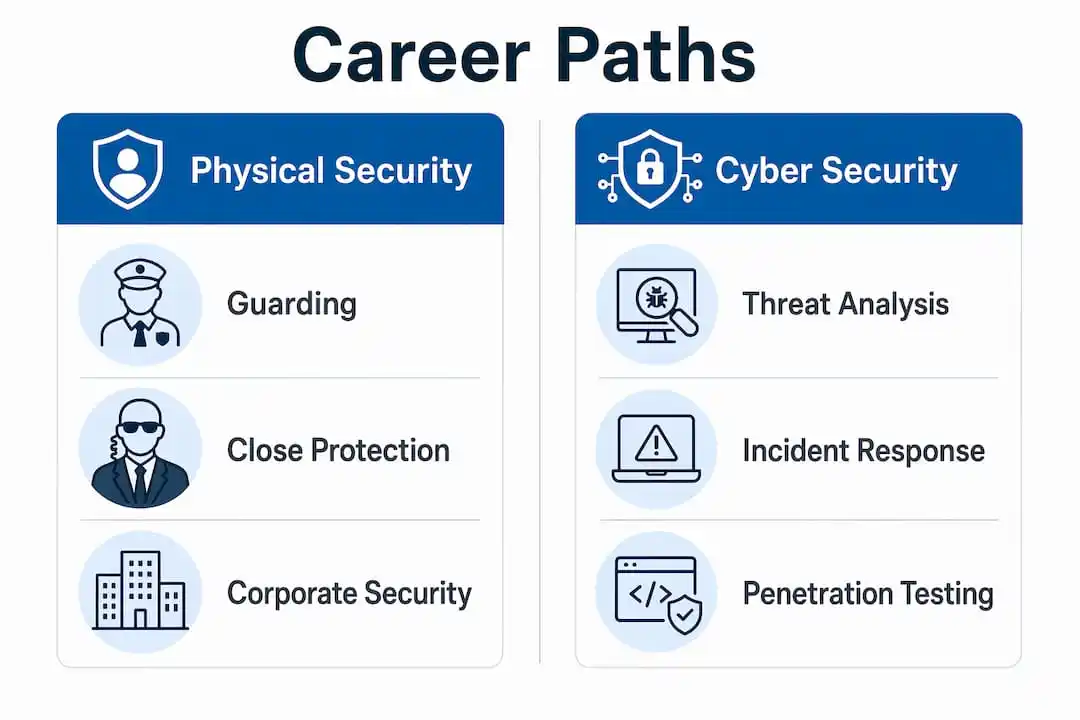
The range of roles available is wider than most people realise. Entry-level positions are accessible after a short training course, while specialist roles can take years to develop and command premium pay.
Entry-level and frontline roles:
- Security guard (manned guarding)
- Door supervisor
- CCTV operator
- Retail security officer
- Event security steward
Specialist and advanced roles:
- Close Protection Officer
- Maritime security specialist
- Cyber security analyst
- Security consultant
- Control room manager
The cyber security stream is particularly strong. The UK cyber security subsector employs nearly 70,000 specialists, generates £14.7 billion in revenue, and posts an average of 2,698 core job vacancies per month. That volume of demand means skilled professionals rarely struggle to find work.
Physical security roles serve corporate offices, public transport, retail, events, and critical national assets such as airports and power stations. Each environment carries different demands and pay scales, which means professionals can move between sectors to grow their earnings without changing their core skill set.
Pro Tip: If you come from customer service, healthcare, or education, your existing communication and situational awareness skills are directly transferable to security roles. Employers actively value these backgrounds.
What qualifications and licensing do you need for UK security?
The SIA licence is the legal requirement for most frontline security roles in England, Wales, Scotland, and Northern Ireland. Without it, you cannot legally work in a licensable role. The process is structured and achievable within weeks.
Steps to obtain your first SIA licence:
- Choose your licence category (door supervisor, security guard, CCTV operator, or close protection are the most common starting points).
- Complete an SIA-approved training course from an accredited provider.
- Pass the required assessments, which include both theory and practical elements.
- Submit your licence application to the SIA, including a criminal record check and identity verification.
- Receive your licence, which is valid for three years before renewal.
Training costs typically range from £380 to £500 for entry-level courses. That is a low barrier compared to most regulated professions. Many employers cover these costs entirely through sponsored training schemes, connecting trainees directly to employment upon certification. Apprenticeship programmes targeting the sector have achieved a 46.8% decrease in staff turnover, which shows how effective structured entry routes are for both workers and employers.
Continuous professional development matters beyond the initial licence. Additional certifications in first aid, conflict management, or counter-terrorism awareness all increase your value to employers. The 2025 Martyn’s Law, which increases licensing requirements at thousands of venues, has created fresh demand for professionals trained in threat assessment. Getting ahead of that requirement now puts you in a strong position.
Pro Tip: Holding more than one SIA licence category significantly increases your employability. A door supervisor licence, for example, also covers security guard work, giving you two roles from one qualification.
What are the key benefits of working in UK security?
The advantages of UK security as a career go well beyond job availability. The sector offers stability, flexibility, and a genuine sense of purpose that many industries cannot match.

Job stability and recession-proof demand
The UK security sector is consistently recession-proof. Businesses and public bodies prioritise security spending regardless of economic conditions. That means redundancy risk is lower than in many other sectors, which matters when you are planning a long-term career.
Competitive pay with clear progression
Entry-level pay starts at approximately £11.44 per hour at the National Living Wage, rising to £12–£15 per hour in London. Specialisation changes the picture dramatically. Close Protection Officers can earn £400 to over £1,000 per day on contract work. Cyber security professionals with core roles earn a median salary of £55,000. The pay ceiling in this sector is genuinely high for those who invest in their development.
Flexibility and varied working patterns
Security roles cover 24-hour operations, which means shift patterns suit people who cannot work standard office hours. Remote CCTV monitoring roles have expanded significantly, offering professionals the option to work from control rooms rather than on-site locations. That flexibility is a real advantage for those managing family commitments or other responsibilities.
Purpose and public impact
Security professionals protect people, assets, and critical infrastructure every day. That sense of purpose is not abstract. Officers working at hospitals, transport hubs, and public events directly affect the safety of thousands of people. The sector is now recognised as a purposeful career choice, not a stopgap, which has raised professional pride and job satisfaction across the workforce.
How do you plan and develop a career in UK security?
Career progression in UK security does not happen by accident. The professionals who reach management, consultancy, or specialist contract work do so through deliberate choices, not just accumulated years of service.
Strategies that drive real career growth:
- Hold multiple SIA licences. Multiple licences make you deployable across more roles and more attractive to employers offering higher rates. A door supervisor who also holds a CCTV licence can fill gaps across an entire site.
- Network within industry bodies. Professional associations and industry events connect you with employers and specialists who influence hiring decisions. Recommendations from within the sector carry significant weight.
- Change employers strategically. Staying with one employer for years without a pay review is the most common way security professionals stagnate. Moving to a new employer every two to three years, armed with additional qualifications, consistently delivers pay increases.
- Pursue specialist training early. Counter-terrorism awareness, first aid at work, and conflict resolution qualifications are inexpensive to obtain and immediately visible on your CV.
- Build a professional reputation. Reliability, punctuality, and professional conduct are noticed and discussed within the sector. A strong reputation opens doors that qualifications alone cannot.
The UK security recruitment market grew at 6.2% in 2025, driven partly by legislative changes and partly by expanding demand in cyber and critical infrastructure roles. Professionals who position themselves at the intersection of physical and cyber security are particularly well placed for the decade ahead.
Pro Tip: Map out a career progression workflow before you apply for your first role. Knowing your two-year and five-year targets shapes which licence you pursue first and which employers are worth prioritising.
Key takeaways
The UK security sector offers one of the most accessible and genuinely stable career paths available to professionals from any background, with structured licensing, strong demand, and clear routes to specialist and management roles.
| Point | Details |
|---|---|
| Accessible entry | SIA training costs £380–£500 and many employers sponsor the full cost. |
| Strong demand | Over 400,000 licensed professionals work in the sector, with cyber roles posting nearly 2,700 vacancies per month. |
| Pay progression | Entry pay starts at £11.44 per hour, rising sharply with specialisation and additional licences. |
| Recession-proof stability | Security spending holds firm across economic cycles, reducing redundancy risk for professionals. |
| Intentional development | Multiple licences, networking, and strategic employer moves drive faster career growth than tenure alone. |
The security sector rewards professionals who treat it seriously
I have spoken with hundreds of people who entered security as a short-term fix and stayed for a decade. The ones who built genuinely rewarding careers all share one trait: they treated the sector as a profession from day one, not a placeholder.
The biggest mistake I see is professionals who obtain their first SIA licence and then stop developing. The sector has changed enormously in the past ten years. Martyn’s Law, the growth of cyber threats, and the expansion of remote monitoring have all created new roles that did not exist when many current professionals started out. The people who adapted to those changes are now earning significantly more than their peers who stood still.
Gender diversity in cyber security remains a real gap, with just over 20% female representation. That gap represents opportunity. Employers in the cyber stream are actively looking to diversify their teams, which means qualified women entering the field now face less competition for specialist roles than at almost any other point in the sector’s history.
My honest view is that the UK security sector is one of the few industries where a motivated person with no degree and modest savings can build a six-figure career within ten years. The path is not easy, but it is clear. Get licensed, get multiple licences, network deliberately, and move when the money stops growing. That formula works.
— Rob
Find your next security role with Securityjobsboard
The UK security sector is hiring across every specialism right now, from entry-level guarding positions to senior close protection and cyber security contracts.

Securityjobsboard is affiliated with the BSIA and connects security professionals directly with verified UK employers. You can create a free profile, upload your CV, and set job alerts that match your licence type and location. Whether you are looking for your first role or your next step up, security jobs in Northern Ireland and across the rest of the UK are listed and updated daily. Securityjobsboard also publishes guides on licensing, training, and optimising your job search to help you move faster. Visit Securityjobsboard to browse current vacancies and take the next step in your security career.
FAQ
What does the SIA licence cover?
The SIA (Security Industry Authority) licence is the legal requirement for frontline security roles in the UK, covering categories including security guard, door supervisor, CCTV operator, and close protection. Each category requires separate training and assessment.
How long does it take to get an SIA licence?
Most entry-level SIA training courses take between three and six days to complete, followed by an application process that typically takes two to four weeks. The full process from starting training to receiving your licence usually takes four to eight weeks.
Is the UK security sector a good long-term career?
The sector is recession-proof, regulated, and growing, with clear progression routes from frontline roles to management, consultancy, and specialist contracts. Professionals who invest in multiple licences and continuous development consistently achieve strong long-term earnings.
How much can you earn in UK security?
Entry-level pay starts at approximately £11.44 per hour, rising to £12–£15 per hour in London. Specialist roles such as close protection can earn £400 to over £1,000 per day, while cyber security professionals in core roles earn a median salary of £55,000.
Do employers pay for SIA training?
Many employers offer sponsored training that covers the full cost of SIA licensing in exchange for a commitment to work with them after qualification. Apprenticeship schemes in the sector also provide funded routes into the profession.


