What to study for cyber security jobs in manned guarding roles
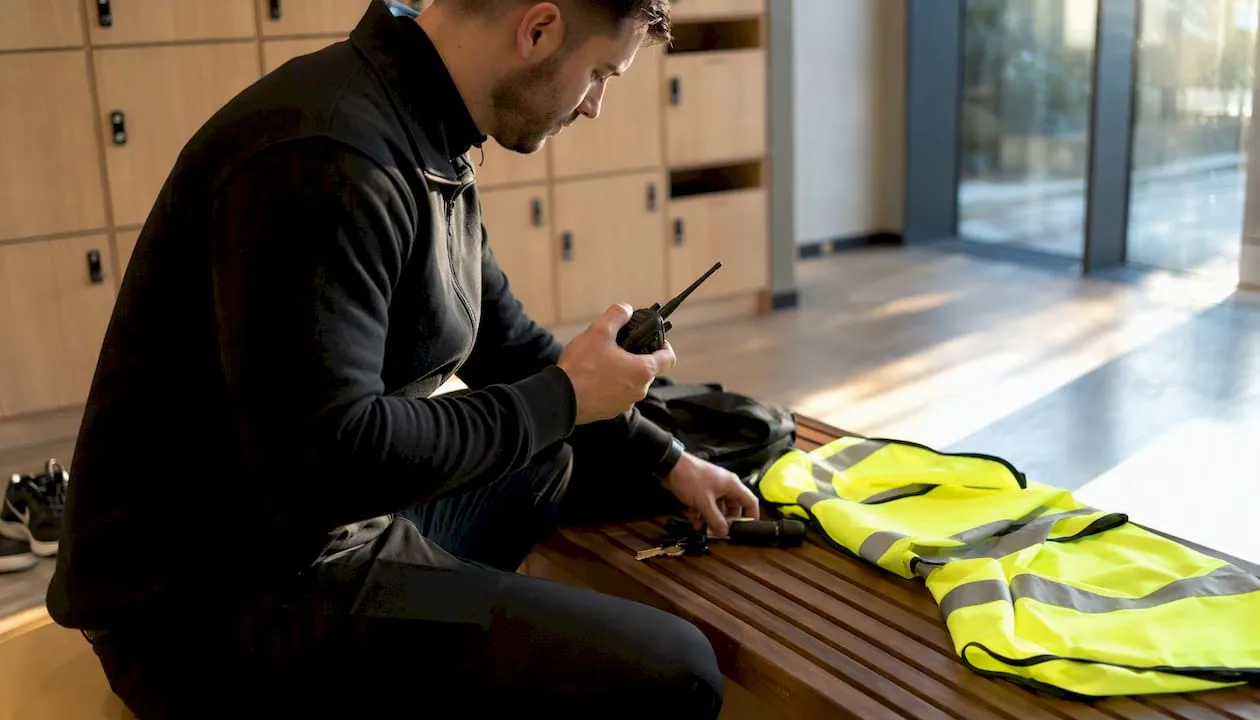
To work as a security guard, door supervisor, CCTV operator or close protection officer in the UK, you need an SIA front-line licence, which means completing the licence-linked vocational award for that role before you apply. That’s the direct answer to what to study for cyber security jobs in the private security sector: a Level 2 Award in Security Operations for guarding, a Level 2 Award in Door Supervision for pub and club work, a Level 2 Award in CCTV Operations for surveillance roles, or a Level 3 Award in Close Protection if you want to work as a bodyguard. Most roles also demand Emergency First Aid at Work (EFAW) either as a standalone certificate or bundled into the course.
The mandatory checklist looks like this for almost every entry-level role:
- The correct licence-linked award (Level 2 for guarding, door supervision, CCTV; Level 3 for close protection)
- A completed SIA licence application, submitted through Gov
- Identity verification and a criminal record check as part of that application
- First aid training, usually EFAW, sometimes Level 3 First Aid at Work for close protection
Pro Tip: Check the course start date against the SIA’s three-year rule before you book anything. A qualification only counts towards your licence application if it was achieved within the last three years, so an old certificate gathering dust in a drawer may not help you at all.
Key Takeaways
Getting hired in UK manned guarding depends on holding the correct licence-linked award, a valid SIA licence, and first aid training that matches your role.
| Point | Details |
|---|---|
| Match award to licence | Study the Level 2 award for guarding, door supervision or CCTV, or Level 3 for close protection. |
| Confirm the three-year rule | Qualifications must usually be achieved within three years of your SIA application. |
| Budget beyond the course fee | Factor in the separate SIA application fee, first aid, DBS checks and travel. |
| Present evidence properly | List exact award names, dates and licence numbers on your CV, and bring originals to interview. |
| Use Securityjobsboard after training | Create a free profile and upload certificates to get matched with employers hiring for your specific licence. |
Table of Contents
- Required qualifications and SIA licensing explained
- Study path by role: guard, door supervisor, CCTV, close protection
- Certificates that make you more employable
- Choosing a training provider you can trust
- Timeline and costs to budget for
- Presenting your qualifications to employers
- Where training leads: progression after your first role
- What employers actually look for when hiring
- Find your next role once you’re qualified
- Sources
- FAQ
Required qualifications and SIA licensing explained
Anyone doing front-line security work for reward, meaning you’re paid to guard, supervise or watch over people or property, must hold a valid SIA licence before starting the job. That’s not a suggestion. The Security Industry Authority requires it by law, and working without one is a criminal offence for both the guard and the employer who hired them.
Five main front-line licence categories exist: security guarding, door supervision, public space surveillance (CCTV), close protection, and cash and valuables in transit. Each one requires its own licence-linked qualification from an SIA-endorsed awarding organisation. You can’t simply do a generic “security course” and expect it to cover all five. The SIA’s Get Licensed guidance sets out exactly which award applies to which licence, and it also fixes the three-year validity window mentioned above.
An SIA-recognised award must come from an endorsed awarding organisation such as City & Guilds. Courses that skip this accreditation, however convincing the marketing, will not get your licence application over the line.
Study path by role: guard, door supervisor, CCTV, close protection
Each manned-guarding role has its own study route, and mixing them up wastes both time and money.
- Security guard. Complete the Level 2 Award in Security Operations, covering law, conflict management, and health and safety basics. Add EFAW. Employers increasingly ask for evidence of practical patrol experience, even informal or voluntary, alongside the paper qualification.
- Door supervisor. Take the Level 2 Award in Door Supervision, which includes physical intervention modules on top of the standard security syllabus. EFAW is expected, and many venues also want conflict de-escalation experience specific to licensed premises.
- CCTV operator. Study the Level 2 Award in CCTV Operations (Public Space Surveillance). Note the distinction here: if you’ll be watching members of the public, identifying individuals or helping guard against disorder, you need the full licence. Purely internal or private camera review for a single business may fall outside licensable activity, as GOV.UK’s CCTV licensing guidance explains, so check which category your job actually sits in before booking a course.
- Close protection officer. This is the most demanding route: the Level 3 Award in Close Protection, plus higher-level first aid, usually Level 3 First Aid at Work rather than basic EFAW. Providers typically build in physical fitness assessments and surveillance awareness modules that guarding and door supervision courses don’t touch.
Apprenticeships offer a useful alternative entry route too. The National Careers Service profile for security officers points to routes like the Professional Security Operative Level 2 apprenticeship, which combines paid work with structured study, and highlights the everyday skills employers actually check for: customer service, attention to detail, and comfort using basic computer or hand-held reporting devices.
Certificates that make you more employable
Beyond the licence-linked award, a handful of shorter certificates consistently show up on job specs and make the difference between a shortlisted CV and one that gets skipped.
- Emergency First Aid at Work (EFAW). Expected for almost every front-line role and often built into the licence-linked course itself.
- Level 3 First Aid at Work. Required or strongly preferred for close protection work, and useful for supervisory roles handling larger sites.
- Conflict management and physical intervention. Already embedded in door supervision training, but standalone refreshers help guards and CCTV operators too.
- Health and safety awareness. A basic IOSH or equivalent short course reassures employers managing sites with higher risk exposure.
- Fire safety awareness. Common in retail and corporate guarding contracts, sometimes mandated by the client site rather than the SIA.
Pro Tip: Ask your training provider whether first aid comes bundled with the main licence-linked course. Many do this as a package deal, which saves you a separate booking, a second day off work, and often some money.
Choosing a training provider you can trust
Not every course advertised online will actually get you licensed, so verification matters before you hand over payment.
Start by confirming the course leads to an SIA-recognised award, not a generic “security certificate” with no licensing value. Then check which awarding organisation issues the qualification. City & Guilds is the most widely recognised, though other endorsed bodies exist. Ask the provider directly which one applies to your course.
- Does this course lead to the specific licence-linked qualification I need?
- Which awarding organisation certifies the course, and can you show accreditation?
- Is first aid included, or do I need to book it separately?
- What does the practical assessment involve, and how is it evidenced?
- Can you provide a sample certificate or a reference from a recent learner?
Watch for red flags: providers who claim they can “include” your SIA licence fee within the course price (they can’t, since the SIA processes applications itself), vague answers about which awarding body they use, or no clear practical assessment component.
Ask to see a sample certificate before you enrol. A legitimate provider will show you exactly what you’ll receive, including the awarding body’s logo and a verifiable certificate number.
Timeline and costs to budget for
Most Level 2 courses run over three to five days, including the practical and exam elements. The Level 3 Close Protection award takes considerably longer, often two to three weeks, given the extra physical and surveillance modules. EFAW typically adds a single day, sometimes folded into the main course timetable.
Once your training is complete, the SIA licence application itself is a separate process with its own processing time and its own fee, which is not covered by your course cost. Budgets that forget this often run short.
The SIA application fee sits apart from any training cost. Published guidance for 2026 references a licence application fee figure commonly cited by training advisers, though you should always confirm the current amount directly with the SIA before applying.
Build your budget around these items:
- Course fee for the licence-linked award
- First aid course fee (if not bundled)
- SIA application fee
- DBS or identity check costs where applicable
- Travel to training venues and assessment centres
- Lost earnings for the days you’re studying rather than working
Refresher training has also become part of the picture for renewals. Staged mandatory refresher requirements for door supervision and security guarding licences rolled out through 2024 and 2025, so factor a future refresher course into your longer-term planning, not just your first application.
Presenting your qualifications to employers
A strong course record only helps you if you present it properly. Your CV should name the exact award (not just “SIA training”), the awarding body, the date achieved, and your SIA licence number once it’s issued. Vague phrasing like “security qualified” tells a hiring manager nothing useful.
At interview, expect to bring original certificates, photo ID, and evidence of your right to work in the UK. Employers routinely check certificate numbers against the awarding body’s database, so a fabricated or exaggerated qualification will surface quickly.
Employers checking your application care as much about the originals and the certificate numbers as they do about the qualification titles themselves. Bring paperwork, not just claims.
| CV field | What to include |
|---|---|
| Qualification name | Exact award title, e.g. “Level 2 Award in Door Supervision” |
| Awarding body | City & Guilds or the relevant endorsed organisation |
| Date achieved | Month and year, checked against the SIA’s three-year window |
| SIA licence number | Add once issued; leave clearly marked “pending” if still in process |
| Right to work | State documentation type, don’t just say “available on request” |
Interview prep should cover practical scenarios too: how you’d handle a conflict situation, report an incident, or respond to a first aid emergency. Employers value calm, specific answers over rehearsed textbook responses. Building soft skills alongside your technical training genuinely changes how interviews go.
Where training leads: progression after your first role
Entry-level licensed work is a starting point, not a ceiling. Most security careers progress from front-line operative to shift supervisor, then to site or contract manager, often supported by a Level 3 management apprenticeship or equivalent qualification.
Licence switching is also common. A door supervisor who wants to move into daytime retail guarding can often add a security guarding refresher rather than starting from scratch, since much of the underlying training overlaps. The same logic applies moving from guarding into CCTV work, provided you complete the specific public space surveillance award.
Qualifications and experience that support progression include:
- First-line management or supervisory awards
- Higher-level first aid (Level 3 First Aid at Work)
- Specialist training such as close protection or CVIT for those wanting a change of direction
- Apprenticeship routes that combine paid work with structured study toward supervisory roles
Some operatives also build additional technical skills that make them more valuable on sites using digital access control or integrated surveillance systems, without needing to leave manned guarding altogether.
What employers actually look for when hiring
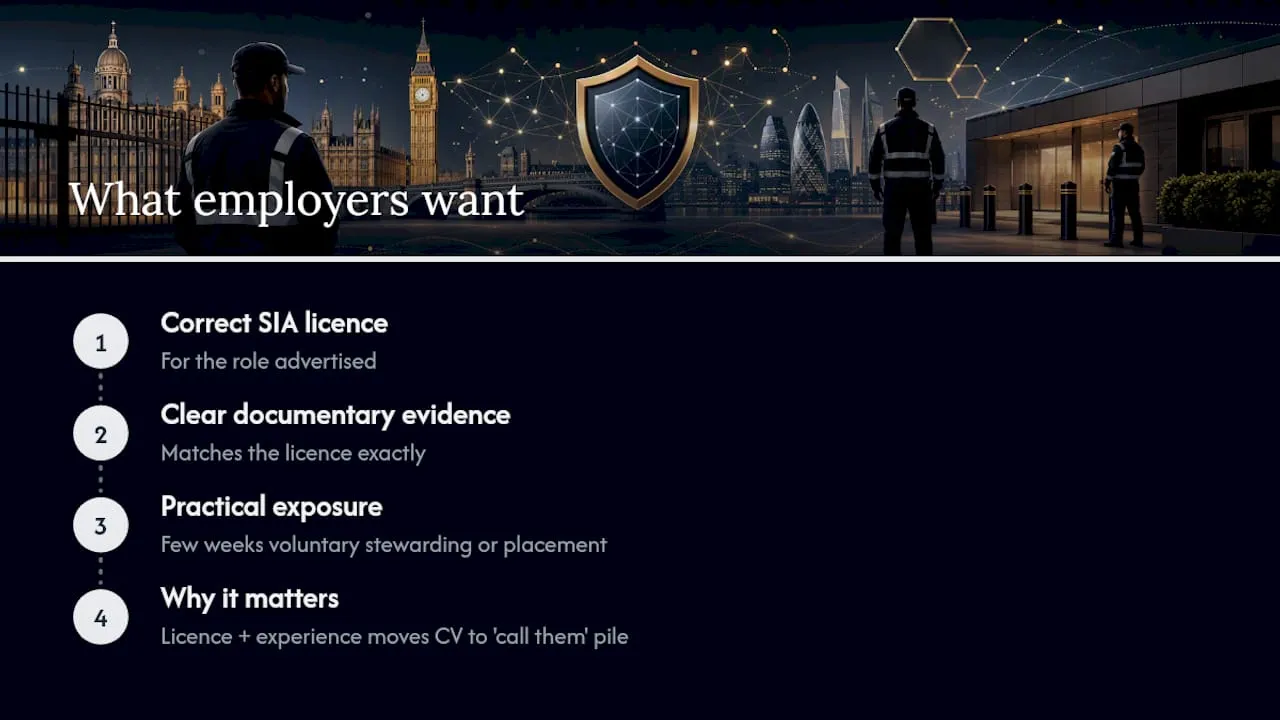
Having reviewed hundreds of security job applications, I’d say the biggest gap isn’t in the qualifications themselves, it’s in how candidates present them. Employers want three things, in this order: the correct SIA licence for the role advertised, clear documentary evidence that matches the licence exactly, and some sign of practical exposure, even a few weeks of voluntary stewarding or a work placement during training.
Newly qualified operatives sometimes expect their Level 2 certificate to open every door immediately. It doesn’t quite work that way. Combining your coursework with short local shifts, event stewarding, or even voluntary community safety work gives you something to talk about at interview beyond the syllabus. That combination, licence plus lived experience, is what moves a CV from the “maybe” pile to the “call them” pile.
Find your next role once you’re qualified
Getting licensed is the hard part. Finding the right employer to actually use that licence shouldn’t add more friction on top. Securityjobsboard is built specifically for the UK security sector, so once your SIA licence and qualifications are in hand, you can create a free profile, upload your certificates, and get matched directly with employers actively hiring for your exact licence type, without wading through generic job boards that bury security roles among unrelated listings.

Employers benefit from the same focus: businesses looking to hire trained, licensed operatives can browse candidate profiles and post vacancies through the employer tools on Securityjobsboard, rather than sifting through applicants who lack the right licence entirely. If you’re a jobseeker who has just finished training, head to the career advice hub for guidance on building your profile properly, then upload your certificates and start applying. Your licence gets you eligible. A well-built profile gets you noticed.
Sources
- Gov
- SIA: Get licensed
- Security officer | Explore Careers | National Careers Service
- SIA Licence Fees 2026: Payment, Refunds And £204 Cost
FAQ
What qualification do I need for an SIA licence?
You need the SIA-recognised licence-linked award for your chosen role, such as a Level 2 Award in Security Operations for guarding or a Level 3 Award in Close Protection, from an endorsed awarding body like City & Guilds.
Do I need first aid training for a security job?
Most licences require Emergency First Aid at Work, while close protection typically demands a higher standard such as Level 3 First Aid at Work.
How long does SIA training take?
Level 2 courses typically run three to five days, while the Level 3 Close Protection award can take two to three weeks including practical modules.
Is the SIA licence fee included in training costs?
No, the SIA application fee is separate from your course cost and must be paid directly as part of your licence application.
How do I find a job after getting my SIA licence?
You can create a free profile on Securityjobsboard, upload your certificates, and get matched directly with employers hiring for your specific licence type.


