Stand Out for CCTV Jobs: Use a Cyber Certificate With Your SIA Licence

A cyber security certificate makes you a stronger candidate for security guard, CCTV operator, door supervisor, mobile patrol and cash-in-transit roles, especially anywhere control rooms, IP cameras or access systems are involved. It sits alongside your Security Industry Authority (SIA) licence rather than replacing it. Check the SIA licence you need, then search Security Jobs Board for vacancies that mention CCTV, control-room or transport security.
TL;DR:
- A cyber security certificate enhances your competitiveness for control-room, CCTV, and transport security roles by demonstrating skills in IP systems, evidence handling, and network basics.
- Most physical security jobs still require an SIA licence, and the certificate is mainly a differentiator for roles like CCTV operator or control-room staff.
- Practical course content, especially hands-on training with CCTV or network systems, carries more weight with employers than purely theoretical certificates.
- The certificate does not replace the SIA licence or qualify you for IT security roles, which require a different career path and credentials.
- Achieving higher reliability and operational value in security positions depends on combining the licence with hands-on knowledge of digital systems and evidence preservation.
Table of Contents
- What jobs can I get with a cyber security certificate?
- How a cyber security certificate helps in physical security roles
- SIA licences and training: what you need and how to combine them
- How to present a cyber security certificate on your CV
- Where to look and next steps
- Types of cyber security roles connected to the certificate
- Entry-level opportunities with just a certificate
- Skills and knowledge covered by typical cyber certificates
- Career progression beyond your first role
- Salary ranges and demand for certificate holders
- IT security roles vs. physical security with cyber elements
- Why the cyber angle matters more than most jobseekers realise
- Ready to put your certificate to work?
- Sources
- FAQ
What jobs can I get with a cyber security certificate?
Most UK physical security roles still run on an SIA licence first. A cyber security certificate is the layer on top that gets your CV noticed, particularly where a role touches digital systems.
- Security guard (Security Guard licence): standard duties, but cyber knowledge helps with alarm response, basic access-control panels and spotting when a system fault is a tech problem rather than a break-in.
- CCTV operator/control room (Public Space Surveillance CCTV licence): the clearest fit. IP camera networks, log review and evidence-handling all draw on the same skills a cyber certificate teaches.
- Door supervisor/event security (Door Supervisor licence): e-ticketing scanners, digital guest lists and incident-reporting software all benefit from someone comfortable with basic systems.
- Mobile patrol officer/key holder (Security Guard licence): patrol teams increasingly monitor alarm data and analytics remotely, so systems literacy is a genuine advantage.
- Cash and valuables in transit (CVIT licence): a smaller factor here, but route-planning software and secure radio or app-based communications are digital, so it still counts.
- Aviation and transport security: Security Guard licence plus sector-specific training, where integrated system literacy across access control, screening and CCTV is a real differentiator.
- Security consultant or officer roles in transport and critical infrastructure: employers in these settings tend to prioritise candidates who understand both the physical and cyber side of an incident, a point echoed in industry job overviews.
How a cyber security certificate helps in physical security roles
Employers value specific, demonstrable skills over the qualification title alone. A decent certificate covers basic networking, IP CCTV fundamentals, awareness of IoT and alarm devices, and how to preserve evidence integrity when reviewing footage or logs.
That translates into real operational value: less time spent training a new control-room hire on camera systems, sharper incident reports, and someone who can actually talk to the IT team when a networked device fails rather than escalating blindly.
- Camera forensics: knowing how to pull and preserve footage without corrupting the file for later evidence use.
- Access-control troubleshooting: recognising whether a locked-out door is a hardware fault, a software glitch or a genuine security event.
- Recognising cyber-physical incidents: spotting when a “technical fault” is actually a tampering attempt on a networked system.
The certificate is decisive for control-room and CCTV roles, and nice to have for general guarding and event work, where interpersonal skills and conflict management still carry more weight. Guidance on the specific skills employers look for is worth a look before you apply.
Pro Tip: If you’re choosing between two certificates, pick the one with a hands-on module on CCTV or network basics over a purely theoretical course. Employers ask about what you’ve actually done, not what you’ve read.
SIA licences and training: what you need and how to combine them
Front-line SIA licences cover security guarding, door supervision, public space surveillance (CCTV), close protection and cash and valuables in transit. GOV.UK sets out which licence applies to which role, and each one is tied to a specific licence-linked qualification you must hold before you can apply.
Before you start training, expect an identity check, a criminal record check and right-to-work verification. Some roles, particularly close protection, also require first aid certification. Licence processing generally takes a few weeks once your application and checks are complete.
A sensible training sequence looks like this:
- Start with a broadly useful licence such as Door Supervisor or Security Guard to open up the widest range of entry-level roles.
- Add a Public Space Surveillance (CCTV) qualification if you want to move into control-room work, choosing a course from a recognised awarding organisation such as Highfield, Pearson or BIIAB.
- Layer on a recognised cyber security certificate once your SIA licence is secured, positioning you for control-room, transport and specialist corporate roles.
This sequencing, licence first and cyber certificate second, is the pathway SIA’s own guidance implicitly supports, since the licence-linked qualification is the legal minimum and everything else builds employability on top.
How to present a cyber security certificate on your CV
Don’t bury the certificate in a training list at the bottom of your CV. Give it a line of its own near your licences, and be specific about what it covers.
- “Cyber security certificate covering network fundamentals, IP CCTV systems and evidence-handling procedures.”
- A short summary line at the top: “SIA-licensed CCTV operator with cyber security certification, experienced in networked surveillance systems and incident documentation.”
- Interview lines that work: describe the actual systems you studied or used, mention a specific evidence-handling exercise from your course, and connect a coursework project directly to a duty in the job advert.
Highlight the certificate hardest when applying to control rooms, transport security and corporate or retail head-office security teams. For general guarding or event steward roles, mention it but don’t lead with it. There’s a full one-line CV trick worth reading if you want the exact wording that gets past a first CV screen.
Pro Tip: Name the specific camera or access-control brand you trained on if you can. “Experience with IP-based CCTV platforms” beats “familiar with CCTV systems” every time it appears in front of a hiring manager.
Where to look and next steps
Set a job alert filtered for CCTV, control-room and transport-security roles, then tailor your CV for each application rather than sending the same version everywhere. Retail chains, transport operators, local councils, corporate control rooms and event management firms are the sectors most likely to reward the hybrid skill set.
- Use the search filters to target CCTV and control-room listings specifically.
- Employers hiring for these roles can post a vacancy or search the CV database directly.
Types of cyber security roles connected to the certificate
It’s worth being clear about where a cyber security certificate stops being about physical security and starts pointing towards dedicated IT security work, because the two paths diverge sharply beyond entry level. Roles like Security Analyst, Incident Responder, Penetration Tester or Security Administrator sit entirely within IT departments and cyber security teams, not within guarding, door supervision or CCTV operations.
For someone working in or entering the UK physical security sector, these titles are not the realistic next step from an SIA licence. They belong to a separate career track with its own entry routes, usually built on IT support experience, computing qualifications or dedicated cyber apprenticeships, rather than on SIA licensing.
What the certificate does inside physical security is narrower and more practical: it makes you the person on a guarding or control-room team who understands why a networked camera has gone offline, or how to preserve a log file properly for later evidence. That’s valuable, but it is a different job to being a Penetration Tester or Security Analyst. If your ambition genuinely lies in the IT security field rather than guarding or CCTV work, treat the certificate as the first step on that separate ladder, not as a stepping stone within security guarding.
Entry-level opportunities with just a certificate
A cyber security certificate on its own, without an SIA licence, will not get you into guarding, door supervision or CCTV operator roles. Those require the licence by law, whatever else is on your CV.
Where the certificate does open doors on its own is in support-level positions inside a security company’s back office. Think roles like alarm-monitoring assistant, access-control system support or junior control-room administrator in organisations that separate the licensed, uniformed side of the business from the technical systems side. These posts vary in how much they demand an SIA licence: some require it because the role includes site duties, others don’t because the work is entirely remote system monitoring.
For most jobseekers reading this, the realistic entry-level path is: get your SIA licence first, since it’s the legal requirement for the roles you actually want, then use the cyber certificate to stand out for the control-room and CCTV vacancies within that pool. Trying to skip the licence and rely on the certificate alone narrows your options considerably, because it locks you out of guarding, door supervision and CCTV work entirely.
Skills and knowledge covered by typical cyber certificates
Most entry-level cyber security certificates, the kind aimed at people without a computing degree, cover a fairly consistent set of topics. Expect modules on basic networking concepts (how devices talk to each other, what an IP address actually does), common threat types, password and access hygiene, and an introduction to how incidents get logged and investigated.
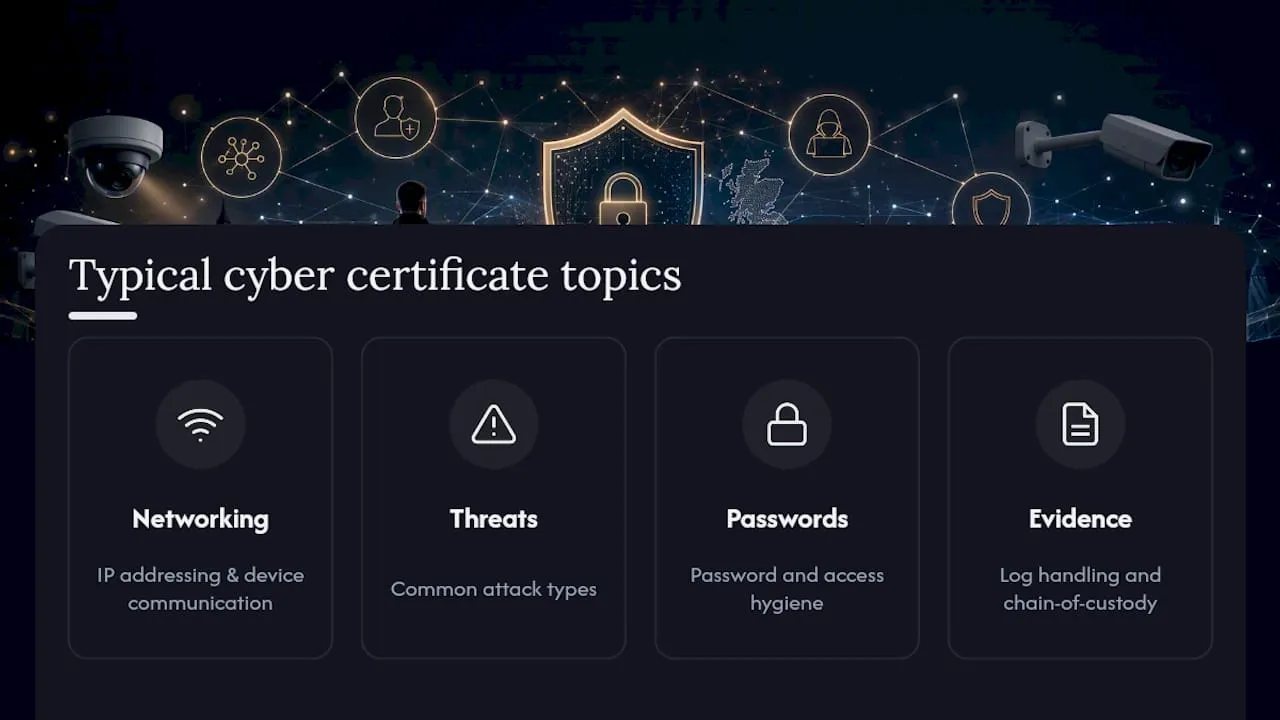
For someone working in physical security, the modules that transfer most directly are the ones on networked device basics and evidence or log handling. Understanding how an IP camera sits on a network, and why chain-of-custody matters when you export footage, are the exact skills a control-room employer wants to see demonstrated.
Courses vary a lot in depth and hands-on content. A short online certificate might be entirely multiple-choice theory, while a longer course could include practical exercises on a test network or simulated CCTV system. When you’re choosing a certificate to add to an SIA licence, the practical, systems-based courses tend to carry more weight with employers than purely theoretical ones, because they map onto something you can actually describe doing in an interview.
Career progression beyond your first role
Progression in UK physical security tends to follow a fairly predictable ladder: guard or CCTV operator, then supervisor, then control-room manager or security manager, with further SIA-linked or management qualifications supporting each step up.
A cyber security certificate earns its keep hardest at the supervisor and control-room manager stages, where you’re responsible for how a team handles system faults, evidence requests and liaison with IT or facilities teams. At that level, being the person who understands both the guarding side and the systems side becomes a genuine asset, not just a CV line.
Beyond the certificate, progression usually means adding a second SIA licence (Door Supervisor alongside Security Guard, for instance), taking a recognised management or team-leading qualification, or moving into a specialist niche such as transport security or corporate investigations. Some professionals use the cyber foundation to move sideways into security systems installation or maintenance work, roles like a security installation team leader, which sit closer to the technical side of the industry while still being physical-security-facing.
Salary ranges and demand for certificate holders
Pay in UK physical security still varies mainly by licence type, sector and shift pattern rather than by certificate alone. Guarding and door supervision roles sit at the lower end of the scale, CCTV operator and control-room roles tend to pay more once you’re SIA-licensed and settled into the role, and specialist transport or corporate security posts sit higher again.
A cyber security certificate is unlikely to move you into a different pay band on its own. What it does, particularly for CCTV operator and control-room roles, is make you a more competitive applicant for the better-paid roles within your existing licence category, and it can support a case for a pay rise once you’re doing the job and demonstrably handling the technical side well.
Demand for candidates who can bridge guarding and basic systems knowledge has been rising, driven by more sites running networked CCTV, access control and alarm systems as standard rather than as an extra. Employers in transport, retail and corporate control rooms are the ones most actively looking for this combination, and it’s a trend worth watching if you’re deciding which certificate or licence to add next.
IT security roles vs. physical security with cyber elements
The clearest way to separate these two worlds is by what you’re actually protecting and how you’re licensed to do it. IT security roles, Security Analyst, Penetration Tester, Incident Responder and similar titles, protect networks, data and software, and they sit inside IT or dedicated cyber security teams. They require no SIA licence at all, because they’re not physical security work in the legal sense.
Physical security roles with cyber elements, guarding, CCTV operating, door supervision, protect people, premises and physical assets, and every front-line one of them legally requires an SIA licence regardless of any cyber knowledge you bring. The cyber certificate is additive here: it makes you better at the physical security job, not a qualified IT security professional.
The practical takeaway for a jobseeker is to be honest about which world you’re aiming for. If it’s guarding, CCTV or door supervision, the SIA licence is your non-negotiable first step and the certificate is your differentiator. If it’s genuinely IT security work, the certificate matters more, but you’re on a different career track entirely, one this article doesn’t attempt to map, because the entry routes, employers and qualifications involved are not the same as the UK guarding and CCTV sector.
Why the cyber angle matters more than most jobseekers realise
Most people treat a cyber security certificate as an add-on, something to mention if it comes up. That’s a mistake for anyone serious about control-room or transport security work, and it’s the opposite mistake from assuming the certificate replaces your SIA licence.
The honest truth is that the certificate rarely wins you a role outright. What it does is win you the interview when two candidates hold the same SIA licence, and then win you the job when the employer realises you can actually explain what happened to a networked camera at 2am without waking up the IT contractor. That’s a narrow, specific advantage, and it only pays off if you can talk about it concretely rather than listing it as a bullet point nobody probes.
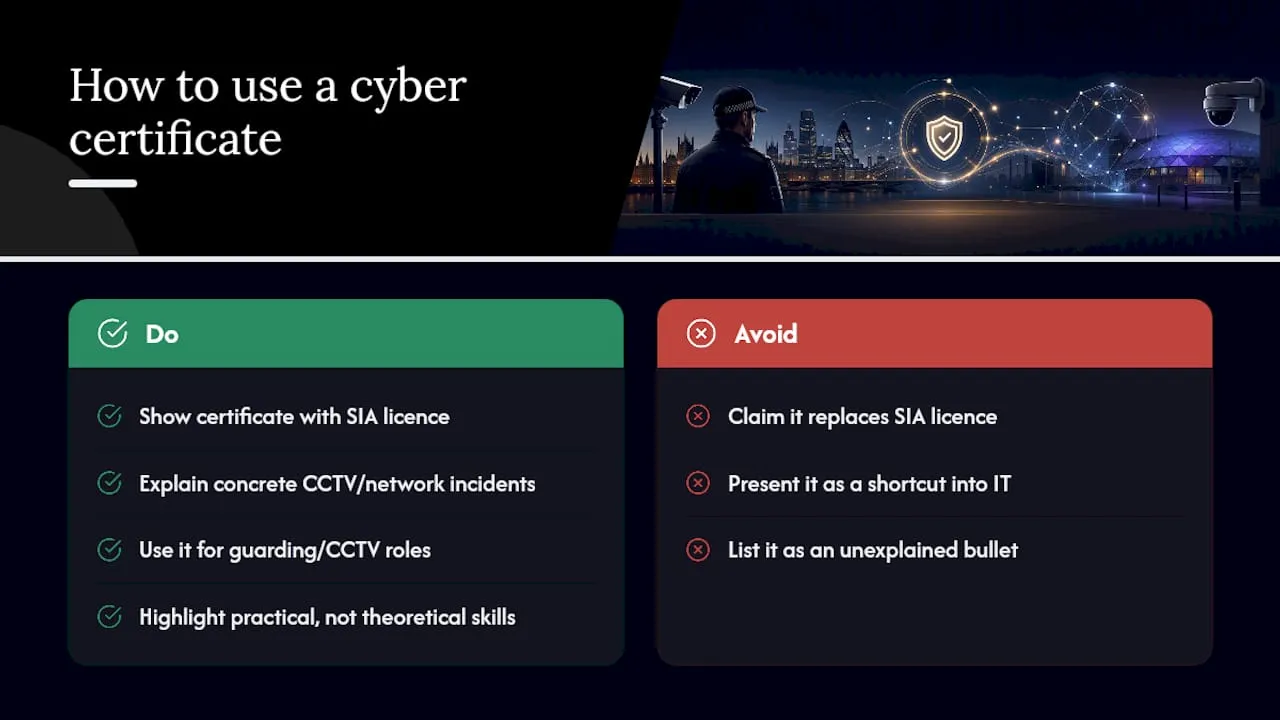
I’d also push back gently on jobseekers who see the certificate as a shortcut into IT security proper. It isn’t, and pretending otherwise on a CV aimed at guarding or CCTV roles just confuses recruiters about what job you’re actually applying for. Use it for what it is: a genuine edge in a sector that’s quietly becoming more technical every year, especially in control rooms, transport hubs and corporate estates running integrated systems.
Rob writes practical guides on cyber pathways for security jobseekers, drawing on a BSIA-affiliated, GDPR-compliant platform built specifically for the UK security industry, with human support behind listings rather than an automated black box.
— Rob
Ready to put your certificate to work?
This platform is an alternative to trawling generic job sites for security-specific vacancies: every listing is UK security industry, filtered for the licences and skills that actually matter, rather than buried among warehouse and retail roles that have nothing to do with your SIA licence.

If you’re job-hunting, create a profile and upload your CV for free, set an alert for CCTV or control-room roles, and start applying to employers who’ll actually read what your certificate means. If you’re hiring, post a job or browse the CV database to reach licensed candidates who already understand the systems side of the role. Security Jobs Board’s BSIA affiliation, GDPR compliance and human support team back every listing on both sides, so neither jobseekers nor employers are left guessing. Start your search or your first listing today.
Sources
For licence rules, check GOV.UK’s SIA licence guidance and the SIA’s Get Licensed guidance. For CV and role-specific advice, see Security Jobs Board’s career advice pages and its guide on required skills.
FAQ
Do I need an SIA licence if I have a cyber security certificate?
Yes. Guarding, door supervision, CCTV operating and CVIT roles all legally require the relevant SIA licence, regardless of any cyber qualifications you hold.
Which physical security role benefits most from a cyber certificate?
CCTV operator and control-room roles benefit most, since IP camera systems, log review and evidence handling draw directly on the same knowledge a cyber security certificate teaches.
Can a cyber security certificate get me an IT security job instead?
Not directly. IT security roles like Security Analyst or Penetration Tester sit on a separate career track with different entry routes, unrelated to SIA-licensed guarding or CCTV work.
Does the certificate increase my pay in security roles?
Not on its own, but it makes you more competitive for higher-paying CCTV, control-room and transport security roles within your existing licence category.
Where should I look for roles that value this combination?
Search and set alerts on Security Jobs Board, filtering for CCTV, control-room and transport security listings where employers specifically value hybrid skills.


