What skills are needed for cyber security roles in UK physical security?
You need a valid Security Industry Authority (SIA) licence matched to your role, the licence-linked qualification that unlocks it, and three skill groups employers actually test: interpersonal soft skills, role-specific technical competence, and basic emergency response including first aid. Before anything else, check which licensable activity your job falls under, because that decision drives everything else, from training provider to application fee.
- Soft skills: communication, conflict de-escalation, customer service, observation
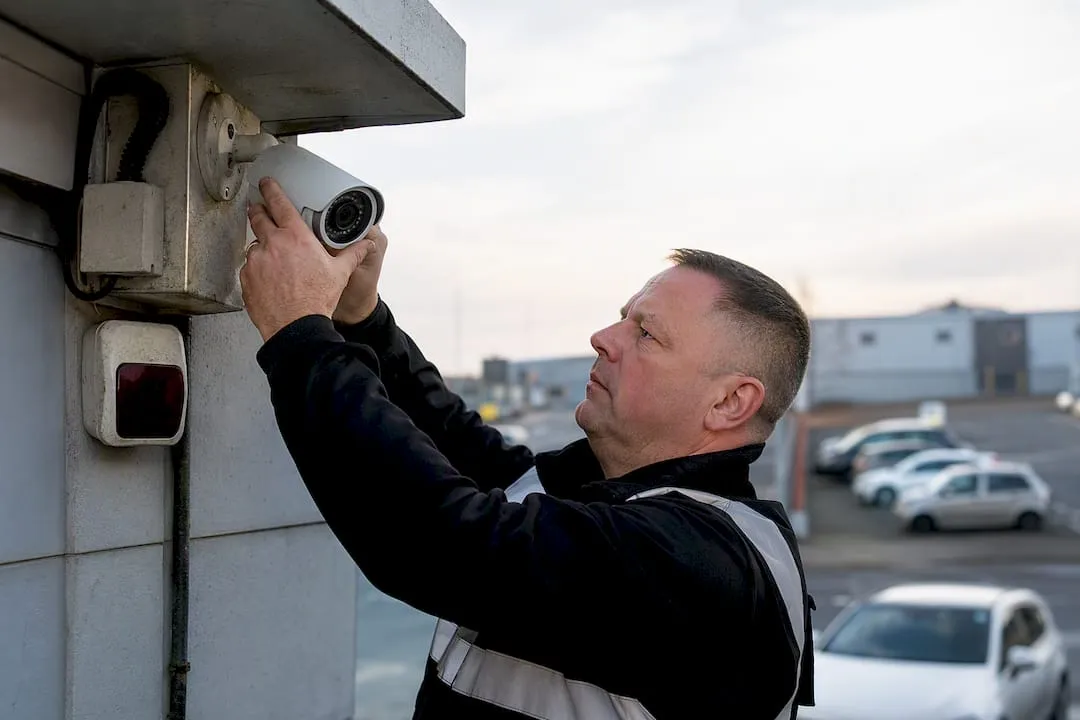
- Technical skills: CCTV operation, access control, patrols, report writing
- Emergency competence: first aid, incident response, safe evacuation procedures
Get the licence wrong and none of the rest matters. Employers cannot legally deploy you on a frontline role without it.
Key Takeaways
Frontline UK security roles demand a matching SIA licence, its linked qualification, and demonstrable soft, technical and first-aid skills before an employer can legally deploy you.
| Point | Details |
|---|---|
| Licence must match activity | Check GOV.UK’s licensable activity list before assuming your role needs a specific SIA licence type. |
| Qualification comes before licence | Complete the licence-linked qualification, such as the Level 2 Door Supervisor Award, before applying. |
| Budget for the application fee | Individual SIA applications carry a £204 fee as of an April 2026 GOV.UK update, plus training costs. |
| Soft skills get tested first | Employers assess de-escalation and communication through scenarios, not just CV claims. |
| List and apply directly | Security Jobs Board lets candidates upload licence details and employers verify credentials before shortlisting. |
Table of Contents
- Soft skills every security operative needs
- Role-specific technical skills for CCTV, doors and patrols
- Licences and qualifications you need before applying
- Proving your skills to employers
- Employer hiring checklist for safe recruitment
- Security Jobs Board resources and next steps
- What UK security jobseekers get wrong about skills
- Ready to put your qualifications to work
- Sources
- FAQ
Soft skills every security operative needs
Ask any door supervisor what actually gets tested on shift and it’s rarely the paperwork. It’s whether you can talk someone down from a fight without laying a hand on them. Soft skills separate the operatives who get rebooked from the ones who don’t, and they’re far easier for an employer to assess quickly than technical knowledge.
Communication and de-escalation sit at the top of most job specs for a reason. A security guard who can calmly redirect an aggressive customer avoids incidents that end in injury, complaint, or a police callout. Employers increasingly run scenario-based interviews specifically to watch how candidates phrase a warning or handle a raised voice, because tone matters as much as the words themselves.
Observation and report-writing matter more than most jobseekers expect. A guard who notices a propped fire door, an unfamiliar vehicle idling near a loading bay, or a pattern of till discrepancies is worth more than one who simply patrols on autopilot. Written incident reports also carry legal weight if a case goes to court or insurance, so clarity and accuracy in that report are non-negotiable skills, not a box-ticking exercise.
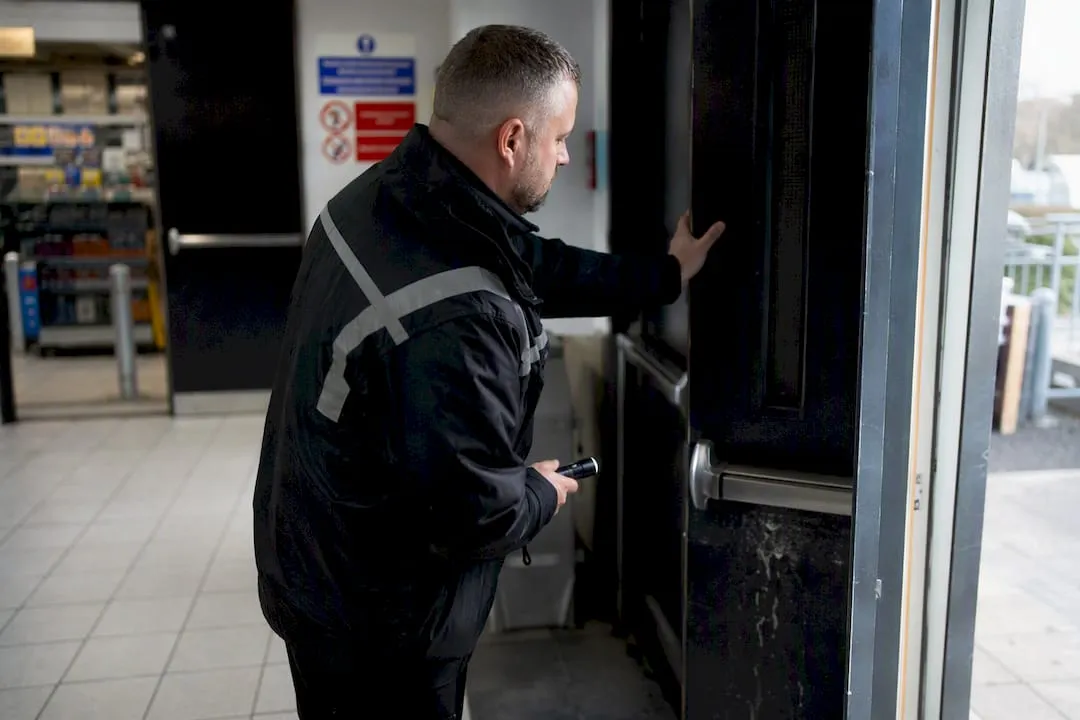
Reliability, punctuality and professionalism round out the list, and GDPR awareness increasingly belongs alongside them, particularly for anyone handling CCTV footage, visitor logs, or incident records containing personal data. A shift that starts late at a construction site or retail unit creates a genuine security gap, not just an inconvenience for the rota manager.
So how do you actually evidence any of this on a CV or in an interview? A breakdown of why soft skills matter in security careers covers the assessment methods employers use in more detail, but the shortlist looks like this:
- Ask for a probationary or trial shift where possible, since behaviour under real pressure tells you more than any interview answer.
- Request two references specifically covering conduct on previous contracts, not just dates of employment.
- Use scenario-based interview questions (“a customer refuses to leave, what do you say first?”) rather than generic competency questions.
- Look for evidence of de-escalation training on a CV, even informal in-house courses count.
Pro Tip: If you’re a jobseeker with no formal record of your soft skills, ask a previous supervisor for a short written reference focused on one specific incident you handled well. A concrete example beats a generic “reliable and hardworking” line every time.
Role-specific technical skills for CCTV, doors and patrols
Every licensable role carries its own technical core, and employers expect candidates to demonstrate it rather than just claim it on paper.
- CCTV monitoring demands more than watching a bank of screens. Operators need to understand data protection principles, since footage often counts as personal data under UK law, and Gov clarifies when the work becomes a licensable activity even if you already hold a different SIA licence. Evidence of this competence usually comes through a public space surveillance qualification plus a short data-handling briefing from the employer.
- Door supervision covers searches, refusing entry, managing queues, and safely removing troublesome individuals without excessive force. Physical intervention training, usually delivered alongside the licence-linked qualification, is the evidence employers check first, followed by a clean incident-report history from previous venues.
- Security guarding revolves around access control, key-holding responsibility, and incident logging. A guard who can explain, step by step, how they’d log and escalate a break-in attempt shows more competence than one who just states “I know the procedures.”
- First aid and emergency response rounds out the technical set. The National Careers Service recommends Emergency First Aid at Work training for door supervisors specifically, and most employers across guarding and CCTV roles now expect a current first-aid certificate as standard, not an optional extra.
Certificates, course completion dates, and a named training provider are what employers actually want to see, not a vague line reading “first aid trained.”
Licences and qualifications you need before applying
The licence type has to match the activity, not the job title. GOV.UK’s guidance on finding out if you need an SIA licence lists door supervision, security guarding, public space surveillance (CCTV), close protection, and cash and valuables in transit as the main frontline categories.
- Frontline licences cover anyone in direct, uniformed or public-facing contact with the public, and these require a licence-linked qualification completed before you apply.
- Non-frontline licences cover roles like managing a security business without personal contact duty, and the qualification rules differ.
- The Level 2 Award for Working as a Door Supervisor is the classic licence-linked qualification example, and you cannot apply for a door supervisor licence without it, per the National Careers Service.
- GOV.UK’s application guidance confirms that frontline applicants must hold the correct licence-linked qualification, pass a criminality check, and provide identity documents before submission.
The SIA licence fee for individual applicants is £204, according to an April 2026 GOV.UK Q&A on the licence fee change. Treat that figure as a current example rather than a permanent number, since the SIA has adjusted fees before and can do so again.
Budget for the training course cost on top of that fee, plus DBS processing time, which can add several weeks to your start date.
Proving your skills to employers
A licence number on a CV means nothing if it can’t be verified in seconds. Keep a digital folder with certified copies of your SIA licence, your licence-linked qualification certificate, and your DBS certificate reference number, ready to attach or share the moment an employer asks.
- List licence type, expiry date, and qualification name clearly under a dedicated “Licences & Qualifications” heading on your CV or job board profile, not buried in a paragraph.
- Use STAR examples (Situation, Task, Action, Result) in interviews to prove soft skills concretely, such as describing a specific de-escalation incident rather than claiming to be “good under pressure”.
- Employers should request sight of the physical licence card and cross-check the expiry date, since an expired licence makes deployment illegal regardless of what a CV states.
- Short practical tasks, like asking a candidate to talk through a mock incident report, reveal competence faster than a formal interview alone.
Concrete examples of security qualifications worth listing on a profile are covered in more depth elsewhere, but the principle stays the same: specific, checkable, dated.
Employer hiring checklist for safe recruitment
Before extending an offer for any frontline role, run through this sequence.
- Confirm the SIA licence is current and matches the exact activity the role requires, not a related but different licence type.
- Verify the licence-linked qualification certificate against the licence application, since a mismatch here is a compliance red flag.
- Check DBS status, right-to-work documents, and photo ID against the licence card details.
- Run a short scenario or practical test covering communication and observation skills rather than relying on interview answers alone.
- For CCTV-facing roles, request evidence of GDPR or data-handling training, since footage mishandling creates real legal exposure for the business.
Skipping step two is the most common shortcut employers regret, usually discovered only after an incident forces a paperwork review.
Security Jobs Board resources and next steps
Once you know which licence and qualification you need, the next step is putting that information somewhere employers can actually see it. Security Jobs Board’s training and course resources walk through qualification routes for guarding, door supervision and CCTV roles, and candidate profiles let you list licence numbers, expiry dates, and certificates directly against your CV.
The platform’s affiliation with the British Security Industry Association (BSIA) gives employers and jobseekers a recognisable trust signal in a sector where verifying credentials matters more than most. GDPR-compliant profile handling and mobile-responsive design mean your details stay secure whether you’re updating them from a phone between shifts or a desktop at home.
Practical next steps:
- Create a free candidate profile and add your SIA licence details in the dedicated fields.
- Set job alerts for your licence type and region so relevant vacancies reach you first.
- Apply directly through the platform and track application status without chasing emails.
What UK security jobseekers get wrong about skills
Most advice on this topic treats the licence as paperwork and the skills as the real substance. That gets the order backwards. The licence is the gatekeeper, and no amount of communication ability or CCTV knowledge matters if the licence-linked qualification is missing or the wrong type for the activity.
Where conventional advice falls down is in treating soft skills as a soft add-on rather than the thing employers actually screen for first. A candidate with a valid licence but no evidence of de-escalation ability will lose out to one who can describe a real incident they handled calmly, even with a shorter CV. Technical competence, CCTV operation, access control, and the rest, tends to be teachable on the job in a way that judgement under pressure isn’t.
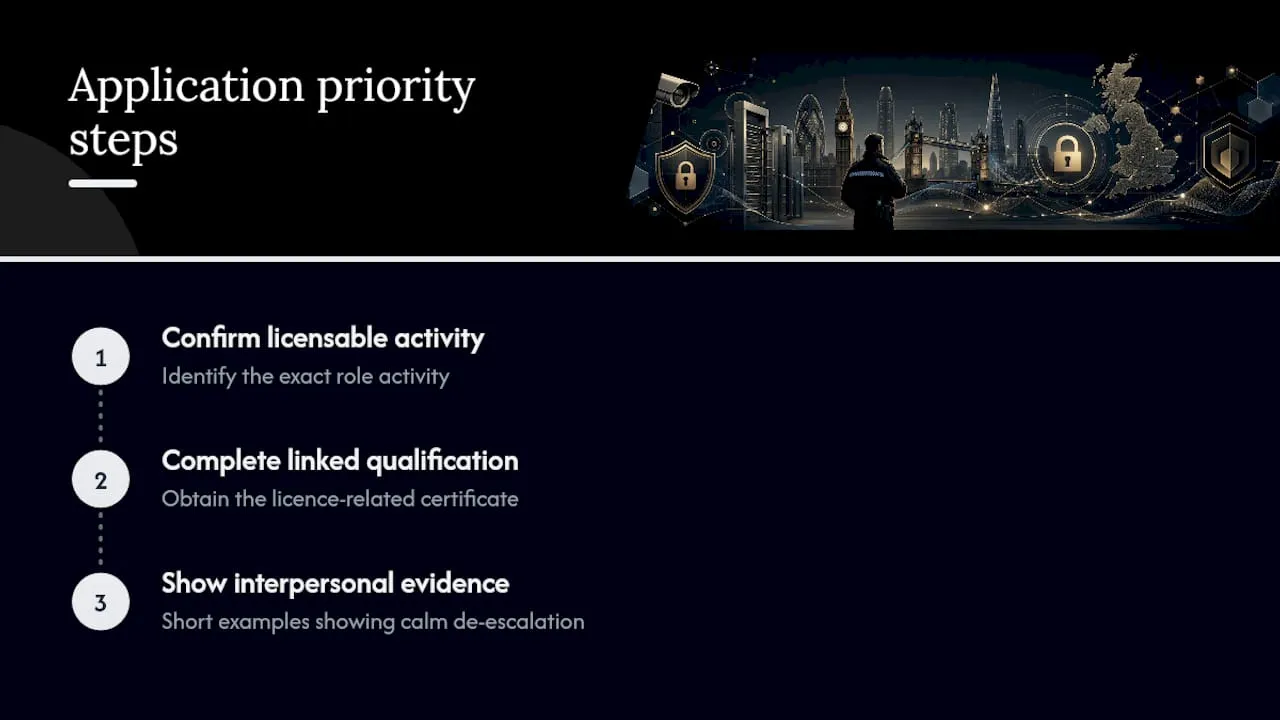
If you’re starting from scratch, the priority order should be: confirm the exact licensable activity, complete the linked qualification, then build a small portfolio of concrete examples that prove you can handle the interpersonal side under pressure. Skip straight to applying for licences without that third piece, and you’ll pass the paperwork but struggle in the interview room.
— Rob
Ready to put your qualifications to work
Security Jobs Board is the direct route between a finished qualification and an actual interview, without the wait that comes from scattering CVs across generic job sites that don’t know an SIA licence from a first-aid certificate.

If you’re a jobseeker, creating a profile is free: upload your CV, add your licence type and expiry date to dedicated fields, and set alerts so relevant vacancies in your region land in your inbox rather than getting buried in a general search. Jobseekers browsing security roles in Northern Ireland can filter straight to licence-matched vacancies rather than scrolling irrelevant listings.
For employers, the employer portal gives you paid job posting options, direct CV database access, and recruitment support built around verifying exactly the licence and qualification details this article covers. Post your first vacancy today and start reviewing licence-verified candidates within days, not weeks.
FAQ
What skills are needed for cyber security roles in physical security?
You need a valid SIA licence matched to your role, its linked qualification, strong communication and observation skills, and role-specific technical competence such as CCTV operation or access control.
What certifications does UK cyber security in physical roles require?
The main certifications are licence-linked qualifications like the Level 2 Award for Working as a Door Supervisor, alongside recommended courses such as Emergency First Aid at Work.
How much does an SIA licence cost?
The individual SIA application fee is £204, according to an April 2026 GOV.UK update, on top of any training course fees.
Do CCTV operators need a separate SIA licence?
Yes, public space surveillance work is a distinct licensable activity, and GOV.UK guidance confirms it can require its own licence even alongside another SIA licence type.
Where can I list my security qualifications to find work?
Security Jobs Board lets candidates create a free profile with licence and qualification fields, upload certificates, and set alerts for matching vacancies across the UK.


