Highest-paying security jobs in the UK: 2026 guide
The highest-paying roles in UK physical security are Head of Security, Chief Security Officer (physical focus), Close Protection Officer, Security Manager, Security Systems Engineer, Loss Prevention Manager, Protective Security Advisor, and CSOC Physical Security Team Leader. Top-end salaries reach £95,000–£110,000 plus bonus for senior leadership, with contractor close protection work delivering equivalent earnings through daily rates.
Here are the headline figures for the top roles:
- Head of Security / Head of Security Operations: £55,000–£110,000+ (senior CNI roles advertise £95,000–£110,000 + 10% bonus)
- Chief Security Officer (physical focus): £70,000–£120,000+
- Security Manager: median £70,000 in England; 75th percentile £85,000, 90th percentile £95,000
- Close Protection Officer (CPO): £31,549 average; UHNW/travelling roles advertised at £55,000–£65,000; day rates £150–£300+
- Security Systems Engineer / Installer: £35,000–£65,000
- Loss Prevention Manager / Head of Loss Prevention: £40,000–£70,000
- Protective Security Advisor: £45,000–£75,000
- CSOC Physical Security Team Leader (Band M): £60,400–£65,886
Market signal: ITJobsWatch records a median Security Manager salary of £70,000 in England (6 months to 25 July 2026), with demand from critical national infrastructure (CNI) and corporate estate clients pushing experienced managers well beyond that figure.
Pro Tip: Check your SIA licence status before applying. Many high-paying posts require a current Door Supervision or Close Protection licence as a baseline, even for management roles.
Key takeaways
The single most important fact is this: Security Manager salaries in England reach a median of £70,000 and a 90th-percentile ceiling of £95,000, with Head of Security roles at CNI sites advertising up to £110,000 plus bonus.
| Point | Details |
|---|---|
| Top-paying roles | Head of Security, CPO, Security Manager, and CSOC Team Leader offer the highest UK physical security salaries. |
| Biggest pay driver | Sector matters more than title: CNI, finance, and UHNW roles pay significantly more than retail equivalents. |
| Fastest qualification gain | An SIA Close Protection licence opens CPO roles paying £55,000–£65,000 and day rates of £150–£300+. |
| Public-sector benchmark | CSOC Band M pays £60,400–£65,886 with a defined-benefit pension, making it competitive with many private roles. |
| Where to search | Securityjobsboard (BSIA-affiliated, free for candidates) and GOV.UK Find a Job are the primary channels for high-paying UK security vacancies. |
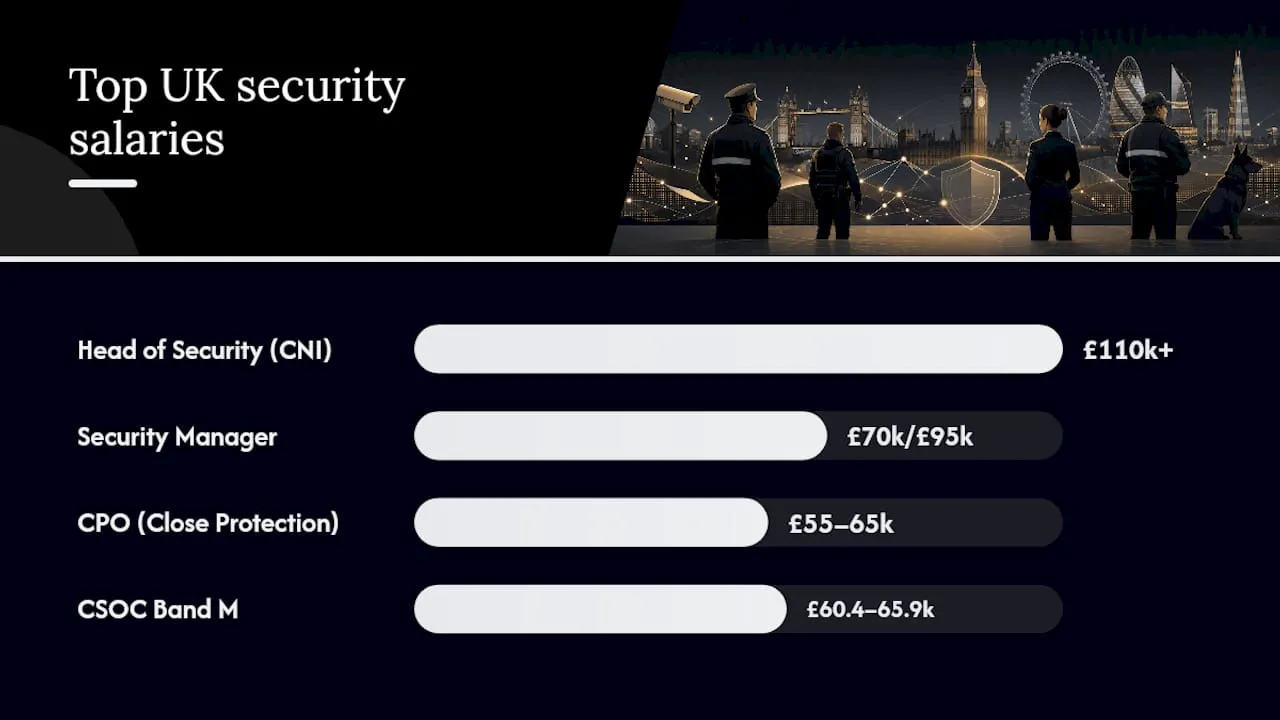
Table of Contents
- What do the highest-paying physical security roles actually involve?
- What actually determines your pay in UK physical security?
- How do you move into the highest-paying roles?
- Salary bands from entry to top end
- Where to find high-paying UK physical security roles
- A note from the Securityjobsboard team
- Securityjobsboard: your route to higher-paying security roles
- Sources
- FAQ
What do the highest-paying physical security roles actually involve?
Understanding why a role pays more comes down to three things: the level of responsibility it carries, the specialist skills it demands, and the risk or disruption it asks of you.
Head of Security and Chief Security Officer (physical focus)
The Head of Security owns the entire protective security strategy for an organisation. That means board-level reporting, budget sign-off, crisis management, and accountability when something goes wrong. Typical employers include FTSE-listed corporates, critical infrastructure operators, government departments, and large private estates. A Head of Security Operations role at a CNI site such as AWE advertises packages of £95,000–£110,000 plus a 10% bonus. The premium reflects the liability sitting on that person’s shoulders, not just the hours.
Security Manager and Senior Security Manager
Security Managers translate strategy into daily operations: rotas, incident response, contractor oversight, and compliance. PayScale puts the UK average at £45,237, but that figure is pulled down by smaller retail and hospitality employers. In finance, CNI, and large corporate estates, the ITJobsWatch median reaches £70,000. The gap between those two numbers is almost entirely explained by sector and employer size.
Close Protection Officer (CPO)
CPOs protect individuals, not buildings. The work ranges from low-key corporate principals to high-risk UHNW clients requiring international travel and hostile-environment capability. Glassdoor’s national average sits at £31,549, but that average includes part-time and domestic-only work. A travelling CPO role for a UHNW client is advertised at £55,000–£65,000 plus benefits. Day rates of £150–£300+ are standard for contract work, and hostile-environment or offshore assignments push rates higher still.
Security Systems Engineer and Installer
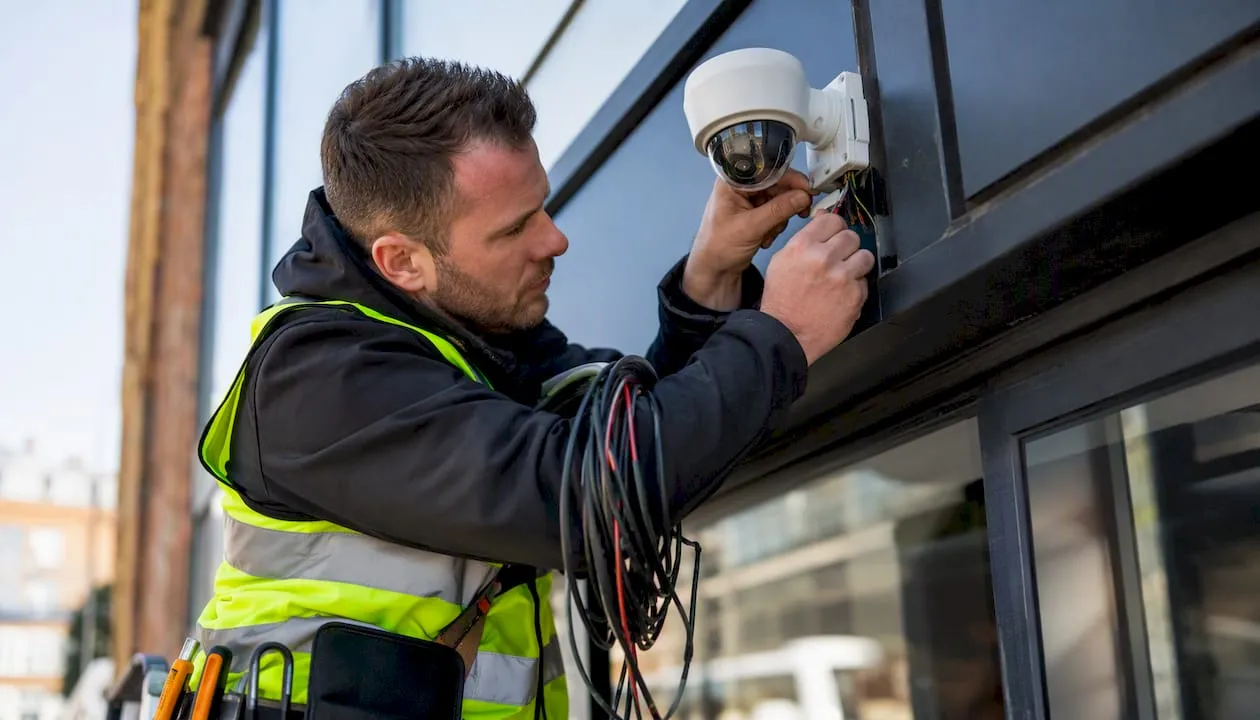
This is the technical end of the sector: designing, installing, and maintaining CCTV, access control, intruder detection, and integrated security management systems. Employers include specialist integrators, facilities management firms, transport operators, and critical infrastructure sites. Pay rises sharply when an engineer holds manufacturer certifications (Genetec, Lenel, Gallagher) alongside SIA eligibility. Technical and technology-integrated roles are a growing premium segment precisely because the combination of physical security knowledge and technical depth is rare.
Loss Prevention Manager and Head of Loss Prevention
Retail and logistics employers pay well for managers who can demonstrably cut shrinkage. A Head of Loss Prevention for a national retailer or distribution network typically earns £45,000–£70,000, with bonuses tied to measurable stock-loss reduction. The role demands data analysis, supplier liaison, and staff training, not just floor presence.
Protective Security Advisor
Protective Security Advisors assess threats, design protective measures, and advise organisations on physical security risk. The National Careers Service lists a Protective Security Advisor Higher Apprenticeship with postings in Leeds and London, making it one of the few structured entry routes into advisory-level pay without a degree. Experienced advisors working in CNI or government contexts earn £45,000–£75,000.
CSOC Physical Security Team Leader (Band M)
Counter Terrorism Policing’s CSOC Physical Security Team Leader role is a concrete public-sector benchmark. The Band M salary range is £60,400–£65,886, with the added value of a defined-benefit pension and structured career framework. For experienced operatives who want stability alongside strong pay, public-sector specialist roles like this are worth targeting.
What actually determines your pay in UK physical security?
Most pay conversations in this sector focus on job title. The smarter conversation is about the levers underneath it.
- Sector: CNI, finance, and UHNW private households pay the most. Retail and hospitality pay the least, regardless of title.
- SIA licences: A Door Supervision licence is the floor. Stacking a Close Protection licence, CCTV licence, or Security Systems licence adds negotiating weight.
- Security clearance: SC and DV clearance opens government and CNI roles that are simply unavailable to uncleared candidates. Understanding how clearance levels affect placement is one of the most underused career levers in the sector.
- Specialist training: Hostile-environment courses (HEAT), maritime/offshore certification, and medical qualifications (FREC4, FPOS) each add a premium.
- Technical certification: For systems engineers, manufacturer accreditations from Genetec, Gallagher, or Lenel are worth more than a generic qualification.
- Management experience: Board-level reporting, P&L responsibility, and multi-site oversight justify the jump from £50,000 to £80,000+.
- Travel and risk: International and hostile-environment contracts pay more because fewer people will do them.
- Union and professional body membership: BSIA membership and affiliation with bodies such as the Security Institute signal professionalism to employers and, in some sectors, support collective pay frameworks.
Additional pay elements worth negotiating: hazard pay, overtime rates, pension contributions (public-sector roles often carry defined-benefit schemes), private healthcare, and annual bonuses tied to performance or incident metrics.
Demand signal: Clients are paying premiums for managers who can protect critical infrastructure and large corporate estates, with Security Manager demand in England reflected in a 90th-percentile salary of £95,000.
Pro Tip: If you are currently a field operative, the fastest single pay uplift is a Close Protection licence. If you are already a supervisor, the biggest lever is sector change — moving from retail to CNI or finance can add £15,000–£20,000 without a change in title.
How do you move into the highest-paying roles?
A realistic 12–36 month plan looks like this:
- Map your target role and identify the gap. Compare your current licences, clearance, and experience against a live job advert for your target role. The gap is your training list.
- Secure the right SIA licence(s). Close Protection requires the SIA CP licence; door supervision is the prerequisite for most management roles. Check current SIA requirements before booking training.
- Add specialist qualifications. HEAT training, FREC4, or a manufacturer certification (for systems engineers) each move you into a smaller, better-paid candidate pool.
- Apply for supervisory posts and seek secondments. Supervisor roles are the bridge between operative and manager pay bands. A secondment to a CNI or government site builds the sector experience that justifies the next salary jump.
- Target private UHNW, CNI, or government postings. These employers pay the most and recruit through specialist channels, not general job boards.
CV and interview tips: Quantify everything — number of sites managed, headcount supervised, budget controlled, incidents resolved. Reference your clearance level and vetting history explicitly. For systems engineers, list every manufacturer certification and software platform you hold. State your availability for travel and on-call clearly; for CPO roles, it is often the deciding factor.
Salary vs day rate: A salaried £55,000 role with pension, healthcare, and 28 days’ holiday is worth considerably more than a £55,000 equivalent in day-rate contracts once you account for gaps, self-employment costs, and no employer pension. Calculate total reward, not just the headline figure, before accepting or rejecting an offer.
Pro Tip: When negotiating, anchor to the ITJobsWatch 75th percentile (£85,000 for Security Managers in England) rather than the average. Employers expect candidates to know the market.
Salary bands from entry to top end
Reading the table: Figures are gross annual salary in GBP. Public-sector Band M roles (CSOC) have a defined ceiling but carry pension and benefits that private-sector equivalents rarely match. Day rates for CPO work (£150–£300+) translate to £39,000–£78,000 annualised at 260 working days, but contract gaps and self-employment costs reduce net take-home.
PayScale’s average of £45,237 for Security Managers reflects the full market including smaller employers. The ITJobsWatch median of £70,000 reflects the active advertised market in England, which skews toward larger and better-paying employers. Use both figures: the PayScale average tells you the floor; the ITJobsWatch percentiles tell you what is achievable.
Where to find high-paying UK physical security roles
The highest-paying vacancies rarely appear on general job boards. Here is where they do appear.
Securityjobsboard is the specialist UK platform affiliated with the BSIA, carrying roles from SIA-licensed operative posts through to senior management and technical positions. Create a profile, upload your CV, and set alerts for your target role, sector, and region. The platform is free for candidates and built specifically for the UK security sector, so you are not competing with irrelevant applicants.
GOV.UK Find a Job lists public-sector and government-contracted roles including CSOC and Protective Security Advisor positions. Search using terms such as “security manager Band M”, “protective security advisor”, or “close protection SC cleared” to surface the right vacancies.
BSIA resources connect you with member employers across the industry. BSIA membership signals credibility to those employers and can open doors to roles that are not publicly advertised.
Specialist recruiters handle senior and confidential appointments, particularly for UHNW households and private estates. These roles are rarely advertised openly. Building a relationship with two or three specialist security recruiters is worth more than any job alert for roles at this level.
Search terms that work: combine role title + sector + region + licence requirement, for example: “head of security CNI London SC cleared” or “close protection officer UHNW hostile environment”. Add “enhanced vetting” or “DV cleared” for government roles.
For confidential applications at senior level, use a covering letter that states your clearance level, vetting history, and availability for travel in the first paragraph. Discretion and reliability are what UHNW and government employers are buying.
Pro Tip: Set a job alert on Securityjobsboard with your target role title and region. New high-paying vacancies move quickly in this sector, and being first to apply matters.
A note from the Securityjobsboard team
The UK physical security sector has more high-paying opportunities than most candidates realise, but they are concentrated in specific sectors and rarely stay live for long. At Securityjobsboard, we work with employers across CNI, corporate, government, and private household sectors, and we are affiliated with the BSIA, which means the roles on our platform come from employers who take security seriously.
If you are serious about moving into a higher-paid role, the single most useful thing you can do today is create a free profile on Securityjobsboard, upload your CV, and set alerts for your target roles. Employers search our CV database directly, so a complete profile works for you even when you are not actively applying.
Securityjobsboard: your route to higher-paying security roles
Finding a £70,000+ security management role or a UHNW close protection contract is not about luck. It is about being visible in the right place at the right moment.

Securityjobsboard is the UK’s specialist security job board, affiliated with the BSIA and built exclusively for the sector. Candidates register free, upload a CV, and set targeted job alerts. Employers search the CV database directly, which means your profile can generate approaches from hiring managers without a single application. For senior and specialist roles, that passive visibility is often what gets the conversation started.
Ready to move? Browse current security vacancies or register your profile at Securityjobsboard and set your first job alert today.
Sources
- Security Manager Job Trends, Salaries & Skill Sets in England | IT Jobs Watch
- Bodyguard job profile | National Careers Service
- Close protection officer salaries | Glassdoor UK
- CSOC Physical Security Team Leader – Band M – Compliance & Assurance – Counter Terrorism Policing HQ
- Security Manager Salary in United Kingdom in 2026 | PayScale
- Travelling Close Protection Officer - Ultra High Net Worth Client | Oplu
- Head of security operations - aldermaston - Sheffield - Job July 2026 - Jobijoba
A note on salary data: Aggregator averages (PayScale, Glassdoor) include part-time, junior, and lower-paying employers, which pulls figures down. ITJobsWatch percentiles reflect the active advertised market and are a better guide to what you can realistically negotiate. Always cross-reference two or three sources and check live job adverts for your specific role and region before setting salary expectations.
FAQ
What is the highest-paying physical security job in the UK?
Head of Security at a CNI or large corporate site is typically the highest-paying physical security role, with senior positions advertising £95,000–£110,000 plus bonus.
How much do Close Protection Officers earn in the UK?
The national average is around £31,549, but UHNW and travelling CPO roles advertise £55,000–£65,000 annually. Day rates run from £150 to over £300 depending on risk and location.
Do I need an SIA licence for the highest-paying security jobs?
Yes. Most senior and specialist roles require a current SIA licence as a minimum. Close Protection roles require the SIA CP licence specifically, and stacking additional licences strengthens your negotiating position.
What is the Band M salary for a CSOC Physical Security Team Leader?
Counter Terrorism Policing’s Band M range for this role is £60,400–£65,886, with the added benefit of a public-sector pension scheme.
Where is the best place to find high-paying UK security jobs?
Securityjobsboard, affiliated with the BSIA, is the specialist UK platform for security roles at all levels. GOV.UK Find a Job covers public-sector and government-contracted positions including Protective Security Advisor and CSOC roles.


