Spot Threats Early: UK Security Awareness for Officers, SIA and ACT
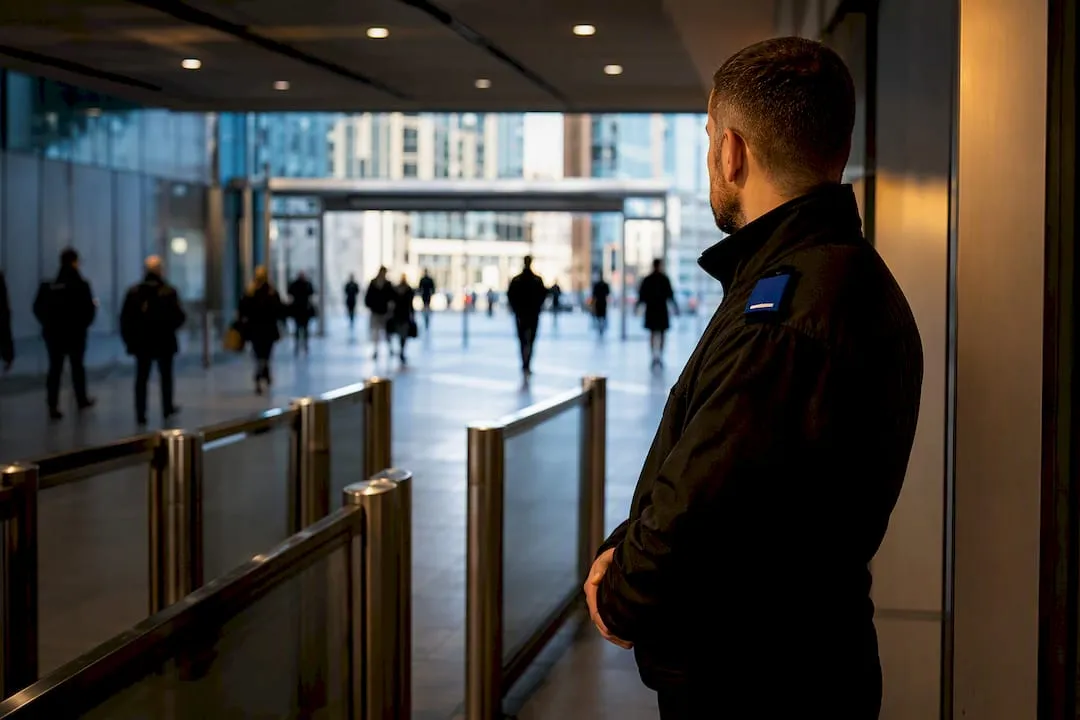
Security awareness is the practical ability of a frontline officer to spot, assess, deter and report threats while on duty, backed by a habit of continuous observation rather than a one-off checklist. Recognised bodies including the Security Industry Authority, ProtectUK and the ACT counter-terrorism programme frame it as an active, trained behaviour. The rest of this guide sets out how to build it into everyday patrols, briefings and training.
TL;DR:
- Regularly varying patrol routes and timing prevents offenders from predicting security presence, enhancing site deterrence.
- Continuous risk assessment and quick response frameworks like the HOT protocol and the Four Cs improve threat detection and response efficiency.
- Ongoing training, including e-learning and practical drills, is essential for maintaining awareness and should be documented and regularly refreshed.
- Non-physical reporting, scene preservation, and contemporaneous notes are critical for effective incident handling and legal protection.
- Employers should evaluate candidates’ security awareness through evidence of additional training and scenario responses, not just license compliance.
Table of Contents
- Core elements of situational and operational awareness
- Practical on-shift behaviours: patrols, briefings and reporting
- Training and legal standards for UK security officers
- Personal safety, equipment and the limits of intervention
- A shift-ready checklist and two quick drills
- How security awareness developed into today’s standard
- Why security awareness matters for organisations and individuals
- Threats covered under security awareness on site
- Beyond the frontline: management and support staff
- Measuring whether a security awareness programme actually works
- Common obstacles to building security awareness
- Why awareness should shape how you hire, not just how you train
- Find security roles and hire trained officers with Security Jobs Board
- Sources
- FAQ
Core elements of situational and operational awareness
Situational awareness starts with scanning, not staring. Officers trained to spot hostile reconnaissance look for the same person returning to a site at odd hours, note-taking near entry points, or someone photographing camera positions rather than the building itself. None of these signs alone means much. Together, repeated over a shift, they build a pattern worth reporting.
Dynamic risk assessment is the mental habit of updating your read on a situation as it changes, rather than locking in a judgement at the start of a shift and sticking with it. ProtectUK’s guidance on personnel security stresses that officers should keep reassessing risk continuously, because a quiet foyer at 2pm and the same foyer during an evacuation drill are two different risk pictures entirely. Judging threat by appearance alone is one of the most common mistakes officers make; a calm-looking individual can still be the one carrying out reconnaissance.
Two frameworks help structure the response once something looks wrong:
- HOT protocol for suspicious items: Hidden (is it concealed or out of place?), Obviously suspicious (wires, unusual smell, unexplained packaging), and Typical (does it fit what you’d expect in this location?).
- The Four Cs for initial response to a suspicious item or person: Confirm, Clear, Cordon, Control.
At a shopping centre, a rail station concourse or a stadium turnstile, these checks take seconds and become instinctive with repetition.
Pro Tip: Run a “two-glance rule” on anything odd. First glance to notice it, second glance thirty seconds later to see if it’s changed. Genuine threats rarely stay static; false alarms usually do.
Practical on-shift behaviours: patrols, briefings and reporting
A predictable patrol is a vulnerability, not a routine. ProtectUK’s tactic VB2 recommends varying both the timing and the route of patrols so that anyone watching the site cannot predict when an officer will pass a given point. Walking the same loop at the same intervals every shift tells a would-be offender exactly when the coast is clear.
- Start-of-shift briefing: cover site SOPs, individual roles, any known or emerging threats, and access points that need extra attention.
- Patrol the site unpredictably, logging observations as you go rather than relying on memory for the debrief.
- Report through the correct channel: internal incident logs for routine observations, the control room for anything live, 999 for an emergency, 101 for non-urgent police matters, and the Anti-Terrorist Hotline or ACT reporting routes for anything with a terrorism dimension.
- End-of-shift debrief: hand over sightings, near-misses and anything flagged but unresolved to the next shift or to a supervisor.
Supervisors close the loop by acting on reports, however minor, and telling the reporting officer what happened next. ProtectUK’s tactic IB2 is clear that feedback sustains reporting confidence; officers who report something and hear nothing back tend to stop reporting.
Training and legal standards for UK security officers
Licence-linked training in the UK is not optional guesswork; it follows a defined specification. The SIA security guarding specification sets out seven core training areas that every licensed guard must cover:
- The role of a security officer, including conduct and communication.
- Access control procedures.
- Use of security-related electronic equipment.
- Personal safety and conflict management.
- Awareness of drugs and their misuse on site.
- Searching procedures, including people, vehicles and premises.
- Patrolling techniques, including terror threat awareness.
Alongside this, the ACT Security e-Learning course gives frontline operatives a free, roughly 90-minute module developed by NaCTSO and NPSA, built specifically for operational environments rather than office-based cyber training. It’s a sensible addition to induction for any new starter, and a useful refresher for existing staff.
For sites with heightened compliance needs, the SFJ Awards Level 2 Award in Counter-Terrorism Protective Security Awareness is an Ofqual-regulated, one-day qualification linked to obligations under the Terrorism (Protection of Premises) Act 2025. No single course guarantees compliance on its own, but a documented programme of training and rehearsal builds the awareness that regulators expect to see. Keep dated records of every course completed and set refresher reminders, since gov.uk’s guidance on licence-linked training expects ongoing renewal, not a single certificate for life. Our breakdown of what’s needed to become a security officer in 2026 covers how these requirements fit together for new entrants.
Personal safety, equipment and the limits of intervention
Awareness protects you as much as it protects the site. Staying mentally alert through a long shift, particularly on night patrols, matters as much as knowing what to look for.
- Standard PPE includes a hi-vis vest, sturdy footwear, a torch, and a radio or body-worn radio link to the control room.
- Body-worn cameras have become common practice; they support evidence gathering and tend to de-escalate confrontations simply because both parties know they’re being recorded.
- Physical intervention has firm limits. Officers are not the police, and stepping in physically beyond reasonable, proportionate self-defence can create legal exposure for both the individual and the employer.
- Call 999 immediately for anything involving weapons, serious violence, or a suspected device, and preserve the scene rather than approaching it.
Pro Tip: After any incident, write your notes within minutes, not hours. Memory degrades fast under adrenaline, and a contemporaneous note carries far more weight if the incident ends up in a police statement.
A supplier like Cwear can help employers standardise uniform and workwear across a site, which also makes it easier for the public to identify staff quickly during an incident.
A shift-ready checklist and two quick drills
Awareness needs to be rehearsed, not just briefed once. Build these into daily routine.
- Pre-shift checks: briefing attended, radio comms tested, equipment collected, known site risks reviewed.
- On-patrol checklist: observe continuously, vary the route each pass, record anything unusual immediately, report clearly using the correct channel.
- Five-minute briefing drill: run a rapid scenario question at shift start (“what would you do if you saw an unattended bag by gate three?”) and log the answer for review.
- Ten-minute unpredictable patrol exercise: a supervisor randomly changes a patrol’s timing or route mid-shift and reviews how the officer adapts.
Feed drill outcomes back into the next site briefing. Our practical training checklist and worked examples of drills give employers more scenarios to adapt for their own sites.
How security awareness developed into today’s standard
Security awareness on UK sites wasn’t always this structured. For decades, guarding relied heavily on static presence, a uniform and a torch, with training weighted toward access control and incident response rather than proactive threat spotting. That started shifting after a string of terrorist attacks on crowded places through the 2000s and 2010s exposed a gap: officers were trained to react, not to notice early.
The response came from national security bodies rather than individual employers. NPSA and NaCTSO developed counter-terrorism guidance aimed specifically at frontline staff, culminating in tools like the ACT e-Learning course and the ProtectUK platform that consolidates tactics, briefings and training guidance in one place.
The Manchester Arena attack in 2017 became a turning point for UK policy, feeding directly into what became known as Martyn’s Law, formally the Terrorism (Protection of Premises) Act 2025. That legislation has pushed protective security awareness from a “nice to have” into an expected standard for venues over a certain capacity, with training and preparedness now a named obligation rather than best practice advice. The definition of security awareness has moved with it, from “know your post” to a continuous, documented, trainable skill set.
Why security awareness matters for organisations and individuals
For an employer, awareness is a direct line to risk reduction. A site where officers actively scan, vary patrols and report consistently deters opportunistic crime and catches early signs of more serious threats before they escalate. Insurance, licensing conditions and increasingly legislation all lean on evidence that a site takes this seriously, not just a contract that says security is present.
For the individual officer, awareness is what turns a stationary role into a skilled one. It’s the difference between clocking hours and doing a job that requires judgement, communication and confidence under pressure. Officers who can demonstrate structured awareness training, not just a licence, tend to stand out to employers reviewing CVs for supervisory roles.
There’s a knock-on benefit too: sites with visibly alert, well-briefed staff tend to see fewer low-level incidents overall, because deterrence works. A patrol that looks purposeful and unpredictable puts off far more trouble than one that looks bored and static. That single behavioural shift, alert versus passive, accounts for much of the practical value security awareness delivers day to day.
Threats covered under security awareness on site
Frontline security awareness spans several distinct threat categories, and officers need a working sense of all of them, not just the most dramatic one.
Physical threats cover intrusion, theft, vandalism and violence, the day-to-day incidents most guarding contracts are built around. Terrorism-related threats include hostile reconnaissance, suspicious items and behaviours flagged through Run, Hide, Tell principles, which ProtectUK’s guidance treats as core knowledge for personnel security. Insider threats are less visible but real: a contractor, delivery driver or even a colleague misusing legitimate access for something they shouldn’t. Officers trained to notice unusual access patterns, not just unfamiliar faces, catch more of these than those focused solely on external visitors.
There’s also a growing overlap between physical and digital security on many sites, where access control systems, CCTV networks and visitor logs are now connected to IT infrastructure. A frontline officer doesn’t need to understand network security, but knowing that a compromised access card reader or a tampered camera feed is worth reporting immediately, the same as a forced door, keeps that overlap covered without blurring the officer’s actual remit.
Beyond the frontline: management and support staff
Awareness breaks down fast if it stops at the guard on the gate. NPSA’s own guidance points to leadership as the deciding factor in whether a security culture actually holds, because staff take their cue from how seriously management treats reports and training.
Supervisors carry specific responsibility for closing the feedback loop, reviewing incident logs, acting on patterns rather than isolated reports, and making sure refresher training actually happens rather than lapsing once a licence is renewed. Receptionists, cleaners and maintenance staff are often the first to notice something out of place, an unfamiliar face in a staff-only corridor, an unlocked door that should be locked, and a site that briefs these teams alongside security officers gets far more eyes on the problem for very little extra cost.
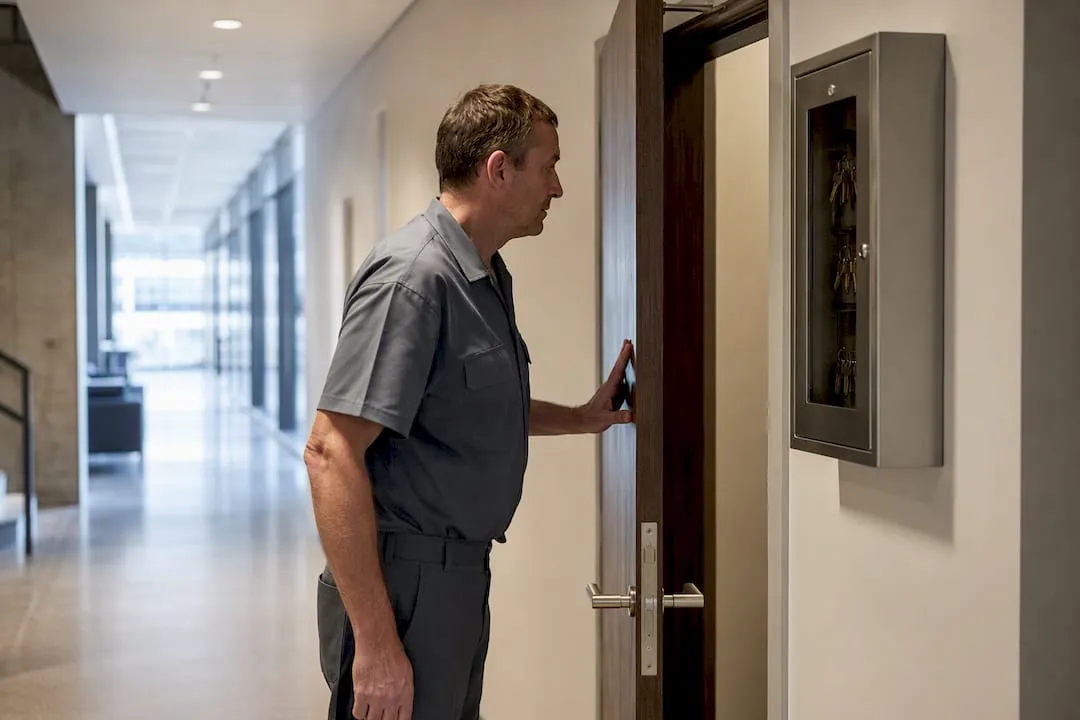
Facilities and HR teams also have a role, since they control onboarding, contractor access and how quickly a leaver’s credentials get revoked. Security awareness that lives only in the guarding team, while everyone else assumes it’s “not my job,” leaves the gaps that hostile reconnaissance is specifically designed to find.
Measuring whether a security awareness programme actually works
Training completion certificates tell you who sat through a course, not whether anyone learned anything useful. A more honest measure tracks reporting volume and quality over time: are officers flagging more genuine concerns, and are those reports getting more specific and actionable?
Unannounced drills, like a supervisor planting a test item or running an unscheduled patrol review, reveal the gap between what was taught and what’s actually happening on shift. Incident response times, debrief attendance and how consistently briefings get logged all serve as practical proxies for whether awareness has become habit rather than theory.
A blended approach combining e-learning, practical drills and active supervision tends to produce better retention than a single training session, according to ProtectUK’s own guidance. That’s a useful benchmark for any employer trying to judge whether their current programme is working or just ticking a compliance box.
Common obstacles to building security awareness
Shift patterns are the first obstacle most employers hit. Briefings work well for day teams but often get skipped for night or weekend cover, exactly when unpredictable patrols matter most. The fix is simple in principle: build briefings into the shift handover itself rather than treating them as a separate task someone has to remember to run.
Staff turnover is the second challenge, particularly in contract guarding where officers move between sites regularly. Site-specific knowledge, which door sticks, which alarm zone false-triggers, walks out the door with every leaver unless it’s documented and handed over properly.
Complacency is the quieter problem. Officers on quiet sites, where nothing happens for months, can slide from alert scanning into passive presence without anyone noticing until an incident exposes it. Regular unannounced drills and rotating officers between duties help keep observation skills sharp even where genuine incidents are rare.
Budget pressure is the final recurring obstacle: training and refreshers cost time and money, and it’s tempting to treat licence renewal as the only training that matters. Employers who instead treat ACT e-Learning and short internal drills as low-cost, high-frequency top-ups tend to keep awareness live between the larger, less frequent formal courses.
Why awareness should shape how you hire, not just how you train
Awareness isn’t a trait some officers have and others don’t. It’s recruitable and measurable, if employers ask for evidence rather than assuming a licence covers it. Ask candidates what training they’ve completed beyond the minimum, how they’d handle a specific scenario, whether they’ve done ACT e-Learning off their own initiative. Those answers tell you far more than a CV line.
Employers who document training properly, and who make that documentation part of the hiring conversation, tend to attract candidates who already take the work seriously. That pairing, well-briefed staff and well-evidenced training, is what keeps sites genuinely secure rather than just licensed. It’s part of why Security Jobs Board exists: connecting employers who value this with officers who can prove it.
— Rob
Find security roles and hire trained officers with Security Jobs Board
Security Jobs Board is the UK’s dedicated route for hiring and being hired in this sector, built specifically for the profession rather than adapted from a general job site. Employers can post job listings and access the CV database to reach candidates already searching for security-specific roles, while jobseekers create a profile, set alerts and apply directly, all free of charge.

The platform’s BSIA affiliation gives employers an added layer of credibility when advertising, and GDPR compliance plus mobile-responsive design mean candidates can apply from a phone between shifts without any friction. For officers looking to strengthen their next application, the career advice section covers how to present training and licence evidence properly, and jobseekers in Northern Ireland can browse current security vacancies in the region directly. If you’re hiring, post your first vacancy today and start reviewing candidates who already take training seriously.
Sources
- Personnel security training and good practice | ProtectUK
- SIA security guarding specification (2021) PDF
- Gov
FAQ
What is security awareness in one sentence?
It’s the trained ability of a frontline officer to observe, assess, deter and report threats continuously while on duty, rather than reacting only when something obvious happens.
Is ACT Security e-Learning mandatory for SIA licence holders?
It isn’t a formal licensing requirement, but it’s a free, roughly 90-minute course that ProtectUK recommends for every frontline operative as practical counter-terrorism grounding.
What are the seven core SIA training areas?
They cover the security officer’s role, access control, security electronics, personal safety, drugs awareness, searching, and patrolling with terror threat awareness, as set out in the SIA specification.
Why should patrols be unpredictable?
A fixed route and timing lets anyone watching the site predict exactly when an officer will pass, which ProtectUK’s tactic VB2 identifies as a significant vulnerability.
How can employers evidence security awareness to candidates and clients?
Keep dated training records, log briefings and debriefs, and ask candidates about training beyond the licence itself. Employers advertising on Security Jobs Board can highlight this directly in job listings to attract officers who already prioritise it.


