8 Step Checklist to Prevent Physical Security Incidents for UK Leaders
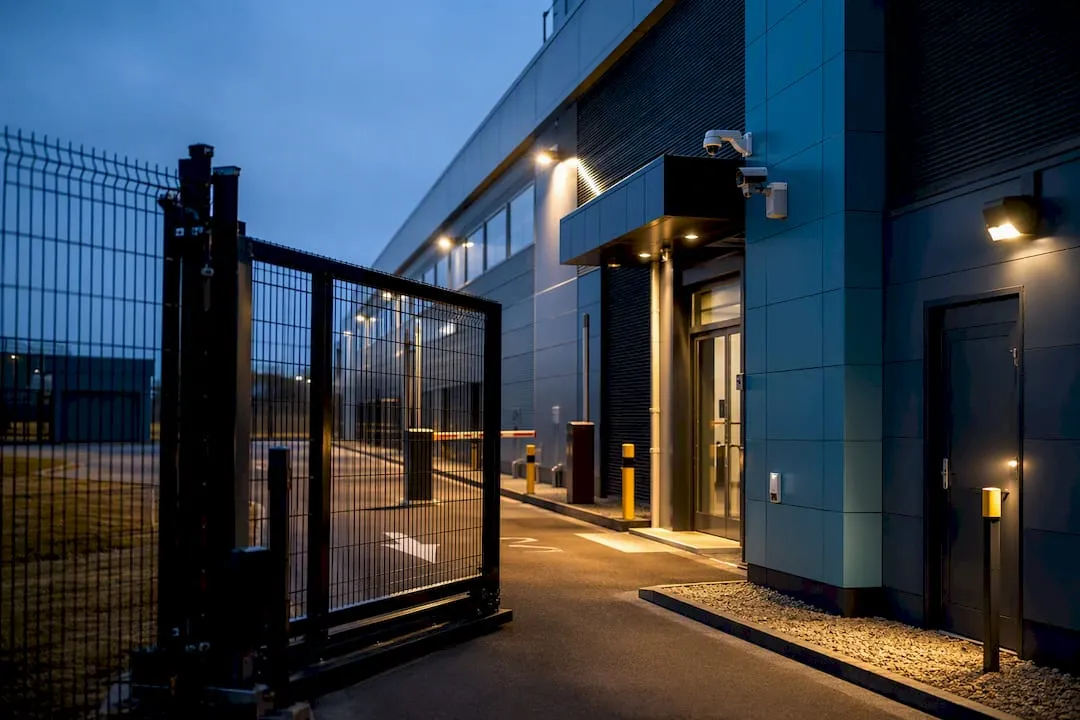
The single best approach is defence-in-depth: layer your risk assessment, access control, perimeter measures, staff vigilance and incident response so no single failure exposes the whole site. Start with a proper risk assessment, close the highest-impact gaps first, usually access and perimeter, then train staff and rehearse your response plan. NPSA, NaCTSO and BS standards all point the same way: no single measure works alone.
TL;DR:
- Proper risk assessment should prioritize fixing high-impact vulnerabilities like access points and perimeter controls before investing in technology.
- Managing tailgating requires not only technical barriers such as ANPR cameras and anti-tailgating turnstiles but also a strong culture of staff challenge and regular testing.
- Effective internal zoning and access tiering reduce insider threats and unauthorized movement inside the site, with permissions reviewed regularly and strict key management.
- Regular staff training, vetting, and incident reporting procedures are critical to noticing threats hardware might miss and ensuring timely response.
- A phased approach focusing on high-impact gaps and demonstrating progress with clear metrics helps maintain management support and improves overall security posture.
Table of Contents
- What can you do to prevent physical security incidents? Start with the threats
- Defence-in-depth explained: deter, detect, delay and respond
- Perimeter and entry controls: barriers, vehicle access and tailgating prevention
- Access control, doors, windows and internal zoning
- Detection and monitoring: CCTV, lighting and control rooms
- People and processes: training, vetting and incident reporting
- Device, records and asset security
- Incident preparedness: alarm response and business continuity
- Standards, specification and procurement: choosing tested products and suppliers
- An 8-step checklist: what to do this week
- How Securityjobsboard helps you put this into practice
- Why prioritisation beats perfection
- Sources
- FAQ
What can you do to prevent physical security incidents? Start with the threats
Most incidents trace back to a handful of recurring weak points, and knowing them shapes everything that follows. Tailgating remains one of the most common entry failures precisely because it exploits a human instinct: holding a door for someone feels polite, not risky. Theft, vandalism and insider threat often share a root cause too, weak access tiering and poor visibility into who is where.
- Tailgating: unauthorised entry following a badge holder through a controlled door.
- Theft: opportunistic or planned removal of stock, equipment or data.
- Vandalism: damage to property, often linked to poor perimeter deterrence.
- Insider threat: misuse of legitimate access by staff or contractors.
- Equipment failure: unmaintained locks, cameras or alarms that quietly stop working.
- Natural hazards: flooding, fire or storm damage compromising physical barriers.
- Reconnaissance: hostile actors testing routines, patrol timing and blind spots before acting.
Poor delivery management, unlogged visitors and unpredictable patrols all widen these gaps. Each threat maps to a specific mitigation covered later, from perimeter hardening to staff training.
Defence-in-depth explained: deter, detect, delay and respond
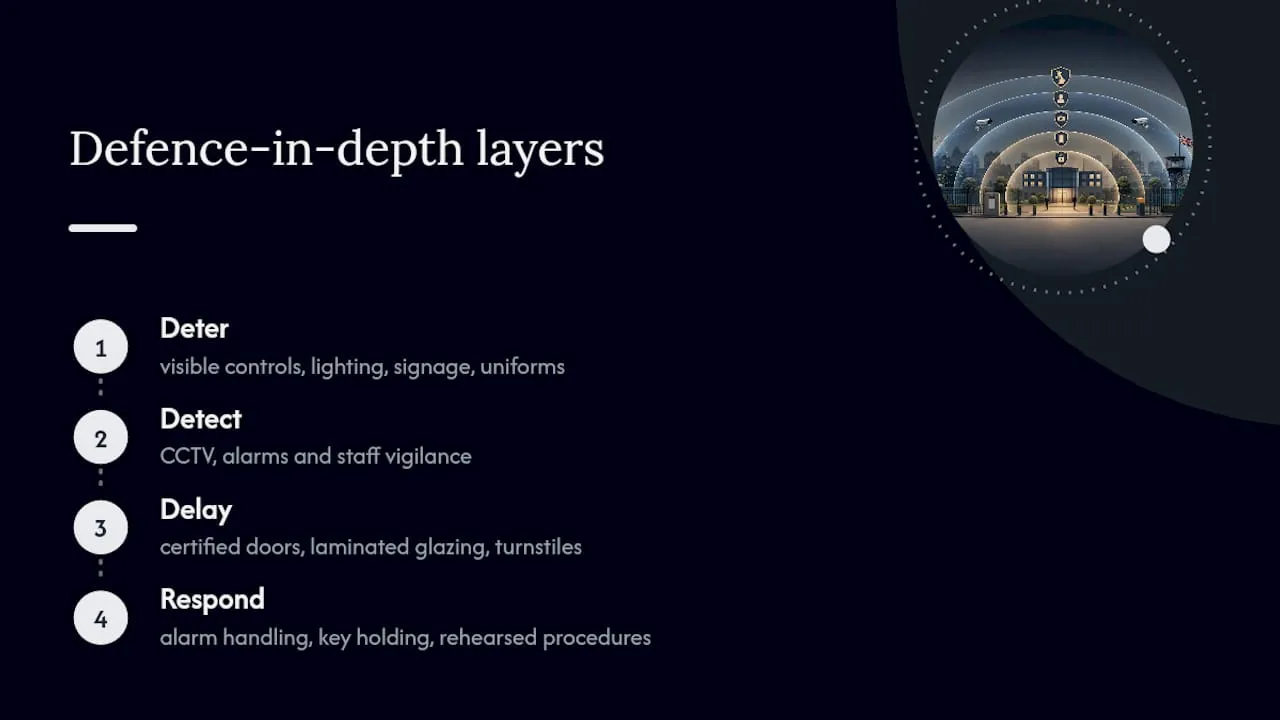
ProtectUK’s physical security guidance frames prevention around four functions: deter, detect, delay and respond. Deterrence works through visible controls, lighting, signage, uniformed presence, that make a site look like hard work. Detection catches what deterrence misses: CCTV, alarms and staff vigilance flag activity early. Delay buys time between an attempt and its completion, through certified doors, laminated glazing or turnstiles. Response, the fourth pillar, converts that delay into a resolved incident through alarm handling, key holding and rehearsed procedures.
Layering matters because no single control is failure-proof. A camera without monitoring only records a crime; a locked door without a certified rating slows nothing. The practical order is: assess your site honestly, mitigate the highest-impact exposures first (usually access points and the perimeter), then add supporting layers.
Budget-constrained organisations should resist the temptation to buy technology before fixing process. A £200 laminated film upgrade recommended in the NaCTSO counter terrorism toolkit can outperform an expensive camera system installed without a monitoring plan behind it.
Perimeter and entry controls: barriers, vehicle access and tailgating prevention
Vehicle and pedestrian entry points are where most reconnaissance efforts get tested first, making managing VIP hospitality transport at sports venues a useful example of detailed access control and movement management. Getting these right stops the majority of opportunistic attempts before they reach the building.
- Fit ANPR (automatic number plate recognition) cameras at vehicle gates, paired with fast-closing barriers to prevent tailgating vehicles from following an authorised car through.
- Use vehicle airlocks or sally ports for higher-risk sites, holding one vehicle at a time for inspection before the inner barrier opens.
- Install anti-tailgating turnstiles or optical sensors at pedestrian entries, enforcing one-badge-one-scan rather than allowing shared access.
- Train gatehouse staff to challenge unbadged individuals politely but firmly, and rotate patrol timing so routines are not predictable.
Unauthorised tailgating at manufacturing and logistics sites is a growing and well-documented risk, and technical fixes alone rarely solve it. Culture matters just as much: staff need explicit permission to challenge someone without a visible pass, otherwise politeness quietly defeats the hardware.
Pro Tip: Run an unannounced “tailgate test” once a quarter, have a colleague from another site try to follow staff through a controlled door without a badge. It exposes cultural gaps that policy documents never catch.
Access control, doors, windows and internal zoning
Once someone is inside the perimeter, internal zoning decides how far they can go. Effective access control means tiering: not every employee needs access to server rooms, finance offices or stockrooms, and rights should be reviewed and revoked as roles change, not left to accumulate indefinitely.
- Set access tiers by role and review permissions quarterly, removing rights the moment someone leaves or changes department.
- Use digital visitor sign-in with photo passes and escorted access for anyone outside staff, keeping GDPR-friendly logs rather than paper books left on reception desks.
- Harden vulnerable glazing with laminated security film, a low-cost measure the NaCTSO toolkit specifically recommends.
- Specify certified doors for sensitive rooms and maintain a strict key-holder list with routine spot checks.
Access control done well is less about the technology and more about discipline: someone has to actually review who holds which keys and cards, and do it on a schedule rather than after something goes wrong.
Detection and monitoring: CCTV, lighting and control rooms
Detection systems only prevent incidents if someone, or something, actually acts on what they show. Coverage gaps at entry points and loading bays are where most blind spots live, so start any camera review there rather than adding coverage to areas that are already well monitored.
- Position CCTV to support identification, not just movement detection, faces and number plates need enough resolution to be usable as evidence.
- Pair lighting upgrades with camera placement; poorly lit entry points defeat even high-resolution cameras.
- Use visible signage as a deterrent in its own right, not just a legal formality.
- Integrate alarms with a monitored control room rather than relying on self-monitoring for anything beyond a very low-risk site.
An annual security audit covering CCTV blind spots and alarm response times catches the kind of protective “drift” that happens when cameras get repositioned, bushes grow over sensor lines, or a bulb blows and nobody replaces it. Graded, monitored systems cost more upfront but close that gap automatically; self-monitored setups need someone disciplined enough to check footage regularly, which many sites simply don’t do.
Learn more about CCTV monitoring options and how they fit different risk levels.
People and processes: training, vetting and incident reporting
Hardware fails silently; people, trained properly, notice things hardware misses. Scenario-based training beats a slideshow because it forces staff to rehearse the awkward moment of challenging someone without a badge.
- Run scenario-based training with repeated refreshers, not a single induction session that fades from memory within weeks.
- Vet new recruits against BS7858, the recognised standard for security screening, and apply the same rigour to contractors as employees.
- Keep a restricted key-holder list and review it whenever staff or contractor arrangements change.
- Build a clear incident reporting workflow, including near-miss logging, so patterns surface before they become losses.
A structured training checklist with defined refresh cadences turns this from good intentions into something that actually happens on a schedule.
Device, records and asset security
Sensitive information walks out of buildings on laptops and paper as often as through a breached door. CISA’s guidance on physical device security recommends fitting physical controls at storage points and enforcing automatic screen locks so an unattended device isn’t an open invitation.
- Store devices and confidential files in locked cabinets, and enforce a clear-desk policy at the end of each shift.
- Shred confidential waste on-site rather than storing it for later disposal.
- Enforce device encryption and automatic screen lock as standard, not optional, settings.
- Maintain secure off-site backups and reconcile an asset register regularly to catch theft or loss early.
An asset register only earns its keep if someone actually checks it against reality every quarter, otherwise a missing laptop can go unnoticed for months.
Incident preparedness: alarm response and business continuity
Prevention reduces frequency; preparedness reduces consequence when something still gets through. Define who responds to an alarm, whether that’s an in-house team or a contracted 24/7 key-holding service, and agree response time SLAs in writing rather than assuming everyone knows their role.
Business continuity planning should cover data backups, an alternate working location, and supplier resilience if a key vendor is disrupted. Recovery priorities need to be set in advance: which systems and processes come back online first matters far more when decided calmly beforehand than during the incident itself.
Every incident, however minor, deserves a short post-incident review: what failed, why, and what policy needs updating as a result. Skipping this step is how the same gap gets exploited twice.
Standards, specification and procurement: choosing tested products and suppliers
Buying security hardware without checking its rating is a common and costly mistake. NPSA’s forced-entry guidance explains that standards like MFES, MTAS, LPS 1175 and BS EN 1627 each address different threat profiles, tools and delay times, so a product rated for one scenario may underperform in another.
Before signing off any purchase, ask for independent test evidence and a clear performance classification rather than relying on a supplier’s marketing claims. Check maintenance schedules are included, a certified door with a neglected lock mechanism offers no real protection. For guarding contracts, always verify SIA licensing, request references, and confirm a maintenance SLA is written into the contract. The BSIA’s guidance index is a solid starting point for specification forms covering CCTV, access control and secure destruction.
An 8-step checklist: what to do this week
You don’t need a full security overhaul to start closing gaps. These steps are ordered by impact and can mostly begin within days.
- Commission a rapid risk assessment of your site (low cost, 1 to 2 days).
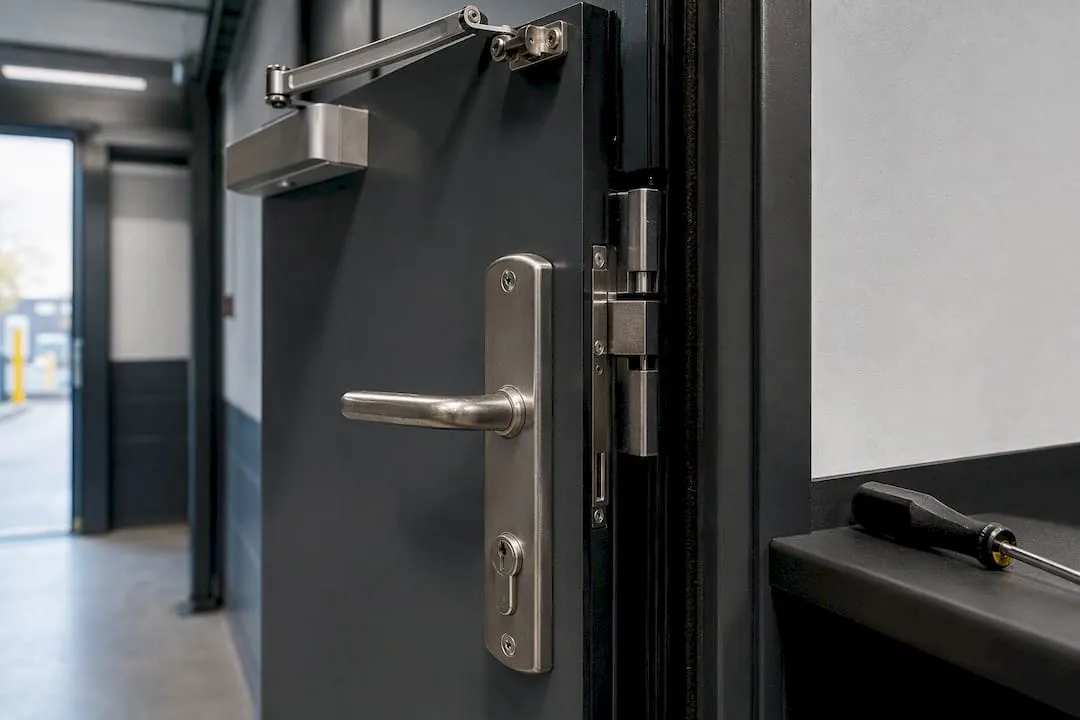
- Secure main entry points with working locks and functioning door closers (low cost, immediate).
- Enforce one-badge-one-scan at all controlled doors (no cost, immediate, policy only).
- Fix any obvious CCTV blind spots at entrances and loading bays (medium cost, 1 week).
- Schedule a staff briefing on challenging unbadged visitors (low cost, immediate).
- Secure confidential waste with locked bins and a shredding schedule (low cost, immediate).
- Test all alarms and confirm response contact details are current (no cost, 1 day).
- Update your business continuity plan with current supplier and backup details (medium effort, 1 week).
Pro Tip: If you only do one thing this week, brief staff on challenging unbadged visitors. It costs nothing and closes the single most common entry gap, tailgating, faster than any hardware purchase.
How Securityjobsboard helps you put this into practice
Securityjobsboard supports UK security leaders beyond hiring, with guides covering physical security fundamentals and incident reporting workflows that turn this article’s guidance into working templates. Hiring SIA-licensed, vetted candidates through the platform reduces insider risk from day one and speeds up remediation when a role needs filling urgently. If you’re building out a guarding team or reviewing your recruitment standards, browse security roles across Northern Ireland or read the career advice hub for guidance on structuring a professional security function.
Why prioritisation beats perfection
The biggest mistake I see isn’t a missing camera or a weak lock, it’s security leaders trying to fix everything at once without management backing, then losing momentum after month two. Pick the two or three highest-impact gaps, usually access control and staff vigilance, and get visible sign-off before touching the rest.
Report progress in terms senior stakeholders actually care about: incidents reported, response times, audit findings closed. A spreadsheet of completed actions convinces a board far more than a list of remaining risks ever will.
— Rob
Sources
- NPSA forced-entry guidance booklet
- Physical security | ProtectUK
- Protect the physical security of your digital devices — CISA
FAQ
How can you prevent physical security incidents?
Apply defence-in-depth: run a risk assessment, control access and the perimeter, train staff to challenge unbadged visitors, and rehearse your incident response so gaps get caught before they’re exploited.
What are the main principles of physical security?
The core functions are deter, detect, delay and respond, layered together so no single failure leaves a site exposed, as outlined in ProtectUK’s guidance.
What are some examples of physical security measures?
Common measures include CCTV, ANPR barriers, anti-tailgating turnstiles, laminated security film, certified doors, visitor sign-in systems, secure shredding, alarm monitoring and staff vigilance training.
What are the main ways to prevent security threats?
Reduce opportunity through access control and perimeter hardening, increase detection through CCTV and lighting, and build resilience through staff training and rehearsed incident response.


