Tips for security job listings: attract UK employers in 2026

TL;DR:
- A well-crafted security job listing effectively attracts the right UK employers by highlighting key details like accurate titles and salary expectations.
- Focusing on relevant skills, outcomes, and clear contact instructions increases responses and reduces unnecessary delays.
A well-crafted security job listing is the single most effective tool a UK jobseeker has for attracting the right employer quickly. Most candidates underestimate how much control they hold over this process. The tips for security job listings covered here draw on current best practices in UK security recruitment, referencing standards from the British Security Industry Association (BSIA) and the National Recruiting Authority (NRA). Platforms like Securityjobsboard exist precisely to connect security professionals with employers, but the quality of your listing determines whether that connection happens at all.
What key elements must every security job listing include?
A security job listing is a structured document that presents your skills, qualifications, and availability to potential employers. Getting the foundations right is non-negotiable.

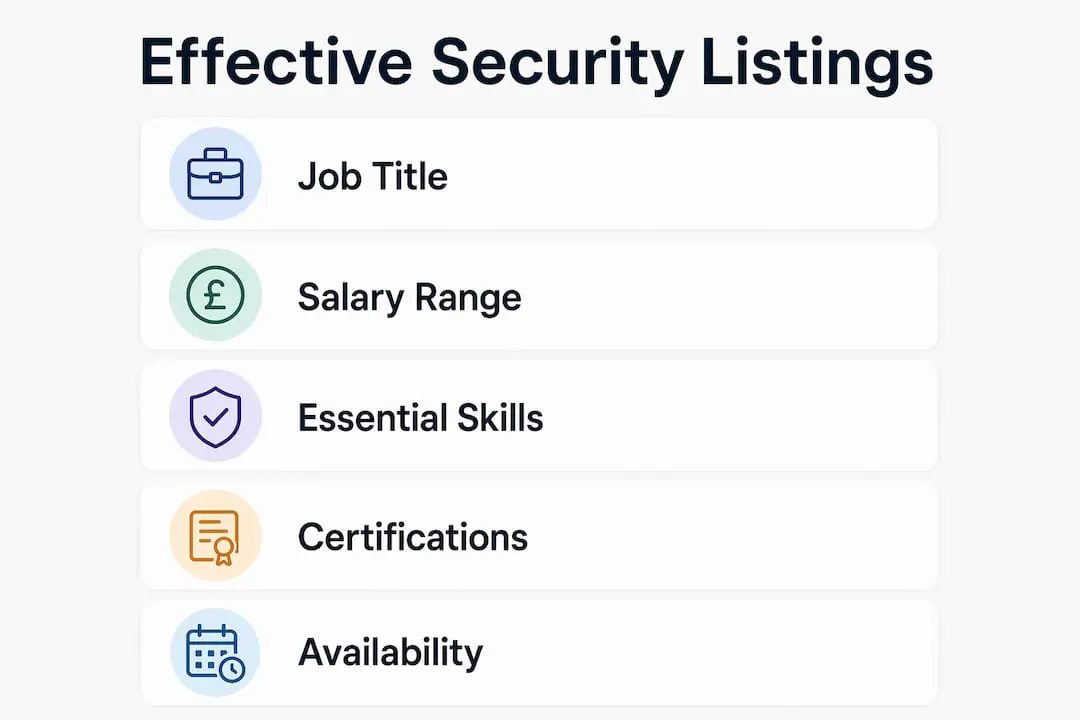
Job title accuracy comes first. Job title alignment with commonly searched terms is the single most important factor in visibility on Google for Jobs. A mismatch between what you call your role and what employers search for reduces your listing’s reach before anyone reads a word. Use standard UK security titles: “Door Supervisor,” “CCTV Operator,” “Close Protection Officer,” or “Security Officer.” Avoid invented titles like “Safety Specialist” that obscure your actual experience.
Salary expectations matter more than most candidates realise. 67% of jobseekers consider salary information the most important element in any listing. Listings that include a realistic pay range attract significantly more employer engagement. State your expected rate clearly, whether hourly or annual, and specify whether you are open to negotiation.
Location and availability details remove friction for employers. Specify the UK regions you can work in, whether you hold a full UK driving licence, and whether you are available for shift work, nights, or weekends. Employers screening dozens of applications will skip listings that leave these details vague.
The remaining essentials to include are:
- A concise professional summary (3–4 sentences) highlighting your key outcomes and sector experience
- Your current SIA licence type and number, with expiry date
- Relevant certifications such as First Aid, CCTV, or conflict management training
- Preferred working arrangements, including contract type (permanent, temporary, or zero hours)
- Benefits you offer as a candidate, such as flexibility, reliability record, or specialist skills
Highlighting your strengths early in the listing improves the likelihood that an employer reads to the end.
How to balance requirements and responsibilities in your listing
The most common mistake security jobseekers make is listing every task they have ever performed. Employers do not need a full job history. They need to know whether you can do the specific role they are hiring for.
80% of applicants are deterred by inflated requirement lists. The same principle applies in reverse: an employer reviewing your listing will disengage if your responsibilities section reads like a shift log. Cap your listed competencies at five to seven core strengths, and make each one count.
Follow this structure when presenting your responsibilities and qualifications:
- Lead with your most relevant experience. If the role is door supervision, your SIA Door Supervisor licence and venue security experience come first, not your general patrol history.
- Separate confirmed qualifications from those in progress. List your current certifications clearly, then note any you are working towards with an expected completion date.
- Describe impact, not just tasks. Write “Reduced incident response time by coordinating with a four-person team” rather than “Responded to incidents.” Outcome-focused descriptions attract outcome-driven employers.
- Include your interview availability. State when you are available for interviews and how quickly you could start. Employers value candidates who make the process easy.
- State your notice period or current availability clearly. Ambiguity here causes unnecessary delays and can cost you an opportunity.
Pro Tip: Separate your “essential” skills from your “desirable” ones using two short sub-lists. This tells employers exactly what you bring to the table without burying the key information.
Transparency about your availability and process reduces drop-off from employers who might otherwise assume you are unavailable or difficult to contact. Detailing your availability upfront keeps employers engaged throughout the hiring funnel.
What language and formatting practices improve readability?
Readability is not a cosmetic concern. A listing that is hard to scan will be skipped, regardless of how strong your credentials are.
Job descriptions exceeding six paragraphs result in lower applicant engagement due to candidate fatigue. The same applies to your listing as a jobseeker. Keep your total listing to four to six paragraphs or roughly one page. Employers reviewing multiple candidates will not read walls of text.
Formatting choices that improve engagement:
- Use short bullet points for skills and certifications, not dense paragraphs
- Bold your SIA licence type and any specialist qualifications so they stand out immediately
- Use consistent formatting throughout: the same font weight, spacing, and structure in every section
- Avoid acronyms without explanation. Write “SIA (Security Industry Authority) Door Supervisor licence” on first mention
- Keep sentences to one idea each. Split anything that runs beyond two clauses
Gendered or exclusionary language measurably reduces the appeal of a listing. Avoid terms like “ex-forces only” or “physically imposing” unless they are genuine legal requirements of the role. Neutral, professional language broadens your appeal to a wider range of employers and roles.
Pro Tip: Read your listing aloud before submitting it. If a sentence takes more than one breath to say, it is too long.
Align your job title with the terms UK employers actually search for. “SIA Licensed Door Supervisor” will appear in more relevant searches than “Venue Safety Professional,” even if the latter sounds more impressive.
Common mistakes to avoid in security job listings
Even experienced security professionals make avoidable errors that reduce their listing’s effectiveness. Recognising these patterns is the first step to fixing them.
The most damaging mistakes are:
- Omitting salary expectations. Listings without pay information receive less engagement. State a range, even a broad one.
- Listing every role you have ever held. Employers want relevance, not volume. Focus on the last five to seven years and the roles most relevant to the position you are targeting.
- Using vague language. Phrases like “good communicator” or “team player” say nothing specific. Replace them with evidence: “Managed handover briefings for a team of six across a 24-hour shift pattern.”
- Misrepresenting certifications. Stating expected completion dates for in-progress qualifications, such as “(expected july 2026),” builds recruiter trust. Listing an unfinished qualification as complete risks automatic rejection.
- Ignoring your contact and application instructions. Make it obvious how an employer should reach you and what you want them to send. Ambiguity here loses opportunities.
Pro Tip: Ask a colleague or mentor to review your listing before you publish it. A fresh pair of eyes catches errors you have stopped seeing.
Vague or inflated listings do not just reduce response rates. They attract the wrong employers, wasting your time and theirs. Precision in every section signals professionalism before an employer has even contacted you.
What steps can security jobseekers take to maximise visibility?
A well-written listing still needs to reach the right people. Visibility requires deliberate choices about where and how you publish.
- Use a sector-specific platform. Securityjobsboard is affiliated with the BSIA and focuses exclusively on UK security roles. Posting your profile and availability there puts you in front of employers who are actively hiring in your sector, rather than competing with unrelated candidates on general job boards.
- Incorporate region-specific keywords. Employers searching for candidates in Manchester, Belfast, or Glasgow use location terms in their searches. Include your target regions explicitly in your listing.
- Reference industry standards. Mentioning compliance with BS 7858 (the British Standard for security personnel screening) or SIA licensing requirements signals that you understand the regulatory environment.
- Keep your listing current. Update your availability, certifications, and contact details regularly. An outdated listing signals disengagement to employers.
- Include a link to your CV or professional profile. Make it as easy as possible for an employer to take the next step. A clear application process reduces friction and increases response rates.
Securityjobsboard also offers CV upload and job alert features at no cost to jobseekers. Using these tools means your profile reaches employers even when you are not actively searching. For a structured approach to the full process, the security job posting guide on Securityjobsboard covers each stage in detail.
Key takeaways
A security job listing that includes a clear salary range, a focused skills section, and accurate certification details consistently attracts more and better-quality employer responses.
| Point | Details |
|---|---|
| Salary transparency | Include a realistic pay range to significantly increase employer engagement with your listing. |
| Limit your skills list | Cap essential competencies at five to seven items to avoid overwhelming employers and diluting your strengths. |
| Use outcome-focused language | Describe the impact of your work, not just the tasks, to appeal to employers who hire for results. |
| Format for scanning | Keep your listing to four to six paragraphs and use bullet points so employers can assess you quickly. |
| Publish on the right platform | Use Securityjobsboard for UK-focused reach and BSIA-affiliated credibility in the security sector. |
What I have learned from reviewing security job listings
Most security professionals I have spoken with treat their job listing as an afterthought. They spend hours on their CV and then paste a few lines into a listing form. That is the wrong approach.
The listings that attract the best employer responses share one quality: they are specific. Not long, not exhaustive. Specific. A Door Supervisor who writes “Managed access control for a 1,200-capacity venue across 48 weekend events” will always outperform one who writes “Experienced in crowd management.” The first sentence tells an employer exactly what they are getting. The second tells them nothing they could not read on any other listing.
The salary question makes candidates uncomfortable, but avoiding it costs more than stating a number. Employers who cannot see your expectations will often move on to someone who has made the process easier. Transparency here is not weakness. It is efficiency.
The certification point is one I feel strongly about. I have seen candidates rejected at the screening stage because they listed a qualification they were still working towards without clarifying its status. A simple note like “(expected september 2026)” changes the entire picture. It shows self-awareness and honesty, which are qualities every security employer values.
Finally, platform choice matters more than most candidates realise. A strong listing on the wrong platform reaches the wrong people. Posting on a sector-specific platform like Securityjobsboard, with its BSIA affiliation and UK security focus, puts your listing in front of employers who are already looking for someone with your background.
— Rob
Security jobs and career advice on Securityjobsboard
Securityjobsboard connects UK security professionals with employers across every region, including active listings for security jobs in Northern Ireland. The platform is free for jobseekers, GDPR-compliant, and built specifically for the UK security sector, with BSIA affiliation adding an extra layer of credibility.

Whether you are refining your listing or planning your next career move, the career advice section on Securityjobsboard covers everything from CV writing to interview preparation. Create your free profile, upload your CV, and set job alerts so the right opportunities reach you directly. The platform’s human support team is also available if you need guidance on presenting your experience effectively.
FAQ
What should every security job listing include?
Every security job listing should include your SIA licence type, a realistic salary expectation, your target UK regions, and a concise summary of your most relevant experience. Clear contact and application instructions are equally important.
How long should a security job listing be?
Keep your listing to four to six paragraphs or roughly one page. Listings beyond six paragraphs see reduced engagement because employers stop reading before reaching your key qualifications.
Should I include salary expectations in my security job listing?
Yes. 67% of jobseekers rate salary information as the most important element in any listing, and the same logic applies when employers review candidate profiles. Including a range increases the likelihood of a relevant response.
How do I list a certification I am still working towards?
List the qualification with a note indicating its expected completion date, such as “(expected march 2027).” This approach builds recruiter trust and avoids the risk of automatic rejection for misrepresentation.
Where is the best place to post a security job listing in the UK?
Securityjobsboard is the leading sector-specific platform for UK security roles, with BSIA affiliation and a candidate database focused exclusively on the security industry. Posting there gives your listing direct visibility with employers who are actively hiring.


