The role of human support in hiring: 2026 guide

TL;DR:
- Human involvement in UK security recruitment ensures legal, ethical, and fair hiring practices by giving qualified reviewers authority to oversee automated decisions. Structured interviews and transparent communication help reduce bias and maintain candidate trust while complying with data protection laws. Employers must embed genuine human oversight at critical decision points to prevent legal risks and protect their reputation.
Human support in hiring is defined as meaningful human involvement that gives a qualified person real authority to review, challenge, and alter a recruitment decision before it is applied. This is not a soft preference. The UK Information Commissioner’s Office (ICO) draws a firm legal line between automated decision-making (ADM) without human oversight and decision-support tools where humans can genuinely influence outcomes. For security industry recruiters, that distinction carries serious weight. Roles in this sector require character assessment, licence verification, and judgement calls that no algorithm can fully replicate. 47% of UK jobseekers experienced AI-led interviews without prior notice, and the resulting transparency failures damaged both candidate trust and employer brands. Getting the role of human support in hiring right is not optional. It is a legal, ethical, and commercial necessity.
Why does meaningful human involvement matter in automated recruitment?
Automation speeds up shortlisting and scheduling, but it creates serious risks when human oversight is removed. The ICO has engaged 16 organisations using ADM to improve safeguards including transparency, bias monitoring, and candidate recourse. That figure signals how widespread the problem already is.
The core issue is bias amplification. Algorithms trained on historical hiring data inherit the biases embedded in that data. Without a human reviewer who can question an output, those biases become decisions. In the security sector, where workforce diversity is a known challenge, this risk is acute.
Candidate experience suffers directly when automation increases without human support. Research confirms that human support is a governance mechanism, not an administrative burden. Candidates who receive no human contact during a hiring process report lower trust in the employer, and many withdraw entirely.
“Automated tools can process applications at scale, but they cannot exercise professional judgement, read context, or explain a decision to a disappointed candidate. That is precisely what human involvement exists to do.”
Key risks of removing human involvement include:
- Bias without accountability. Algorithmic outputs reflect training data. A human reviewer can catch patterns that disadvantage protected groups under the Equality Act 2010.
- No candidate recourse. UK GDPR gives candidates the right to contest automated decisions. Without a named human responsible for the outcome, that right becomes meaningless.
- Transparency failures. 82% of candidates who experienced AI-led interviews were not told beforehand. That is a direct breach of fair processing obligations.
- Employer brand damage. Candidates talk. A reputation for faceless, automated rejection harms future talent pipelines.
Pro Tip: Before deploying any screening tool, map every decision point where a candidate could be rejected. Assign a named human reviewer to each one. This single step satisfies both ICO guidance and basic fairness obligations.
How to integrate human judgement with structured screening processes
The most effective method for combining human expertise with automated tools is the structured interview, endorsed by GOV.UK as more likely to reduce bias and produce better hiring outcomes. Structured processes standardise questions, scoring criteria, and panel composition. They give human reviewers a consistent framework rather than leaving judgement entirely to instinct.

Structured interview implementation
Follow these steps to build a structured process for security roles:
- Define benchmark answers. Write model responses for each interview question before the panel meets any candidate. This anchors scoring to the role, not to interviewer preference.
- Standardise scoring sheets. Use a numerical scale (for example, 1–5) with written descriptors at each level. Every panellist scores independently before discussion.
- Use diverse panels. Include at least two interviewers from different backgrounds or departments. Panel diversity reduces the risk of groupthink and strengthens fairness under the Equality Act 2010.
- Train interviewers on bias awareness. GOV.UK guidance confirms that standardised scoring and benchmark answers allow human judgement at scale without losing fairness. Training is not optional.
- Document every decision. Record the scores, the rationale, and the final outcome. This creates an audit trail for ICO compliance and candidate feedback requests.
CV screening with human oversight
Anonymised CV screening reduces name-based and demographic bias at the initial sift. GOV.UK recommends anonymised templates and ATS screening modes alongside human adjustment for Equality Act 2010 compliance. However, anonymisation is not a complete solution. It may affect targeted diversity recruitment and should be treated as a full-system experiment with monitoring, not a one-off fix.
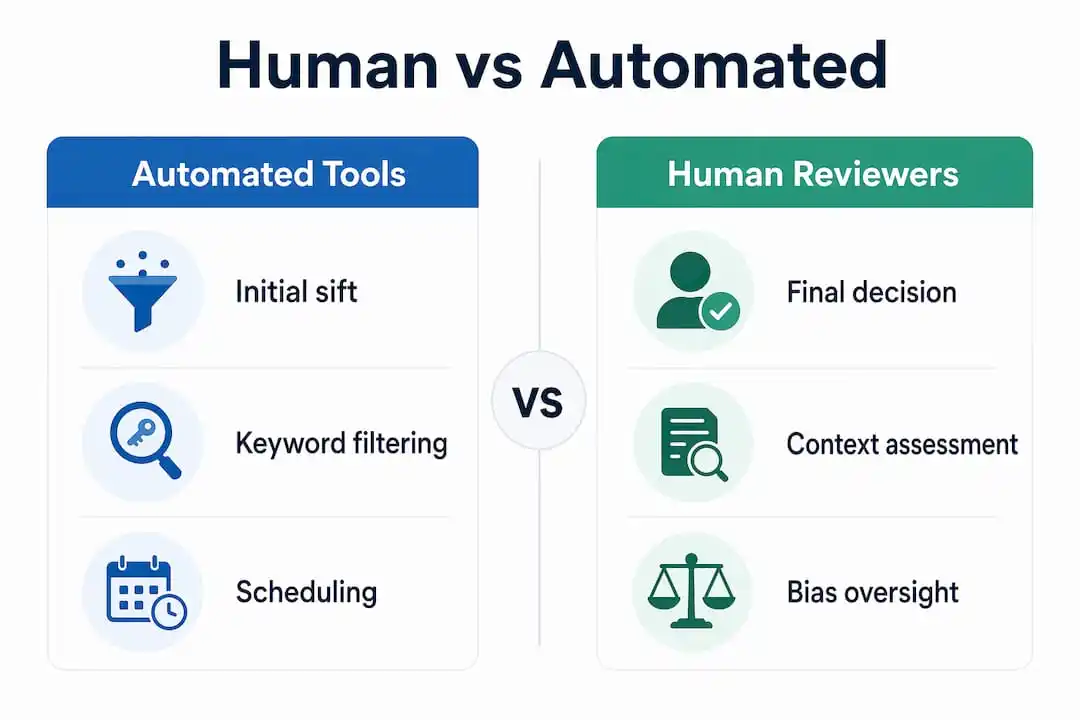
The table below shows how human review should sit alongside automated screening at each stage.
| Screening stage | Automated tool role | Human reviewer role |
|---|---|---|
| Initial sift | ATS keyword filtering | Review borderline rejections and override where appropriate |
| CV anonymisation | Remove personal identifiers | Assess skills and experience against role criteria |
| Shortlisting | Score and rank applications | Confirm shortlist and check for diversity gaps |
| Interview scheduling | Automated calendar invites | Confirm candidate communication and answer queries |
| Final selection | Aggregate interview scores | Make and document the final hiring decision |
Pro Tip: Use your CV screening compliance guide to audit your current process against UK GDPR and Equality Act 2010 requirements before adding any new automated tool.
What are the challenges of balancing human support and AI efficiency?
AI-driven recruitment creates what researchers call a resourcing paradox. Efficiency gains conflict with ethical concerns and candidate alienation, and security recruiters sit squarely in the middle of that tension. Processing hundreds of applications for door supervisor or CCTV operator roles is genuinely faster with automation. The risk is that speed becomes the only metric that matters.
The most dangerous failure mode is rubber-stamping. This occurs when a human reviewer approves an algorithmic decision without actually reviewing the supporting materials. The ICO is explicit: meaningful human involvement requires real authority and competence to alter a decision before it is applied. A reviewer who clicks “approve” without reading the application does not meet that standard. It exposes the employer to legal challenge and produces no fairness benefit.
Other challenges security recruiters face include:
- The “black box” problem. Many AI screening tools cannot explain why a candidate was rejected. This makes it impossible for a human reviewer to assess whether the output was fair.
- Inconsistent review quality. Human involvement only works if every reviewer applies the same standard. Without training and structured scoring, human review introduces its own variance.
- Candidate communication gaps. Candidates rejected by automated tools often receive no explanation. Accessible communication and human explainers are necessary to maintain trust and meet transparency obligations.
- Governance gaps. Human support must be embedded in the recruitment technology governance framework, not bolted on as an afterthought.
Pro Tip: Ask your ATS or AI screening vendor to provide a plain-English explanation of every rejection decision. If they cannot, treat that tool as non-compliant with ICO transparency expectations.
How does UK law define human involvement in hiring decisions?
UK GDPR Article 22 gives candidates the right not to be subject to solely automated decisions that produce significant effects. The Data (Use and Access) Act 2025 reinforces this with updated obligations for employers using ADM in recruitment. The ICO’s definition of “meaningful human involvement” sets a clear bar: the reviewer must have the authority and competence to change the decision, must access the relevant application materials, and must apply consistent and thorough review across all candidates.
The ICO has flagged specific risks where human reviewers do not access supporting materials before a rejection is issued. This is a common failure. A reviewer who sees only an algorithmic score, without the underlying CV or interview notes, cannot exercise genuine judgement.
Compliance for security industry recruiters requires three things. First, document who is responsible for each hiring decision and what materials they reviewed. Second, communicate with candidates about how ADM is used in your process and what their rights are. Third, monitor outcomes across protected characteristics under the Equality Act 2010 to detect and correct algorithmic bias.
Pro Tip: Review your applicant tracking system setup to confirm that human reviewers can access full application materials, not just summary scores, at every decision point.
Best practices for embedding human support in security sector hiring
Security industry hiring carries specific obligations. SIA licence checks, vetting requirements, and the physical and reputational stakes of the roles mean that human judgement is not just a legal requirement. It is a professional one. The following practices build human involvement into the process at the points where it matters most.
- Design human review at rejection points. Human involvement must occur at sensitive decision points such as candidate rejection. Assign a named reviewer to every rejection decision, not just final offers.
- Use diverse interview panels. Panel diversity reduces individual bias and strengthens the employer’s position under the Equality Act 2010. Rotate panel membership across hiring rounds.
- Maintain feedback loops with candidates. Candidates who receive a clear, human explanation of a rejection decision are significantly less likely to raise a complaint or leave a negative review.
- Train HR and hiring managers continuously. Bias awareness training should be refreshed annually, not delivered once at onboarding. The ICO expects ongoing governance, not a one-time tick-box exercise.
- Monitor diversity outcomes. Track shortlist and hire rates across gender, ethnicity, and age. If automated tools are producing skewed outputs, human review must catch and correct them before they become patterns.
- Use specialist resources. Platforms like Securityjobsboard are built for the security sector and incorporate GDPR-compliant processes, giving HR teams a foundation that general-purpose job boards do not provide.
For practical guidance on screening security candidates fairly and efficiently, Securityjobsboard publishes sector-specific resources aligned with current UK law.
Key takeaways
Human support in hiring is the single most important safeguard against biased, non-compliant, and candidate-damaging automated recruitment decisions in the UK security sector.
| Point | Details |
|---|---|
| Legal definition of human involvement | Reviewers must have real authority to alter decisions and must access full application materials. |
| Structured interviews reduce bias | Standardised questions, scoring panels, and benchmark answers produce fairer and more defensible outcomes. |
| Rubber-stamping is non-compliant | Approving algorithmic decisions without genuine review breaches UK GDPR and ICO expectations. |
| Candidate communication is mandatory | Candidates must be told how ADM is used and given a clear, human explanation of any rejection. |
| Monitoring must be continuous | Diversity outcomes should be tracked after every hiring round to detect and correct algorithmic bias. |
Why I think most security recruiters underestimate this problem
The honest truth is that most security recruitment teams adopt automated tools because they are under pressure to fill roles quickly. That pressure is real. Door supervisor vacancies, control room positions, and event security roles often need to be filled within days. Automation feels like the answer.
What I have seen repeatedly is that the human review step gets treated as a formality. A manager clicks through a shortlist without reading the underlying CVs. An interview score gets approved without checking whether the scoring criteria were applied consistently. These are not malicious failures. They are the predictable result of under-resourcing the human side of a process that was sold as reducing human workload.
The ICO’s engagement with 16 organisations is a warning, not a headline. Those organisations were caught with inadequate safeguards. The security sector is not exempt from that scrutiny. Employers who treat human involvement as a compliance checkbox rather than a genuine quality control step will face both legal exposure and reputational damage when things go wrong.
The fix is not complicated. It requires assigning real responsibility, providing real training, and building real review into the process at the points where candidates are most at risk of unfair treatment. That is what meaningful human involvement actually means.
— Rob
Hiring security staff the right way with Securityjobsboard
Security recruitment done well requires more than a fast shortlisting tool. It requires a platform built for the sector, with compliance built in from the start.
Securityjobsboard connects UK security employers with vetted candidates across every specialism, from manned guarding to CCTV and event security. The platform is BSIA-affiliated, GDPR-compliant, and designed to support the kind of transparent, human-centred hiring process this article describes. Employers can post roles, browse CVs, and communicate directly with candidates, keeping human contact at the centre of every hire. If you are recruiting for security roles in Northern Ireland, Securityjobsboard gives you a targeted, compliant route to the right candidates without sacrificing the human oversight that UK law requires.
FAQ
What is meaningful human involvement in recruitment?
Meaningful human involvement means a qualified person has real authority to review and change a hiring decision before it is applied. Simply approving an algorithmic output without reviewing the underlying application does not meet ICO or UK GDPR standards.
Does UK law require human oversight in automated hiring?
UK GDPR Article 22 gives candidates the right not to be subject to solely automated decisions with significant effects. The Data (Use and Access) Act 2025 reinforces this obligation for employers using ADM tools in recruitment.
How do structured interviews reduce bias in security hiring?
Structured interviews standardise questions, scoring criteria, and panel composition across all candidates. GOV.UK confirms this approach reduces inter-interviewer variance and produces fairer, more defensible hiring outcomes.
What counts as rubber-stamping in recruitment?
Rubber-stamping occurs when a human reviewer approves an algorithmic decision without accessing or reviewing the supporting application materials. The ICO considers this non-compliant with meaningful human involvement requirements.
How should security recruiters communicate with candidates about AI use?
Candidates must be told how automated decision-making is used in the hiring process, what data is assessed, and how they can contest a decision. This communication should be provided before the process begins, not after a rejection is issued.


