Security vetting importance: a guide for HR professionals

TL;DR:
- Security vetting is a structured process assessing candidates’ identity, background, and trustworthiness for sensitive roles. Proper implementation protects organizations from insider threats, ensures legal compliance, and maintains a documented record of due diligence. Using a risk-based, intelligence-led approach enhances security beyond basic screening by considering specific role sensitivities and ongoing reviews.
Security vetting is defined as the formal process of assessing a candidate’s identity, background, and character to confirm they are trustworthy and suitable for roles involving access to sensitive information or assets. The importance of security vetting extends well beyond a simple background check. For employers and HR professionals in the UK security sector, it is a structured, multi-stage process governed by frameworks including the UK Cabinet Office’s National Security Vetting (NSV) scheme and the Information Commissioner’s Office (ICO) personnel security policy. Done properly, it protects your organisation from insider threats, satisfies legal obligations, and creates a defensible record of due diligence that stands up to both internal and external scrutiny.
Why is the security vetting process structured in stages?
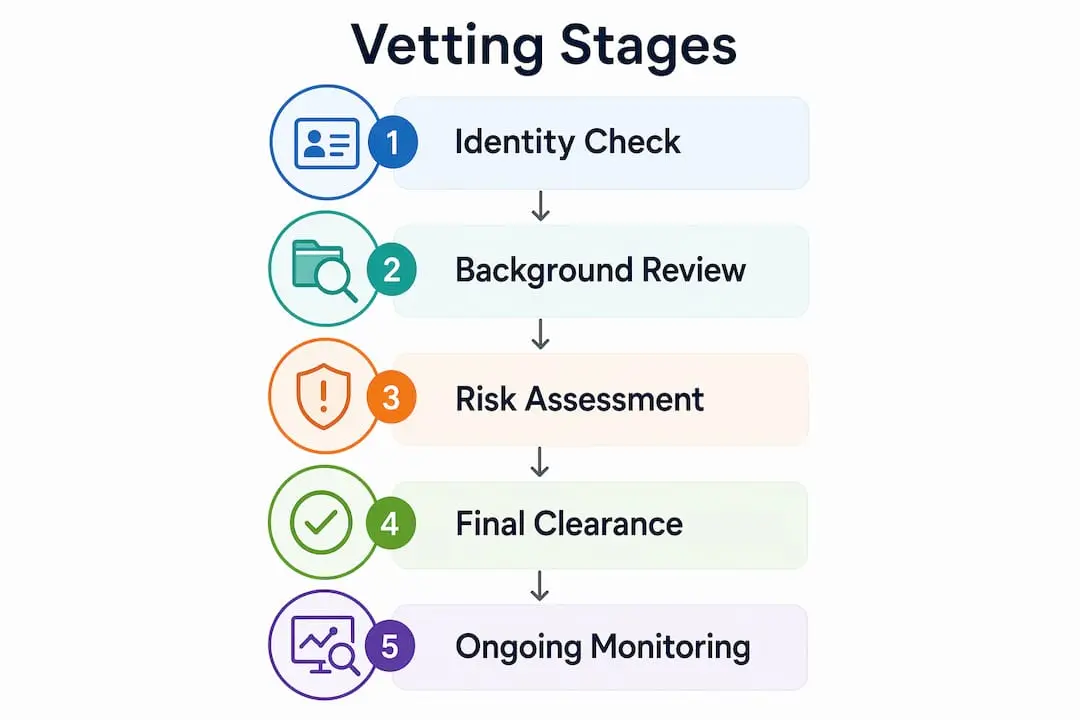
The security vetting process is layered by design, and understanding that structure is the first step to managing it without costly errors. The ICO’s personnel security policy sets out a clear dependency chain: right-to-work and identity checks must be completed before an NSV application is initiated. Employment history and criminal record checks can run concurrently after NSV is initiated, but they must be fully completed before the vetting process can conclude.
The baseline level is the Basic Personnel Security Standard (BPSS), which covers identity, nationality, employment history, and basic criminal record checks. NSV goes further, applying to roles where a compromise could cause significant damage to national security, public safety, or organisational integrity. The three main NSV clearance levels are Counter Terrorist Check (CTC), Security Check (SC), and Developed Vetting (DV), each progressively more thorough.
Here is the correct sequence HR teams should follow:
- Confirm right-to-work status using original documents before any further steps.
- Verify identity through photo ID and address confirmation.
- Initiate the NSV application via the UK Security Vetting portal once identity checks pass.
- Run employment history checks covering the past three to ten years depending on clearance level.
- Complete criminal record checks through the Disclosure and Barring Service (DBS) or equivalent.
- Finalise vetting only after all checks are complete and reviewed.
In intelligence roles, the process goes further still. The US Intelligence Community’s clearance framework assesses loyalty, character, and discretion, and may include polygraph testing. That level of scrutiny reflects the principle that vetting depth should match role sensitivity.
Pro Tip: Never schedule an NSV application before identity checks are confirmed. Doing so creates rework, delays clearance, and can frustrate candidates who are otherwise strong hires.
How does security vetting reduce risk for employers?
Vetting is a risk management tool, not a bureaucratic formality. Effective vetting integrates with HR and compliance functions and employs risk-based, intelligence-led approaches rather than relying on basic screening alone. Basic screening leaves gaps. A standard DBS check tells you about convictions, but it does not reveal patterns of behaviour, financial vulnerability, or undisclosed associations that could make a candidate susceptible to exploitation.
The benefits of security checks conducted at the right depth include:
- Reduced insider threat exposure. Vetting identifies individuals with financial pressures, undisclosed relationships, or loyalty conflicts before they gain access to sensitive assets.
- Defensible hiring records. The ICO frames vetting as both a legal compliance measure and a mechanism for building documented trust evidence. If a hiring decision is ever challenged, a thorough vetting record is your protection.
- Better quality hiring decisions. Vetting surfaces information that interviews and references rarely reveal, giving HR a fuller picture of each candidate.
- Regulatory compliance. In the UK security sector, employing unvetted staff in regulated roles carries legal consequences, including licence revocation under the Security Industry Authority (SIA) framework.
- Reputational protection. A single insider incident can damage client relationships and public trust in ways that take years to repair.
Risk-based, intelligence-led vetting closes the gaps that a checklist approach misses. It means asking not just “does this person have a criminal record?” but “does this person’s full profile present a risk given the specific access this role requires?” That shift in thinking is what separates organisations with mature security cultures from those that treat vetting as a tick-box exercise.
For a practical overview of how these checks operate in the UK context, the security checks UK guide on Securityjobsboard covers the process step by step.

What happens when vetting cannot be fully granted?
Vetting is not always a binary pass or fail outcome, and HR professionals need to understand what happens in the grey areas. The Her Majesty’s Prison and Probation Service (HMPPS) Risk Assessed Access Policy Framework establishes that failure to achieve full clearance does not automatically bar an individual from a role. Instead, a structured risk-assessed access process can enable conditional employment with documented safeguards.
This matters particularly in rehabilitation contexts, where individuals with lived experience of the criminal justice system bring genuine value to certain security and probation roles. The HMPPS framework requires Governors, senior leaders, and security personnel to coordinate and implement a formal risk management plan before access is granted.
The table below summarises how risk-assessed access differs from standard vetting clearance:
| Factor | Standard Vetting Clearance | Risk-Assessed Access |
|---|---|---|
| Eligibility | No disqualifying history | Criminal history present but managed |
| Decision maker | Security vetting authority | Governor or senior leader with security input |
| Documentation | Clearance certificate | Mandatory risk assessment and management plan |
| Access level | Full role access | Conditional, with defined restrictions |
| Review frequency | Periodic renewal | Ongoing monitoring and review |
The HMPPS framework also supports diversity and inclusion goals. Blanket exclusions based on criminal history can prevent organisations from accessing a pool of candidates with directly relevant experience. Risk-assessed access, when governed properly, balances security requirements with fairness.
Pro Tip: Risk-assessed access decisions must never rest with HR alone. Always involve your security function and document every step of the risk management plan. Accountability is the foundation of this process.
How can HR teams integrate vetting into hiring effectively?
Integrating the security vetting process into your wider hiring strategy requires deliberate coordination between HR, security, and compliance functions. Vetting that sits in a silo produces delays, inconsistencies, and gaps that create risk rather than reduce it.
Practical steps for HR professionals include:
- Align with your security team from the outset. Define which roles require which clearance levels before advertising. Advertising a role without knowing its vetting requirement wastes time for both candidates and hiring managers.
- Adopt a risk-based approach. Not every security role requires DV clearance. Match the depth of vetting to the actual access and sensitivity of the role. Over-vetting creates unnecessary delays; under-vetting creates exposure.
- Manage the process in stages and respect dependencies. As the ICO policy makes clear, poor sequencing creates rework. Build a vetting checklist with clear sign-off gates at each stage.
- Prepare candidates for candour. The US Intelligence Community clearance process identifies honesty and accuracy as critical to a smooth clearance. Brief candidates that full disclosure reduces complications. Omissions discovered later trigger deeper scrutiny and can end an application entirely.
- Plan for ongoing vetting management. Clearances are not permanent. Access conditions change, roles evolve, and personal circumstances shift. Build periodic review into your HR calendar rather than treating vetting as a one-time event.
For guidance on how UK employment law intersects with these obligations, the employment law compliance guide on Securityjobsboard is a useful reference for security sector employers in 2026.
Key takeaways
Thorough security vetting is the single most effective control employers have for establishing trust, reducing insider risk, and maintaining legal compliance in the security sector.
| Point | Details |
|---|---|
| Vetting is staged, not single-step | Identity and right-to-work checks must precede NSV; poor sequencing causes delays and rework. |
| Risk-based vetting outperforms basic screening | Intelligence-led approaches close gaps that standard DBS checks leave open. |
| Risk-assessed access is a valid option | HMPPS framework allows conditional access with documented safeguards when full clearance is not possible. |
| HR must coordinate with security functions | Vetting decisions require cross-functional accountability, not HR acting alone. |
| Candidate candour speeds up clearance | Honest disclosure from candidates reduces complications and avoids additional scrutiny. |
Why vetting must be treated as a continuous strategic control
I have seen organisations treat security vetting as a one-time hurdle cleared at the point of hire, and it is one of the most common and costly mistakes in security sector HR. Vetting is not a gate. It is an ongoing control that needs to be revisited as roles change, as access levels shift, and as the threat environment evolves.
The organisations that get this right are the ones where HR and security functions speak the same language. They define clearance requirements before a role goes live, they stage checks correctly, and they build review cycles into their workforce management processes. The ones that struggle treat vetting as a compliance burden to be processed as quickly as possible and then forgotten.
What I find particularly underappreciated is the role of candidate preparation. Coaching candidates to be fully candid before they submit their vetting paperwork is not just good practice. It is the difference between a smooth clearance and a protracted investigation. Omissions, even minor ones, create suspicion. Suspicion creates delay. Delay costs money and sometimes costs you the candidate entirely.
The future of vetting in the UK security sector will require HR professionals to engage more deeply with intelligence-led approaches, particularly as insider threat patterns grow more complex. That means investing in the relationship between HR and security, not just the process itself.
— Rob
Find vetted security talent across the UK

Sourcing candidates who are ready for the rigorous demands of security vetting starts with finding them in the right place. Securityjobsboard connects UK security employers with candidates who understand the sector’s standards, including the vetting requirements that come with it. Whether you are recruiting for roles requiring BPSS, SC, or DV clearance, a specialist platform gives you access to a candidate pool that is already aligned with the industry’s expectations. If you are looking to fill roles in security jobs in Northern Ireland, Securityjobsboard lists active vacancies across the region. Post your roles, browse CVs, and connect with candidates who are serious about working in a sector where trust is everything.
FAQ
What is the difference between BPSS and national security vetting?
The Basic Personnel Security Standard (BPSS) covers identity, right-to-work, employment history, and basic criminal record checks. National Security Vetting (NSV) goes further, applying to roles where a compromise could cause significant harm to national security or public safety, with clearance levels including CTC, SC, and DV.
Can a candidate with a criminal record be employed in a security role?
Yes, in some cases. The HMPPS Risk Assessed Access Policy Framework allows conditional employment through a documented risk assessment and management plan, provided senior leaders and security personnel coordinate and approve the safeguards before access is granted.
Why does candidate honesty matter during security vetting?
The US Intelligence Community clearance process identifies candour as critical. Omissions or inaccuracies discovered during vetting trigger deeper scrutiny and can result in polygraph testing or outright rejection, even when the original issue would not have been disqualifying.
How often should security clearances be reviewed?
Clearances should be reviewed periodically and whenever a role’s access level or responsibilities change significantly. Treating vetting as a one-time event leaves organisations exposed to risks that develop after the initial hire.
What is risk-based vetting and why does it matter?
Risk-based vetting matches the depth and type of checks to the actual sensitivity of the role and the specific access it requires. Basic screening alone leaves insider threat gaps that a risk-based, intelligence-led approach closes more effectively.


