Practical Security Awareness Examples UK Guards Can Use From Day One
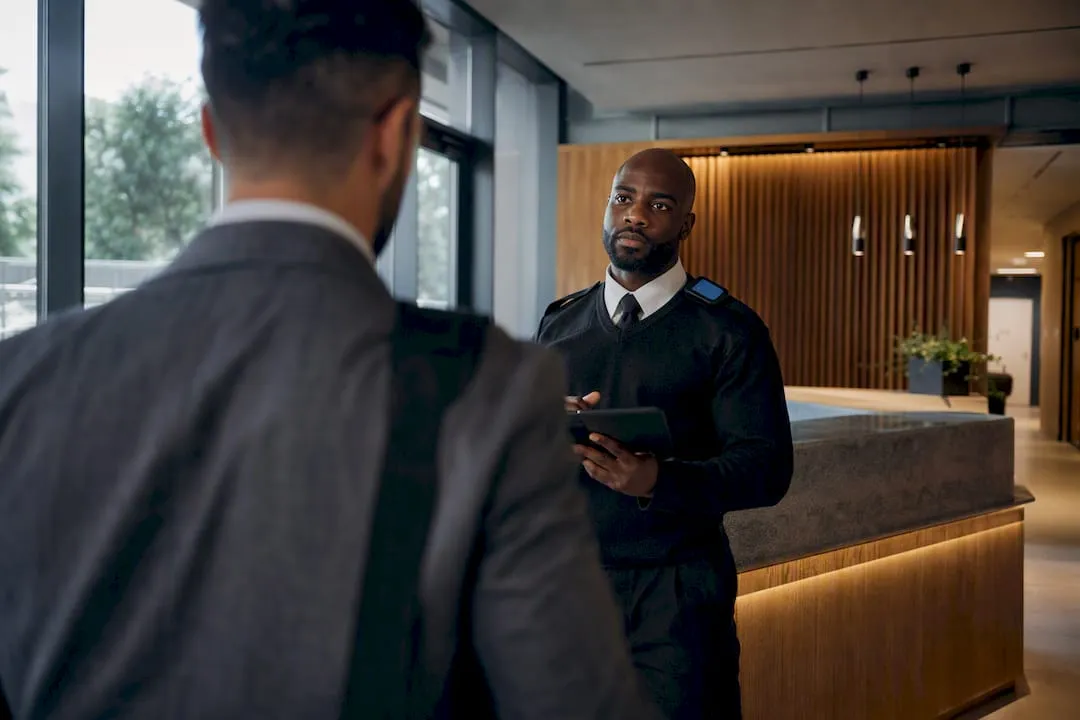
Staff-level security awareness means guards moving through three stages on every patrol: perceiving what’s around them, comprehending whether it matters, and projecting what happens next. In practice, that translates into unpredictable patrol routes, structured shift briefings, disciplined incident reporting, and rehearsed responses like HOT, the Four Cs, and Run Hide Tell. The examples below show exactly how supervisors and guards put this into daily practice.
TL;DR:
- Guards should vary patrol timing along with routes to prevent hostile observers from predicting their movements and planning around fixed schedules.
- Conducting briefings each shift and recording incident details in specific, actionable logs improves detection and accountability.
- Training should combine e-learning with scenario-based practice and regular refreshers to reinforce responses and reduce reaction time under pressure.
- SOPs must clearly define roles, escalation procedures, and reporting channels, especially since SIA licensing does not authorize arrests or use of force.
- Continuous observation and feedback, along with a strong reporting culture, are essential for maintaining effective security awareness and detecting insider threats.
Table of Contents
- Security awareness examples for patrols, briefings and reporting
- How to train and rehearse these behaviours so they stick
- What SOPs must cover, and where SIA authority ends
- Why these examples hold up: sources behind the guidance
- Examples of phishing and social engineering awareness scenarios
- Real-world case studies illustrating security awareness failures and successes
- Common cyber security threats and their awareness approaches
- Methods to measure effectiveness of security awareness programmes
- Behavioural indicators of insider threats and how to recognise them
- Looking for security roles in your area?
- Why the basics get skipped, and shouldn’t
- Sources
- FAQ
Security awareness examples for patrols, briefings and reporting
These are the practices that separate a guard going through the motions from one who actually spots trouble before it starts. Each one is something you can introduce at your next shift, not a theory to file away.
-
Vary your patrol timing, not just your route. A patrol that always passes the loading bay at 10pm sharp is one a hostile observer can plan around. ProtectUK’s guidance on patrol and positioning recommends genuinely unpredictable timing, logged afterwards so supervisors can confirm coverage without creating a pattern.
-
Run a two-minute shift briefing, every shift, no exceptions. Cover the previous shift’s incidents, any access changes, visitor bookings, and known risks. A briefing that gets skipped because “nothing’s happening” is exactly when something does.
-
Practise perceive, comprehend, project on routine scans. Walking a car park, don’t just look. Ask: what’s here (perceive), does it fit (comprehend), what happens if it doesn’t (project)? A car parked for four hours near a fire exit isn’t automatically a problem, but a guard who’s rehearsed this loop will clock it faster than one who hasn’t. ProtectUK frames situational awareness exactly this way, as a continuous three-level process.
-
Use HOT for anything left behind. Hidden, Obviously suspicious, Typical. If an item fails all three, it needs escalating, not investigating personally.
-
Pair HOT with the Four Cs for the response itself. Confirm the threat, Clear the area, Communicate to control and colleagues, Control access to the scene. This sequence, set out in ProtectUK’s personnel security training guidance, stops guards freezing or improvising under pressure.
-
Script your access-control challenges. “Good afternoon, can I see your pass or take your details for our visitor log?” delivered the same way every time removes hesitation and makes refusal conspicuous.
-
Engage politely as a deterrent, not a last resort. A calm, visible approach to someone loitering often ends the problem on its own, and it’s a lower-risk tactic than waiting to see what happens.
-
Know when engagement stops and escalation starts. If a person becomes aggressive, evasive, or refuses to identify themselves twice, that’s the line for calling a supervisor or police, not pushing further yourself.
-
Treat body-worn cameras as evidence tools, not deterrents. Footage needs timestamping, secure storage, and a clear chain of custody the moment an incident happens, not an afterthought once someone asks for it.
-
Log incidents with specifics, not summaries. Time, exact location, description, actions taken, who else was informed. “Dealt with a disturbance” tells the next shift nothing useful.
-
Build a proper handover, not a five-minute chat. The outgoing guard should walk the incoming one through open logs, ongoing concerns, and anything flagged for follow-up.
-
Run a fatigue self-check before each patrol. Tired guards miss auditory cues especially, footsteps, a door left ajar, that a rested guard would catch instantly.
-
Know your search limits before you’re tested on them. SIA-licensed staff can search bags and belongings with consent in most retail and venue settings, but detention and use of force sit under strict legal boundaries covered in the section below.
-
Annotate your site map with awareness notes. Blind spots, weak lighting, gates that don’t latch properly. A marked-up map turns institutional knowledge into something the next guard can actually use.
Pro Tip: Run a five-minute Run Hide Tell role-play regularly using random, unannounced scenarios. Guards who’ve rehearsed it even once respond faster and calmer than those who’ve only read about it.
How to train and rehearse these behaviours so they stick
Reading a procedure and being able to execute it under pressure are different skills. Blended learning, e-learning modules combined with hands-on scenario work, closes that gap far better than either method alone, according to ProtectUK’s guidance on personnel training.
- Combine e-learning with role-play and tabletop exercises. The theory gets covered online; the muscle memory gets built in the room.
- Use stress inoculation deliberately. Start with a straightforward scenario, then add complexity, a second intruder, a communication failure, a member of the public getting involved, and debrief after each run. Progressive difficulty like this reduces the odds of a guard freezing during a genuine incident.
- Set a cadence, not a one-off. Induction training covering the core SIA specification, short refreshers regularly, and one full-scale exercise annually.
- Have supervisors run quick competency checks. A two-minute “talk me through what you’d do if…” during a routine walk-round catches gaps before they matter.
- Measure with observation checklists and training logs, not gut feeling. Did the guard follow the challenge script? Did they use HOT correctly? Write it down.
Pro Tip: Keep a simple spreadsheet log of who’s completed which refresher and when. When an incident review happens, being able to show training records is often as important as the response itself.
What SOPs must cover, and where SIA authority ends
A standard operating procedure isn’t a formality. It’s the document that gets read line by line if something goes wrong, so it needs specifics, not vague intentions.
- Roles and responsibilities: who does what, in what order, during a fire, a break-in, or a medical emergency.
- Reporting lines: exactly who a guard calls first, and the backup if that person doesn’t answer.
- Patrol expectations: frequency ranges rather than fixed times, to preserve unpredictability.
- Escalation steps and record-keeping: what triggers a call to police versus a supervisor, and what gets logged either way.
SIA licensing does not grant powers of arrest, forced entry, or unrestricted physical restraint. Searching generally requires consent; detention beyond a citizen’s arrest in narrow circumstances needs proper legal grounding, and guards uncertain of the line should escalate to a supervisor rather than guess. Supervisors verify all this through random audits, patrol log reviews, and after-action reviews following any incident, testing SOPs through tabletop exercises rather than assuming they’ll hold up untested. Keep patrol detail out of public-facing communications; broadcasting exact timings only helps anyone conducting hostile reconnaissance.
Why these examples hold up: sources behind the guidance
The practices above come from ProtectUK’s tactical guidance on staff briefing and situational awareness, and from the SIA licence-linked training specification, which sets the session-level learning objectives for patrolling, personal safety, and incident response that UK licence holders train against.
The platform is affiliated with the BSIA, emphasizes GDPR compliance and mobile responsiveness, and aims to connect UK security employers with licensed candidates. Rob, contributing here, focuses on translating official training frameworks into guidance frontline staff and hiring managers can actually use. For related detail on role expectations, see the guide to duty of a security guard and the security staff onboarding checklist.
Examples of phishing and social engineering awareness scenarios
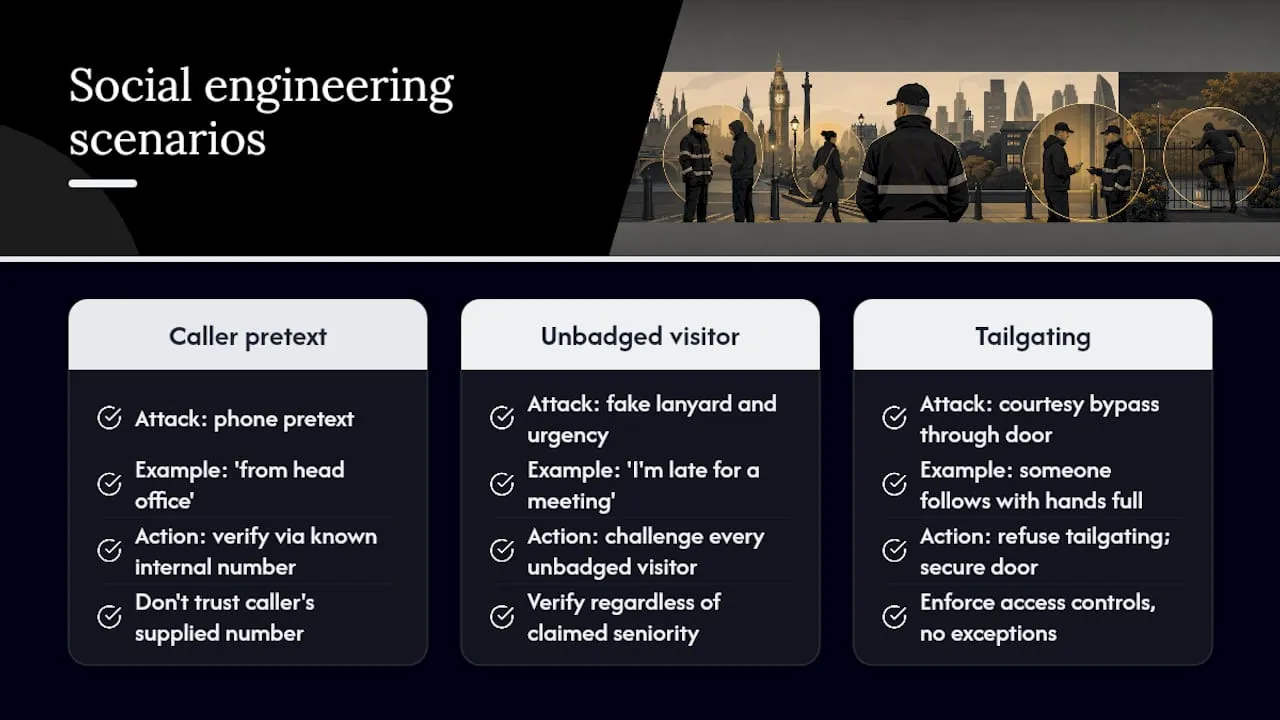
Social engineering against physical security staff rarely looks like an email. It looks like a person at reception with a plausible story. A caller claiming to be “from head office” asking a guard to disable an alarm zone for “maintenance” is a classic pretext attack, and the correct response is verification through a known internal number, never the one the caller provides.
A visitor with a convincing lanyard and a rushed manner, “I’m late for a meeting with the director, can you just wave me through?”, is testing whether procedure bends under social pressure. Guards trained to challenge every unbadged visitor regardless of how senior they claim to be shut this down immediately. Tailgating through a controlled door because someone’s hands are full is the physical-world equivalent of clicking a suspicious link: a small courtesy that bypasses the entire access-control system. The awareness principle is the same across all three scenarios: procedure applies to everyone, and politeness doesn’t override verification.
Real-world case studies illustrating security awareness failures and successes
Failures in this sector tend to share a pattern: a guard notices something, hesitates because it doesn’t fit a rigid checklist, and says nothing. A vehicle parked oddly close to a building for hours, dismissed as “probably nothing,” is the recurring theme in post-incident reviews across retail and event security. The fix isn’t more rules; it’s a reporting culture where flagging something that turns out to be nothing carries zero downside.
Successes look different: a guard who challenges a tailgater politely and gets a straight answer, a briefing that flags a planned protest so the team isn’t caught off guard, a patrol log that shows a genuinely varied route rather than the same loop every night. A positive reporting culture starts at senior management and is sustained by showing staff that their reports actually lead somewhere, whether that’s a thank you, a policy change, or simply an acknowledgement the information was useful. Teams that skip that feedback loop see reporting drop off within weeks.
Common cyber security threats and their awareness approaches
Frontline security staff aren’t cybersecurity specialists, but the physical and digital sides of a site overlap more than most guards realise. Unattended terminals in a control room, USB devices left in common areas, or visitors asking to “just plug in a laptop” to a site network all sit at that overlap point.
The awareness approach here is procedural rather than technical: guards don’t need to understand malware, they need to know that any unfamiliar device connecting to site systems, or any request to bypass IT access controls, gets reported and escalated rather than accommodated. Site access logs and physical control room security matter here too, since a compromised badge reader or an unlocked server cupboard is as much a security failure as a phished password. Treat digital equipment the same way you’d treat a locked door: unauthorised access attempts, physical or otherwise, go in the incident log.
Methods to measure effectiveness of security awareness programmes
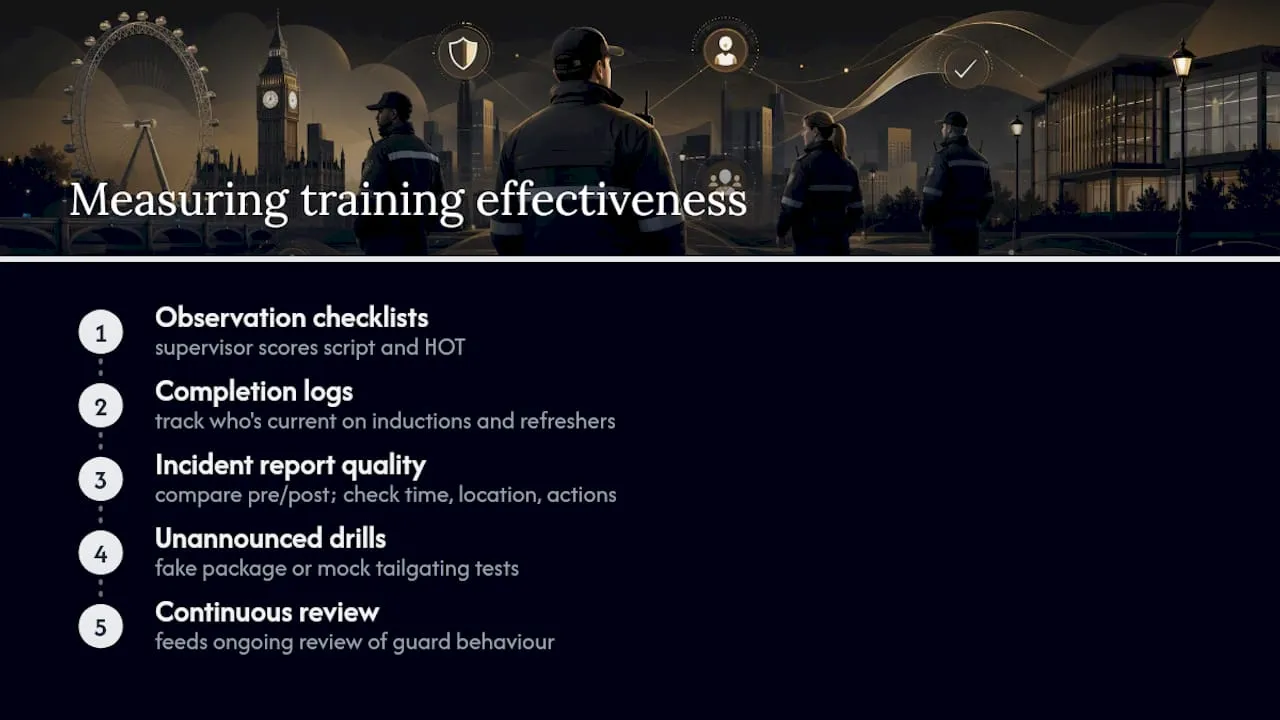
Training that isn’t measured tends to decay fast. The most reliable methods stay simple: observation checklists during live patrols, where a supervisor scores whether a guard followed the challenge script or used HOT correctly, and training completion logs that track who’s current on inductions and refreshers.
Incident report quality is a strong secondary indicator. Compare logs from before and after a training cycle: are guards capturing time, location, and specific actions taken, or still writing vague summaries? A rise in near-miss reporting, incidents caught and logged before they escalated, is usually a sign the programme is working, not a sign something’s going wrong. Unannounced drills, a fake suspicious package, a mock tailgating attempt, give the clearest read on whether training translates into behaviour under pressure rather than just theory recalled in a classroom.
Behavioural indicators of insider threats and how to recognise them
Insider risk rarely announces itself. The signals tend to be small and cumulative: someone accessing areas or information outside their normal role, working unusual hours without a clear reason, or showing sudden financial stress alongside access to valuable stock or sensitive areas.
Watch for a colleague who becomes unusually curious about security procedures, patrol timings, or camera blind spots, particularly if that curiosity doesn’t match their job function. Disgruntlement following a disciplinary action or a passed-over promotion is a well-documented precursor in personnel security guidance, worth noting rather than ignoring. None of these signs alone proves anything, and guards shouldn’t treat colleagues as suspects on a hunch. The right response is the same as with any anomaly: note it, report it through proper channels, and let a supervisor assess the pattern rather than acting alone.
Looking for security roles in your area?
If you’re building a career on the practices covered here, Securityjobsboard lists frontline and supervisory vacancies across the UK, including a dedicated listing for security jobs in Northern Ireland. Employers recruiting against this same standard, guards who understand HOT, the Four Cs, and proper patrol discipline, can post roles and search CVs through Securityjobsboard, which is affiliated with the BSIA and built for the UK security sector specifically. Jobseekers wanting to strengthen their applications first should also see the guide on applying for security guard jobs while training.
Why the basics get skipped, and shouldn’t
Most security awareness advice reads like a compliance checklist, and that’s exactly why it fails to stick. The guards who actually catch problems aren’t the ones who’ve memorised the most acronyms. They’re the ones who’ve rehearsed HOT and Run Hide Tell enough times that the response is automatic rather than something they’re trying to recall mid-incident.
The overrated piece of conventional advice is “more training.” What actually moves the needle is shorter, more frequent practice: a two-minute competency check on a routine patrol beats an annual half-day course nobody remembers by March. The other gap I see constantly is reporting culture. Sites can have flawless SOPs on paper and still fail, because guards have learned that flagging something unusual gets brushed off rather than acknowledged. Fix that feedback loop before you fix anything else. If you only prioritise one thing from this guide, make it the shift briefing. It’s the cheapest intervention here and the one most sites quietly let slide.
— Rob
Sources
For full procedural detail beyond this guide, read ProtectUK’s tactic on staff briefing, the SIA training specification, and Gov.
- Tactic VB2: Review patrol and positioning of security staff
- SIA licence-linked training specification (security guarding)
FAQ
What are the three levels of situational awareness?
Perceiving what’s around you, comprehending whether it’s significant, and projecting what might happen next. ProtectUK frames this as a continuous cycle rather than a one-off assessment.
What is the HOT protocol for suspicious items?
HOT stands for Hidden, Obviously suspicious, and Typical. If an unattended item fails all three checks, guards should escalate rather than investigate it themselves.
How often should security awareness training be refreshed?
A typical cadence includes full induction training, short refreshers regularly, and periodic full-scale exercises, alongside supervisor-led competency checks during routine shifts.
Can SIA-licensed guards search or detain someone?
Searches generally require consent, and detention beyond a citizen’s arrest in narrow circumstances needs proper legal grounding. Guards uncertain of the boundary should escalate to a supervisor rather than act alone.
Why should patrol routes be unpredictable?
Fixed timing lets anyone conducting hostile reconnaissance plan around it. ProtectUK recommends varying patrol timing and routes while keeping coverage documented for supervisors to verify.


