Planning security job campaigns: your 2026 UK guide

TL;DR:
- Planning security job campaigns requires integrating compliance, clear job descriptions, and targeted channels from the start.
- Fast recruitment workflows and early vetting are crucial to attract and secure qualified, license-verified candidates.
Planning security job campaigns is the process of designing and executing targeted recruitment strategies to source qualified candidates for security roles in the UK. Done well, it combines compliance with the Security Industry Authority’s licensing requirements, authentic job marketing, and efficient hiring workflows. Recruitment managers who treat it as a structured discipline, rather than a series of ad hoc adverts, consistently attract better candidates and fill roles faster. Standards like BS7858 and platforms like Securityjobsboard give you the framework and reach to do exactly that.
What compliance and vetting requirements must be integrated into security job campaigns?
Compliance is not a post-hire formality. It belongs at the design stage of every recruitment campaign. Failing to build it in from the start creates legal exposure, insurance risk, and the very real possibility of deploying an unlicensed operative.
The Security Industry Authority requires all front-line security personnel to hold a valid SIA licence before deployment. Physical licence cards can be misleading, because a card may appear valid even when the licence has been suspended. Always verify status via the live SIA Public Register before any candidate starts work. This single check eliminates the most common compliance failure in UK security recruitment.
BS7858 is the leading UK screening standard for security personnel. BS7858 vetting covers identity verification, a five-year employment history check, Disclosure and Barring Service checks, and credit references. Insurers treat BS7858 compliance as a marker of responsible hiring. Firms that skip it face both higher premiums and greater liability if an incident occurs.
Negligent hiring due to inadequate vetting compromises insurance coverage and increases liability risk. That consequence alone makes compliance a commercial priority, not just a regulatory one.
Build these steps into your campaign from day one:
- Confirm SIA licence status via the Public Register for every shortlisted candidate.
- Require BS7858 documentation as a condition of progressing to interview.
- Run DBS checks at the appropriate level for the role.
- Maintain a full audit trail of every check, including dates, outcomes, and the name of the person who verified each document.
- Set automated renewal alerts 12 weeks before SIA licence expiry to prevent lapses for existing staff.
Pro Tip: Build a compliance checklist into your applicant tracking process so every hiring manager follows the same verification steps. Inconsistency in checks is the most common audit failure.
How to craft effective job descriptions for security roles
A generic job description is a wasted opportunity. Candidates quickly spot copy-and-paste adverts, and the result is a lower quality applicant pool. The most credible candidates, those with current SIA licences and verified experience, apply to roles that feel specific and honest.
Effective job descriptions for security roles include the following:
- Role-specific duties: State exactly what the operative will do on shift, including patrol routes, access control responsibilities, or control room tasks. Avoid vague phrases like “maintain a safe environment.”
- Licence and vetting requirements: Specify the SIA licence category required and confirm that BS7858 vetting applies. This filters out unqualified applicants before they reach your inbox.
- Salary range: Mid-level security engineers in London command £65,000 to £80,000 in 2026. Benchmarking your salary band against current market data signals credibility and reduces wasted interviews.
- Career development: Candidates weigh progression opportunities heavily. Mention training pathways, CCTV operator qualifications, or supervisor routes where they exist.
- Shift patterns and flexibility: Security roles often involve unsociable hours. State shift patterns clearly. Candidates who accept the role knowing the schedule are far less likely to drop out during onboarding.
Writing effective security job descriptions takes more time upfront but reduces the volume of unsuitable applications significantly. That time saving compounds across every stage of the hiring process.
Which channels best amplify security job campaigns?
Reaching qualified candidates requires a deliberate channel mix. Posting one advert on a general job board and waiting is not a campaign. It is a lottery.

Specialist job boards deliver the highest concentration of security-qualified candidates. Securityjobsboard offers targeted advertising to candidates who are actively searching for security roles in the UK, with compliance-aware recruitment tools built into the platform. The BSIA affiliation adds credibility that general platforms cannot match.
Social media channels, particularly LinkedIn and Facebook, work well for reaching passive candidates. Operatives who are not actively job hunting still scroll their feeds. Paid posts targeting users by location, job title, and licence type can surface your vacancy to candidates who would never visit a job board. Organic posts from your company page build brand recognition over time, which reduces cost-per-hire on future campaigns.
Partnerships with security training providers and colleges that deliver SIA-approved courses give you access to newly qualified candidates before they appear on the open market. These relationships take time to build but produce a consistent pipeline.
| Channel type | Best for | Typical reach | Cost model |
|---|---|---|---|
| Specialist job boards | Active, licence-verified candidates | High within sector | Pay-per-post or subscription |
| General job boards | Volume applications, entry-level roles | Very high, lower quality | Pay-per-click or flat fee |
| LinkedIn paid adverts | Passive, experienced candidates | Medium, highly targeted | Pay-per-click |
| Training provider partnerships | Newly qualified candidates | Low volume, high quality | Relationship-based |
| Organic social media | Brand awareness, passive candidates | Variable | Time investment |
Pro Tip: Use UTM parameters on every job advert link so your analytics platform shows exactly which channel drives the most completed applications. Gut feel is not a measurement strategy.
For firms hiring flexible or temporary security staff, specialist flexible staffing platforms that focus on the security sector can fill gaps faster than traditional job boards.
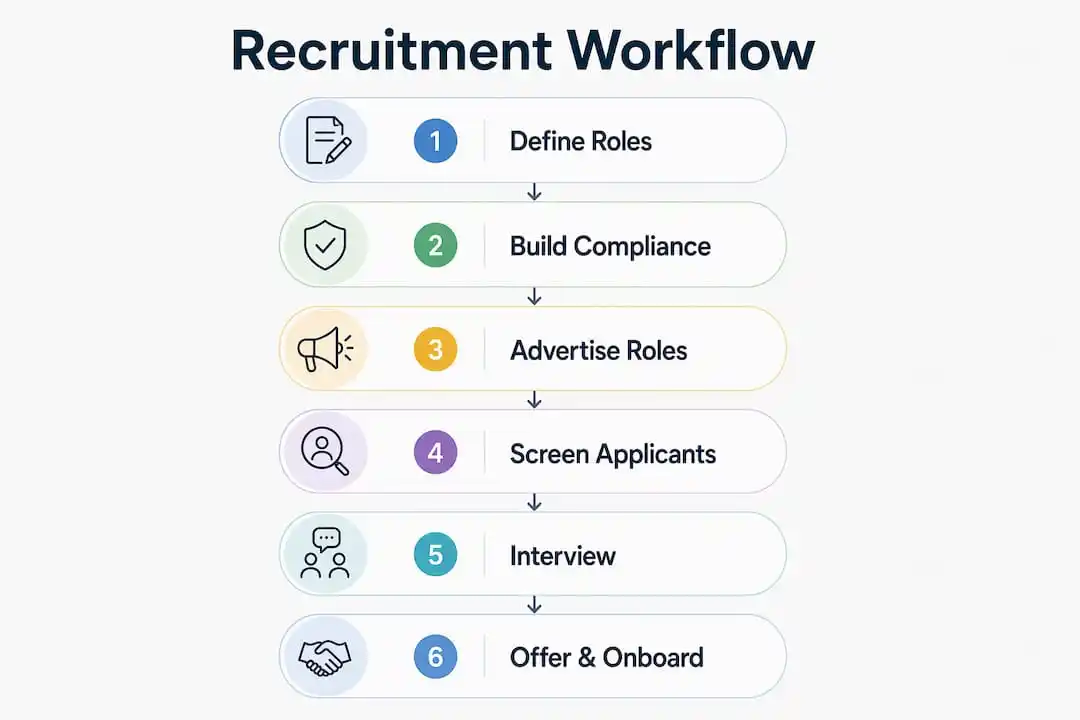
How to structure recruitment workflows for security job campaigns
Speed matters more in security hiring than most recruitment managers realise. Candidates in scarce roles apply to multiple employers simultaneously. The firm that moves fastest often wins the hire.
A well-structured recruitment workflow removes the delays that cause candidates to accept offers elsewhere. Follow these steps to keep your process tight:
- Define the role and compliance requirements before advertising. Every delay caused by unclear requirements at the start multiplies later. Know the SIA licence category, shift pattern, and salary band before the advert goes live.
- Set a closing date and stick to it. Open-ended adverts create drift. A defined window creates urgency for candidates and a clear review date for your team.
- Screen applications within 48 hours of receipt. Candidates notice when they hear nothing for two weeks. A quick acknowledgement and a clear timeline keeps them engaged.
- Consolidate interview stages. More than three weeks between interview and offer risks losing top candidates to faster competitors. Combine competency and compliance interviews where possible.
- Run vetting checks in parallel with final interviews. Starting BS7858 and DBS checks only after a verbal offer adds weeks to your timeline. Begin them as soon as a candidate reaches the final stage.
- Issue the written offer within 24 hours of the decision. Delays at this stage are the most damaging. A candidate who has mentally accepted a role will still take a faster offer if it arrives first.
Common pitfalls include slow feedback between interview stages, poor coordination between HR and operational managers, and treating compliance checks as an afterthought. Each one adds days to your time-to-offer and increases the risk of losing the candidate you wanted.
For a detailed breakdown of security recruitment best practices, including how to manage multi-site hiring, the Securityjobsboard blog covers the full process.
Key takeaways
Effective planning security job campaigns requires compliance, honest job marketing, the right channel mix, and a fast hiring process working together from the start.
| Point | Details |
|---|---|
| Build compliance in from day one | Verify SIA licences via the Public Register and require BS7858 documentation before interview. |
| Write specific job descriptions | Include exact duties, salary bands, and shift patterns to attract credible, licence-verified candidates. |
| Use a specialist job board | Platforms like Securityjobsboard reach security-qualified candidates that general boards miss. |
| Move fast on offers | Candidates in high-demand roles accept competing offers quickly; keep interview-to-offer under three weeks. |
| Track every channel | Use UTM parameters to measure which sources produce completed applications, not just clicks. |
What I have learned about security recruitment after years of watching campaigns fail
The most common mistake I see is treating compliance as a final hurdle rather than a campaign design principle. Firms spend weeks crafting adverts and building shortlists, then lose their preferred candidate because the vetting process was not started early enough. The candidate accepted an offer from a firm that had already completed its checks.
The second mistake is underestimating how quickly experienced candidates form an opinion of your organisation. A vague job description, a slow acknowledgement email, or a disorganised interview process all signal the same thing: this employer does not have its house in order. Candidates with options, and the best ones always have options, move on.
What actually works is treating the candidate experience with the same rigour you apply to site security. Every touchpoint, from the advert to the offer letter, should be clear, timely, and professional. That standard is not difficult to meet. It just requires someone to own the process end to end.
The firms that consistently hire well in the UK security sector are not necessarily the ones with the biggest budgets. They are the ones that screen candidates thoroughly and communicate clearly at every stage. Those two things cost nothing except discipline.
— Rob
How Securityjobsboard supports your security job campaigns
Securityjobsboard is built specifically for the UK security sector, which means every candidate on the platform is there because they are looking for a security role.
Employers can post vacancies, browse a CV database of licence-verified candidates, and manage applications through a GDPR-compliant interface. The platform’s BSIA affiliation gives your adverts credibility that general job boards cannot offer. Whether you are hiring door supervisors in Manchester or security professionals in Northern Ireland, Securityjobsboard puts your vacancy in front of the right people. Flexible pricing plans mean the platform works for single-site operators and national contractors alike. Visit Securityjobsboard to post your next vacancy.
FAQ
What does planning a security job campaign involve?
Planning a security job campaign involves defining role requirements, building compliance checks into the hiring process, writing specific job descriptions, selecting the right advertising channels, and structuring a fast recruitment workflow from application to offer.
Is SIA licence verification mandatory before hiring?
Yes. Every front-line security operative must hold a valid SIA licence before deployment. Always verify status via the live SIA Public Register, as physical licence cards can appear valid even when suspended.
What is BS7858 and why does it matter for recruitment?
BS7858 is the UK’s leading screening standard for security personnel. It covers identity checks, a five-year employment history, DBS checks, and credit references. Compliance with BS7858 is favoured by insurers and reduces liability risk for security firms.
How long should a security recruitment process take?
Interview-to-offer periods longer than three weeks risk losing top candidates to faster competitors. Consolidate interview stages, run vetting checks in parallel with final interviews, and issue written offers within 24 hours of the hiring decision.
Which job boards work best for security recruitment in the UK?
Specialist platforms that focus on the security sector deliver the highest concentration of licence-verified candidates. Securityjobsboard is affiliated with the BSIA and offers targeted advertising tools designed specifically for UK security recruitment.


