How to Write Job Descriptions for UK Security Roles

Finding skilled, reliable security personnel often starts with how well you define and communicate the role. For HR managers and recruiters in British security firms, vague job descriptions lead to mismatches, wasted resources, and compliance risks. By focusing on clear role requirements and industry standards such as the Government Security Profession Career Framework, you can craft descriptions that attract the right candidates and support your organisation’s operational needs.
Table of Contents
- Step 1: Define The Role Requirements Clearly
- Step 2: Structure The Job Description Effectively
- Step 3: Optimise Language For Security Talent
- Step 4: Verify Compliance And Accuracy
Quick Summary
| Key Takeaway | Explanation |
|---|---|
| 1. Clearly define role requirements | Specific requirements help attract suitable candidates and reduce hiring errors. |
| 2. Structure job descriptions effectively | A well-organised format ensures clarity and aids candidate evaluation before applications. |
| 3. Use clear and direct language | Simple, active language enhances understanding and encourages suitable candidates to apply. |
| 4. Verify compliance and accuracy | Ensure descriptions meet legal standards to avoid potential liabilities and attract the right candidates. |
| 5. Regularly review and update descriptions | Keeping job descriptions current is essential as roles and industry requirements evolve. |
Step 1: Define the role requirements clearly
Clear role requirements form the foundation of any effective security job description. Without them, you risk attracting candidates who don’t match your actual needs, wasting time on unsuitable applications and potentially hiring the wrong person for the job.
Start by identifying the core responsibilities your security role needs to cover. What will this person actually do on a daily basis? Are they managing access points, conducting risk assessments, responding to incidents, or overseeing a team?
Next, determine the skills and competencies required. This goes beyond experience level—you need to spell out technical abilities, soft skills, and any certifications or qualifications that matter. The Government Security Profession Career Framework provides detailed guidance on skill levels and expectations that can help you align your requirements with professional standards.
Consider involving your team in this process. The people who work alongside this role daily understand what’s actually needed better than anyone. Ask them what gaps exist, what frustrates them about current workflows, and what they’d want in an ideal candidate.
Work through these key areas:
- Technical knowledge and certifications (SIA licence, specific systems, software)
- Physical demands and shift patterns
- Leadership or supervisory expectations
- Security clearance requirements
- Industry-specific experience or specialisations
- Problem-solving abilities and decision-making authority
Document everything clearly. Vague requirements produce vague applications. When you write “strong communication skills,” define what that actually means in your context—does it mean writing detailed incident reports, briefing management, or managing client relationships?
Clear, specific requirements attract better-matched candidates and reduce hiring mistakes significantly.
Remember that requirements should evolve. Security threats change, technology updates, and business priorities shift. Plan to review and update your role requirements annually or when your business needs change.
Pro tip: Involve stakeholders from the start—security operations, management, and finance—to ensure everyone agrees on what the role requires before you write the job description.
Step 2: Structure the job description effectively
A well-structured job description acts like a roadmap for both you and your candidates. It tells them exactly what you expect, and it helps you evaluate whether applicants can actually do the job.
Start with a clear job title that accurately reflects the role and experience level. Instead of just “Security Officer,” consider “Senior Site Security Officer” or “Access Control Specialist” to be more specific.
Next, introduce the organisation and the role itself briefly. Give candidates context about what they’ll be doing and why it matters. Then move into the core sections that every security job description needs.
Your description should cover these essential areas:
- Job title and reporting line showing where this role sits in your structure
- Key responsibilities listing what they’ll actually do day-to-day
- Required qualifications and certifications, such as SIA licence requirements
- Shift patterns and working hours so there’s no confusion later
- Salary range and benefits to attract serious candidates
- Work environment details describing locations, physical demands, and conditions
Organise responsibilities by priority rather than random order. Start with the most critical duties, then work down to secondary tasks. Use action verbs like “monitor,” “patrol,” “respond,” and “report” to make duties clear and active.
For qualifications, distinguish between essentials and nice-to-haves. Candidates need to know what’s mandatory versus what would strengthen their application. Be specific—“excellent communication” is vague, but “ability to write detailed incident reports and brief management” is concrete.
Here’s a quick reference comparing essential and desirable requirements for security job descriptions:
| Requirement Type | Description | Business Impact |
|---|---|---|
| Essential | Mandatory for lawful and safe operation, e.g., SIA licence, physical fitness, shift flexibility | Ensures compliance and operational readiness |
| Desirable | Adds value but not strictly required, e.g., leadership experience, advanced technology skills | Enhances team performance and adaptability |
A well-structured description filters unsuitable candidates before they even apply, saving everyone time.
Include any certifications, clearances, or licences upfront. Security roles often require specific credentials, and candidates need to know immediately whether they qualify. Don’t bury requirements at the bottom where people miss them.

Pro tip: Use a consistent format across all your security job descriptions so candidates recognise your organisation’s hiring approach and find information quickly.
Step 3: Optimise language for security talent
The language you use in your job description directly affects who applies and how seriously they take the role. Security professionals respond to clarity, specificity, and language that respects their expertise.
Start by eliminating internal jargon and acronyms that candidates outside your organisation won’t understand. If you must use industry-specific terms, define them clearly the first time they appear. Security has its own vocabulary, but overloading descriptions with unexplained terminology confuses applicants and filters out good candidates who simply don’t speak your internal dialect.
Use active, direct language throughout. Instead of “candidate should be capable of performing security tasks,” write “monitor site access points, respond to security incidents, and conduct regular patrols.” Action verbs like monitor, inspect, respond, report, and coordinate make your expectations concrete and unmistakable.
Focus on qualities that matter in security roles. These include:
- Reliability and dependability in all conditions
- Attention to detail in identifying potential threats
- Clear communication in incident reports and briefings
- Ability to stay calm under pressure
- Problem-solving and sound judgement
- Physical fitness or specific physical demands
When describing certifications and qualifications, use precise language rather than vague phrases. Don’t write “relevant security experience required.” Instead, specify “minimum two years site security experience” or “SIA Door Supervisor licence with current DBS clearance.” Candidates need to know exactly what qualifications matter and in what form.
Highlight what makes your role unique. When optimising language for candidate engagement in security talent pooling, emphasise career development opportunities, training programmes, or the chance to work with specific technologies or clients. Security professionals want to know if they’re joining a team that invests in their growth.
Clear, direct language attracts serious candidates and reduces mismatches before interviews even happen.
Avoid overusing superlatives like “dynamic,” “fast-paced,” or “exciting.” Security professionals value stability and clear procedures, not hype. Describe the role honestly so candidates self-select accurately.
Pro tip: Read your job description aloud as if you were a candidate. Does it feel clear, or would you be confused about whether you qualify? If you stumble over terminology or feel uncertain, your candidates will too.
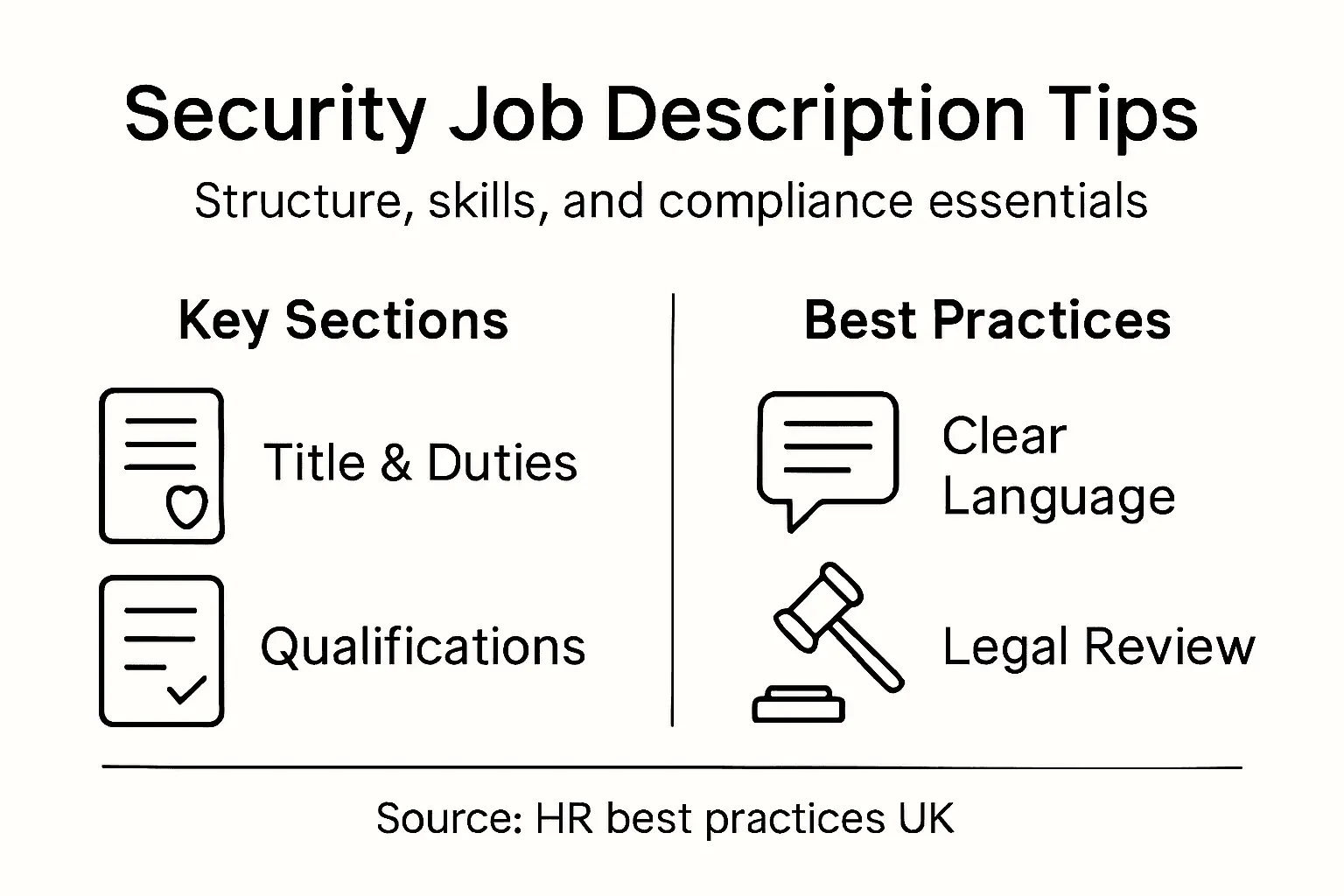
See how candidate-focused language can improve your job description effectiveness:
| Language Style | Candidate Reaction | Likely Outcome |
|---|---|---|
| Clear and specific | Understands requirements easily | Better-matched applications |
| Jargon-heavy or vague | Experiences confusion or doubt | Lower quality applicants |
Step 4: Verify compliance and accuracy
Before publishing your job description, you need to verify it meets UK employment law and reflects what you actually need. A non-compliant or inaccurate description creates legal risk and attracts the wrong candidates.
Start by checking for discriminatory language. Words like “young,” “energetic,” or “digital native” can inadvertently exclude protected groups. Focus on job-related requirements instead. If the role needs physical fitness, describe the specific physical demands rather than using age-coded language.
Ensure your description reflects actual duties. When writing about role requirements, accuracy in job descriptions maintains compliance with employment standards and reduces disputes later. Don’t inflate responsibilities to sound more impressive. If the role involves occasional report writing, say “occasional,” not “strong writing skills essential.” Misrepresenting the job attracts candidates who discover it’s different once hired, leading to early departures.
Review these compliance checkpoints:
- No age, gender, or appearance requirements unless genuinely essential
- No unnecessary physical demands listed without justification
- Accurate job title matching your role structure
- Clear distinction between essential and desirable requirements
- Precise salary range or salary banding information
- Specific qualifications rather than vague experience requests
- No unrealistic expectations relative to pay or seniority level
Check your data protection practices too. If you’re collecting personal information through applications, ensure your job description mentions this and links to your privacy policy. This aligns with GDPR requirements.
Have someone outside your team read it. A fresh set of eyes catches confusing language, unclear requirements, and inadvertent bias that you’ve become blind to after drafting.
Compliance isn’t bureaucracy—it protects your organisation and ensures fair recruitment.
Schedule regular reviews of your job descriptions. As your security operation evolves, requirements change. What was accurate six months ago might now be outdated. Annual updates keep descriptions current and compliant with any changes in employment law or industry standards.
Pro tip: Keep a checklist of compliance items specific to security roles—SIA licensing requirements, DBS clearance levels, and shift pattern expectations—and review it for every description before posting.
Streamline Your Security Recruitment with Expert Job Descriptions and Our Platform
Crafting clear and compliant job descriptions is vital to attracting the right security professionals in the UK. This guide breaks down how to define precise role requirements, use active language, and ensure compliance so you avoid common pitfalls and save valuable hiring time. Now you can leverage this knowledge directly when recruiting on the Security Jobs Board, a trusted platform dedicated solely to the UK security sector.

Take advantage of our tailored tools to post your newly optimised security job descriptions and immediately reach qualified candidates who match your specific criteria. Whether you need to verify licences like the SIA, highlight shift patterns, or promote career development opportunities, our user-friendly site supports every step of your recruitment journey. Start attracting quality candidates today with Security Jobs Board and transform your hiring process with clarity and confidence.
Frequently Asked Questions
How do I define role requirements for a security position?
To define role requirements clearly, start by identifying the core responsibilities of the position, such as managing access points or conducting risk assessments. Involve your team to gain insights into what skills and competencies are truly necessary, and document everything without ambiguity.
What should be included in a job description for a UK security role?
A job description should include a clear job title, key responsibilities, required qualifications and certifications, shift patterns, and a salary range. Organising these elements logically helps candidates understand their fit for the role and saves time during the hiring process.
How can I ensure my job descriptions attract qualified security candidates?
To attract qualified candidates, use clear and specific language that avoids jargon and highlights the unique aspects of the role. Action-oriented verbs can clarify expectations and improve engagement—emphasise skills like monitoring, responding, or reporting to draw in more suitable applications.
What steps should I take to verify compliance and accuracy in my job descriptions?
Verify compliance by reviewing your job description for discriminatory language and ensuring it accurately reflects the role’s duties and requirements. Check for essential qualifications upfront and avoid unrealistic expectations to maintain compliance and attract the right candidates.
How often should I review and update job descriptions for security roles?
You should plan to review and update job descriptions annually or whenever your business needs change. Regular updates help ensure that your descriptions remain accurate and compliant with current employment laws and industry standards.


