How to build a talent pipeline for security roles

TL;DR:
- Building a proactive talent pipeline in security requires forecasting, targeted sourcing, and ongoing relationship nurturing. Regular engagement and data-driven segmentation ensure candidates remain interested and ready for roles. Consistent relationship management and technology use significantly reduce hiring time and improve quality of hire.
A talent pipeline is defined as a targeted, role-focused pathway of prequalified candidates maintained proactively so that vacancies can be filled without sourcing from scratch. For HR professionals and managers in the UK security industry, knowing how to build a talent pipeline is not optional. Security roles demand SIA licensing, vetted backgrounds, and specialist skills that take time to verify. Waiting until a position opens before searching for candidates costs you time, money, and operational continuity. The good news is that building a structured pipeline is a learnable, repeatable process.
How to build a talent pipeline: start with workforce forecasting
The foundation of any effective pipeline is knowing which roles you will need to fill before you need to fill them. Cornerstone’s six-step framework places workforce forecasting and role success profiling at the very start of the process. That sequencing is deliberate. Without a clear picture of future demand, your sourcing efforts scatter across roles that may never open.
For security employers, this means conducting a multi-year workforce plan that accounts for contract renewals, seasonal demand shifts, and attrition patterns. Manned guarding contracts, for example, often turn over large numbers of officers within the first three months. If you know that pattern, you can build a pipeline of SIA-licensed door supervisors or CCTV operators before the attrition hits.
When forecasting, focus your pipeline efforts on roles that are hardest to fill and have the most imminent openings. A critical role profile for each position should define the success factors clearly:
- SIA licence type required (Door Supervisor, Security Guard, CCTV Operator)
- Physical and site-specific requirements
- Vetting level needed (BS 7858 screening, DBS check tier)
- Compensation range and shift pattern expectations
- Soft skills and behavioural indicators of long-term retention
This level of specificity prevents you from filling your pipeline with candidates who look right on paper but fail at the vetting stage. It also gives your sourcing team a precise brief, which saves time at every subsequent step.
What are the best ways to source security talent proactively?
Proactive sourcing draws from internal succession pools and external passive candidates before any vacancy is advertised. In the security sector, this distinction matters enormously because the best candidates are rarely actively job-hunting. They are already deployed on contracts, often without a strong reason to move unless someone makes contact.
Here is a structured approach to sourcing for security pipelines:
- Map your internal talent first. Identify high-potential officers and supervisors who could step into senior or specialist roles. Succession planning within your own workforce is the fastest and lowest-cost sourcing method available.
- Engage passive candidates through industry events. The BSIA (British Security Industry Association) annual conference, regional networking events, and CPD training days are all environments where you will find experienced security professionals who are not actively applying for roles.
- Use LinkedIn and security-specific platforms. Search by SIA licence type, location, and previous employer. Competitor intelligence, reviewing who works for rival firms and whether they are open to contact, is a legitimate and effective sourcing tactic.
- Build relationships with SIA training providers. Colleges and private training centres that deliver Door Supervisor or Security Guard qualifications produce newly licensed candidates every month. A standing relationship with two or three providers gives you first access to fresh talent.
- Run structured internship and apprenticeship programmes. The Level 2 Award for Door Supervisors and the Security Industry apprenticeship standard both create pathways for younger candidates. Sponsoring or partnering with these programmes builds your pipeline at the entry level.
Pro Tip: When reaching out to passive candidates, lead with something of genuine value: a relevant industry update, a training opportunity, or a brief conversation about their career goals. Never open with a job pitch. Candidates who feel respected at first contact are far more likely to engage when a role does open.
Securityjobsboard gives employers direct access to a CV database of security-specific candidates across the UK, which shortens the time needed to identify passive talent worth approaching.
How do you keep pipeline candidates engaged over time?
A list of names in a spreadsheet is not a talent pipeline. Candidate engagement is ongoing relationship nurturing, and the difference between a database and a live pipeline is the quality of the relationships you maintain within it. This is where most security employers fall short. They source well but nurture poorly, and candidates go cold.
The solution is a structured communication cadence built around where each candidate sits in their readiness to move. Consider these engagement principles:
- Newly identified candidates deserve an initial contact within the first week, followed by a light-touch check-in every six to eight weeks.
- Warm candidates who have expressed interest but are not yet ready to move should receive relevant content: industry news, training updates, or brief market insights every four to six weeks.
- Active candidates who are ready to consider a move should be contacted every one to two weeks with specific role information and next steps.
Personalised, brief messages consistently outperform generic outreach in response rates. A message that references a candidate’s specific licence type, their last conversation with you, or a relevant development in their area of work signals that you see them as a person, not a number.
A recruiting CRM (candidate relationship management) tool is the technology that makes this scalable. Platforms like iCIMS allow you to automate nurture sequences with exit conditions, so that when a candidate converts to an active applicant in your ATS (applicant tracking system), they are automatically removed from the nurture sequence. This prevents the awkward experience of a candidate receiving a pipeline email while they are already mid-interview with you.

For practical guidance on structuring your outreach, the Securityjobsboard resource on improving candidate engagement covers specific techniques tested within the UK security sector.
Pro Tip: Trigger your nurture messages based on candidate actions or inactivity periods rather than fixed calendar schedules. If a candidate opens three of your emails without responding, that is a signal to try a different channel or message format, not to send a fourth identical email.
How should you segment and qualify pipeline candidates?
Continuous qualification is what separates a healthy pipeline from a stagnant contact list. Lighter-touch assessments such as informal conversations, skills validation calls, and brief competency checks allow you to segment candidates by readiness without the overhead of a formal interview process.
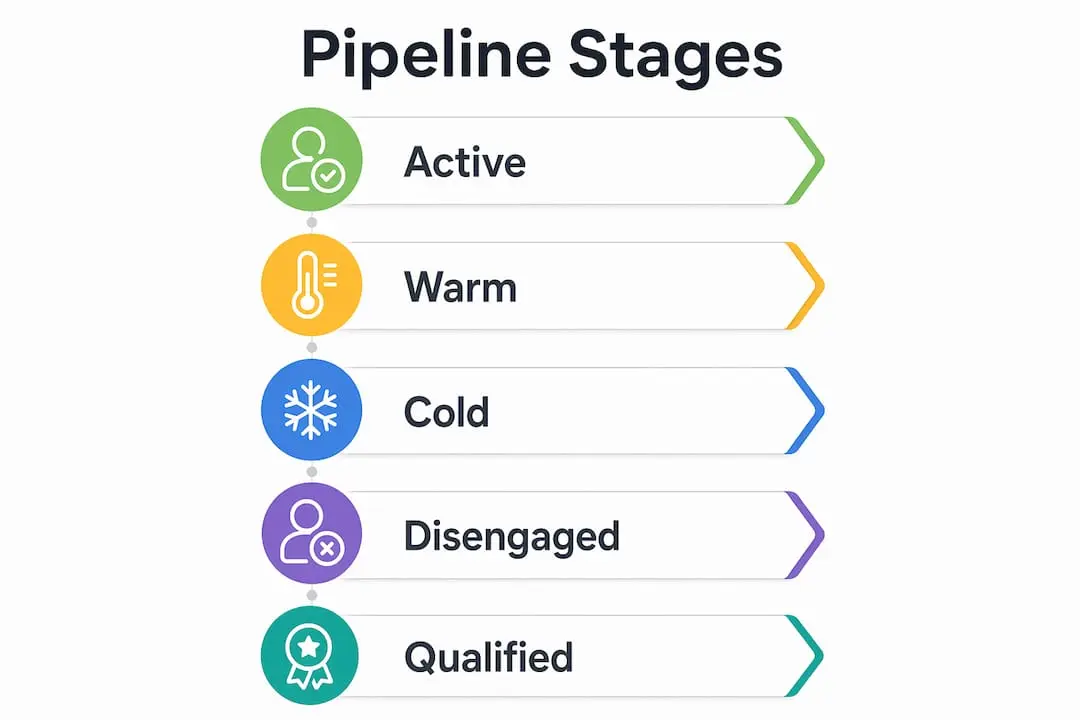
The table below shows a practical segmentation model for security pipeline candidates:
| Segment | Readiness Level | Outreach Frequency | Key Data to Track |
|---|---|---|---|
| Active | Ready to move now | Every 1–2 weeks | Current role, notice period, licence status |
| Warm | Open but not urgent | Every 4–6 weeks | Compensation expectations, location flexibility |
| Future Prospect | Not ready yet | Every 6–8 weeks | Career goals, training progress, SIA renewal date |
Per-candidate readiness data should include the date of your last meaningful conversation, their openness to relocation, and any changes in their personal circumstances. Tracking pipeline stage transitions with clear entry and exit signals keeps the flow dynamic. A candidate who was a future prospect six months ago may have just completed their DS licence renewal and is now actively looking. Without a system to capture that shift, you miss the window.
The Securityjobsboard applicant tracker gives security employers a structured way to manage candidates at different stages without losing track of where each person sits in the process.
What metrics tell you if your pipeline is actually working?
Pipeline health is measured by engagement rates, conversion rates, and quality of hires. Tracking these three metrics consistently tells you whether your pipeline is producing results or simply accumulating contacts.
The key performance indicators worth monitoring are:
- Pipeline conversion rate: the percentage of pipeline candidates who progress to a formal interview when a role opens.
- Time to fill from pipeline: how long it takes to place a candidate who was already in your pipeline versus one sourced reactively.
- Engagement rate: the proportion of pipeline candidates who respond to outreach within a defined period.
- Quality of hire: retention rates and performance scores for candidates placed from the pipeline versus those sourced through job boards alone.
A structured pipeline stage model with explicit contact cadence prevents candidate neglect and fatigue. If your engagement rate drops below a meaningful threshold, that is a signal to review your messaging, your segmentation, or the frequency of your outreach. If your conversion rate is low, the problem is likely in your qualification process: candidates are entering the pipeline without being properly assessed for fit.
Integrating your recruiting CRM with your ATS gives you the data visibility to diagnose these issues quickly. The CRM and ATS work together by managing pre-applicant candidates and active applicants distinctly, which keeps your data clean and your reporting accurate.
Key takeaways
Building a talent pipeline in the security industry requires forecasting, structured sourcing, continuous engagement, and data-driven optimisation working together as a single system.
| Point | Details |
|---|---|
| Define before you source | Create detailed role profiles with SIA licence requirements before building any pipeline. |
| Prioritise hard-to-fill roles | Focus pipeline efforts on specialist security positions with the longest lead times. |
| Nurture, do not just collect | Use a CRM with automated cadences to maintain active relationships, not just contact lists. |
| Segment by readiness | Classify candidates as active, warm, or future prospects and adjust outreach frequency accordingly. |
| Measure pipeline conversion | Track time-to-fill and engagement rates to identify and fix weak points in the pipeline. |
The part most security employers get wrong
I have spoken with dozens of security managers who believe they have a talent pipeline because they have a spreadsheet of CVs from the last six months. That is not a pipeline. That is an archive.
The mistake is treating pipeline building as a one-time sourcing exercise rather than an ongoing relationship management discipline. The security industry compounds this problem because so many employers are reactive by nature. A contract is won, headcount is needed immediately, and the scramble begins. The pipeline never gets built because there is always a more urgent fire to fight.
What actually works is committing to a small, consistent investment of time each week in pipeline activity, even when you have no open roles. Fifteen minutes of personalised outreach to three warm candidates every week compounds into a genuinely warm network within six months. I have seen security firms cut their average time to fill specialist roles by more than half simply by maintaining that discipline.
Technology helps, but it does not replace the human element. A well-configured CRM automates the scheduling and tracking, but the message still needs to feel personal. Candidates in the security sector are perceptive. They know when they are receiving a mass email dressed up as a personal note. The firms that build the strongest pipelines are the ones where a real person writes a real message, even if the CRM reminds them to do it.
— Rob
Start building your security talent pipeline today
Security recruitment does not have to be a last-minute scramble. Securityjobsboard connects UK security employers with a database of vetted, SIA-licensed candidates across every specialism, from manned guarding to CCTV operations and close protection.

Whether you are looking to fill roles in Northern Ireland security jobs or build a national pipeline across multiple contracts, the platform gives you the tools to source, track, and engage candidates before you need them. Post your roles, browse CVs, and use the applicant tracker to manage your pipeline in one place. Visit Securityjobsboard to explore employer plans and start building a pipeline that works before the next vacancy lands on your desk.
FAQ
What is a talent pipeline in security recruitment?
A talent pipeline is a targeted group of prequalified candidates maintained proactively for specific roles. In security recruitment, it means having SIA-licensed, vetted candidates ready to fill positions before vacancies are advertised.
How long does it take to build a talent pipeline?
A functional pipeline for priority security roles typically takes three to six months to establish. The timeline depends on the complexity of the roles, the quality of your sourcing channels, and the consistency of your candidate engagement activity.
What tools do you need to manage a talent pipeline?
A recruiting CRM manages pre-applicant candidates through nurture sequences, while an ATS handles active applicants. Used together, they prevent duplication and keep your pipeline data accurate and current.
How often should you contact pipeline candidates?
Contact cadence depends on readiness stage: active candidates every one to two weeks, warm candidates every four to six weeks, and future prospects every six to eight weeks. Overcontacting candidates at early stages causes disengagement.
What is the difference between a talent pool and a talent pipeline?
A talent pool is a broad, often unvetted collection of potential candidates. A talent pipeline is role-specific, prequalified, and actively maintained with regular engagement to keep candidates ready for imminent openings.


