Talent Pooling – Transforming Security Recruitment UK

Recruiting skilled security professionals can feel like a race against time, especially when urgent vacancies emerge across the UK. For analysts and managers striving to secure top talent, traditional hiring methods often fall short in addressing complex security requirements. By embracing the power of talent pooling, you can build a proactive database of pre-qualified candidates, streamlining recruitment while supporting long-term career growth and operational continuity within the demanding UK security industry.
Table of Contents
- Defining Talent Pooling In Security Recruitment
- Key Types Of Talent Pools Explained
- How Talent Pooling Works For Employers
- Legal And Data Compliance In Talent Pooling
- Common Pitfalls And How To Avoid Them
Key Takeaways
| Point | Details |
|---|---|
| Talent Pooling Enhances Recruitment | Organisations can strategically manage candidate databases to anticipate staffing needs, significantly reducing time-to-hire and recruitment costs. |
| Types of Talent Pools are Strategic | Internal, external, and specialised pools serve different recruitment purposes, aiding in workforce diversity and identifying future leaders. |
| Continuous Engagement is Crucial | Regular communication with candidates maintains their interest and ensures a ready pool of qualified professionals when roles become available. |
| Legal Compliance is Imperative | Adhering to data protection regulations not only protects sensitive information but also builds candidate trust in the recruitment process. |
Defining Talent Pooling In Security Recruitment
Talent pooling represents a strategic approach in modern security recruitment, transforming traditional hiring processes into proactive talent management systems. At its core, talent pooling is about creating a strategic candidate database that enables security organisations to anticipate and meet staffing requirements more efficiently.
In the UK security sector, talent pooling goes beyond simple candidate tracking. It involves systematically identifying, engaging, and nurturing potential candidates who possess specialised skills critical for security roles. This approach allows employers to build relationships with talented professionals before immediate hiring needs arise, reducing recruitment timelines and improving overall candidate quality. Talent pools help organisations maintain a ready reservoir of pre-screened security professionals who can be quickly deployed when specific roles become available.
The strategic advantages of talent pooling are significant for security recruitment. By maintaining an active database of potential candidates, organisations can dramatically reduce time-to-hire, minimise recruitment costs, and ensure continuous access to top-tier security talent. This approach is particularly valuable in a sector where specialised skills, security clearances, and precise role requirements make finding the right candidate challenging.
Security Recruitment Pro Tip: Regularly update and engage with your talent pool through targeted communications, professional development opportunities, and personalised outreach to maintain candidate interest and readiness.
Key Types Of Talent Pools Explained
In the dynamic landscape of security recruitment, understanding the diverse types of talent pools is crucial for developing a robust hiring strategy. Security organisations can segment their talent acquisition approaches into several strategic categories, each serving a unique purpose in meeting workforce requirements.
Internal Talent Pools represent a critical resource for security employers, focusing on existing employees with potential for advancement or role transitions. These pools enable organisations to identify high-potential staff members who can be groomed for leadership positions or specialised security roles. Meanwhile, External Talent Pools comprise candidates sourced from the broader job market, including professionals actively seeking new opportunities and passive candidates who might be enticed by compelling career prospects.

Talent pools can be further categorised based on specific recruitment objectives. Network pools encompass freelancers, former employees, and professional contacts who maintain connections with the organisation. High-Potential Talent Pools are particularly strategic, targeting individuals with exceptional skills and leadership capabilities who could drive future innovation in security roles. Critical Skills Pools focus on niche expertise, capturing candidates with specialised technical or security-related competencies that are challenging to recruit.
Security Recruitment Pro Tip: Implement a dynamic tracking system that allows continuous updating and categorisation of talent pools, ensuring your recruitment strategy remains agile and responsive to changing organisational needs.
Here’s a summary of common talent pool types and their strategic value for security recruitment:
| Talent Pool Type | Main Focus | Strategic Value |
|---|---|---|
| Internal Talent Pool | Existing staff with potential | Enables succession planning, promotion |
| External Talent Pool | Wider job market candidates | Expands skills, increases diversity |
| Network Talent Pool | Freelancers, ex-employees, contacts | Flexible resourcing, quick deployment |
| High-Potential Pool | Outstanding skills and leadership | Drives innovation, future leadership |
| Critical Skills Pool | Niche technical expertise | Fills specialist roles, addresses gaps |
How Talent Pooling Works For Employers
Talent pooling is a sophisticated recruitment strategy that enables security employers to transform their hiring approach proactively. By creating a dynamic database of pre-qualified candidates, organisations can strategically anticipate and address future workforce requirements, moving beyond traditional reactive recruitment methods.
The process involves systematic candidate identification and engagement across multiple channels. Security employers develop detailed candidate personas, mapping potential talent from professional networks, industry conferences, educational institutions, and referral programmes. This approach allows for comprehensive talent mapping and strategic workforce planning, enabling organisations to forecast skill requirements and maintain a competitive edge in recruitment.
Critical to successful talent pooling is continuous candidate communication and relationship management. Employers utilise sophisticated Applicant Tracking Systems (ATS) to maintain personalised interactions, sharing targeted career updates, industry insights, and potential opportunity notifications. This ongoing engagement keeps potential candidates interested and prepared, significantly reducing recruitment timelines and improving the overall quality of hires by ensuring a ready pool of skilled professionals.
Security Recruitment Pro Tip: Develop a structured communication strategy that keeps potential candidates engaged through personalised, value-added content that demonstrates your organisation’s commitment to professional development and career growth.
Legal And Data Compliance In Talent Pooling
Talent pooling in the security sector demands rigorous adherence to legal frameworks, particularly the critical data protection regulations governing candidate information management. The UK General Data Protection Regulation (UK GDPR) and Data Protection Act 2018 establish comprehensive guidelines that security employers must meticulously follow when collecting, storing, and processing candidate personal data.
Key compliance requirements centre on fundamental data protection principles. Security organisations must ensure that candidate information is collected lawfully, processed transparently, and used only for specified recruitment purposes. This means obtaining explicit consent, limiting data collection to relevant professional information, and implementing robust security measures to protect sensitive personal details. Ethical data handling builds candidate trust and prevents potential regulatory penalties, making comprehensive compliance a strategic imperative for modern talent pooling strategies.
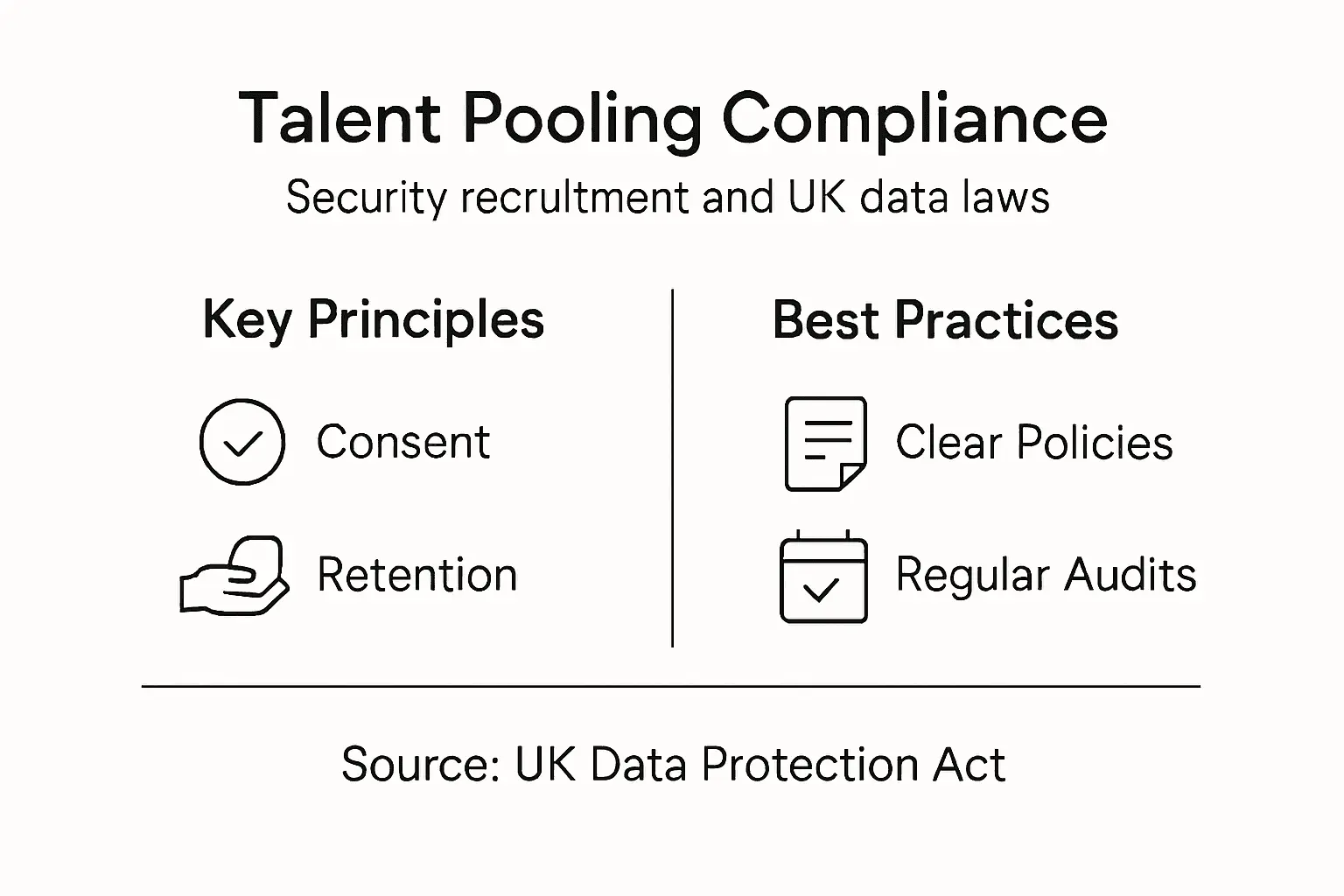
Practical compliance involves developing clear, transparent data management policies. Employers must establish precise protocols for candidate data retention, provide mechanisms for candidates to access or request deletion of their information, and maintain detailed records of consent and data processing activities. Special attention is required when handling sensitive categories of personal data, such as criminal record information or health-related details, which demand additional layers of protection and explicit candidate consent.
Security Recruitment Pro Tip: Create a standardised consent form that clearly outlines how candidate data will be used, stored, and protected, ensuring transparency and building trust throughout the talent pooling process.
This table highlights key legal requirements and their impact during security talent pooling:
| Legal Requirement | Employer Obligation | Impact on Recruitment |
|---|---|---|
| Data Protection Principles | Collect and store lawfully | Enhances candidate trust |
| Explicit Candidate Consent | Obtain clear permission | Reduces legal risk |
| Data Retention Protocols | Set duration for data storage | Maintains compliance |
| Secure Sensitive Data Handling | Extra safeguards for sensitive data | Protects privacy, avoids penalties |
| Transparent Usage Communication | Clearly inform data usage | Improves candidate relationships |
Common Pitfalls And How To Avoid Them
Talent pooling in security recruitment presents numerous challenges that can significantly undermine organisational recruitment strategies. Organisations frequently encounter complex talent management obstacles that require strategic intervention and proactive management to overcome effectively. Understanding these potential pitfalls is crucial for developing robust talent acquisition approaches.
One critical challenge involves maintaining candidate engagement and preventing talent pool deterioration. Security employers often struggle with continuous candidate communication, leading to candidate disinterest and potential talent decay. Strategic sourcing and diverse recruitment channels become essential in mitigating these risks. This means implementing regular communication strategies, segmenting candidate databases effectively, and ensuring personalised interactions that keep potential candidates actively interested in future opportunities.
Data management represents another significant potential pitfall in talent pooling. Security organisations must develop rigorous systems for candidate information maintenance, ensuring data accuracy, relevance, and compliance with legal regulations. This involves creating comprehensive data hygiene protocols, establishing clear candidate review cycles, and implementing automated systems that can track and refresh candidate information periodically. Ineffective data management can lead to outdated candidate profiles, reduced recruitment efficiency, and potential legal complications.
Security Recruitment Pro Tip: Implement a quarterly talent pool audit process that systematically reviews and refreshes candidate information, removing outdated profiles and re-engaging potential candidates through targeted communication strategies.
Build Your Security Talent Pool With The Security Jobs Board
If you are ready to transform your security recruitment strategy by embracing talent pooling, the Security Jobs Board offers the tools and audience you need to act swiftly and securely. The article highlights how nurturing a strategic candidate database can cut time-to-hire and ensure access to top-tier security professionals. Our platform allows employers to post specialised security roles, browse a rich CV database, and establish meaningful connections with both active and passive candidates—all fully compliant with UK GDPR standards.

Don’t let valuable talent slip away due to slow outreach or outdated recruitment methods. Join the thousands of UK security employers using Security Jobs Board to maintain a dynamic talent pool that is ready when you are. Create your employer profile today to post jobs, engage candidates, and secure the specialised skills your organisation needs. Explore more about how we can help you deliver faster, smarter hiring by visiting Security Jobs Board - Your Gateway to Security Recruitment. Take control of your talent pipeline now and future-proof your security workforce.
Frequently Asked Questions
What is talent pooling in security recruitment?
Talent pooling in security recruitment involves creating a strategic database of potential candidates to proactively manage staffing needs, allowing organisations to identify, engage, and nurture candidates with specialised skills critical for security roles.
How does talent pooling benefit employers in the security sector?
Talent pooling helps employers reduce time-to-hire, minimise recruitment costs, and maintain continuous access to pre-screened security talent, leading to improved overall candidate quality and quicker deployment for open roles.
What are the different types of talent pools used in security recruitment?
Common types of talent pools include internal talent pools (existing employees), external talent pools (broader job market), network talent pools (freelancers and contacts), high-potential pools (outstanding candidates), and critical skills pools (niche expertise).
How can organisations maintain candidate engagement in their talent pool?
Organisations can maintain candidate engagement by implementing regular communication strategies, personalised outreach, sharing industry insights, and providing professional development opportunities to keep candidates interested and ready for future roles.


