Steps to land security jobs in the UK: 2026 guide

TL;DR:
- Getting a security job in the UK requires obtaining the correct SIA licence, completing accredited training, and passing thorough employer screening. Preparing a verified employment history, tailored CV, and timely first aid certification significantly improve employability and application success. Following the licensing process diligently and demonstrating reliability streamline your entry into the security industry.
Getting a security job in the UK is not as simple as submitting a CV and waiting for a call back. The real steps to land security jobs involve obtaining the correct Security Industry Authority (SIA) licence, completing accredited training in the right order, and passing thorough employer screening that goes well beyond a standard background check. Miss one requirement and you can lose weeks to delays or rejections. This guide walks you through every stage, from understanding your licence options to standing out in interviews, so you enter the market prepared rather than frustrated.
Table of Contents
- Key takeaways
- Steps to land security jobs: understanding the prerequisites
- Completing training and obtaining your SIA licence
- Improving your employability beyond licensing
- Avoiding common pitfalls in applications and licensing
- My honest take on getting hired in security
- Find your next security role on Securityjobsboard
- Common questions
Key takeaways
| Point | Details |
|---|---|
| Choose the right licence first | Selecting the wrong SIA licence route before training wastes money and delays your application significantly. |
| First aid must come before training | Your Emergency First Aid at Work certificate must be valid before you can begin any licence-linked security training course. |
| Complete all ‘next steps’ promptly | Outstanding identity checks or unpaid fees stall SIA applications well before the processing clock starts. |
| Employment history consistency matters | Employers use BS7858 screening standards, so gaps or inconsistencies in your work history create real barriers to hiring. |
| A targeted CV outperforms a generic one | Tailoring your application to the specific security role and licence type significantly improves your chances of interview. |
Steps to land security jobs: understanding the prerequisites
Before booking any training or filling out an application form, you need to understand what the UK security industry actually requires of you. The term “security jobs” covers a broad range of roles, and each has its own SIA licence category. The main licence types are Security Guard, Door Supervisor, CCTV Operator, Close Protection Officer, and Cash and Valuables in Transit. Choosing the right one before you spend any money on training is not optional. It is the single most important decision you make at the start of this process.
To be eligible for any SIA licence you must be at least 18 years old, have the right to work in the UK, and demonstrate a sufficient level of English proficiency to carry out your duties safely. You will also need a valid Emergency First Aid at Work (EFAW) certificate before you can enrol on licence-linked training. Training providers verify EFAW certificates before allowing entry to courses, and an expired certificate causes delays rather than shortcuts. The EFAW certificate typically carries a validity of 12 months, so timing matters.
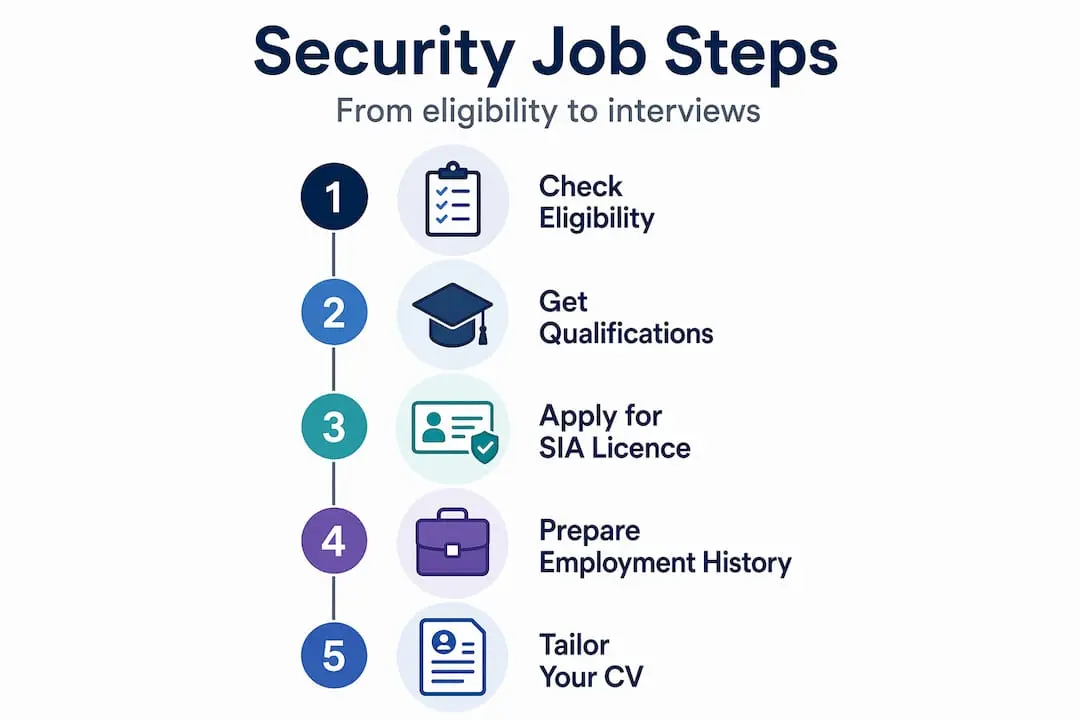
Beyond the SIA licence itself, most employers apply BS7858 screening standards as a condition of employment. This is an enhanced background check that covers identity verification, a five-year employment history, financial probity, and character references. Many first-time applicants are caught off-guard by the depth of this screening. Understanding it in advance lets you prepare your documentation properly before you even get to the job search stage.
Here is a summary of what you need to have in place before applying:
- Valid right to work in the UK
- Age 18 or above
- In-date Emergency First Aid at Work certificate
- Chosen SIA licence type confirmed
- Verifiable employment history for at least the past five years
- Two or more credible references ready to provide
You can review examples of security qualifications that are relevant to different licence types, which is a useful starting point if you are still deciding which route suits your circumstances best.
Pro Tip: Check the SIA website directly to confirm the exact licence type required for the role you want before paying for any training. A Door Supervisor licence does not automatically cover you for CCTV work, and vice versa.
Completing training and obtaining your SIA licence
Once your prerequisites are confirmed, the four-step licensing process follows a logical sequence: choose your licence route, complete the correct accredited training course, apply online with identity verification and payment, and wait for the SIA to process your application.
Here is how each stage works in practice:
-
Book the correct licence-linked training course. Search for an SIA-approved training provider and confirm they deliver the specific qualification for your chosen licence type. A reputable provider will ask to see your EFAW certificate during enrolment. If they do not, treat that as a warning sign.
-
Time your first aid certificate carefully. Your EFAW must remain valid throughout your training and your licence application window. If it expires mid-process, providers enforce this rule and you cannot proceed until it is renewed. Book your EFAW renewal early if your certificate is within three months of expiry.
-
Apply for your SIA licence online. After completing your training and receiving your qualification certificate, submit your application through the official SIA portal. You will need to upload identity documents, complete a criminal record declaration, and pay the licence fee.
-
Pay the current licence fee. As of 1 April 2026, the SIA licence fee is £204, following the end of the previous £20 rebate. Budget for this amount from the outset. It applies to both first-time applicants and renewals.
-
Complete all ‘next steps’ without delay. After submitting, the SIA may request additional identity verification or documents. The processing clock does not start until these are resolved. Once your application reaches the ‘checks in progress’ phase, the SIA targets a decision within 10 working days. Leaving outstanding actions unresolved for days or weeks is one of the most common causes of long waits.
-
Confirm your licence type before training, not after. It sounds obvious, but confirming the correct licence pathway before spending money on a course saves candidates real pain. Training refunds are rarely straightforward, and re-booking means starting the timeline from scratch.
For a detailed walkthrough of the entire application process, the SIA licence step-by-step guide on Securityjobsboard covers the process clearly and is regularly updated.
Pro Tip: Set a calendar reminder four weeks before your EFAW certificate expires. That window gives you enough time to book a renewal course and complete it before any licence or training application deadline.
Improving your employability beyond licensing
Having your SIA licence is the entry requirement, not the competitive advantage. The candidates who receive job offers quickly are those who have prepared their employability as thoroughly as they prepared for their training. This is where BS7858 screening becomes particularly relevant. Employers use it as the benchmark for vetting, which means your CV consistency matters as much as your qualification.
Getting your employment history ready
A fully documented, gap-free employment history is one of the strongest things you can bring to any security job application. Go back at least five years and account for every period, including any gaps. If you were unemployed, in education, or travelling, note it with dates. Employers screening to BS7858 standards will ask about unaccounted periods, and a proactive explanation in your CV or covering letter is far better than an awkward question during referencing.

Gather your references before you apply. Security employers want to verify references, not chase them. A reference that goes unanswered for two weeks can delay your start date or even cost you the role. Contact your referees in advance, confirm they are willing and available, and provide accurate contact details.
Writing a CV that gets you past the first filter
Generic CVs do not perform well in security recruitment. Tailor your CV to the licence type and role you are applying for. If you are applying for a Door Supervisor role, lead with your DS licence, any physical intervention training, and relevant venue or crowd management experience. If you are applying for a CCTV position, foreground your CCTV licence, monitoring experience, and any relevant software or systems knowledge.
Keep your CV to two pages. Use clear headings for each employer, include your start and end dates in month and year format, and write a brief description of your responsibilities for each role. Security employers read dozens of CVs for every vacancy. A well-structured, specific CV signals that you understand the industry.
Here are a few do’s and don’ts that apply directly to security job applications:
- Do include your SIA licence number on your CV once it is issued
- Do mention any specialist training such as conflict management, counter-terrorism awareness (ACT), or first aid beyond EFAW
- Do not leave unexplained gaps in your employment dates
- Do not use the same covering letter for every role without adjusting it to the specific employer
- Do not omit dates or use vague entries such as “various roles” without elaboration
For interview preparation, research the employer’s contracts and sites before attending. Security interviewers consistently ask situational questions such as “How would you handle an aggressive member of the public?” Prepare structured answers using real examples where possible. Showing knowledge of the qualities employers seek in security staff gives you a genuine advantage in interview.
Pro Tip: Ask your chosen referees to expect a call or email from potential employers and brief them on the role you are applying for. A prepared referee gives a more confident and relevant reference than one who is surprised by the contact.
Avoiding common pitfalls in applications and licensing
Even well-prepared candidates run into problems. Knowing the most common pitfalls lets you sidestep them before they cost you time or an offer.
- Unresolved ‘next steps’ in the SIA portal. Many applicants submit their application and assume the wait is simply about processing time. In reality, outstanding identity checks or unpaid fees are the most frequent cause of delays. Check your portal regularly after submission.
- Inconsistent personal information. Your name, address, and date of birth must match across your SIA application, training records, and employer-submitted documents. Even minor discrepancies trigger manual reviews that extend processing times.
- Expired first aid certificates discovered mid-training. You cannot save time by starting licence training on an expiring EFAW certificate. Providers check, and the cost is a delay rather than a shortcut.
- Incomplete employment history submitted for BS7858. Employers conducting this screening will request clarification on any gaps. Submitting incomplete records up front extends the vetting period and signals disorganisation to a prospective employer.
- Applying for roles before your licence is issued. It is reasonable to apply and interview in advance, but be transparent with employers about your expected licence issue date. Most will accommodate a short wait. Misleading them about your status will not.
Preparation is not about perfection. It is about removing every obstacle you can control before the process starts. The candidates who move through licensing and hiring quickly are not luckier. They are more organised.
My honest take on getting hired in security
I have worked with enough security job seekers to notice a pattern. The people who struggle most are not the ones who lack qualifications. They are the ones who rush the beginning. They book training before confirming their first aid is valid, or they apply for the wrong licence because they assumed rather than checked. One candidate I worked with had completed an expensive Security Guard training course only to discover the role she wanted required a Door Supervisor licence. That mistake cost her six weeks and several hundred pounds.
What I have learned is that the employability side is underestimated as much as the licensing side is misunderstood. You can hold a perfectly valid SIA licence and still fail a BS7858 check because your employment history contains two months with no entry and no explanation. Employers conducting security vetting are not trying to catch you out. They are trying to build a documented picture of who you are. Give them that picture proactively and you remove their reason to hesitate.
For newcomers to the industry, I would say this: the security sector genuinely rewards people who demonstrate reliability and attention to detail before they have even been hired. Show those qualities in your application and you have already started communicating the most important things an employer in this sector wants to know.
— Rob
Find your next security role on Securityjobsboard
If you have followed the steps above and your SIA licence is in order, the next move is putting yourself in front of the right employers.

Securityjobsboard is a UK-specific platform built for exactly this. You can browse security jobs across the UK by role type, licence category, and location, with listings updated regularly to reflect current vacancies. Whether you are looking for door supervisor work, CCTV monitoring roles, or close protection positions, the platform covers the full range of licensed security employment. Setting up a profile and uploading your CV takes minutes, and you can activate job alerts so you are notified as soon as relevant vacancies appear. If you are based in or targeting a specific area, you can explore listings such as security jobs in Northern Ireland to narrow your search further. The service is free for jobseekers, with no fees at any stage.
Common questions
What SIA licence do I need for most security guard roles?
Most frontline security guard roles require a Security Guard licence issued by the SIA. Door Supervisor or CCTV Operator licences are needed for specific roles and are not interchangeable with a standard Security Guard licence.
How long does an SIA licence application take to process?
Once your application reaches the ‘checks in progress’ stage, the SIA targets a decision within 10 working days. Delays typically occur when identity verification or payment steps remain incomplete after initial submission.
What is BS7858 screening and will it affect my application?
BS7858 is a British Standard for screening individuals in security roles. It requires a verified five-year employment history, identity confirmation, and character references. Most UK security employers use it as a condition of hire.
How much does an SIA licence cost in 2026?
As of 1 April 2026, the SIA licence fee is £204. The previous £20 rebate has ended, so this full amount applies to both new applications and renewals.
Can I apply for security jobs before my SIA licence arrives?
Yes. You can interview and receive a conditional job offer before your licence is issued, provided you are transparent with the employer about your expected timeline. Most security companies will accommodate a short wait for a well-prepared candidate.


