Employee Vetting Process for UK Security Recruitment Success

Hiring for security roles in the United Kingdom demands more than a handshake and a reference check. HR managers and recruiters are under constant pressure to get vetting right, balancing compliance with the need for high quality candidates. Building a robust vetting process using a clear definition of role requirements and tailored criteria is key to preventing risk, meeting government standards, and protecting your business from legal or reputational harm. This guide helps you map out each step with clarity and confidence.
Table of Contents
- Step 1: Define Role Requirements And Vetting Criteria
- Step 2: Gather Candidate Information And Authorisations
- Step 3: Conduct Background And Right-To-Work Checks
- Step 4: Verify References And Assess Suitability
- Step 5: Confirm Compliance And Finalise Onboarding
Quick Summary
| Key Insight | Explanation |
|---|---|
| 1. Define role requirements clearly | Establish specific responsibilities and access levels to guide the vetting process effectively. |
| 2. Collect necessary candidate information | Use standardised forms to gather relevant data while ensuring compliance with data protection laws. |
| 3. Conduct thorough background checks | Implement mandatory right-to-work and criminal record checks to confirm eligibility and trustworthiness. |
| 4. Verify references diligently | Request specific feedback from references to evaluate reliability and character, enabling better risk assessment. |
| 5. Confirm onboarding compliance meticulously | Ensure all vetting is documented and that employees understand their security responsibilities before they start. |
Step 1: Define role requirements and vetting criteria
You cannot build an effective vetting process without first understanding exactly what you need from a candidate. Defining clear role requirements and establishing appropriate vetting criteria forms the foundation of your entire recruitment strategy.
Start by documenting the specific responsibilities and access levels required for the position. Consider what information or assets the role will have access to, whether it involves managing sensitive data, supervising others, or working with restricted facilities. This clarity directly determines which vetting level you’ll need.
The vetting framework in the UK operates on a tiered system. Baseline Personnel Security Standard checks cover identity verification, nationality confirmation, employment history, and criminal records for standard roles. If your position requires access to classified information or sensitive government assets, you may need higher security clearance levels that involve more extensive background investigations.
Here’s what you need to include in your role definition:
- Access level: What classified or sensitive information will the candidate handle?
- Supervisory responsibility: Will they manage other staff or have control over security systems?
- Public interaction: Does the role involve contact with vulnerable people or restricted areas?
- Data handling: Will they process personal data, financial information, or confidential records?
- Risk profile: What threats could arise if this role was filled by an unsuitable candidate?
Documenting these factors helps you determine your vetting requirements accurately. The Information Commissioner’s Office emphasises that clear role definitions help determine necessary vetting levels to manage risks appropriately whilst maintaining compliance with legal frameworks.
To help clarify UK vetting levels, here is a comparison of typical security vetting tiers and their business impact:
| Vetting Level | Typical Coverage | Business Impact |
|---|---|---|
| BPSS | Identity, employment, basic criminal check | Suitable for non-sensitive roles |
| Standard DBS | Criminal records, suitability for regulated roles | Ensures legal compliance |
| Enhanced DBS | In-depth criminal history, vulnerable group protection | Vital for positions with public contact |
| Security Clearance (SC) | Thorough background, financial & security risk | Required for access to classified data |
| Developed Vetting (DV) | Extensive lifestyle and risk assessment | Critical for high-trust government posts |
Once you’ve mapped your role requirements, translate them into specific vetting criteria. Your criteria should cover background checks, reference verification, skills assessment, and any specialist certifications relevant to the position. For instance, a security operations manager might require SIA licensing alongside background clearance, whilst a reception security role may need different checks altogether.
Clear role requirements prevent costly hiring mistakes and ensure your vetting process focuses on genuine security needs rather than unnecessary checks.
If you’re unsure about structuring your role documentation, reviewing how to write effective job descriptions for security roles can help you articulate requirements in ways candidates understand.
Pro tip: Create a vetting checklist specific to each role type within your organisation, then reuse it for similar positions. This saves time, ensures consistency, and makes it easier to demonstrate fair and compliant recruitment practices to auditors.
Step 2: Gather candidate information and authorisations
You cannot proceed with vetting without first collecting the right information and securing proper authorisations from candidates. This step ensures you have everything needed whilst respecting data protection requirements and building trust with applicants.
Begin by creating a standardised information collection form that requests only data relevant to your vetting criteria. Ask for employment history, educational qualifications, references, and any certifications required for the role. Keep questions focused and avoid collecting unnecessary personal information that could complicate your compliance obligations.
Under UK GDPR, candidate data collection must be lawful and transparent, limited only to information necessary for recruitment decisions. This means you cannot request details unrelated to the role or your security requirements. You also need to explain to candidates why you’re collecting specific information and how you’ll use it.
Securing proper authorisations is equally important. Your candidates must explicitly consent to data processing before you proceed with background checks, reference verification, or vetting investigations. This consent should be clear, specific, and documented.
Here’s what you need to gather from each candidate:
- Full employment history with dates and reasons for leaving previous roles
- Education and professional qualifications with verification details
- Contact information for references who can speak to their character and reliability
- Authorisation to conduct background checks and access criminal records
- Permission to contact previous employers and educational institutions
- Consent for data storage and retention during the vetting process
When requesting authorisations, be transparent about what data you’ll collect, who you’ll contact, and how long you’ll retain information. The Home Office provides guidance emphasising that transparency about data handling builds candidate trust and supports lawful processing under UK GDPR requirements.
Provide candidates with a privacy notice explaining the purposes of data collection, the lawful basis for processing, and their rights. This might include how long you’ll keep their information and whether you’ll share data with third parties like reference checkers or background screening providers.
Transparent data practices aren’t just legal requirements—they signal to candidates that your organisation takes security and integrity seriously from day one.
Maintaining proper records of authorisations protects both you and your candidates. Store signed consent forms separately from candidate CVs and ensure your team understands that gathering information without proper consent exposes your organisation to compliance violations.
Pro tip: Create a digital consent checklist that candidates must complete before any vetting activity begins, then automatically trigger your background check workflow only after all authorisations are confirmed. This prevents costly delays and keeps your compliance record spotless.
Step 3: Conduct background and right-to-work checks
Background and right-to-work checks form the backbone of your vetting process. These mandatory verifications protect your organisation legally whilst ensuring candidates are genuinely eligible and suitable for security roles.

Start with right-to-work verification, which is legally required before any employment begins. You must examine original documents proving the candidate’s entitlement to work in the UK. Acceptable documents include passports, visas, or certificates of settlement issued by the Home Office.
Unfortunately, verifying right-to-work status has become more complex. Rather than accept outdated photocopied documents, you should verify right-to-work status through official UK government online services where available, ensuring accuracy and compliance with current immigration regulations.
Next, conduct criminal record checks where legally appropriate for your role. For regulated security positions, you’ll typically need Disclosure and Barring Service (DBS) checks. These reveal spent and unspent convictions relevant to the role, helping you assess trustworthiness and risk.
Here’s your background check process:
- Request right-to-work documentation and verify through government services
- Apply for appropriate DBS checks based on role requirements
- Cross-reference employment history with previous employers
- Verify educational qualifications directly with institutions
- Contact references to assess reliability and character
- Document all check results and maintain compliance records
Applying a consistent framework for background checks ensures fairness and protects your organisation from discrimination claims. Conduct the same checks on all candidates in similar roles, following documented procedures consistently.
Keep detailed records of what you checked, when you checked it, and what you discovered. These records demonstrate due diligence if your hiring decisions are ever questioned. Store this information securely, separate from other candidate files, and ensure your team understands confidentiality requirements.
Timing matters significantly. Conduct these checks only after securing proper authorisations but before making final employment offers. This protects candidates’ privacy and prevents embarrassment if checks reveal disqualifying information.
Thorough background checks aren’t bureaucracy—they’re your primary defence against hiring unsuitable candidates and potential security breaches.
Be prepared for checks to take time. DBS checks typically take two to four weeks, depending on the level required and any complications with the candidate’s history. Plan your recruitment timeline accordingly to avoid delays.
Pro tip: Begin your right-to-work checks and DBS applications the moment candidates provide authorisations, rather than waiting until you’ve completed reference checks. This parallelisation saves weeks of recruitment time and demonstrates your efficiency to candidates, improving your employer brand.
Step 4: Verify references and assess suitability
References provide invaluable insight into a candidate’s actual performance, reliability, and character. This step transforms vetting from tick-box compliance into genuine risk assessment, revealing how candidates behaved in previous roles.
Begin by requesting candidates nominate at least two references, ideally from recent or current employers. Academic supervisors work well for graduates, whilst previous line managers offer the most credible perspective on work behaviour. Ask candidates to alert their referees that you’ll be contacting them, ensuring they’re prepared and willing to participate.
When contacting referees, ask about the candidate’s conduct and reliability in their previous role rather than simply asking generic questions. This information directly supports your assessment of suitability for security responsibilities. Prepare specific questions relevant to your role requirements.
Here’s what to ask references:
- How long did you work with this person and in what capacity?
- Would you describe them as honest and trustworthy?
- How did they handle confidential information or sensitive responsibilities?
- Were there any absences, disciplinary issues, or conduct concerns?
- Would you rehire them or recommend them for a trusted position?
- Can you describe their reliability and professionalism?
Don’t rely solely on written references. Make phone calls when possible, as you’ll detect hesitation or concern more easily through conversation. Sometimes referees provide bland written statements to avoid liability, but verbal conversations reveal their true assessment.
Document every reference contact you make. Record the date, who you spoke with, their role, and their key comments. This documentation proves you conducted due diligence and protects you if hiring decisions are later questioned.
Assess the overall suitability picture by combining background checks, reference feedback, and interview impressions. No single element should determine hiring, but patterns matter significantly. A candidate with stellar references but failed background checks presents different risks than someone with excellent checks but lukewarm references.
Strong references don’t guarantee suitability, but weak ones should trigger serious concern about whether this candidate belongs in a trusted security role.
Be cautious of references that are overly glowing or suspiciously vague. Either extreme suggests the referee may not be providing honest feedback. Push gently for specific examples of the candidate’s performance and behaviour.
Pro tip: Create a standardised reference feedback form that you email to referees rather than relying on informal conversations alone. This ensures consistent information gathering and gives you documented evidence of due diligence that protects your organisation legally.
Step 5: Confirm compliance and finalise onboarding
You’ve completed all vetting checks and are ready to bring your new employee on board. This final step ensures legal compliance whilst setting the right tone for your new hire’s first days in a security role.
Before the employee’s start date, confirm that all vetting requirements have been fully satisfied and documented. Review your checklist ensuring right-to-work verification is complete, background checks have cleared, references have been verified, and you’ve kept detailed records of every check conducted. Nothing moves forward without this confirmation.
Issue written terms of employment on or before the first day. These should clearly outline role responsibilities, salary, working hours, leave entitlements, and any security-specific obligations. Formal employment documentation establishes legal compliance with UK employment law and protects both you and the employee.
Register your new employee for payroll and tax purposes immediately. Collect their national insurance number and ensure HMRC records are accurate. This registration is legally required and establishes their official employment status.
Here’s your compliance checklist before day one:
- All vetting checks completed and documented
- Right-to-work verification confirmed and filed
- Written employment contract issued and signed
- Employee registered with payroll and tax systems
- Emergency contact details recorded
- Health and safety induction scheduled
- Security-specific training booked
- Line manager briefed on the new employee
- Access credentials and equipment ordered
Schedule a comprehensive induction programme covering company policies, security protocols, and role-specific training. For security positions, this might include SIA licensing requirements, security system familiarisation, or data protection training. Proper induction reduces early mistakes and demonstrates professionalism.
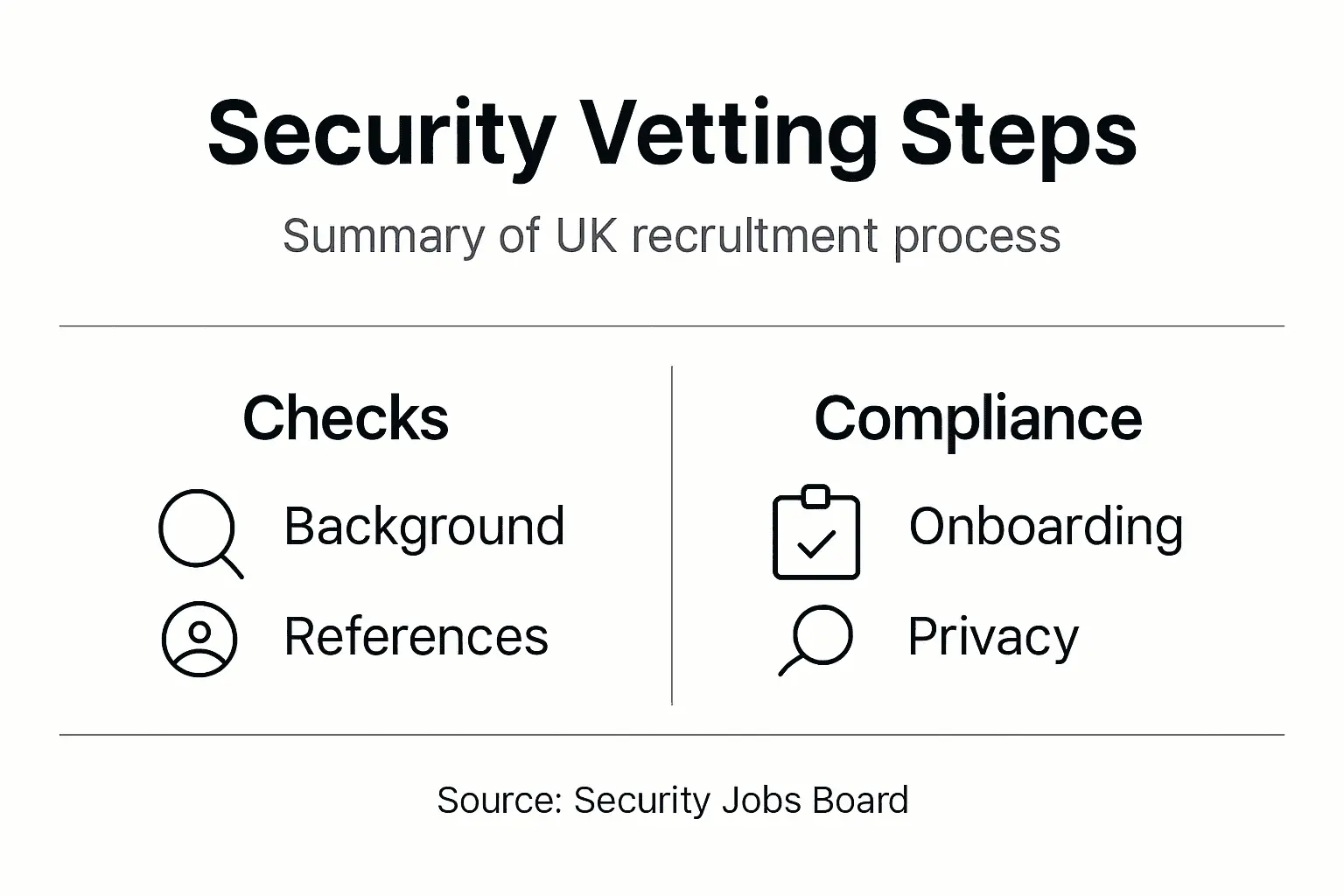
During the first week, confirm the employee understands their security obligations and signed any necessary confidentiality or security agreements. Address questions about vetting, explain your data protection practices, and establish clear reporting lines.
Keep all vetting documentation securely stored, separate from the employee’s general personnel file. Maintain confidentiality and ensure only authorised personnel access sensitive vetting information. Retention periods typically follow employment duration plus six years for compliance purposes.
Here is a summary of key onboarding compliance steps and their organisational significance:
| Onboarding Step | Legal Requirement | Impact on Organisation |
|---|---|---|
| Written contract issued | Yes (UK employment law) | Defines terms, reduces disputes |
| Payroll registration | Yes (HMRC) | Ensures accurate pay, prevents fines |
| Security training booked | Role-specific | Minimises early mistakes |
| Confidential records storage | GDPR & vetting policy | Maintains compliance and confidentiality |
| Health & safety induction | Statutory | Prevents workplace incidents |
Thorough onboarding isn’t an afterthought—it’s where you establish trust, clarity, and the security culture your organisation needs.
Document that all onboarding tasks have been completed and that the employee has acknowledged understanding their security responsibilities. This creates your audit trail proving due diligence if questions ever arise later.
Pro tip: Create an automated onboarding checklist in your HR system that tracks each compliance requirement and triggers reminders when tasks are overdue. This prevents compliance gaps and ensures consistent onboarding across your entire security team.
Streamline Your UK Security Recruitment with Expert Vetting Support
The article highlights the challenges of correctly defining role requirements, securing candidate authorisations, and conducting thorough background checks to ensure compliant and secure hiring decisions. If you are aiming to master the complexities of the employee vetting process for UK security recruitment, you know the importance of precise role definitions, transparent data handling, and verified candidate backgrounds — all critical to reducing risk and maintaining compliance.

Take your recruitment strategy to the next level with the Security Jobs Board, a specialist platform designed specifically for the UK security sector. Whether you need to post detailed vacancies aligned with vetting requirements, quickly access verified candidate CVs, or manage GDPR-compliant data with ease, this platform supports every step of your process. Join employers who trust this BSIA-affiliated site for speed, security, and quality matches. Start today to avoid delays in hiring and safeguard your operation by visiting the Security Jobs Board homepage. Your next trusted security professional is waiting.
Frequently Asked Questions
What is the employee vetting process for UK security recruitment?
The employee vetting process for UK security recruitment involves steps such as defining role requirements, gathering candidate information, conducting background checks, verifying references, and finalising onboarding. Follow this structured approach to ensure compliance and secure hiring practices.
How can I determine the appropriate vetting level for a security role?
To determine the appropriate vetting level, document the specific access levels and responsibilities of the position, including any sensitive data handling or supervisory duties. This will help you establish the necessary background checks and compliance requirements for the role.
What information should I gather from candidates during the vetting process?
Gather essential information such as full employment history, educational qualifications, references, and authorisations for background checks. This allows you to assess their suitability for security responsibilities while respecting data protection standards.
How do I verify references effectively during the vetting process?
Verify references by contacting previous employers and asking specific questions related to the candidate’s conduct and reliability in security contexts. Document your findings to ensure a thorough assessment and retention of due diligence records.
What steps should I take to confirm compliance before onboarding a new hire?
Before onboarding, confirm that all vetting checks are completed and documented, including right-to-work verification and reference checks. Create a checklist to ensure all necessary compliance requirements are fulfilled prior to the employee’s start date.
How can I maintain candidate data privacy during the vetting process?
Maintain candidate data privacy by collecting only relevant information and securing proper authorisations for data processing. Implement a transparent data handling process to build trust and comply with UK data protection laws.
Recommended
- Security Vetting in the UK: What Every Employer & Professional Should Know
- Step by Step Hiring Process for Security Firms UK | Security Jobs Board
- Hiring for Security Roles Guide: Effective UK Recruitment Steps
- Step by Step Recruitment Process for Security Firms UK
- 7 Essential Immigration Law Tips for UK Companies | Ali Legal
- Ultimate Laptop Security Systems Guide in the UK | Stay Protected


