Care Assistant CV (UK): Lead With SIA Licence and Security Duties
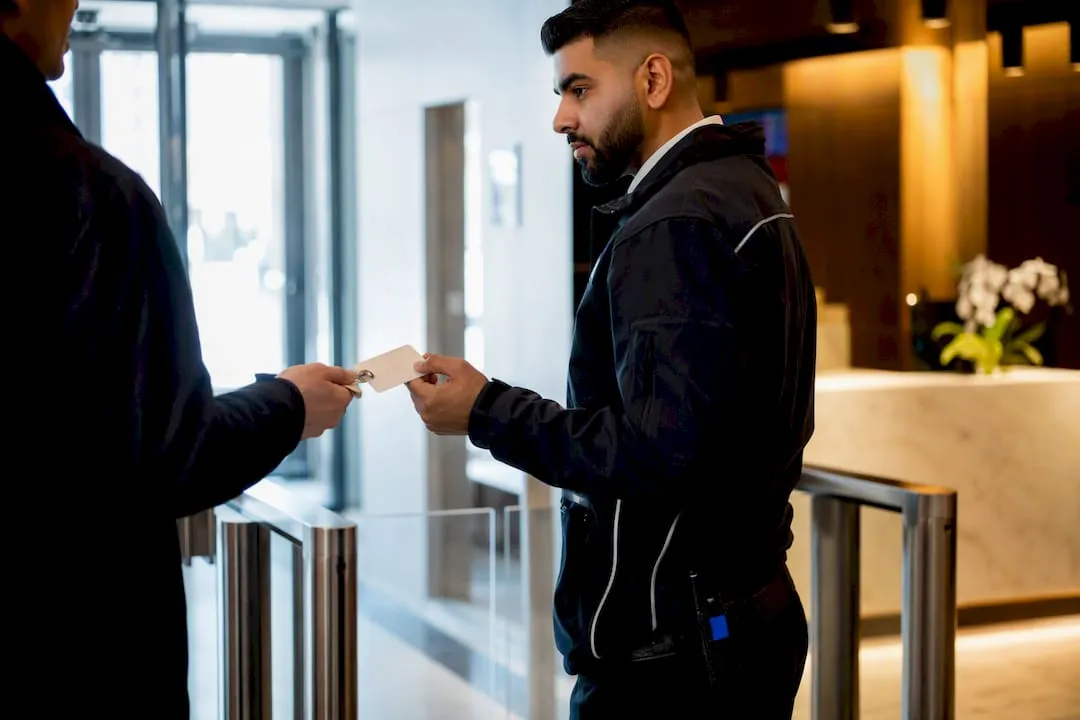
List your SIA licence details first, including type, number and expiry date, then your role-specific duties in order of relevance to the job you want. Lead with patrols, access control, CCTV monitoring or incident reporting, whichever matches the advert, and back each one with a number: sites covered, cameras monitored, incidents logged per week. Licence and role match come before achievements every time.
TL;DR:
- Including specific site sizes, incident numbers, and shift details for each role can demonstrate the scale and scope of your security experience.
- Use action verbs and quantify tasks such as monitoring multiple cameras, responding to alarm activations, or managing crowd flow to strengthen your duty descriptions.
- position your SIA license details — type, number, and expiry date — prominently at the top of your CV to ensure immediate visibility for recruiters.
- Adapt your duty bullets to match the specialism of the role, emphasizing relevant skills like access control for corporate roles or crowd management for events.
- Keep your CV concise at two pages, ensuring each bullet contains a relevant keyword from the advert, is started with a strong verb, and includes measurable achievements.
Table of Contents
- Core duties to list on a security CV, organised by specialism
- How to write duty bullets: templates, action verbs and ATS keywords
- How to list SIA licences and other certifications correctly
- Role-specific CV snippets: example duty sections for common security roles
- Common mistakes and a final CV checklist specific to security roles
- Specific care assistant duties and responsibilities to include on a CV
- Skills and personal qualities relevant to security roles
- Tailoring your CV to different security settings
- How to highlight security experience and incident handling effectively
- Structuring a security CV: summary, skills, experience
- Publisher perspective: why we push SIA detail this hard
- Ready to put this into practice? Upload your CV to Security Jobs Board
- Sources
- FAQ
Core duties to list on a security CV, organised by specialism
Recruiters skim a security CV in seconds, so the duties you list need to match the role advertised rather than reading as a generic job description. Different specialisms carry different expectations, and grouping your experience by role type makes it far easier for a hiring manager to see the fit.
A static or mobile guard CV should centre on site protection and movement between locations. A CCTV operator CV needs to show technical monitoring competence. Door supervisors need conflict management and access control front and centre. Corporate and concierge roles lean towards customer-facing professionalism, while events and cash-in-transit work demand crowd awareness and secure handling procedures respectively.
Typical duty lines worth adapting to your own experience include:
- Patrolling premises internally and externally, checking doors, windows and fire exits on scheduled rounds
- Controlling access and egress, verifying ID badges and visitor passes against site registers
- Monitoring CCTV systems across multiple screens, flagging suspicious activity in real time
- Responding to alarm activations and investigating triggers before escalating to police or management
- Searching bags, vehicles or deliveries in line with site protocol
- Managing crowd flow at entrances, exits and pinch points during events or peak trading hours
- Escorting cash, valuables or VIPs between secure locations
- Preserving evidence and writing incident reports that hold up if a matter goes to court
Several of these map directly onto the training sessions covered in SIA licence-linked training, which includes dedicated modules on access control, searching and patrolling. Naming these on your CV signals you’ve had structured training, not just on-the-job habit. The National Careers Service also confirms that patrolling, CCTV monitoring and guarding cash or valuables in transit sit among the most commonly requested duties in the sector, so if your experience covers any of them, they belong near the top of your CV.
How to write duty bullets: templates, action verbs and ATS keywords
A duty bullet that starts with “responsible for” tells a recruiter nothing. Start with an action verb instead: monitored, patrolled, logged, de-escalated, escorted, searched, reported. These verbs carry weight because they describe what you actually did, not your job title restated.
Quantify wherever you can. For example, “Monitored multiple cameras across a retail site, flagging several theft incidents per month” tells a stronger story without unsourced specific numbers. Add context too: site type, footfall, shift pattern, team size. A hiring manager reading “corporate HQ, 800 staff” understands the scale instantly.
Mirror the exact keywords used in the job advert. If the posting says “access control” and “SIA licensed”, use those phrases rather than paraphrasing them, because ATS software scans for exact matches before a human ever opens your CV.
Try adapting these templates:
- Patrolled a specified site type, completing scheduled rounds per shift
- Monitored CCTV cameras, identifying and reporting multiple incidents per week
- Controlled access for staff and visitors daily, verifying ID against site registers
- De-escalated multiple confrontational incidents without need for police escalation
- Searched vehicles and deliveries at [site type], preventing unauthorised items from entering site
- Managed crowd flow for events with varying attendee capacities
- Escorted cash deliveries between secure locations
- Logged and reported multiple incidents monthly, maintaining evidence chains for police handover
- Trained junior guards on patrol procedure and radio protocol
- Maintained zero security breaches over a period at a specified site type
Pro Tip: Quantified incident-handling lines beat vague adjectives every time. “De-escalated three serious confrontations in twelve months” says far more than “calm under pressure”, and it’s the kind of detail that sticks in a recruiter’s memory.
Before submitting, check every bullet starts with a verb, contains at least one number, and uses language lifted straight from the advert.
How to list SIA licences and other certifications correctly
Your SIA licence line should sit directly under your name and contact details, not buried in a certifications section three pages deep. Recruiters scan for it in the opening seconds, and a licence that’s hard to find is a licence that risks being missed entirely.
Show the following clearly:
- Licence type (e.g. Door Supervision, CCTV/Public Space Surveillance, Security Guarding)
- Licence number
- Expiry date
Beyond the SIA licence itself, list other relevant certifications in a short block underneath: First Aid at Work, conflict management training, or a CCTV/public space surveillance certificate if it’s separate from your main licence. Format them as a simple list rather than a paragraph, so they’re scannable.
If your licence has expired or is being renewed, say so honestly, for example “SIA licence renewal in progress, expected [month].” Never leave a gap where the licence should be. And a quick note on evidence: a public-facing CV is not the place for specific incident details, names, or case references. Keep any operational specifics for the interview, not the document itself.
For readers still working through the licensing process, Security Jobs Board’s SIA licence guide breaks down the routes available and what each licence type covers.
Role-specific CV snippets: example duty sections for common security roles
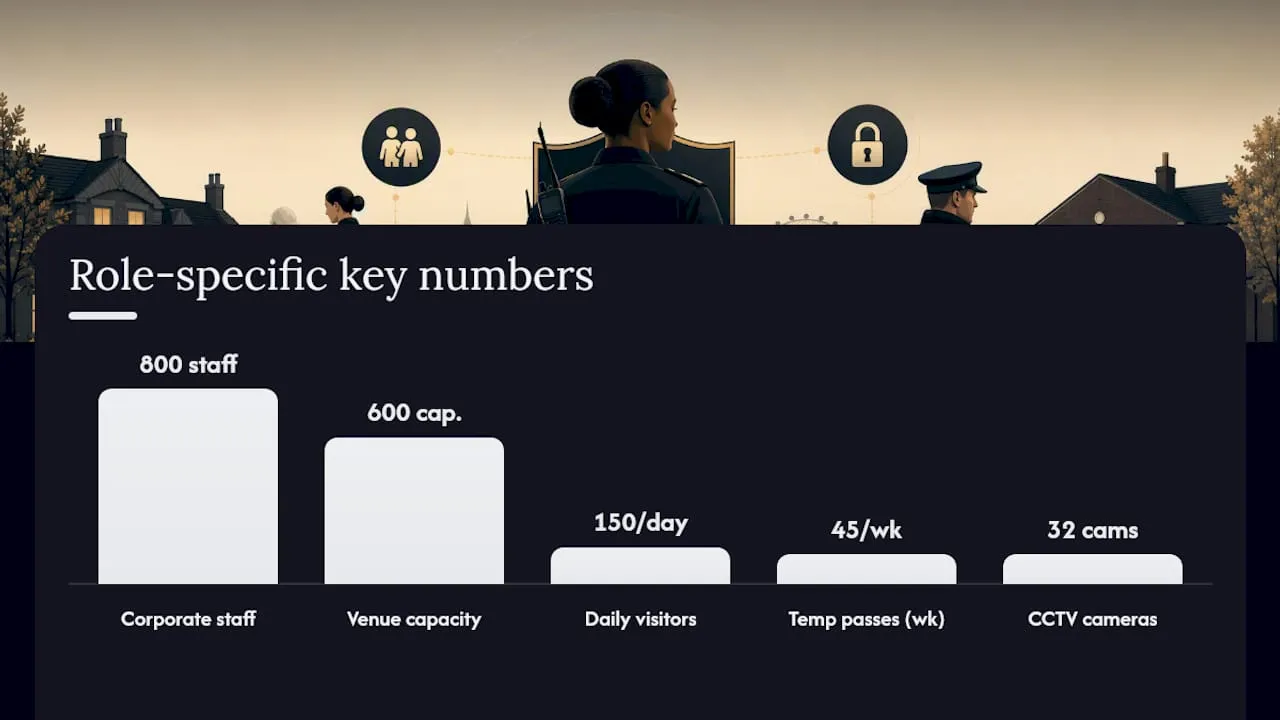
Copy the structure below and swap in your own figures and site names.
CCTV Operator SIA CCTV/Public Space Surveillance Licence, No. [XXXXXXXX], expires [date]
- Monitored 32 cameras across a shopping centre covering 400,000 sq ft
- Identified and reported 6 to 8 incidents weekly, coordinating with on-site guards
- Maintained incident logs to evidential standard for police handover
- Reduced response time to alarm triggers by improving screen rotation protocol
Door Supervisor SIA Door Supervision Licence, No. [XXXXXXXX], expires [date]
- Managed entry for a 600-capacity venue on Friday and Saturday night shifts
- De-escalated an average of 2 confrontational incidents per weekend without police involvement
- Checked ID for age verification, refusing entry to underage attempts weekly
- Trained 3 new door staff on venue-specific conflict procedures
Mobile/Static Guard SIA Security Guarding Licence, No. [XXXXXXXX], expires [date]
- Patrolled a 12-acre industrial site across 4 scheduled rounds per shift
- Controlled access for 150 contractors and visitors daily
- Responded to 15 alarm activations over 6 months, all resolved without incident
- Reduced site break-ins to zero across a 12-month period
Corporate Concierge/Security SIA Security Guarding Licence, No. [XXXXXXXX], expires [date]
- Managed reception security for a corporate HQ housing 800 staff
- Verified visitor credentials and issued 40 to 50 temporary passes weekly
- Liaised with facilities and IT teams on access control system upgrades
- Maintained a professional front-of-house presence for high-profile client visits
Replace every placeholder with your real numbers. A vague site or a rounded-up statistic reads as filler; a specific one reads as proof.
Common mistakes and a final CV checklist specific to security roles
The most common error is burying the SIA licence somewhere in the middle of the CV instead of putting it front and centre. Close behind that: vague verbs (“assisted with security”), no site context, no quantification, and file names like “CV2.docx” that tell a recruiter nothing and look unprofessional in an inbox.
Run through this before you apply:
- Licence type, number and expiry visible in the first few lines
- At least 3 quantified bullets per role relevant to the job you’re applying for
- Keywords from the advert mirrored in your skills and duties sections
- File saved as “Firstname Surname Security CV.pdf”, not a generic default name
- No sensitive incident details, case numbers or third-party names included
One more thing worth saying plainly: a public CV is not the place for anything that could identify a victim, witness or ongoing case. Keep it professional and general.
Specific care assistant duties and responsibilities to include on a CV
If you’re moving into security from another frontline sector, or you’re comparing how duty-based CVs work across industries, the same principle applies: list what you actually did, not a generic title. For security roles specifically, that means naming the exact tasks you carried out rather than a broad label like “security duties.”
Break your experience down into discrete, provable actions. Instead of “handled site security,” write “patrolled a retail site of 200,000 sq ft across four shifts weekly, checking fire exits and stockroom access points.” Instead of “worked on CCTV,” specify the number of cameras, the site type, and how many incidents you flagged per week.
This level of detail matters because a security CV competes against dozens of similar applications for the same role. A hiring manager reading generic phrasing has no way to judge whether you’ve handled a small retail unit or a large industrial site. Specifics remove that guesswork.
If you’ve worked across multiple site types, list them separately rather than lumping them together. A CV that shows “static guard, corporate HQ” and “mobile patrol, industrial estate” as two distinct entries demonstrates range that a single blended paragraph would hide. Recruiters searching CV databases often filter by site type and duty keyword, so separating your experience this way also improves how easily your profile surfaces in those searches.
Skills and personal qualities relevant to security roles
Technical duties get you shortlisted, but the personal qualities behind them are what convince a recruiter you’ll hold the role under pressure. Communication sits at the top of the list. A guard who can calmly explain a refusal of entry, or relay an incident clearly over radio, prevents small situations becoming serious ones.
Attentiveness matters just as much, particularly for CCTV operators watching multiple screens for hours at a time. Physical fitness and stamina count for mobile and static guards covering large sites on foot across long shifts. And a level head under confrontation, the kind that shows up in a de-escalation statistic rather than an adjective, tends to carry more weight than any soft-skills paragraph.
List these qualities briefly in a skills section, but back at least one with evidence from your duties. “Strong communicator” means little on its own. “Communicated hourly patrol updates to control room via radio, maintaining zero missed check-ins across six months” proves the same point with a fact behind it.
Reliability and punctuality also deserve a mention, particularly for shift-based roles where a missed handover creates a genuine security gap. If you’ve covered night shifts, weekend cover, or last-minute call-outs without incident, say so. It signals dependability in a sector where gaps in coverage carry real consequences.
Tailoring your CV to different security settings
A retail security CV and a corporate security CV should not read the same way, even if the underlying skills overlap. Retail environments call for visible deterrence, loss prevention awareness and customer interaction, so duties like “identified and reported shoplifting incidents” or “managed queue flow during peak trading hours” fit naturally.
Corporate and office settings shift the emphasis towards access control, visitor management and a more formal, front-of-house tone. Duties here should highlight professionalism: “issued and tracked visitor passes for a 500-employee office” reads differently to a retail-focused bullet, and it should.
Events security demands crowd management and rapid response to fast-changing situations, often across short, high-intensity shifts. If you’ve worked events, quantify attendance figures and incident response times, since those numbers carry particular weight with event organisers reviewing CVs.
Industrial and construction site security, meanwhile, leans on access control for contractors, out-of-hours patrol coverage and coordination with site management on health and safety compliance. If you’re applying across multiple settings, keep one core CV but adjust the top third, licence line, summary and lead duties, to match each advert’s specific context.
How to highlight security experience and incident handling effectively
Experience only lands if it’s framed around outcomes, not just tasks completed. Rather than listing “handled incidents,” describe what happened and what you did about it: “responded to an attempted break-in at a warehouse site, securing the perimeter and coordinating with police until arrival.”
Where you’ve built relationships with site management, clients or the public, mention it. A guard who’s worked the same corporate contract for two years and become the trusted face of security for that building brings something a temporary or agency-only CV doesn’t show. Say so directly: “maintained the primary security contact role for a client site across 18 months.”
If you’ve trained or mentored newer staff, that’s leadership experience worth naming even without a formal title change. It shows a recruiter you’re trusted with responsibility beyond your own shift.
Avoid drowning genuine achievements in operational jargon. A recruiter reading your CV for the first time needs to understand the impact quickly: numbers, outcomes, and the specific role you played in resolving a situation, not a blow-by-blow account of procedure.
Structuring a security CV: summary, skills, experience
Open with a short professional summary, two to three lines, stating your licence type, years in the sector, and the kind of role you’re targeting. Something like: “SIA licensed Security Guard with four years’ experience across retail and corporate sites, seeking a static guarding role within a corporate environment.”
Follow that with a key skills block, five to eight short items mixing hard skills (CCTV monitoring, access control, radio procedure) with personal qualities (communication, reliability, conflict management). Keep this section tight; a long list dilutes the strongest points.
Your experience section should follow in reverse chronological order, most recent role first, with each entry showing job title, employer, dates, and three to five quantified duty bullets. This is where the detailed CV templates and guidance from Security Jobs Board can help you structure each entry consistently.
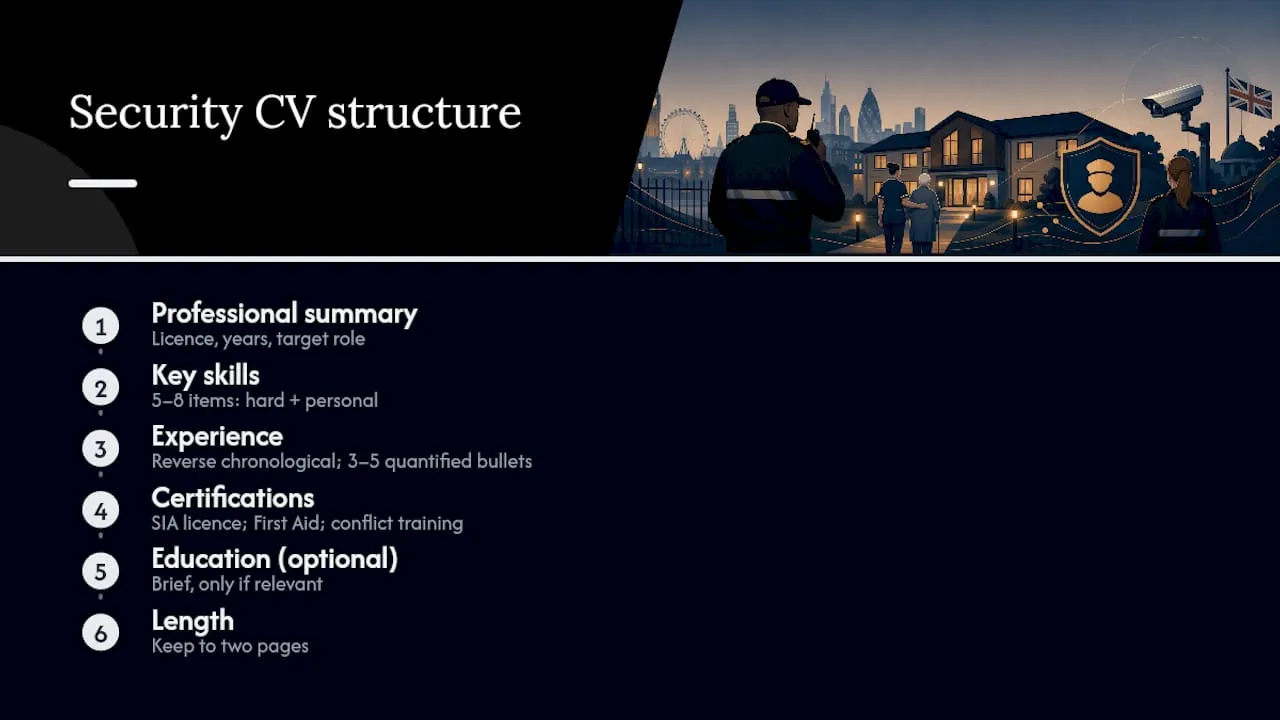
Close with certifications (SIA licence details repeated here for clarity, plus First Aid or conflict management training) and, if relevant, a brief education section. Keep the whole document to two pages wherever possible. A three-page CV padded with repetition loses a recruiter’s attention long before page three.
Publisher perspective: why we push SIA detail this hard
Specialized security job boards exist to address unique sector needs such as SIA licence verification, role-specific duty matching, and GDPR-compliant processes with credible affiliations. Use CV advice and job alerts to align your licence and duties with suitable vacancies.
— Rob
Ready to put this into practice? Upload your CV to Security Jobs Board
Once your CV reflects your licence, your quantified duties and the right keywords, the next step is getting it in front of employers who are actually hiring for your specialism. Use a specialized security job board to create a free profile, upload your CV, set job alerts for roles and licence types you hold, and apply directly without the distractions of generic job sites.

Such platforms typically ensure GDPR compliance, mobile accessibility for job applications, and affiliations with industry bodies to build employer confidence. If you’re based in Northern Ireland, browse current security jobs in Northern Ireland directly, or head to the career advice section for more guidance before you apply. Get your CV live today and let the right employers find you.
Sources
FAQ
What should go at the top of a security CV?
Your SIA licence type, number and expiry date should sit directly under your name and contact details, ahead of any summary or duty list.
Do I need to quantify every duty on my CV?
Not every line, but aim for at least three quantified bullets per role, covering things like cameras monitored, incidents handled or site size.
Can I put duties on my CV if my SIA licence has expired?
Yes, but state clearly that renewal is in progress and give an expected date rather than leaving the licence section blank.
What’s the biggest CV mistake security jobseekers make?
Burying the SIA licence details mid-document instead of placing them near the top, where recruiters look first.
How do I tailor my CV for different security roles?
Keep one core CV but adjust the top third, licence line, summary and lead duties, to match each advert’s specific site type and requirements.
Where can I upload my CV for UK security roles?
You can create a free profile and upload your CV directly at Security Jobs Board, then set alerts for roles matching your licence type.


